- Time Period: Post-WW2
- Institution: 28 June 1941
- Country: United States
The Good Conduct Medal is one of the oldest awards in the U.S. military and has been adopted by each branch of the armed forces at different times. The U.S. Navy first introduced its version in 1869, followed by the Marine Corps in 1896, the Coast Guard in 1923, the Army in 1941, the Air Force in 1963, and, most recently, the Space Force in 2023.
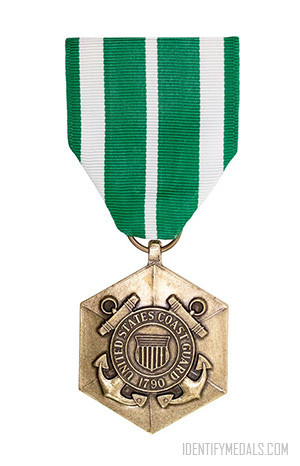
The Coast Guard Good Conduct Medal was established in 1923 to recognize enlisted personnel for honorable, faithful, and exemplary service. It is one of the oldest Coast Guard-specific awards and reflects the service’s emphasis on discipline, professionalism, and dedication. Over the decades, it has honored countless Coast Guardsmen who have consistently demonstrated integrity and reliability in carrying out their duties.
The Coast Guard Good Conduct Medal Criteria
The medal is awarded to enlisted members of the Coast Guard who demonstrate:
- Exemplary behavior, efficiency, and fidelity during a period of service.
- A standard qualifying period of three continuous years of active service without any disciplinary actions, such as courts-martial or non-judicial punishments.
- Shorter qualifying periods (often one year) may apply during wartime or national emergencies.
- Additional awards are denoted by devices (typically bronze or silver stars) added to the ribbon for each subsequent period of qualifying service.
The Coast Guard Good Conduct Medal Design
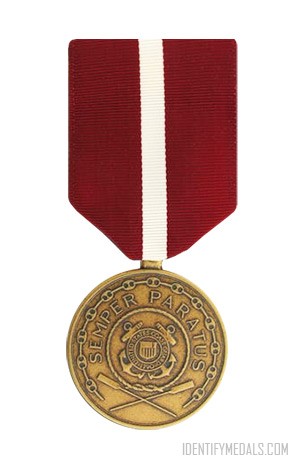
The Coast Guard Good Conduct Medal’s design closely mirrors the Navy’s version but incorporates distinct Coast Guard symbolism. The obverse (front) features a Coast Guard cutter, often depicted with rope and chain edging, symbolizing the maritime mission of the service. The reverse (back) typically bears the inscription honoring faithful and exemplary service.
The medal visually represents the Coast Guard’s values of discipline, loyalty, and “Semper Paratus” (Always Ready) while celebrating sustained, honorable service by enlisted personnel.
- Ribbon: Primarily red with white stripes, reflecting the traditional colors associated with long-standing honorable service.
- Devices: Bronze or silver stars indicate subsequent awards for additional qualifying service periods.