The Order of Leopold (Belgium)

The Order of Leopold (Leopoldsorde / Ordre de Léopold / Leopoldsorden) is the oldest and highest order of Belgium (and one of the three current Belgian national honorary orders of knighthood). Leopold I, first King of the Belgians, is the Founder and First Grand Master of the Order. No membership can be granted to a person before the age of 42, except in the military division.

Established on 11 July 1832 and named in honor of its founder; King Leopold I, it consists of a military, a maritime and a civil division. The Order of Leopold is awarded by Royal order. The Belgian court often used the Grand Cordon as a valuable diplomatic gift, although towards the second half of the 19th century, it was also used as a dynastic order to bestow on family members during major family celebrations such as the wedding of Prince Albert in 1900 (where 15 Grand Cordons were sent to the Bavarian Court). Those who fought in the Belgian revolution became members in great numbers, and King Leopold II bestowed the order upon notable Belgian artists, generals and clergy.

The Order of Leopold is issued in five classes, each coming in three divisions (civil, military and maritime):

  • Grand Cordon; who wears the badge on a collar (chain) or on a sash on the right shoulder, plus the star on the left side of the chest;
  • Grand Officer; who wears a badge on a necklace, plus a star on the left side of the chest (created on 31 December 1838);
  • Commander; who wears the badge on a necklace;
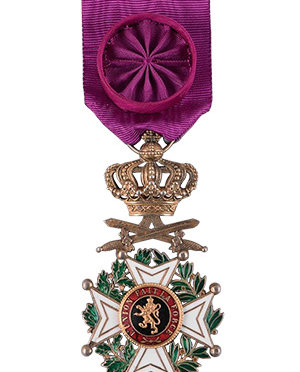
  • Officer; who wears the badge on a ribbon with rosette on the left side of the chest;
  • Knight; who wears the badge on a ribbon on the left side of the chest.

The Order of Leopold Design

The Order of Leopold is based on the French honor tradition with 5 classes. In 1832 Felix de Merode had a design approved by the Chambers for military and civil merit, with the exact colors being defined later the same year. The king approved both the color and grades both civil and military, as well as the official motto L’Union fait la Force/Eendracht maakt Macht.

The collar of the order has nine crowns, nine face-to-face monograms “LR” (“Leopoldus Rex” for King Leopold I), and eighteen lions.

The badge is a white-enameled Maltese Cross (in silver for the Knight class and in gold for the higher classes), with a green-enameled wreath of laurel and oak leaves between the arms of the cross. The obverse features a lion on a black background and the reverse the monogram “LR”. Both discs are surrounded by a red enamel ring with the motto “Unity Is Strength“. The cross is topped by a crown with crossed swords or anchors (or without either) depending on the division.

The ribbon is usually plain purple, although some variations have been noted, such as swords for when awarded in wartime, a vertical gold border on both sides for a special act of valor at war and others.
The Inter Allied Victory Medal (Siam)

The Siam (or Thailand) Victory Medal was established in 1919, soon after the country declared war on Germany and sent a expeditionary force.

  • Time Period: World War I
  • Institution: 1919
  • Country: Siam

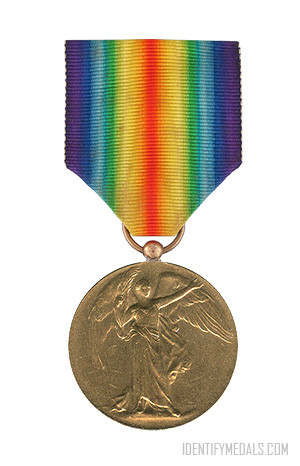
The Allied Victory Medal was recommended by an inter-allied committee in March 1919. Fourteen victorious countries finally awarded the medal after World War I, and each allied nation would design a ‘Victory Medal’ for award to their own nationals. Certain features were to be shared: a winged figure of Victory on the obverse and the same ribbon.

Siam declared war on Germany on 22 June 1917, after the USA’s entry to gain allied recognition of Thailand’s sovereignty in international affairs, and send an expeditionary force to France in July 1918. The official reason was to respond to Germany’s policy of unrestricted submarine warfare.

The medal (about 1,500 of them) were given to all the officers and soldiers of the task force, sailors that transported them and the royalty and staff officers.

The Siam Inter-Allied Victory Medal Design

The Victory Medal measures 36 millimetres (1.4 in) in diameter and was designed by William McMillan. The design and ribbon was also adopted by Belgium, Brazil, Cuba, Czechoslovakia, France, Greece, Italy, Japan, Portugal, Romania, Siam, Union of South Africa and the USA. Each allied nation would design a ‘Victory Medal’ for award to their own nationals, all issues having certain common features, including a winged figure of victory on the obverse and the same ribbon.

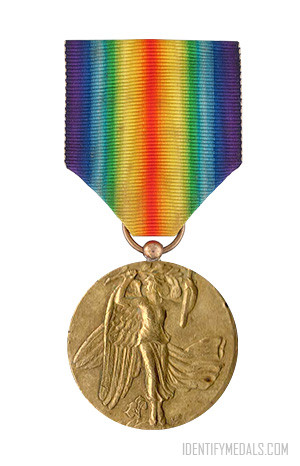
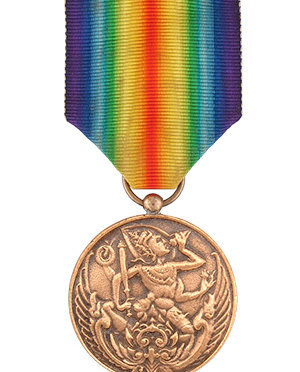
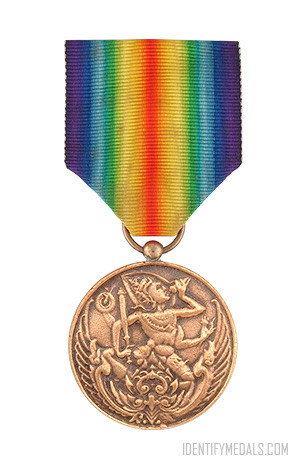
The obverse of the medal was designed by Prince Iddhidebsan Kritakara (1890-1935) and is presumed to have been manufactured at the Royal Thai Mint. There were two contemporary un-official versions, distinguishable by the ear of Vishnu being covered in all. Because Siamese culture didn’t have the traditional Western figure of victory, they instead used the image of a deity based on Vishnu riding the mythical bird Garuda holding, in its four hands, a club, a disk, a conch shell, and a lotus flower.

The reverse bears the inscription in Thai letters for ‘THE GREAT WAR FOR CIVILISATION’, within a lotus-decorated border.

The 39 millimeters (1.5 in) wide watered ribbon has an iridescent color scheme, with the violet moving through to a central red stripe where both schemes meet. It attaches to the medal through a ring suspender. The recipient’s name, rank, service number and unit were impressed on the edge of the medal. The name of the regiment or corps was omitted on medals awarded to Army officers.

All the Inter-Allied Victory Medal Variations

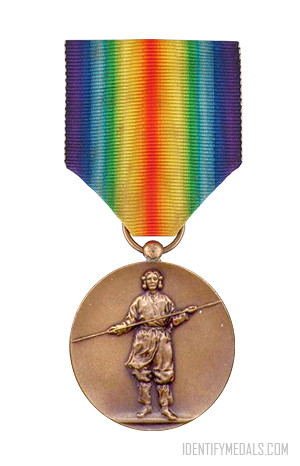
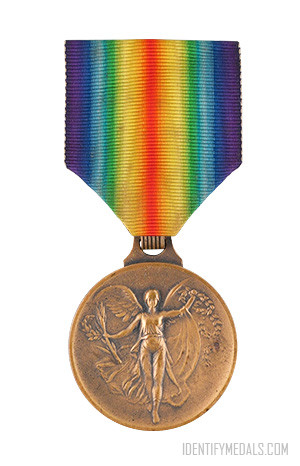
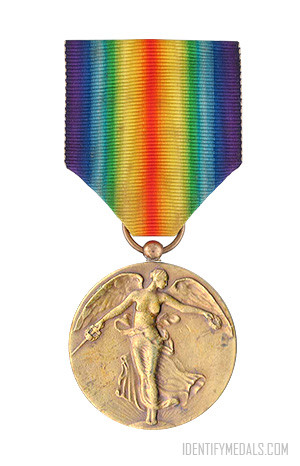
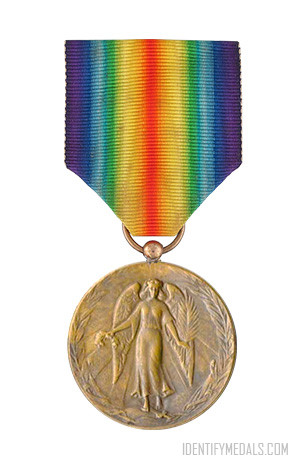
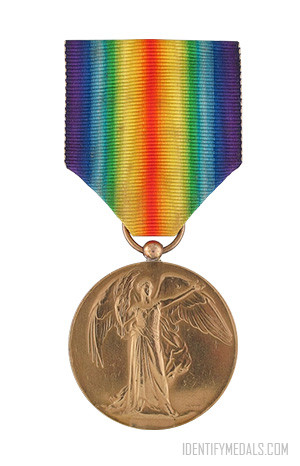
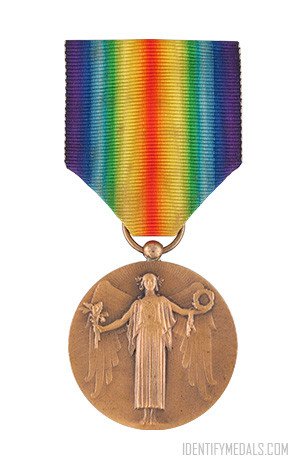
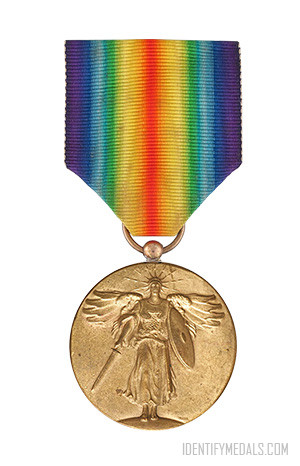
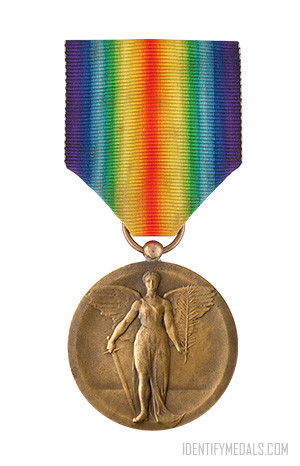
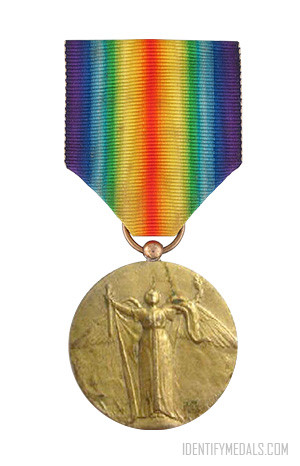
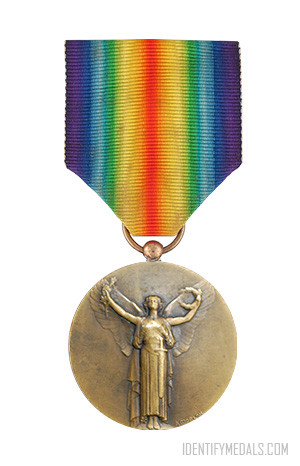
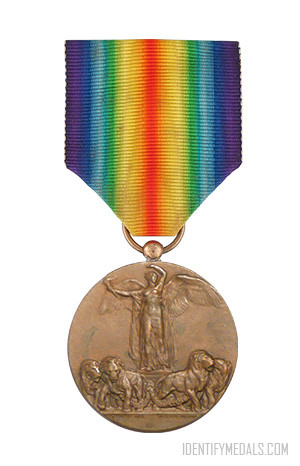
Although each country designed its own version of the Inter-Allied Victory Medal, all of them shared some common elements, such as a winged victory figure on the obverse and a similar ribbon with rainbow colors symbolizing unity among the Allies. Here are the versions for all countries:

Find an Inter-Allied Victory Medal Online

Right Now on eBay 
Clicking a link to eBay may result in a referral commission being paid if a purchase is made.
Loading...

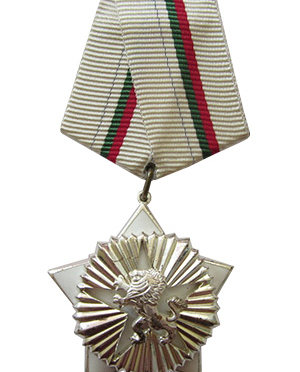
The Order of Military Valor And Merit

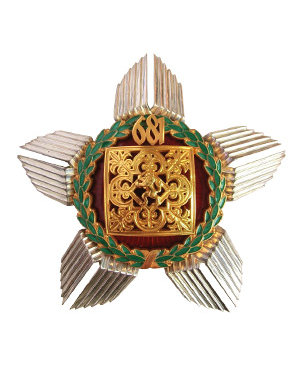
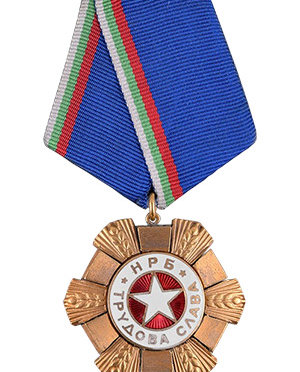
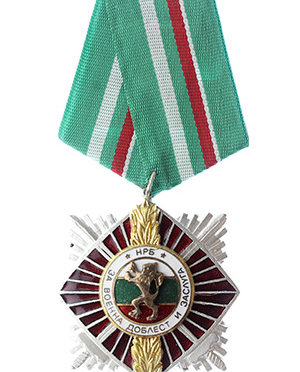
The Order of Military Valor And Merit is a Bulgarian medal established on 28 May 1974 and awarded to Military personnel, Workers of the Ministry Of Defence and reservists for long distinguished and honorable service or for merit in the strengthening of the power of armed forces and national security or for merit in combat training.

The award was designed by B. Kozarev and M. Markov.

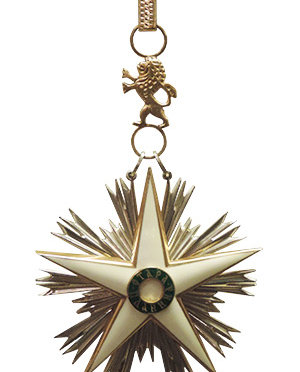
The Order of The Balkan Mountains

The Order of The Balkan Mountains is a Bulgarian medal established on 4 August 1966 and awarded to statesmen, ministers, diplomats, civil servants, and foreign citizens for the establishment and strengthening of friendly international relations with The People’s Republic Of Bulgaria.

If awarded for Military relationships the award was presented with swords. Designed by V. Starchev and K. Damjanov.

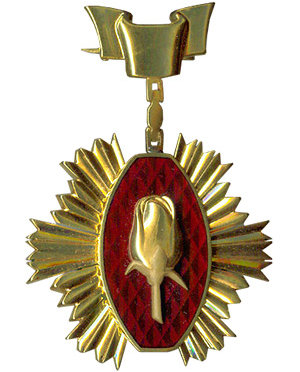
The Order Of The Rose

The Order Of The Rose is a Bulgarian medal established on 4 August 1966 by Decree No. 606 of the Presidium of the National Assembly of the People’s Republic of Bulgaria. It’s awarded to female foreigners for merit in establishing friendly international relationships with The People’s Republic Of Bulgaria.

The Order was designed by Dechko Uzunov, and the insignia are made at the State Mint in Sofia. Oval in shape, it measures 40.5 mm in diameter. In the center is a gilded embossed rose form. The rays are gold for the first degree and silver for the second degree. The plate is mounted on a rosette consisting of 10 bundles of rays, each of which is formed by three beams. The silver order differs from the gold only in that with the exception of the rose, which is gilded, is silver.

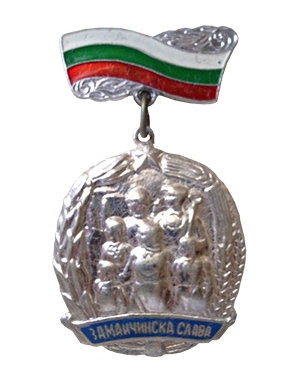
The Order Of Maternal Glory (Bulgaria)

The Order Of Maternal Glory is a Bulgarian medal established on 13 December 1950 and awarded to Bulgarian mothers for raising numerous children.

Three variations of this award exist: One on a ribbon which is numbered, latterly one on a ribbon which is unnumbered and then finally one on a metal suspension.

Classes:

  • 1st Class: Awarded to Bulgarian mothers for raising 8 or 9 children.
  • 2nd Class: Awarded to Bulgarian mothers for raising 6 or 7 children.
  • 3rd Class: Awarded to Bulgarian mothers for raising 4 or 5 children.

The Order Of Cyril And Methodius

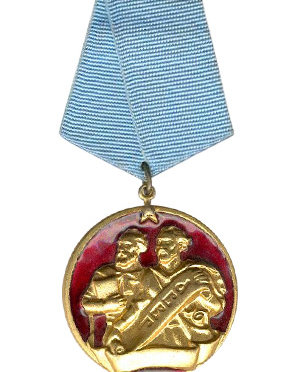
The Order Of Cyril And Methodius is a Bulgarian medal established on 13 December 1950 and awarded to Bulgarian and foreign citizens and organizations for merit in sciences, culture and information.

There are two variations of this award, originally one which is numbered and then issued later, one which is unnumbered. The medal was designed by P. Doychinov and O. Odabashja.

The award exists in three classes:

  • 1st Class
  • 2nd Class
  • 3rd Class