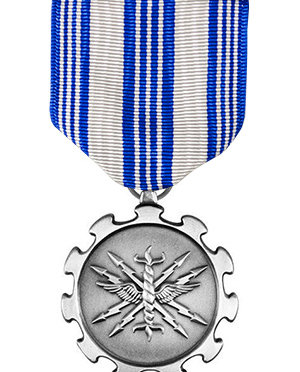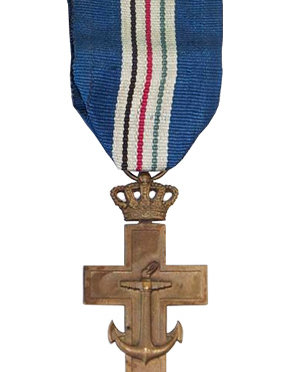
The Royal Hellenic Navy Campaign Cross

  • Time Period: WW2
  • Year of Institution: 22 December 1943
  • Country: Greece

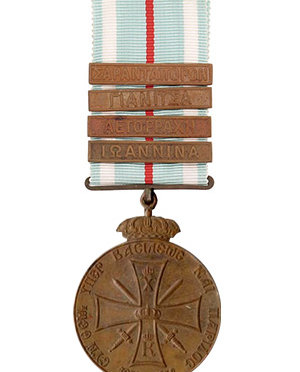
The Royal Hellenic Navy Campaign Cross was instituted by the Law of 22 December 1943 and awarded to officers and sailors of the Royal Hellenic Navy for a minimum of six months’ active service in World War II.

When Italy invaded Greece from Albania on 28 October 1940, the Greek Navy worked with the British Royal Navy to interrupt Italian shipments across the Adriatic. When Greece fell to German invasion in April 1941, much of the fleet steamed to Alexandria in Egypt and joined the British Mediterranean Fleet, continuing the fight against the Italians and Germans. Greek naval forces also escorted convoys in the Atlantic and Indian Oceans and supported the Normandy landings in June 1944.

The Royal Hellenic Navy (RHN) was, after the British Royal Navy, the largest Allied Naval force in the Mediterranean. The RHN fought against the Italians and the Germans in the Aegean Sea and the Eastern Mediterranean, participated in the defense of Malta, escorted convoys in the Atlantic and the Indian Ocean and supported the landings in Sicily, Italy, Southern France and Normandy.

The Royal Hellenic Navy Campaign Cross Design

The medals were issued by Kelaidis of Athens in bronze gilt. They measured 32 mm x 58.5 mm inclusive of its crown suspension. It came in three grades:

  • Gold (gilt) for officers,
  • Silver (silvered) for petty officers and
  • Bronze for sailors.

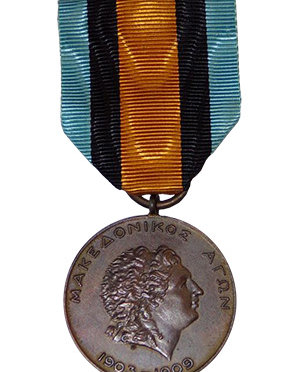
The Medal for the Macedonian Struggle

The Medal for the Macedonian Struggle was instituted in 1931 by the Second Hellenic Republic (1924-1935) first by law and then by Presidential Decree a year later.

It was awarded to living Makedonomachoi (Macedonian fighters) veterans of the Macedonian Struggle 1903-1909. The Macedonian Struggle was a the Greek guerrilla warfare against the forces of the supporters of the Bulgarian Exarchate such as the IMRO (International Macedonian Revolutionary Organization) that were aiming to annex Macedonia to Bulgaria. The Greek efforts for Macedonia were coordinated by the Hellenic Macedonian Committee, formed in 1903.

Its fighting forces were mainly former Officers of the Hellenic Army, volunteers brought to Crete and the Peloponnese,m as well as Macedonian Greeks.

The success of their efforts bolstered Greek presence in the still Ottoman-ruled Macedonia, and prepared the annexation of the Greek major part of Macedonia, following the Balcan Wars.

The Medal for the Macedonian Struggle Design

There were only approximately 2000 medals awarded. The text “Hellenic Republic” circumscribes it. The ribbon is colored light blue, black and yellow.

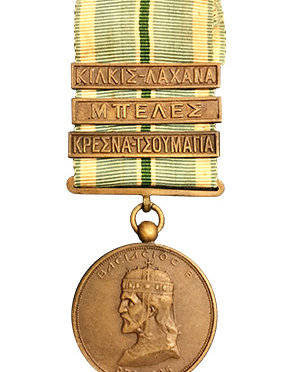
The Commemorative Medal for the Greco-Bulgarian War of 1913

  • Time Period: Pre-WW1
  • Year of Institution: 17 February 1914
  • Country: Greece

The Commemorative Medal for the Greco-Bulgarian War of 1913 was instituted by Royal Decree on 17 February 1914 and awarded for participation in the war against Bulgaria the previous year.

An alliance of Bulgaria, Greece, Montenegro and Serbia threw the Ottoman Turks out of almost all their remaining European territories in 1912 and the First Balkan War ended with the Treaty of London on 30 May 1913. However, the victors fell out over the division of the spoils, with Serbia and Greece forming an alliance against Bulgaria and the Second Balkan War broke out at the end of June. After initial setbacks, Bulgarian military successes stabilized the front in Macedonia. The situation was transformed by the invasion of Bulgaria by Romania on 10 July, leaving the former in a hopeless position. An armistice was agreed on 31 July with Greece gaining significant additional territory at the expense of Bulgaria.

The sense of grievance thus created led to Bulgarian participation in the two subsequent world wars on the side of Germany and against Greece but the territorial settlement has endured. The Byzantine Emperor Basil II earned the epithet ‘Bulgar-slayer’ during his wars against the Bulgarian empire of Tsar Samuel which led to the incorporation of most Bulgarian lands into the Byzantine Empire.

The Commemorative Medal for the Greco-Bulgarian War of 1913 Design

The medal is struck in bronze and measures 30 mm.

The ribbon is pale blue with white edge stripes and a white-edged green central stripe.

The Medal for the Greco-Turkish War of 1912-13

  • Time Period: Pre-WW1
  • Year of Institution: 1914
  • Country: Greece

The Medal for the Greco-Turkish War of 1912-13 is a Greek medal instituted in 1914 and awarded to men of all armed forces who took part in battles or Naval battles or served in commandeering and auxiliary services on battle-sites, and also to civilians, either Greek or foreign subjects, who offered any kind of service to the Navy during the battles.

During the 1st Balkan War the alliance of Greece, Bulgaria, Montenegro and Serbia liberated the remaining Christian populations of the European territories from the Ottoman Empire. The War ended with the Treaty of London in 1913 but soon the 2nd Balkan War started, this time against Bulgaria.

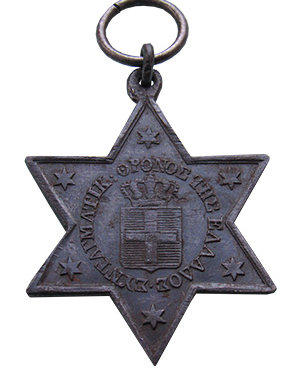
The Medal for the Proclamation of the Constitution of 1843

  • Time Period: Pre-WW1
  • Year of Institution: 1843
  • Country: Greece

The Medal for the Proclamation of the Constitution of 1843 was created on September 3, 1843 and it also known as the Cross of the Provinces.

On 3 September 1843, the military garrison of Athens, with the help of citizens, rebelled and demanded from King Otto the concession of a Constitution. The Constitution that was proclaimed in March 1844 came from the workings of the “Third of September National Assembly of the Hellenes in Athens” and was a Constitutional Pact, in other words a contract between the monarch and the Nation. This Constitution re-established the Constitutional Monarchy and was based on the French Constitution of 1830 and the Belgian Constitution of 1831.

Its main provisions were the following: It established the principle of monarchical sovereignty, as the monarch was the decisive power of the State; the legislative power was to be exercised by the King – who also had the right to ratify the laws – by the Parliament, and by the Senate. The members of the Parliament could be no less than 80 and they were elected for a three-year term by universal suffrage. The senators were appointed for life by the King and their number was set at 27, although that number could increase should the need arise and per the monarch’s will, but it could not exceed half the number of the members of Parliament.

The ministers’ responsibility for the King’s actions is established, who also appoints and removes them. Justice stems from the King and is dispensed in his name by the judges he himself appoints.

Lastly, this Assembly voted the electoral law of 18 March 1844, which was the first European law to provide, in essence, for universal suffrage (but only for men).

Despite the fact that Otto accepted the establishment of a Constitutional regime, he was not inclined to enforce it and by breaking both the spirit and the letter of the Constitution he tried to gather as much power as he possibly could. On the night of 10 October 1862 the rising wave of discontent led the people and the military to rebel and to decide Otto’s deposition.

The Cross for the Bavarian Auxiliary Corps

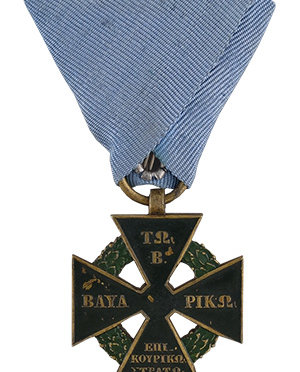
The Cross of the Bavarian Auxiliary Corps medal was created on November 22, 1833 and awarded to 3582 members of the Bavarian Auxiliary Corps who escorted King Otho I (the young Prince Otho of Bavaria) from his native Bavaria to Greece in that same year.

The Royal Bavarian Auxiliary Corps (or Β. Βαυαρικό Επικουρικό Σώμα in GreekKgl. Bayerisches Hilfskorps in German) was a Bavarian Army expeditionary force established in 1832 to accompany Prince Otto as the first king of independent Greece in 1833, to serve as a military force and enforce order until a native military could be established. It replaced the forces maintained there by the Great Powers—chiefly the French troops of the Morea Expedition—as well as the remnants of the Greek forces organized during the Greek War of Independence.

Most of the Bavarians left by 1837, but many remained behind, dominating the Greek army and the administration. This “Bavarocracy” (Βαυαροκρατία) provoked great resentment from the Greeks, and was one of the chief causes of the 3 September 1843 Revolution. Many Bavarians remained behind in Greece and became Greek citizens.

The Cross for the Bavarian Auxiliary Corps Design

The bronze and lacquer Cross features an obverse inscription that translates to “Othon King of the Hellenes,” and a reverse inscription that translates to “To the Royal Bavarian Auxiliary Corps.”

It measures 32.7mm x 37.5mm.

The Cross for the War of Independence 1821-1829

  • Time Period: Pre-WW1
  • Year of Institution: 3 September 1843
  • Country: Greece

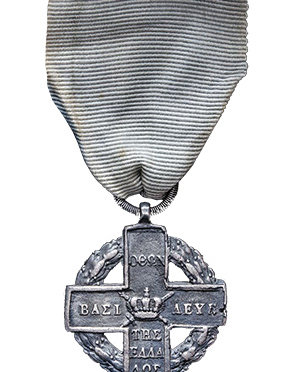
The Cross for the War of Independence 1821-1829 medal is was created in 1834 to be awarded to all those who took part in the Struggle for the Independence of Greece, or the Greek War of Independence.

Its final form and way of conferring were confirmed by the National Assembly of the 3rd of September 1843.

The Greek War of Independence, also known as the Greek Revolution (or Ελληνική ΕπανάστασηElliniki Epanastasi in Greek), was a successful war of independence waged by Greek revolutionaries against the Ottoman Empire between 1821 and 1830. The Greeks were later assisted by the Russian Empire, Great Britain, and the Kingdom of France, while the Ottomans were aided by their North African vassals, the eyalets of Egypt, Algeria, and Tripolitania, and the Beylik of Tunis.

The Cross for the War of Independence 1821-1829 Design

The medal is struck in bronze or silver and weights 11,1 grams. It measures 31 mm.

The Meritorious Service Medal (USA)

The Meritorious Service Medal (or MSM) is a military award presented to members of the U.S. Armed Forces who distinguished themselves.

The Meritorious Service Medal (also known as MSM) is a military award presented to members of the United States Armed Forces who distinguished themselves by outstanding meritorious achievement or service to the United States subsequent to January 16, 1969.

The MSM was previously awarded as a decoration for achievement during peacetime, but effective 11 September 2001, this decoration may also be bestowed in lieu of the Bronze Star Medal for meritorious achievement in a designated combat theater. Normally, the acts or services rendered must be comparable to that required for the Legion of Merit but in a duty of lesser, though considerable, responsibility. At the Tri-Department Awards Conference (February 5, 1968), there was a discussion on the need for a third meritorious award to provide appropriate recognition for non-combat achievement or service comparable to that of the Bronze Star Medal for combat achievement or service. It was felt that the Legion of Merit‘s prestige was slipping because it was being used with increasing frequency to reward service below the Legion of Merit’s intended standard, but higher than that required for the Commendation Medals of the various military services.

Foreign military personnel in the ranks of NATO OF-5 and below and individuals who have displayed a level of service that warrants an award of such magnitude may also be eligible to be awarded the MSM.

The Meritorious Service Medal Design

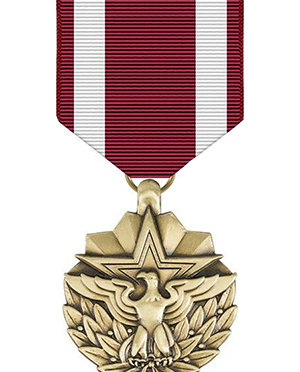
The Meritorious Service Medal is a bronze medal, 1.5 inches in diameter overall, consisting of six rays appearing from the upper three points of a five-pointed star with beveled edges and containing two smaller stars defined by incised outlines.

In the obverse, in front of the lower part of the star an eagle with wings upraised standing upon two upward curving branches of laurel tied with a ribbon between the feet of the eagle. The reverse has the encircled inscriptions “UNITED STATES OF AMERICA” and “MERITORIOUS SERVICE.” The suspension ribbon is 1 3/8 inches wide and consists of the following stripes: 1/8 inch Crimson 67112; 1/4 inch White 67101; center 5/8 inch Crimson; 1/4 inch White; and 1/8 inch Crimson.

Additional awards of the Meritorious Service Medal are denoted by bronze oak leaf clusters in the U.S. Army and U.S. Air Force and gold 5/16 inch stars in the U.S. Navy, U.S. Marine Corps and U.S. Coast Guard. These devices are also authorized for wear on the suspension and service ribbon of the medal.

Buy a Meritorious Service Medal

Note: As an eBay partner, I earn from qualifying purchases. This is all done automatically when you use a link and at no extra cost to you.

Right Now on eBay 
Clicking a link to eBay may result in a referral commission being paid if a purchase is made.
Loading...

The Achievement Medal – Joint Service

The Achievement Medal is a military decoration of the Armed Forces for contributions of junior officers and enlisted personnel

The Achievement Medal is a military decoration of the United States Armed Forces. It was first proposed as a means to recognize the contributions of junior officers and enlisted personnel who were not eligible to receive the higher Commendation Medal or the Meritorious Service Medal. Award authority rests with local commanders, granting a broad discretion of when and for what action the Achievement Medal may be awarded.

Each military service issues its own version of the Achievement Medal, with a fifth version authorized by the U.S. Department of Defense for joint military activity.

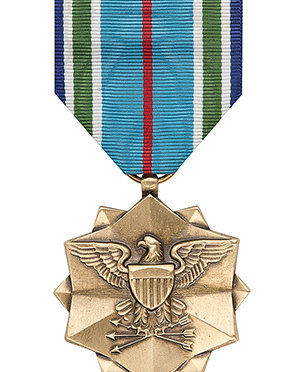
The Joint Service Achievement Medal was created in 1983. This award was considered a Department of Defense decoration senior to the service department Achievement Medals.

The Achievement Medal Design

The following devices may be authorized to be worn on the following achievement medals suspension ribbon and service ribbon:

  • All Achievement Medals, “C” device, which signifies meritorious performance “under combat conditions”, after January 2016
  • Army Achievement Medal, for additional awards – oak leaf clusters
  • Air Force Achievement Medal, for additional awards – oak leaf clusters
  • Navy and Marine Corps Achievement Medal, for additional awards – 5/16 inch stars
  • Coast Guard Achievement Medal, for additional awards – 5/16 inch stars
  • Joint Service Achievement Medal (all service branches), for additional awards – oak leaf clusters
  • Coast Guard Achievement Medal – Operational Distinguishing Device (“O” device)
  • Coast Guard Achievement Medal – Combat Distinguishing Device (Combat “V”)

Find This Medal Online

Right Now on eBay 
Clicking a link to eBay may result in a referral commission being paid if a purchase is made.
Loading...

The Achievement Medal – Air Force

The Achievement Medal is a military decoration of the Armed Forces for the contributions of junior officers and enlisted personnel

The Achievement Medal is a military decoration of the United States Armed Forces. It was first proposed as a means to recognize the contributions of junior officers and enlisted personnel who were not eligible to receive the higher Commendation Medal or the Meritorious Service Medal. Award authority rests with local commanders, granting a broad discretion of when and for what action the Achievement Medal may be awarded.

Each military service issues its own version of the Achievement Medal, with a fifth version authorized by the U.S. Department of Defense for joint military activity.

The U.S. Army and U.S. Air Force issued their own versions of the award with the Army Achievement Medal in 1981 and Air Force Achievement Medal in 1980. 

The Achievement Medal Design

The following devices may be authorized to be worn on the following achievement medals suspension ribbon and service ribbon:

  • All Achievement Medals, “C” device, which signifies meritorious performance “under combat conditions”, after January 2016
  • Army Achievement Medal, for additional awards – oak leaf clusters
  • Air Force Achievement Medal, for additional awards – oak leaf clusters
  • Navy and Marine Corps Achievement Medal, for additional awards – 5/16 inch stars
  • Coast Guard Achievement Medal, for additional awards – 5/16 inch stars
  • Joint Service Achievement Medal (all service branches), for additional awards – oak leaf clusters
  • Coast Guard Achievement Medal – Operational Distinguishing Device (“O” device)
  • Coast Guard Achievement Medal – Combat Distinguishing Device (Combat “V”)

Find This Medal Online

Right Now on eBay 
Clicking a link to eBay may result in a referral commission being paid if a purchase is made.
Loading...