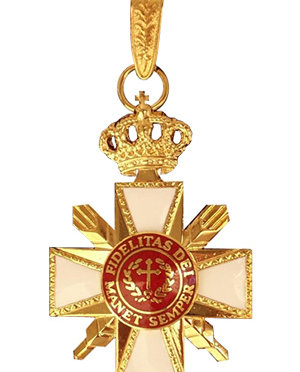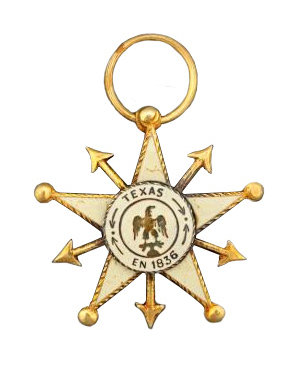
The Star for the Defense of Texas (1836)

This set of medals were issued during the period 1835-1841 of armed conflict between settlers and the Mexican army that began in late 1835.

As the number of American settlers in the Mexican state of Texas kept growing, the Mexican government made the decision in 1830 to close the border to all immigration, imposing as well numerous restrictions like the abolition of slavery.

The Mexican government believed the United States had instigated the Texas insurrection (October 2, 1835 – April 21, 1836) with the goal of annexation. The Mexican Congress passed the Tornel Decree, declaring that any foreigners fighting against Mexican troops “will be deemed pirates and dealt with as such, being citizens of no nation presently at war with the Republic and fighting under no recognized flag.”

The revolution began in October 1835, after a decade of political and cultural clashes between the Mexican government and the increasingly large population of American settlers in Texas. Colonists and Tejanos disagreed on whether the ultimate goal was independence or a return to the Mexican Constitution of 1824. In March 1836, a second political convention declared independence and appointed leadership for the new Republic of Texas.

Determined to avenge Mexico’s honor, Santa Anna vowed to personally retake Texas. His Army of Operations entered Texas in mid-February 1836 and found the Texians completely unprepared. Mexican General José de Urrea led a contingent of troops on the Goliad Campaign up the Texas coast, defeating all Texian troops in his path and executing most of those who surrendered. Santa Anna led a larger force to San Antonio de Béxar (or Béxar), where his troops defeated the Texian garrison in the Battle of the Alamo, killing almost all of the defenders.

After the Texans’ defeat in April 1836 of General Santa Anna, Mexico made no further attempt to reconquer the territory, although it refused to recognize its independence. The annexation of Texas as the 28th state of the United States, in 1845, led directly to the Mexican–American War. By the terms of the Treaty of Guadalupe Hildago, signed in 1848, Mexico ceded almost half its national territory to the United States.
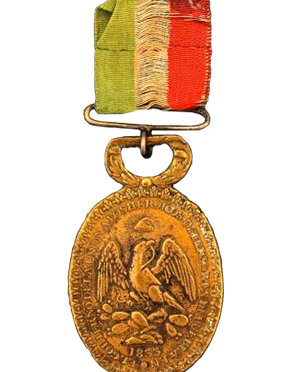
The Defense of Puebla Medal (1833)

The Defense of Puebla was a government authorized medal for the militia defenders at Puebla during the Revolt of the Polkos in Mexico in 1833.

The Defense of Puebla was a government authorized medal for the militia defenders at Puebla during the Revolt of the Polkos in Mexico in 1833.

Valentín Gómez Farías (14 February 1781 – 5 July 1858) was the President of Mexico for five short periods between the 1830s and 1840s. During his term in 1833 and in the absence of President Antonio López de Santa Anna (1794–1876), he enacted significant liberal reforms that were aimed at undermining the power of the Roman Catholic Church and the army in Mexico – for example, he advised Catholic clerics to limit their sermons to religious concerns and stop intervening in politics.

Some of Gómez Farías’ legislation restricted the Catholic Church’s power and eliminated some military privileges. The Conservatives, the Church, and the Army quickly responded in the form of the Revolt of the Polkos, calling for the removal of the Liberal government. During it, five Mexican National Guard regiments rose up in rebellion against the Mexican government, in protest over legislation that permitted the government to requisition money and property from the Catholic Church.

After the revolt was put down, the government authorized a medal for the militia defenders at Puebla: The Defense of Puebla medal.

The Medal of Freedom (1945)

The Medal of Freedom was a decoration established by President Harry S. Truman to honor civilians whose actions aided in the war efforts.

The Medal of Freedom was a decoration established by President Harry S. Truman to honor civilians whose actions aided in the war efforts of the United States and its allies.

The medal was intended to be awarded by the Secretary of State, the Secretary of War, or the Secretary of the Navy, but Presidents Dwight D. Eisenhower and John F. Kennedy also authorized awards.

The original Executive Order 9586 establishing the medal specified “No more than one Medal of Freedom shall be awarded to any one person, but for a subsequent act or service justifying such an award a suitable device may be awarded to be worn with the medal” and bronze, silver, and gold palm devices were produced and awarded.

The Medal of Freedom (1945) Design

The medal is a bronze disc whose obverse features the profile of the Statue of Freedom of the US Capitol Building, with the word “FREEDOM” in capital letters in an arc at the bottom of the disc.

The reverse features the Liberty Bell surrounded by the words “UNITED STATES OF AMERICA” in capital letters. The medal is suspended on a red ribbon with four thin white stripes.

The Presidential Medal of Freedom

The Presidential Medal of Freedom is an award bestowed by the President of the United States. It is the highest civilian award of the USA.

The Presidential Medal of Freedom is an award bestowed by the President of the United States and is—along with the Congressional Gold Medal—the highest civilian award of the United States.

The medal recognizes those people who have made “an especially meritorious contribution to the security or national interests of the United States, world peace, cultural or other significant public or private endeavors”. The award is not limited to U.S. citizens and, while it is a civilian award, it can also be awarded to military personnel and worn on the uniform.

President John F. Kennedy established the current decoration in 1963 through Executive Order 11085, with unique and distinctive insignia, vastly expanded purpose, and far higher prestige. It was the first U.S. civilian neck decoration and, in the grade of Awarded With Distinction, is the only U.S. sash and star decoration.

The Executive Order calls for the medal to be awarded annually on or around July 4, and at other convenient times as chosen by the president, but it has not been awarded every year (e.g., 2001, 2010). Recipients are selected by the president, either on the president’s own initiative or based on recommendations.

The medal may be awarded to an individual more than once.

The Presidential Medal of Freedom Design

The badge of the Presidential Medal of Freedom is in the form of a golden star with white enamel, with a red enamel pentagon behind it; the central disc bears thirteen gold stars on a blue enamel background (taken from the Great Seal of the United States) within a golden ring. Golden North American bald eagles with spread wings stand between the points of the star. It is worn around the neck on a blue ribbon with white edge stripes.

A special rarely given grade of the medal, known as the Presidential Medal of Freedom with Distinction, has a larger execution of the same medal design worn as a star on the left chest along with a sash over the right shoulder, with its rosette resting on the left hip.

Both medals may also be worn in miniature form on a ribbon on the left chest, with a silver North American bald eagle with spread wings on the ribbon, or a golden North American bald eagle for a medal awarded With Distinction.

In addition, the medal is accompanied by a service ribbon for wear on military service uniform, a miniature medal pendant for wear on mess dress or civilian formal wear, and a lapel badge for wear on civilian clothes (all shown in the accompanying photograph of the full presentation set).

Find This Medal Online

Right Now on eBay 
Clicking a link to eBay may result in a referral commission being paid if a purchase is made.
Loading...

The Congressional Gold Medal

The Congressional Gold Medal is an award bestowed by the Congress and one of the three highest civilian awards in the United States. 

Institution: 1776
Country: United States
 

The Congressional Gold Medal is an award bestowed by the United States Congress and one of the three highest civilian awards in the United States. Alongside the Presidential Medal of Freedom, it’s the oldest and highest American civilian award.

The medal is awarded to persons “who have performed an achievement that has an impact on American history and culture that is likely to be recognized as a major achievement in the recipient’s field long after the achievement.”

The tradition within the U.S. Congress of awarding gold medals as a form of recognition originated during the American Revolution, initially bestowed upon military personnel. Over time, this practice expanded to include individuals from various professions and, in the late 20th century, even groups. 

At the time of writing this, there have been 184 Congressional Gold Medals awarded.

How the Congressional Gold Medal is Awarded

There are no permanent statutory provisions for the creation of Congressional Gold Medals. When one has been deemed appropriate, Congress has, by legislative action, provided for the creation of a medal on an ad hoc basis.

Since the American Revolution, Congress has commissioned gold medals as its highest expression of national appreciation for distinguished achievements and contributions. The medal was first awarded in 1776 by the Second Continental Congress to General George Washington.

Although the first recipients were military figures who participated in the American Revolution, the War of 1812 and the Mexican–American War, Congress broadened the scope of the medal to include actors, authors, entertainers, musicians, pioneers in aeronautics and space, explorers, lifesavers, notables in science and medicine, athletes, humanitarians, public servants, and foreign recipients.

The medal is normally awarded to persons, but in 1979 the American Red Cross became the first organization to be honored with a gold medal. U.S. citizenship is not a requirement.

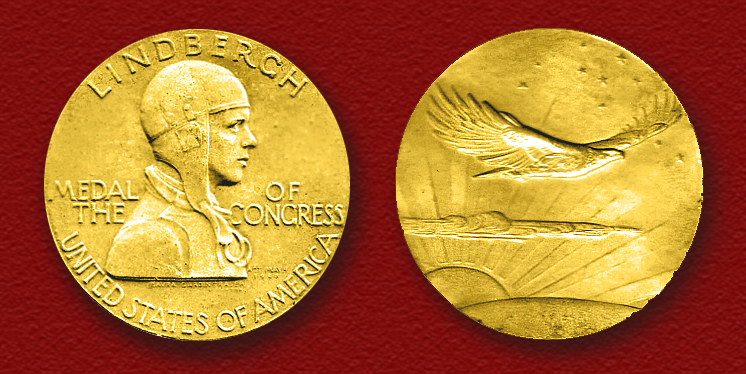
Medal awarded to Charles A. Lindbergh in 1930
Medal awarded to Charles A. Lindbergh in 1930. Image courtesy of Wikipedia.

The Congressional Gold Medal Design

A Congressional Gold Medal is designed by the United States Mint to commemorate the person and achievement for which the medal is awarded specifically. Medals are therefore different in appearance, and there is no standard design.

Congressional Gold Medals are considered non-portable, meaning that they are not meant to be worn on a uniform or other clothing but rather displayed. In rare instances, miniature versions have been made or converted for wear on clothing suspended from a ribbon.

Often, bronze versions of the medals are struck for sale by the U.S. Mint, and may be available in both larger and smaller sizes.

Find This Medal Online

Right Now on eBay 
Clicking a link to eBay may result in a referral commission being paid if a purchase is made.
Loading...

The Royal Order of Sports Merit

  • Time Period: Post-WW2
  • Institution: 18 June 1982
  • Country: Spain

The Royal Order of Sports Merit (or Real Orden del Mérito Deportivo) is a Spanish civil Order of Merit established 18 June 1982.

The order is indented to recognize distinguished service in sports, in teaching physical education, or the management, organization, promotion and development of physical education and sports. The order may be presented to individuals in one of four classes. It may also be presented to legal personalities, organizations, and other entities in one of three classes.

The Spanish Constitution of 1978 contains in article 43.3, a guiding principle in the conduct of public authorities to promote physical education and sport. The Royal Order of Sports Merit is a tool of this constitutional mandate to promote, advertise, and propagate physical culture and sports.

Individuals may be awarded the Royal Order of Sports Merit in one of four classes:

  • Grand Cross, awarded by Royal Decree in accordance with the Council of Ministers.
  • Gold Medal, awarded by the Minister of Education, Culture and Sport, on the proposal of the President of the Sports Council.
  • Silver Medal, awarded by the President of the Sports Council.
  • Bronze Medal, awarded by the President of the Sports Council.

Groups and organizations may be awarded in one of three different classes:

  • Gold Plaque, awarded by Royal Decree in accordance with the Council of Ministers.
  • Silver Plaque, awarded by the President of the Sports Council.
  • Bronze Plaque, awarded by the President of the Sports Council.

The Western European Union Mission Service Medal

  • Time Period: Post-WW2
  • Institution: 20 December 1994
  • Country: Spain

The Western European Union Mission Service Medal, is an international military decoration awarded to individuals, who served with Western European Union (WEU) military missions.

The WEU first acted in military operations in the context of the Iran–Iraq War. In 1987, mines were laid in the Persian Gulf, restricting the freedom of navigation in international waters. A joint mine sweeping effort was undertaken by member nations of the WEU.

The WEU next took part in military operations during the Yugoslav Wars in 1992. The WEU undertook Operation Sharp Fence starting in 1992, in tandem with NATO who was executing Operation Maritime Guard. WEU and NATO joined their operations together in a single command as Operation Sharp Guard in June 1993.

The Western European Union Mission Service Medal Design

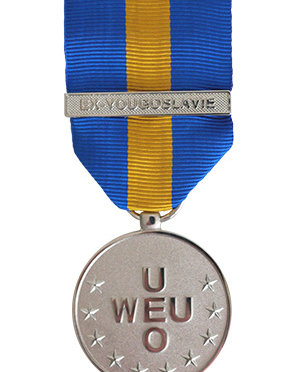
The medal is circular, made of silver-colored oxidized metal, 36 mm in diameter.

The obverse of the medal displays the letters WEU arranged horizontally for “Western European Union”. Above the letter E is the letter U and below the letter O. UEO is the acronym for the French equivalent, Union de l’Europe Occidentale. Below the acronyms, arranged along the edge, are ten five pointed stars.

The reverse bears the Latin words in relief, PRO PACE UNUM, meaning “one for peace”, or idiomatically as “united for peace”.

The suspension ribbon of the medal is blue with a central stripe of yellow-gold. Worn on the ribbon are clasps naming the mission for which the medal is awarded. The service ribbon is the same as the suspension ribbon, utilizing miniature versions of the clasps.

The Common Security and Defence Policy Service Medal

  • Time Period: Post-WW2
  • Institution: 1 January 2003
  • Country: Spain

The Common Security and Defence Policy Service Medal (or European Security and Defence Policy Service Medal prior to 2009), is an international military decoration awarded to individuals, both military and civilian, who have served with CSDP missions.

Since the 1990s the European Union has taken a greater role in military missions both in Europe and abroad. These actions were taken under the Common Security and Defence Policy (CSDP), which is implemented by the European Union Military Staff, a department of the EU.

The The Common Security and Defence Policy Service Medal Design

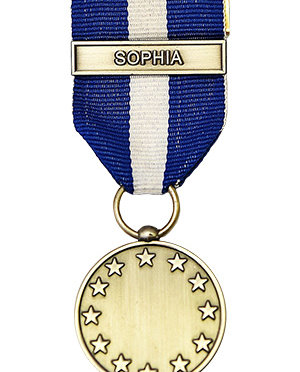
The medal is 36 mm in diameter, made of a silver colored metal. All versions share a common design.

The obverse of the medal is plain except for a circle of twelve five pointed stars around the outside edge of the medal. The reverse contains the Latin phrase, Pro Pace Unum, meaning “United for Peace”.

The words are arranged in three lines one word above the other in the center of the medal. The medal is suspended from a 36 mm ribbon in EU blue with either a wide gold center stripe for headquarters and combat forces, or a wide white stripe for planning and support. Each operation is identified with a different clasp with the name of the operation worn on the ribbon of the medal. A miniature version is worn on the ribbon bar, when medals are not worn.

To recognize service in these missions the EU authorized the creation of a medal with a common obverse and reverse, to which clasps featuring the missions’ name are attached to the ribbon bar.

The Long Military Service Cross (Spain)

The Long Military Service Cross is a military decoration of the Spanish Armed Forces and Civil Guard for long service.

  • Time Period: Post-WW2
  • Institution: 26 December 1958
  • Country: Spain

The Long Military Service Cross (or Cruz a la Constancia en el Servicio) is a military decoration of the Spanish Armed Forces and Civil Guard, designed to reward long and meritorious service below the level required for induction into the Royal and Military Order of Saint Hermenegild.

The medal was established by the Spanish government on December 26, 1958, and approved by Juan Carlos I in Royal Decree 682/2002. Regulations for the award were later modified in 2011, by Royal Decree 1385/2011.

The Long Military Service Cross may be awarded to all members of the Spanish Armed Forces, as well as to members of the Civil Guard at or below the rank of Corporal (OR-3). It can be presented in three grades, depending on time of service:

  • Gold for 30 years of meritorious service.
  • Silver for 25 years of meritorious service.
  • Bronze for 15 years of meritorious service.

The Long Military Service Cross Design

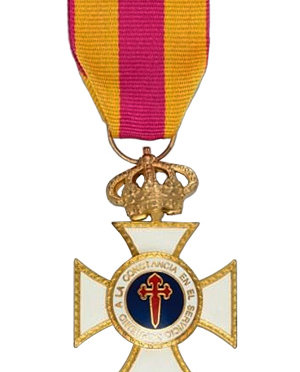
The ribbon of the medal is yellow, with a central stripe and thin border of magenta. The medal is a white cross pattée, bordered in either bronze, silver, or gold, and suspended from a crown.

At the center of the cross is a deep-blue enameled medallion, circumscribed by a white-enameled border which reads PREMIO A LA CONSTANCIA EN EL SERVICIO (Award for Constant Service). At the center of the medallion is a red Cross of Saint James, in the style of the Order of Santiago.

The Fidelity Cross (Spain)

The Fidelity Cross (Cruz Fidélitas) is a medal of the Spanish Armed Forces, primarily awarded to military chaplains to reward service.

  • Time Period: Post-WW2
  • Institution: 25 July 2007
  • Country: Spain

The Fidelity Cross (or Cruz Fidélitas) is a medal of the Spanish Armed Forces, primarily awarded to military chaplains. It is awarded by the military archbishopric to reward faithful service by chaplains, as well as services to the archbishopric by deserving civilians, institutions and other military personnel.

The decree established the award as a decoration of the Archdiocese of Spain, rather than the military, and stipulated that only the current military archbishop had the authority to award grades of the Cruz Fidélitas. However, he may temporarily delegate the power to award any class of the award to any chaplain he sees fit, other than that of Grand Cross.

There are three classes of the Cruz Fidélitas that can be awarded to military chaplains:

  • Cruz de la Cruz Fidélitas (Cross of the Fidelity Cross), awarded for 15 years of service.
  • Encomienda de la Cruz Fidélitas (Commendation of the Fidelity Cross), awarded for 20 years of service.
  • Plata de la Cruz Fidélitas (Plate of the Fidelity Cross), awarded for 25 years of service.

The Fidelity Cross Design

The ribbon of the medal is purple, with two white stripes extending down each side. From the ribbon hands a white-enameled cross bordered in gold, with gold spikes extending between the arms.

In the center of the cross, in the obverse, is the emblem of the Military Archbishopric of Spain, enameled in red. The reverse of the medal features a capital letter “F” relieved in the center of the cross, and the year “2007” on the lower arm, also in relief. A gold crown is used to suspend the cross from the ribbon.

Aside from that of the Cross of Honor, the ribbon bars of each grade also bear a device, dependent on the grade received. The ribbon bars of the Plate, Commendation, and Cross of the Cruz Fidélitas bear a Latin cross fleury, in gold, silver or bronze, respectively. The ribbon bar of the Grand Cross features a Spanish Royal Crown.