The Medal for Voluntary Military Service

The Medal for voluntary military service (or “Médaille des services militaires volontaires”) is a French military decoration established on 13 March 1975 by decree 75-150. It was established in three grades to recognize voluntary military service in the reserves.

During World War I, the reserves served as an important part of the defense of France. Between the abolition of the Order of military merit in 1963 and the creation of the Medal for voluntary military service in 1975, no award existed to adequately recognize reservists.

The Medal for voluntary military service is awarded to military personnel not in the full-time regular army serving honorably part-time in information, training and improvement of reserves, recruiting, military preparedness as well as activities within special associations. It may be exceptionally awarded to military personnel of either the reserves or regular army who distinguished themselves by the exceptionally high quality of their service. For award to a member of the regular army, this service must have been carried out outside of normal working hours and for no pay. The medal may be awarded posthumously.

The Medal for Voluntary Military Service Design

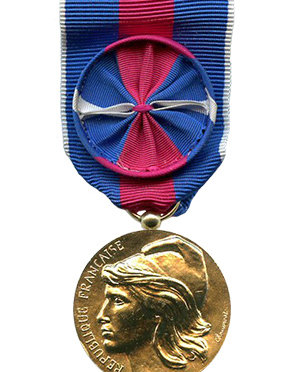
The Medal for voluntary military service is a 32mm in diameter circular medal struck from bronze, it is silvered for the silver grade or gilt for the gold grade.

Its obverse bears the left profile of the effigy of the Republic wearing a Phrygian cap with the relief semi circular inscription “RÉPUBLIQUE FRANÇAISE” (“French Republic”) along the left circumference.

The reverse bears the relief image of a vertical sword superimposed over two crossed naval anchors themselves superimposed over air force wings, at the bottom along the medal circumference, the relief inscription “SERVICES MILITAIRES VOLONTAIRES” (“Voluntary Military Services”).

The medal hangs from a ribbon passing through a suspension ring itself passing through a ball shaped suspension loop at the top of the medal. The 37mm wide silk moiré ribbon differs according to the grade of the award. The ribbon of the bronze grade award is blue with an 11 mm central red stripe; the silver grade ribbon only differs from the bronze grade in the addition of white 2mm edge stripes; a rosette in the colors of the silver grade ribbon is added for the gold grade award.
The Overseas Medal

The Overseas Medal (or Médaille d’Outre-Mer) is a commemorative or campaign medal issued to members of the French Armed Forces for participating in operations outside national territory. It replaced the French Colonial Medal by decree on 6 June 1962.

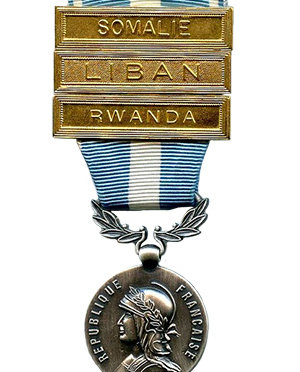
The areas of service are indicated by a gilt silver campaign clasp, there are currently 13 available:

  • Cambodge (Cambodia)
  • Liban (Lebanon)
  • Tchad (Chad), awarded to all French personnel, military or otherwise, who served in Chad regardless of the length of service from March 15, 1960 to January 27, 2008 . As of January 28, 2008, the campaign clasp is awarded for fifteen days of consecutive service or a cumulative equivalent of non-consecutive days.
  • Mauritanie (Mauritania), awarded to all French personnel, military or otherwise, who served in Mauritania from November 1977 to July 1990, regardless of length of service.
  • Moyen-Orient (Middle East)
  • Ormuz (Hormuz)
  • République centrafricaine (Central African Republic)
  • République de Côte d’Ivoire (Republic of Côte d’Ivoire)
  • République démocratique du Congo (Democratic Republic of Congo)
  • République du Congo (Congo)
  • Rwanda (Rwanda)
  • Somalie (Somalia)
  • Zaïre (Zaire)
  • Sahel (Mali)

The Overseas Medal Design

The medal’s design is the work of engraver Georges Lemaire, and it’s made in silver. The obverse shows a helmeted allegorical effigy of a woman as the personification of the French Republic, circled by the words “République française“. The reverse shows a terrestrial globe on top of trophies of military conquest with the words “MEDAILLE D’OUTRE-MER“.

The ribbon is sky blue and has three vertical white bands, the two side ones of 2mm and the central one of 7mm. The link is a silver laurel branches and the bars are gilt, showing the territory where the campaign occurred.

The Aeronautical Medal

The Aeronautical Medal (“Médaille de l’Aéronautique”) is a French decoration awarded to military personnel and civilians for outstanding aeronautics.

The Aeronautical Medal (or “Médaille de l’Aéronautique”) is a state decoration of France established by the decree of 14 February 14. It is awarded to both military personnel and civilians for outstanding accomplishments related to the field of aeronautics.

Originally envisioned before the Second World War, it was intended as an equal to the Order of Maritime Merit. The intent was to create an aerial order of merit intended for civilian and military personnel working in aeronautics. The war temporarily put an end to the project until February 1945.

Recipients are chosen by a council presided by a member of the office of the secretary of state for the armed forces (air) that will be composed of:

  • the chief of staff of the air force,
  • the director of the aeronautical administration control department,
  • the technical and industry director to the secretary of state for the armed forces (air),
  • a member named by decree of the minister for public works, transport and tourism, representing the ministry,
  • a representative of the aerial navigation companies named for two years by decree of the minister for public works, transport and tourism,
  • a personality with a history of exceptional services in aeronautics named for two years by decree of the secretary of state for the armed forces (air).

The Aeronautical Medal is limited to no more than 275 new recipients per year, it is awarded twice annually on 1 January and 14 July.

The Aeronautical Medal Design

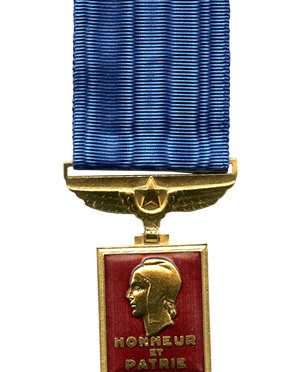
The medal is rectangular and of gilt metal. The obverse bears the gilt left profile of Marianne from the 1940s representing France, below Marianne, the gilt inscription “Honneur et Patrie” (Honour and Country). The reverse bears the inscription on four lines “MÉDAILLE DE L’AÉRONAUTIQUE 1945” (AERONAUTICAL MEDAL 1945).

The medal is enameled in red except for Marianne, the inscription and a 2 mm exterior border. The medal is suspended to a 37 mm wide royal blue silk moiré ribbon by a wing shaped pendant with a relief five pointed star at its center and an horizontal slot to receive the ribbon.

The Cross of the Resistance Volunteer Combatant

The Cross of the Resistance Volunteer Combatant (“Croix du combattant volontaire de la Résistance”) is a decoration for the French resistance.

The Cross of the resistance volunteer combatant (or “Croix du combattant volontaire de la Résistance”) is a French decoration that recognizes, as its name implies, those who fought in one of the resistance groups, or who were deported or interned for acts of resistance, or who were killed or injured while taking parts in acts of resistance against the German occupation forces during World War II.

This award was created by a special law in 1954 and awarded to those who had been designated and issued cards certifying them as voluntary resistance fighters. It was issued to all cardholders of voluntary resistance fighter created in 1949, which itself is obtained using the following criteria:

  • Holders of the a card Resistant-Deported or Interned-Resistant.
  • Those executed, killed or injured in an act of resistance.
  • Those who were members of a resistance group, recognized as a fighting unit and who actually fought at least 90 days in the French Forces Combattantes (FFC) or French Forces of the Interior ( FFI) or the French Resistance Interior (RFI).
  • The people who have belonged for 90 days before June 6, 1944, the FFC, FFI, or RFI in an area occupied by the enemy, and have affidavits from two persons well known for their activity in the French Resistance.

The Cross of the Resistance Volunteer Combatant Design

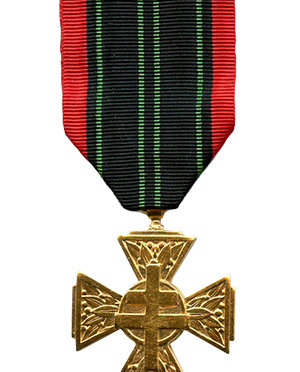
The Cross of the resistance volunteer combatant, a design of engraver Frédéric de Vernon, is a 36 mm wide cross pattée made of gilt bronze.

On the obverse, over the central medallion of the cross, a relief Cross of Lorraine overflowing onto the four cross arms which are covered in laurel leaves. On the reverse, the relief inscription on three lines on the central medallion COMBATTANT VOLONTAIRE RÉSISTANCE.

The cross is suspended by a ring through a suspension loop which is an integral part of the top of the upper cross arm. It hangs from a 36 mm wide black silk moiré ribbon with 5 mm wide red vertical edge stripes, it is further divided by four vertical 1 mm wide green stripes, two at center spaced 2 mm apart and one on each side 2 mm from the red edge stripes.

The Volunteer Combatant’s Cross

The Volunteer combatant’s cross (Croix du combattant volontaire) was a French decoration for volunteers that served during World War II.

The Volunteer combatant’s cross (or “Croix du combattant volontaire”) was a French decoration that originally recognized those who volunteered to serve in a combat unit during World War II. It is the equivalent of the “1914–1918 Volunteer combatant’s cross“.

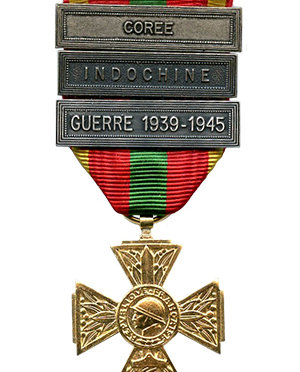
This decoration is equivalent to that awarded to the soldiers of the First World War. At the request of the associations of veterans the state fixed by Act of 4 February 1953, accompanied by a decree of 19 November 1955, the award Croix du Combattant Volontaire 1939–1945, designated for those who volunteered to serve. Additional revisions of the act establishing this award in 1995 and 2007 have added a total of five clasps:

  • Guerre 1939–1945
  • Indochine
  • Corée
  • Afrique du Nord
  • Missions extérieures

The Volunteer combatant’s cross was created to honor those who voluntarily participated in an armed conflict, during which they put their lives at risk.

In this spirit, the candidate for this distinction must provide proof from what he has done is a voluntary act of serving in a combat unit, so that because of his age or his circumstances, he was compelled to any “service obligation” (read “no obligation such “). From what he has in fact been present in a unit recognized fighter, during a specified time.

The Volunteer Combatant's Cross Design

A cross with four arms in bronze, 36 mm wide. Engraved by Frédéric de Vernon.

On the obverse is a round central medallion with the legend surrounding REPUBLIQUE FRANCAISE. An effigy of a helmeted Poilu (World War I infantryman), on a sword drawn vertically on the arms of the cross which is covered with laurel leaves and oak leaves in relief.

On the reverse is, inside the central medallion, a branch of laurel is surrounded by the inscription: COMBATTANT VOLONTAIRE 1939–1945. The reverse of the 1983 version has no date. The cross arms are covered with leaves of laurel and oak forming relief.

Find This Medal

Right Now on eBay 
Clicking a link to eBay may result in a referral commission being paid if a purchase is made.
Loading...

The Resistance Medal

The Resistance medal (Médaille de la Résistance) was a decoration bestowed by the French Committee of National Liberation during World War II.

The Resistance medal (or Médaille de la Résistance) was a decoration bestowed by the French Committee of National Liberation, based in the United Kingdom, during World War II.

It was established by a decree of General Charles de Gaulle on 9 February 1943 “to recognize the remarkable acts of faith and of courage that, in France, in the empire and abroad, have contributed to the resistance of the French people against the enemy and against its accomplices since 18 June 1940“.

The Resistance medal was awarded to approximately 38,288 living persons and 24,463 posthumously. These awards were both for membership in the Free French forces and for participation in the metropolitan clandestine Resistance during the German occupation of France in World War IIThe medal was also awarded to 18 communities and territories, 21 military units, and to 15 other organizations including convents, high schools, and hospitals that particularly distinguished themselves.

The Resistance Medal Design

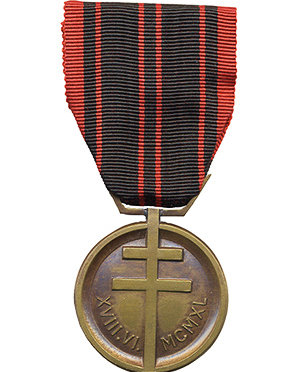
The Resistance medal is a 37mm in diameter circular medal struck from bronze. Its slightly concave obverse bears at center a vertical Cross of Lorraine with the relief semi circular inscription of the date of General de Gaulle’s appeal of 18 June 1940 in Roman numerals “XVIII.VI.MCMXL” (18.06.1940) bisected by the lower part of the cross.

The reverse bears the relief image of an unfurling ribbon bearing the relief inscription in Latin”PATRIA NON IMMEMOR” translating into “THE NATION DOES NOT FORGET”. The suspension is cast as an integral part of the medal.

The medal hangs from a 36mm wide black silk moiré ribbon with six vertical red stripes of varying widths, 3mm wide edge stripes, two 1mm wide central stripes 2mm apart, and two 1mm wide stripes 6mm from the central stripes. A 28mm in diameter rosette is on the ribbon of the Officer of the Resistance medal.

The Medal of the Gendarmerie Nationale

The Medal of the National Gendarmerie or Federal Police (Médaille de la Gendarmerie nationale) is a military decoration created in 1949.

The Medal of the National Gendarmerie or Federal Police (or Médaille de la Gendarmerie nationale) is a French military decoration created on 5 September 1949 on the proposition of the then Minister of Defence, mister Paul Ramadier.

It was originally created in a single grade for award to officers and NCOs of the Gendarmerie nationale who were cited in the orders of the entire service. Such a citation in the orders of the entire service, and all potential subsequent ones would be denoted by a grenade device on the ribbon as the medal could, and can still only be awarded once to any potential recipient.

The medal could also be exceptionally awarded to persons not members of the service for important services rendered to the gendarmerie or for help during special missions. These presentations were made without a citation and thus without any ribbon device.

The ribbon of the medal will be adorned by a device denoting the degree of the award as described in its accompanying citation:

  • Bronze palm when cited to the entire service;
  • Gilt star when cited to its relevant army corps;
  • Silver star when cited to its relevant division;
  • Bronze star when cited to its relevant brigade or division.

The medal may be awarded posthumously.

The Medal of the Gendarmerie Nationale Design

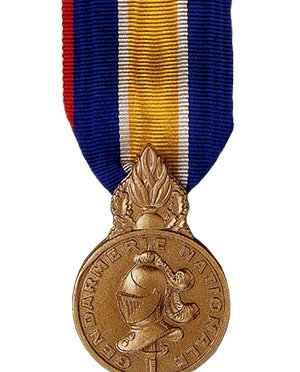
The Médaille de la Gendarmerie nationale is a 36 mm in diameter circular gilt bronze medal. At its top, also in gilt bronze and hiding the ribbon suspension loop, is affixed a grenade with flames between laurel leaves.

The obverse bears the relief image of a plumed close helmet resting on a sword pointing upward, it bears the circular inscription along its circumference “GENDARMERIE NATIONALE”. The reverse bears a laurel wreath with the relief inscription “COURAGE DISCIPLINE” on two lines at the top, the center being reserved for the inscription of the recipient’s name.

The Médaille de la Gendarmerie nationale is suspended by a 37 mm wide silk moiré ribbon divided by vertical stripes in the following colors:

  • 10 mm wide yellow central stripe representing the color of the old “Maréchaussée”, the military service charged with police and jurisdictional duties under the old regime;
  • 2 mm wide white stripes bordering the central stripe, they represent the two subdivisions of the service, the police service and the Republican Guard;
  • these central stripes are themselves bordered by 9,5 mm wide blue vertical stripes representing the color of the police service;
  • 2 mm wide bright red edge stripes represent the Republican Guard.

The War Cross 1939-1945

The War Cross 1939–1945 (Croix de guerre 1939–1945) is a French military decoration to honor those who fought with the Allies during WW2.

The War Cross 1939–1945 (or Croix de guerre 1939–1945) is a French military decoration, a version of the Croix de guerre created on September 26, 1939, to honor people who fought with the Allies against the Axis forces at any time during World War II.

Due to the large extent of the war zone, recipients included those who fought during, with, at, or in the following:

  • Battle of France
  • French Forces of the Interior
  • Free French Forces
  • Western Front
  • Middle East Theater
  • Mediterranean Theater
  • African campaigns

The War Cross 1939-1945 Design

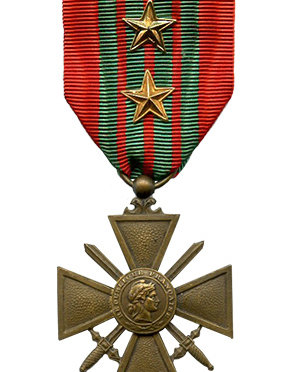
The Croix de Guerre was designed by the sculptor Paul-Albert Bartholomé. The medal measures 37 mm in size and is made in the shape of a Maltese cross with two swords crisscrossed through the center.

In the center of the obverse is the profile of the French Republic crested by a Phrygian cap. Around this portrait are the words “République française” (“French Republic”). On the reverse of the medal are the dates of the conflict: 1939–1940, 1939–1945, or simply 1940.

The suspension and service ribbon of the medal has a red background crossed with four green lines in its center.

On every medal and ribbon, there is at least one ribbon device, either in the shape of a palm or of a star, and fashioned from either bronze, silver, or gilded silver (gold).

The French Croix represents a mention in dispatches awarded by a commanding officer. An individual could be awarded the decoration several times, for different actions, and from different sources. The devices are:

  • A bronze star for those who were mentioned at the regiment or brigade level.
  • A silver star, for those who were mentioned at the division level.
  • A silver-gilt (gold) star for those who were mentioned at the corps level.
  • A bronze palm for those who were mentioned at the army level.
  • A silver palm stands for five bronze ones.
  • A silver-gilt (gold) palm for those who were mentioned at the Free French Forces level (World War II only).

Find This Medal

Right Now on eBay 
Clicking a link to eBay may result in a referral commission being paid if a purchase is made.
Loading...

The Royal Order of Cambodia

The Royal Order of Cambodia (Ordre Royal du Cambodge) was a colonial chivalric order in French Cambodia and is still in use in the present day.

The Royal Order of Cambodia (គ្រឿងឥស្សរិយយសព្រះរាជាណាចក្រកម្ពុជា; or Ordre royal du Cambodge) was a French colonial chivalric order in French Cambodia and is still in use in present-day Cambodia.

For French appointments, the recipient had to be at least 29 years old and enter the Order first as a knight, to be promoted to a higher grade after a certain period. In 1948 France ceased granting the order. Formally it remained a French colonial policy, but it was now only granted by the King of Cambodia.

On September 1, 1950 the (colonial) French medal system was reformed. The Order of the Star of Anjouan and the Order of the Black Star were formalized as French Overseas Orders. In 1955, Cambodia became independent. The order was approved by King Norodom Sihanouk during his government and also granted during his exile in Beijing. Even after the restoration of the Khmer dynasty, it remained the highest Cambodian distinction.

The Royal Order of Cambodia Design

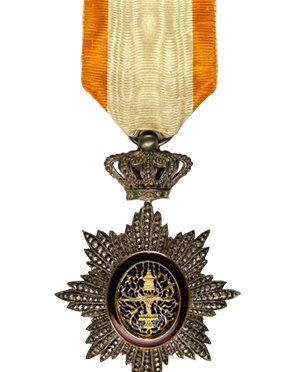
The medal of the order comes in many different forms, as a slightly elongated silver or gold star surmounted by a Cambodian crown and with an image of the king’s crown and coat of arms in gold on a violet-blue background and surrounded by a red circle. The reverse of the medal is left rough. To promote the order if it was awarded by the French, the Cambodian crown was replaced with a European one surmounted by a small cross, and in the early years, the order was even awarded without any crown.

The central image on the star of the order is the same as the medal, though the crown is missing and the rays are usually smooth. The star is elongated, with the vertical rays longer than the horizontal rays. The regalia of Knights is in silver, whilst those of the higher grades are gold. The medal and star are equally for civilians and soldiers. The ribbon of the order was originally green with a red border, changing in 1899 to white with an orange border (in the same year the French government changed the colours of the ribbons of all five colonial orders), before reverting to the original black ribbon when it became a purely Cambodian order again.

The Order of Public Health

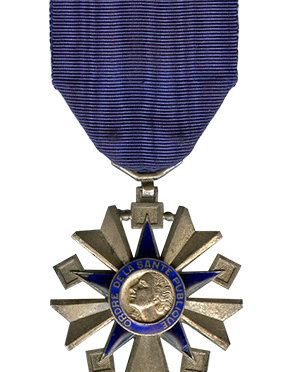
The Order of Public Health (or Ordre de la Santé publique) was a French order of merit, created by presidential decree of President Albert Lebrun on 18 February 1938 and amended on 22 May 1954, and awarded for services to the public health and protection of children.

The Order had three classes, and was only awarded to people who was minimum 30 years old.

  • Commander (40 awards)
  • Officer (170 awards)
  • Knight (806 awards)