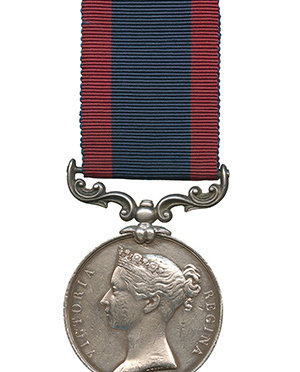
The Sutlej Medal

The Sutlej Medal is a campaign medal issued to officers and men of the British Army and East India Company who served in the Sutlej campaign.

The Sutlej Medal is a campaign medal issued to officers and men of the British Army and Honourable East India Company who served in the Sutlej campaign of 1845-46 (also known as the First Anglo-Sikh War).

This medal was approved in 1846 and was the first one to use clasps to denote soldiers who fought in the major battles of the campaign.

The Sutlej Medal commemorates four battles (the first in which the recipient participated is shown on the reverse of the medal, with any further battles indicated by a clasp).

As there was no battle prior to the battle of Moodkee no clasp was produced for this action. The three clasps awarded were for the battles of FerozeshuhurAliwal and Sobraon.

The Sutlej Medal Design

The Sutlej medal is a circular silver medal measuring 36 millimeters (1.4 in) in diameter. It was designed by William Wyon.

The obverse depicts the diademed head of Queen Victoria with the legend VICTORIA REGINA. The reverse shows a standing figure of victory, facing left and holding a wreath in her outstretched hand, with a collection of trophies at her feet. Around the circumference is the legend ARMY OF THE SUTLEJ, with the name and year of the first battle in which the recipient served below.

The ribbon measures 31.7 millimetres (1.25 in) wide and is dark blue with crimson edges.
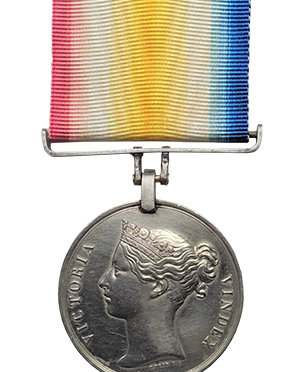
The Scinde Medal

The Scinde Medal is a British medal issued to soldiers who participated in Major General Sir Charles Napier’s conquest of Scinde.

The Scinde Medal is a British medal issued to soldiers of the Honourable East India Company, the 22nd Regiment of Foot of the British Army and members of the Indian Navy, who participated in Major General Sir Charles Napier’s conquest of Scinde between 1842 and 1843.

The Scinde medal was authorized on 22 September 1843. Scinde had made various hostile demonstrations against the British government after the termination of the First Anglo-Afghan War. General Napier’s campaign against these Amirs resulted, after the victories of Miani and Hyderabad, in the complete subjugation of the province of Sindh, and its annexation to the Bombay Presidency of the British Raj.

The Scinde Medal Design

The Scinde Medal was designed by William Wyonand struck in silver. It measures 36 millimeters (1.4 in) wide.

The obverse displays a left facing, diademed bust of Queen Victoria facing left with inscription VICTORIA REGINA. The reverse shows three different versions were issued, all containing the name and year of the battle(s) where the recipient was present, surrounded by a laurel wreath and surmounted by a crown.

  • MEEANEE / 1843. For participation in the Battle of Miani (or Meeanee), 17 February 1843.
  • HYDERABAD / 1843. For participation in the Battle of Hyderabad, 24 March 1843.
  • MEEANEE / HYDERABAD / 1843. For participation in both battles.

The suspender is a straight steel clip with a straight bar suspender. The ribbon measures 45 millimeters (1.8 in) rainbow pattern watered red, white, yellow, white and blue. The medals were impressed or engraved with recipient’s name and regiment around the rim.

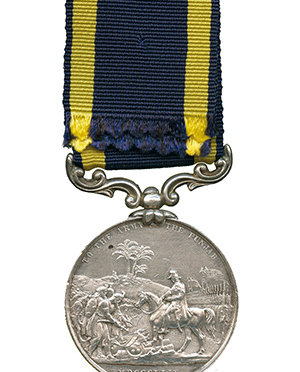
The Punjab Medal

The Punjab Medal is a campaign medal issued to officers and men of the British Army and East India Company who served in the Punjab campaign.

The Punjab Medal is a campaign medal approved on 2 April 1849 and issued to officers and men of the British Army and Honourable East India Company who served in the Punjab campaign of 1848-49 (between 7 September 1848 and 14 March 1849), which ended in the British annexation of the Punjab.

Three clasps were authorized, although no medals were awarded with more than two, since no unit qualified for both the Mooltan and Chilianwala clasps.

The clasps were: Multan (7 September 1848 – 22 January 1849), awarded to troops engaged in the siege of Multan. In total, 18,967 of these clasps were awarded, 2,900 to Europeans and 16,067 to Indian troops; Chilianwala, (13 January 1849) awarded to troops under the command of Lord Gough who engaged with the Sikh army of Sher Singh and Lal Singh near Chilianwala. In total, 21,453 of these clasps were awarded, 4,300 to Europeans and 16,153 to Indian troops; and Goojerat (21 February 1849) awarded to troops under the command of Lord Gough who defeated the Sikh army of Sher Singh at Gujarat. In total, 32,960 of these clasps were awarded, 6,200 to Europeans and 26,760 to Indian troops.

The Punjab Medal Design

The Punjab medal is a circular silver medal measuring 36 millimeters (1.4 in) in diameter and designed by William Wyon

The obverse shows the diademed head of Queen Victoria with the legend VICTORIA REGINA. The reverse depicts a scene showing Sir Walter Gilbert receiving the Sikh surrender with the legend TO THE ARMY OF THE PUNJAB above, and below MDCCCXLIX, the year 1849 in Roman numerals.

The ribbon measures 31.7 millimeters (1.25 in) wide and is dark blue with a yellow stripe towards each edge.

The Naval General Service Medal (1847)

The Naval General Service Medal was a campaign medal issued to officers of the Royal Navy and awarded retrospectively for naval actions.

The Naval General Service Medal (or NGSM) was a campaign medal issued to officers and men of the Royal Navy and awarded retrospectively for various naval actions during the period 1793–1840. Admiral Thomas Bladen Capel was one of the members of the board that authorized the medal.

The period for the NGSM included the French Revolutionary Wars, the Napoleonic Wars and the Anglo-American War of 1812. Each battle or campaign was represented by a clasp on the ribbon (the medal was never issued without a clasp, and there were 231 of them). These clasps covered a variety of actions from boat service, ship to ship skirmishes, to major fleet actions such as the Battle of Trafalgar.

This medal and its army counterpart, the Military General Service Medal, were amongst the first real British campaign medals, issued to all ranks for serving in combat actions.

The Naval General Service Medal Design

The medal was designed by William Wyon, and is made of silver. It measures 1.4 inches (36 mm) in diameter.

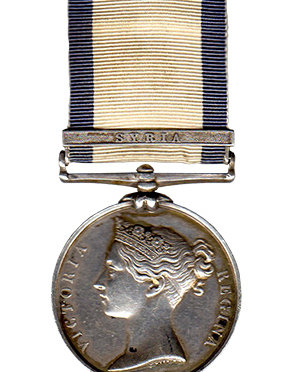
The obverse shows a left facing effigy of Queen Victoria with the inscription “VICTORIA REGINA” and the date “1848”. The reverse shows the figure of Britannia, holding a trident, seated on a seahorse.

The name of the recipient is impressed on the rim in block Roman capitals, while medals to officers and warrant officers also include the recipient’s rank. The ribbon measures 1.25 inches (32 mm) and is white with dark blue edges.

The Military General Service Medal

The Military General Service Medal is a campaign medal issued to officers and men of the British Army in 1848 for various military actions.

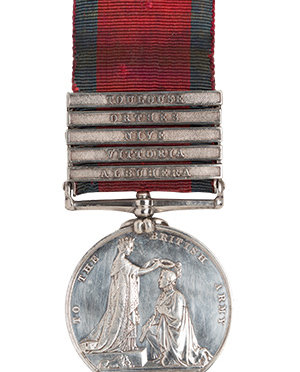
The Military General Service Medal (or MGSM) is a campaign medal issued to officers and men of the British Army in 1848 and approved on 1 June 1847 as a retrospective award for various military actions from 1793–1814.

The period the medal encompasses is that of the French Revolutionary Wars, the Napoleonic Wars, and the Anglo-American War of 1812.

Each battle or campaign covered by the medal was represented by a clasp on the ribbon, of which twenty-nine were sanctioned (although a man could awarded up to fifteen).

The MGSM was only awarded to surviving claimants. Only about 10 per cent of those who served applied for this medal, due to general illiteracy and limited publicity for it. Next of kin could not apply for it on behalf of a deceased relative.

A total of 26,091 medals were awarded.

The Military General Service Medal Design

The medal was designed by William Wyon and is  made of silver. It measures 1.4 inches (36 mm) in diameter.

The obverse depicts a left facing effigy of Queen Victoria with the inscription “VICTORIA REGINA” and the date “1848”. The reverse shows Queen Victoria standing on a dais, crowning a kneeling Duke of Wellington with a laurel wreath. Above is the inscription “TO THE BRITISH ARMY”, with the dates “1793-1814” below.

The name and regiment of the recipient is impressed on the rim in block Roman capitals. The 1.25 inches (32 mm) wide ribbon was crimson, with dark blue edges.

The Medal for the Defence of Kelat-I-Ghilzie

The Kelat-I-Ghilzie Medal is a British campaign medal issued by the British East India Company to the defenders of Kelat-I-Ghilzie.

The Kelat-I-Ghilzie Medal is a British campaign medal issued by the British East India Company to the defenders of the fort at Kelat-I-Ghilzie during the First Anglo-Afghan War.

After the Massacre of Elphinstone’s Army, the only forces left in Afghanistan were at Jalalabad and Kelat-I-Ghilzie, a fort between Kabul and Kandahar. The garrison numbering 932 (55 Europeans and 877 Natives) was besieged for most of the winter. Finally, on 19 May 1842, a force was sent to draw off the garrison and relieve them from their post. A few days after this attack the garrison was finally relieved by the forces under Sir William Nott, on 26 May 1842.

For the courage displayed by the garrison at Kelat-i-Ghilzie, the East India Company authorized the medal to be awarded to all troops who participated in the protracted siege.

The Medal for the Defence of Kelat-I-Ghilzie Design

The medal for the Defence of Kelat-I-Ghilzie was designed by William Wyon, official chief engraver at the Royal Mint. It was silver and measured 36 millimeters (1.4 in) in diameter.

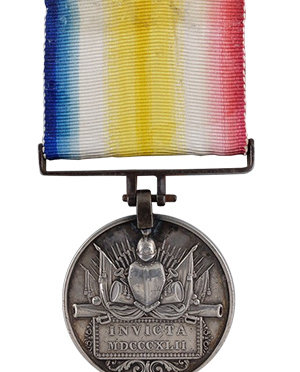
The obverse displays a laurel wreath with mural crown at the top of a shield with the inscription KELAT-I-GHILZIE. The reverse has a trophy of arms on top of a plaque bearing the inscription ‘INVICTA MDCCCXLII’.

The suspension consists of a straight steel suspender, attached to the medal by way of a steel clip and pin. The ribbon is the watered rainbow colored ribbon common to most East India Company medals (red on the left edge fading into white, which changed to yellow in the center, fading back to white, until finally changing to blue at the right edge).

The medals were engraved with the name of the recipient in script on the edge for the medals issued to British personnel. The medals issued to indigenous troops were often not named.

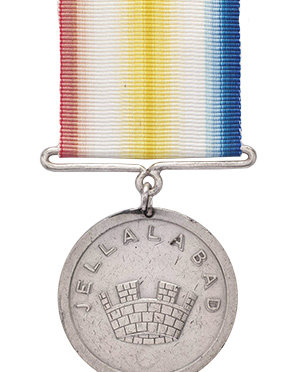
The Jellalabad Medals

The Jellalabad Medal is a campaign medal awarded for the defence of Jalalabad and issued by the British East India Company.

The Jellalabad Medal is a campaign medal awarded for the defence of Jalalabad from 12 November 1841 to 7 April 1842 and issued by the British East India Company and established by George Eden, the Governor-General of India, on 30 April 1842.

The medal was awarded during the First Afghan War to the troops under the command of Sir Robert Sale. About 2,600 soldiers had taken part, including the 13th Foot, the 35th Bengal Native Infantry and detachments from other Indian Army units and some loyal Afghan forces.

The Jellalabad Medal Design

Two different versions of the Jellalabad Medal were awarded. The original medal was struck in silver and produced by the Calcutta Mint. It measured 39 millimeters (1.5 in) in diameter.

The obverse depicts a mural crown with the word ‘JELLALABAD’ above. The reverse shows the date ‘VII APRIL 1842‘ over three lines. The suspension is a straight steel suspender attached to the medal by way of a steel clip.

This version was considered inartistic and insufficient to issue to next of kin of those who had died during the campaign. The East India Company therefore decided to strike a further issue of a new design.

The second version of the medal was struck in silver and designed by William Wyon and produced by the Royal Mint in London. It measured 36 millimeters (1.4 in) in diameter.

The obverse depicts the diademed head Queen Victoria facing left with the inscription ‘VICTORIA VINDEX’ (PROTECTOR). The reverse shows a winged figure of Victory flying over the fortress at Jellalabad. Above is the inscription ‘JELLALABAD VII APRIL’ with below the year ‘MDCCCXLII’. The suspension is a straight suspender attached to the medal by way of a steel clip.

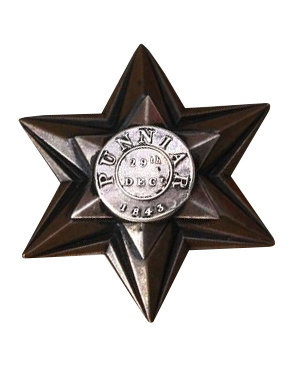
The Gwalior Star (Punniar)

The Gwalior Star is a Campaign medal presented to the soldiers of the British Army and Bengal Army who took part in the Gwalior Campaign.

The Gwalior Star is a Campaign medal presented to the soldiers of the British Army and the British led Bengal Army who took part in the 1843 Gwalior Campaign by the Honourable East India Company.

Tensions between the East India Company and the State of Gwalior had been growing and finally led to a British advance into Gwalior early in December 1843.

On December 29, 1843, the British Army defeated Maharaja Shrimant Jayaji Rao Scindia, and regained control of Gwalior. The first division of the army, commanded by General Sir Hugh Gough, was victorious at the Battle of Maharajpoor. Major-General Grey, with the second division, was victorious at the Battle of Punniar on the same day.

The Gwalior Star Medal Design

The Gwalior medal is a six pointed star and measures 50 millimeters (2.0 in) diameter. It’s made of bronze from guns captured during the Gwalior Campaign.

In the obverse, the center of the star is a silver disk, which bears the Date 29th Dec, 1843 and the name of one of the Gwalior Campaign battles, either Maharajpoor or Punniar. The reverse of the medal is plain and engraved with the name and regiment of the soldier to whom the medal was awarded.

Manufactured at the Calcutta Mint, this medal was presented by the British India Government originally as a star with a clip on the back to be worn on the breast. Eventually most of these were fitted with a ring or bar of varying design.

The ribbon used was the common ribbon used on many East India Company medals: a red-white-yellow-white-blue gradient ribbon such as that found on the Candahar, Ghuznee, Cabul Medal.

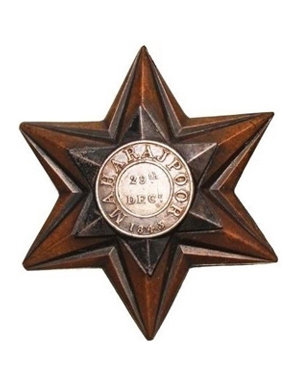
The Gwalior Star (Maharajpoor)

The Gwalior Star is a campaign medal presented to the soldiers of the British Army and the British led Bengal Army for the Gwalior Campaign.

The Gwalior Star is a Campaign medal presented to the soldiers of the British Army and the British led Bengal Army who took part in the 1843 Gwalior Campaign by the Honourable East India Company.

Tensions between the East India Company and the State of Gwalior had been growing and finally led to a British advance into Gwalior early in December 1843.

On December 29, 1843, the British Army defeated Maharaja Shrimant Jayaji Rao Scindia, and regained control of Gwalior. The first division of the army, commanded by General Sir Hugh Gough, was victorious at the Battle of Maharajpoor. Major-General Grey, with the second division, was victorious at the Battle of Punniar on the same day.

The Gwalior Star Medal Design

The Gwalior medal is a six pointed star and measures 50 millimeters (2.0 in) diameter. It’s made of bronze from guns captured during the Gwalior Campaign.

In the obverse, the center of the star is a silver disk, which bears the Date 29th Dec, 1843 and the name of one of the Gwalior Campaign battles, either Maharajpoor or Punniar. The reverse of the medal is plain and engraved with the name and regiment of the soldier to whom the medal was awarded.

Manufactured at the Calcutta Mint, this medal was presented by the British India Government originally as a star with a clip on the back to be worn on the breast. Eventually most of these were fitted with a ring or bar of varying design.

The ribbon used was the common ribbon used on many East India Company medals: a red-white-yellow-white-blue gradient ribbon such as that found on the Candahar, Ghuznee, Cabul Medal.

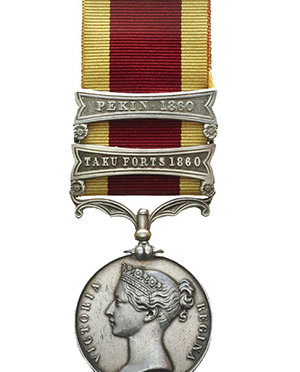
The Second China War Medal

The Second China War Medal is a British medal for British and Indian armies and Royal Navy who took part in the Second Opium War.

The Second China War Medal is a British medal issued by the British Government in 1861 to members of the British and Indian armies and Royal Navy who took part in the Second Opium War against China between 1857 to 1860.

The medal was issued with the following clasps: China 1842 (awarded to those who had already received the medal for the First China War), Fatshan 1857, Canton 1857, Taku Forts 1858, Taku Forts 1860 and Pekin 1860.

The medal could also be awarded without a clasp.

The Second China War Medal Design

The Second China War medal was designed by William Wyon. The medal’s obverse shows the diademed head of Queen Victoria with the legend ‘VICTORIA REGINA’. The reverse has the same shield bearing the Royal Arms, with a palm tree and trophy of arms behind, as found on the First China War Medal with the inscription ‘ARMIS EXPOSCERE PACIM’ above and the word ‘CHINA’ in the exergue below.

The 32 mm ribbon is crimson with yellow edges. The original design had five equal stripes of blue, yellow, red, white and green, edged with red, representing the colors of the Qing dynasty flag, but this ribbon was not finally adopted.