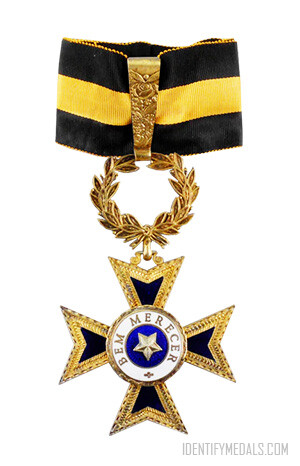
The Order of Merit (Portugal)

The Order of Merit is awarded those responsible for meritorious acts or services performed in the exercise of any functions.

The Order of Merit (or Ordem do Mérito in Portuguese) is a prestigious Portuguese honorific order that recognizes individuals for meritorious acts or services performed in any capacity, both public and private, demonstrating self-sacrifice for the benefit of the community.

The President of the Portuguese Republic, acting as the Grand Master of the Portuguese Honorific Orders, bestows these decorations. The Order of Merit can be awarded both during a recipient’s lifetime and posthumously, to Portuguese and foreign citizens alike, as well as to localities or institutions that are legal entities governed by public law or recognized for public utility. Recipients have included ambassadors, businesspeople, military personnel, athletes, and musicians.

The Order of Merit traces its origins to April 1927 with the creation of the Order of Instruction and Benefaction (Ordem da Instrução e da Benemerência). This initial order aimed to recognize services furthering education in Portugal. In 1929, it was divided into two distinct orders: the Order of Benefaction, focused on social causes and public assistance, and the Order of Public Instruction. The Order of Benefaction was renamed to the Order of Merit in 1976.

The Order of Merit Grades

The Order of Merit is organized into several classes, listed in descending order of seniority:

  • Grand Cross (Grã-Cruz – GCM)
  • Grand Officer (Grande-Oficial – GOM)
  • Commander (Comendador or Comendadeira – ComM)
  • Officer (Oficial – OM)
  • Medal (Medalha – MedM)
  • Honorary Member (Membro Honorário – MHM)
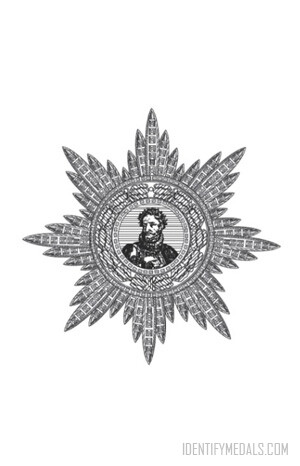
The Order of Merit Design

The badge features a star or cross with intricate designs symbolizing merit and excellence. Higher classes such as the Grand Cross and Grand Officer include more elaborate decorations, often incorporating gold and enamel work, as well as additional symbols representing the recipient’s contributions to society.

The ribbon of the Order is typically adorned with colors and patterns that signify the Order’s values and history. For instance, the ribbon may feature blue and white stripes, reflecting the traditional colors associated with Portuguese national honors.

The insignia worn by recipients can vary in complexity and design according to their specific class within the Order, with higher ranks displaying more ornate and detailed decorations.

The Order of Camões

The Order of Camões was created in 1985 and integrated in 2021. It is awarded for relevant services to the language and its promotion.

The Order of Camões (or Ordem de Camões in Portuguese) is a distinguished Portuguese order of knighthood, originally established in 1985 and fully integrated into the Portuguese honors system on 30 June 2021.

Named in honor of Luís de Camões, Portugal’s national poet, this order celebrates significant contributions to the Portuguese language and its international promotion, as well as the strengthening of cultural relations among Portuguese-speaking communities.

Membership in the Order is conferred by the President of Portugal, either on their initiative, upon the recommendation of Ministers, or following a nomination by the Council of the Order.

The Order of Camões Grades

The Order of Camões is composed of several classes, listed in descending order of seniority:

  • Grand Collar (Grande-Colar – GColCa)
  • Grand Cross (Grã-Cruz – GCCa)
  • Grand Officer (Grande-Oficial – GOCa)
  • Commander (Comendador – ComCa)
  • Officer (Oficial – OCa)
  • Knight/Dame (Cavaleiro – CvCa / Dama – DmCa)
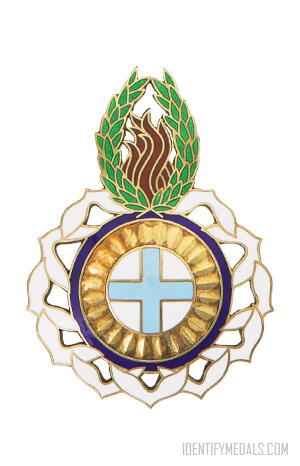
Additionally, the title of Honorary Member (Membro Honorário – MHCa) can be awarded to institutions and localities without specifying a grade. The Grand Collar is a special distinction reserved exclusively for heads of state.

The Order of Camões Design

The insignia of the Order of Camões reflects its dedication to the promotion of Portuguese culture and language.

The badge features elements that symbolize literary excellence and cultural heritage, often incorporating imagery related to Luís de Camões and his contributions to Portuguese literature. The design includes a distinctive cross or emblem, which varies in complexity and decoration according to the class of the order.

For the higher classes, such as the Grand Collar and Grand Cross, the insignia is more elaborate, often featuring intricate designs and additional symbols that highlight the esteemed nature of these awards.

The ribbon associated with the Order is typically adorned in colors and patterns that reflect the cultural and historical significance of Luís de Camões and the values the Order stands for.

The Order of Liberty (Portugal)

The Order of Liberty or Order of Freedom was established in 1976 and distinguishes relevant services to the cause of democracy and freedom.

The Order of Liberty (or Ordem da Liberdade in Portuguese) is a prestigious Portuguese civil order that honors significant contributions to democracy and freedom, particularly in defending the values of civilization and human dignity.

Established in 1976 following the Carnation Revolution of 1974, which overthrew the corporatist authoritarian Estado Novo regime of António de Oliveira Salazar and Marcello Caetano, this order reflects Portugal’s commitment to democratic principles.

The Grand Collar can be conferred by the President of Portugal to former heads of state and individuals whose extraordinary deeds are of particular relevance to Portugal. This includes political actions, acts of physical defense, or outstanding representation of Portugal internationally.

The Order of Liberty Grades

The Order of Liberty comprises six classes, listed in decreasing order of seniority:

  • Grand Collar (Grande-Colar – GColL)
  • Grand Cross (Grã-Cruz – GCL)
  • Grand Officer (Grande-Oficial – GOL)
  • Commander (Comendador – ComL)
  • Officer (Oficial – OL)
  • Knight/Dame (Cavaleiro – CvL / Dama – DmL)

Additionally, the title of Honorary Member (Membro Honorário – MHL) can be awarded to institutions and localities.

The Order of Liberty Design

The insignia of the Order of Liberty is characterized by a ribbon and badge design that reflects the values of freedom and democracy.

The badge typically features symbols and motifs that represent liberty and human dignity, often incorporating elements that signify the struggle and triumph over authoritarianism. The exact design details, including the colors and specific symbols, emphasize the Order’s dedication to the principles of freedom and the protection of human rights.

The Grand Collar, Grand Cross, and other higher classes often include more elaborate and intricate designs, befitting their seniority and the distinguished nature of their recipients.

The Order of Prince Henry

The Order of Prince Henry is a Portuguese order of knighthood established in 1960 to mark the 500th anniversary of Prince Henry’s death.

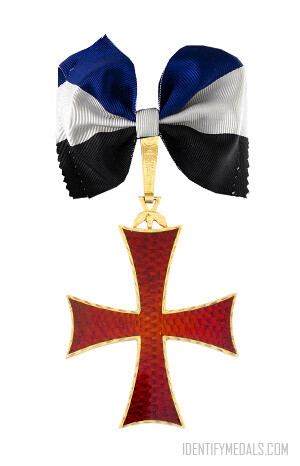
The Order of Prince Henry (or Ordem do Infante Dom Henrique in Portuguese) is a distinguished Portuguese order of knighthood established on 2 June 1960 to mark the 500th anniversary of Prince Henry the Navigator’s death. Prince Henry was a pivotal figure in the Age of Discovery. The Order underwent minor reforms in 1962 and 1980.

This five-tier order recognizes significant contributions to Portugal, particularly in the expansion of its culture, history, and values, with a focus on maritime history. Membership in each grade is limited by the Order’s constitution, and titles are awarded by the President of Portugal, who serves as the Grand Master.

The Order of Prince Henry Grades

The Order of Prince Henry consists of several classes, listed in decreasing order of seniority:

  • Grand Collar (Grande-Colar – GColIH)
  • Grand Cross (Grã-Cruz – GCIH)
  • Grand Officer (Grande-Oficial – GOIH)
  • Commander (Comendador – ComIH)
  • Officer (Oficial – OIH)
  • Knight/Dame (Cavaleiro – CvIH / Dama – DmIH)
Additionally, there are a Silver Medal (Medalha de Prata – MedPIH) and a Gold Medal (Medalha de Ouro – MedOIH). The Grand Collar is a special distinction that can only be awarded to heads of state.

The Order of Prince Henry Design

The insignia of the Order features ribbons and medals characterized by equal stripes of blue, white, and black, either horizontal or vertical, along with a ruby-enameled golden cross pattée.

The stars of the Grand Officer and Grand Cross include the inscription “Talant de bien faire”.

Military Order of Saint James of the Sword

The Military Order of Saint James of the Sword was founded in 1172 and s endorsed by papal legate Cardinal Hyacinthus of Acardo.

The Military Order of Saint James of the Sword (or Ordem Militar de Sant’Iago da Espada in Portuguese) is a distinguished Portuguese order of chivalry. Its full title is the Ancient, Most Noble, and Enlightened Military Order of Saint James of the Sword, of the Scientific, Literary, and Artistic Merit.

History

Founded in 1172, the Order originated from the Order of Santiago, established in the Kingdom of León in 1170 to protect pilgrims traveling to Santiago de Compostela. The Order expanded into Portugal in 1172 under King Afonso I, who granted them lands, but they were expelled in 1179 due to conflicts with León. They returned in 1186 under King Sancho I.

The Order played a significant role in the Reconquista and later Portuguese conquests, such as the capture of Ceuta in 1415. In 1288, King Denis of Portugal separated the Portuguese branch from the Castilian Order, which was confirmed by Pope John XXII in 1320.

Transition and Modern Era

During the 1383–1385 Portuguese succession crisis, the Order supported John I. In 1418, the mastership was secured for his son, and eventually, the Order’s leadership became intertwined with the Portuguese royal family.

In 1789, Pope Pius VI and Queen Maria I reformed the Order into a secular institution. The Order lost its properties and privileges after the 1834 liberal revolution. Though abolished in 1910 with the fall of the monarchy, the Order was later re-established as an order of merit.

The Order of Saint James of the Sword Grades

The Order of St. James of the Sword, as currently awarded by the Portuguese government, has six classes:

  • Grand Collar (GColSE): Wears the badge of the Order on a special collar (chain) and the gold star of the Order on the left chest.
  • Grand Cross (GCSE): Wears the badge of the Order on a gilt collar (chain) or on a sash over the right shoulder, and the gold star of the Order on the left chest.
  • Grand Officer (GOSE): Wears the badge of the Order on a gilt collar (chain) and the gold star of the Order on the left chest.
  • Commander (ComSE): Wears the badge of the Order on a gilt collar (chain) and the silver star of the Order on the left chest.
  • Officer (OSE): Wears the badge of the Order on a gilt collar (chain) and on a ribbon with a rosette on the left chest.
  • Knight (CavSE) or Dame (DamSE): Wears the badge of the Order on a silver collar (chain) and on a plain ribbon on the left chest.
The Order of Saint James of the Sword Design

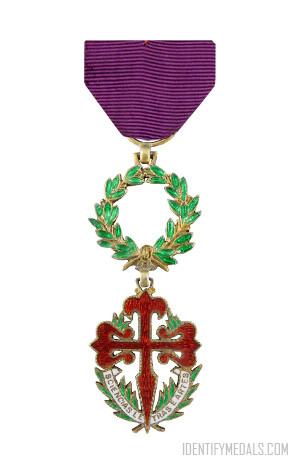
The insignia of the Order prominently features the Cross of St. James.

The badge is a gilt cross with red enamel, similar to the Order’s emblem but with a longer lower arm, encircled by a wreath of green-enameled palm leaves. At the bottom of the badge is a white-enameled scroll with the inscription “Ciência Letras e Artes” (Science, Literature, and Art). The Grand Collar badge differs by having no scroll and a laurel wreath instead of palm leaves.

During the monarchy, the badge was topped by the Sacred Heart of Christ.

The star of the Order has 22 asymmetrical rays, gilt for the Grand Collar, Grand Cross, and Grand Officer, and silver for the Commander. The central disc is white enamel with a miniature of the modern badge. Under the monarchy, the Sacred Heart of Christ was placed at the top of the star.

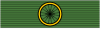
The ribbon of the Order is plain lilac.

The Military Order of Aviz

The Military Order of Aviz is a Portuguese order of chivalry founded in 1146. It gave its name and coat of arms to the Aviz Dynasty.

The Military Order of Saint Benedict of Aviz, established in 1146, is a Portuguese order of chivalry. Initially known as the Knights of Saint Benedict of Aviz, it gained prominence for its military role during the Reconquista and later became tied to the Aviz Dynasty (1385-1580). The order was originally a monastic military group inspired by the Knights Templar.

King Afonso I granted the knights the town of Évora in 1166, and they were first known as the Friars of Santa Maria of Évora. After capturing Aviz, the order adopted the Benedictine rule and became the Knights of Saint Benedict of Aviz. They gained wealth and influence, especially during the Age of Discoveries, and their mission evolved from military conquest to aiding Portuguese expeditions.

In 1789, Pope Pius VI and Queen Maria I secularized the order. It was briefly abolished in 1910 with the end of the monarchy but was revived in 1917 as an order of merit. Today, the Military Order of Aviz is one of the “Ancient Military Orders” and is awarded for outstanding military service. It is administered by a chancellor and a council of eight members, appointed by the President of the Republic, who serves as grand master.

The Military Order of Aviz Grades

The Order of Aviz, as currently awarded by the Portuguese government, is divided into six classes:

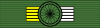
  • Grand Collar (GColA): Introduced in 2021, it outranks all other classes.
  • Grand Cross (GCA): Wears the badge of the Order on a sash over the right shoulder, and the gold star of the Order on the left chest.
  • Grand Officer (GOA): Wears the badge of the Order on a necklet, and the gold star of the Order on the left chest.
  • Commander (ComA): Wears the badge of the Order on a necklet, and the silver star of the Order on the left chest.
  • Officer (OA): Wears the badge of the Order on a ribbon with a rosette on the left chest.
  • Knight (CvA) or Dame (DmA): Wears the badge of the Order on a plain ribbon on the left chest.
The Military Order of Aviz Design

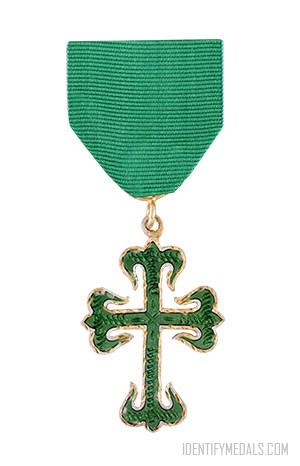
The badge of the Order features a gilt cross with green enamel, similar to the Order’s emblem but with an elongated lower arm. Under the monarchy, this badge was topped with the Sacred Heart of Christ.

The star of the Order is an eight-pointed, faceted star, gilt for the Grand Cross and Grand Officer, and silver for the Commander. The central disc is white enamel, displaying a miniature of the modern badge. During the monarchy, the star also included the Sacred Heart of Christ at the top.

The ribbon of the Order is plain green.

The Military Order of Christ

The Military Order of Christ was founded in 1319 after the Templars were abolished. It is one of the Ancient Military Orders.

The Military Order of Christ is the reconstituted form of the former Knights Templar in Portugal. Originally established in 1319 with the support of King Denis of Portugal, the order emerged after the Knights Templar were disbanded by Pope Clement V in 1312. Unlike other European monarchs, King Denis refused to persecute the Templars and instead transformed them into the Order of Christ.

This transformation was recognized by Pope John XXII in 1319, allowing the new order to inherit the Templars’ assets. The Order of Christ played a significant role in Portugal’s history, especially during the Age of Discoveries, amassing considerable wealth and influence. In 1789, Queen Maria I secularized the order. Although it was extinguished with the fall of the Portuguese monarchy in 1910, it was revived in 1917, with the President of Portugal serving as its Grand Master.

Today, the Military Order of Christ, alongside the Orders of Aviz and St. James of the Sword, forms the “Ancient Military Orders,” managed by a chancellor and council appointed by the President. It now honors outstanding service to the Republic and can be awarded to both military officers and civilians, including foreigners, members of parliament, the diplomatic corps, the judiciary, the civil service, and other public authorities.

The Military Order of Christ Grades

The Order of Christ, as currently awarded by the Portuguese government, is divided into six classes:

  • Grand Collar (GCol): Wears a grand collar, the badge of the Order on a sash over the right shoulder, and the star of the Order in gold on the left chest. This rank was introduced in 2021.
  • Grand Cross (GCC): Wears the badge of the Order on a sash over the right shoulder, and the star of the Order in gold on the left chest.
  • Grand Officer (GOC): Wears the badge of the Order on a necklet, and the star of the Order in gold on the left chest.
  • Commander (ComC): Wears the badge of the Order on a necklet, and the star of the Order in silver on the left chest.
  • Officer (OC): Wears the badge of the Order on a ribbon with a rosette on the left chest.
  • Knight (CvC) or Dame (DmC): Wears the badge of the Order on a plain ribbon on the left chest.
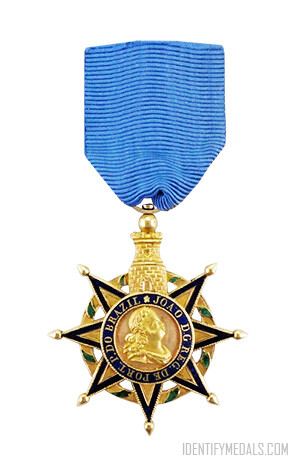
The Military Order of Christ Design

The grand collar of the Order features alternating simple crosses of the Order and armillary spheres, all gilded and connected by a double chain of simple links. At the center are two interlocked branches of quercus coccifera, also gilded. The cross of the Order hangs from the necklace, surrounded by an open-cut laurel wreath with its fruits, tied with crossed ribbons, all in gold.

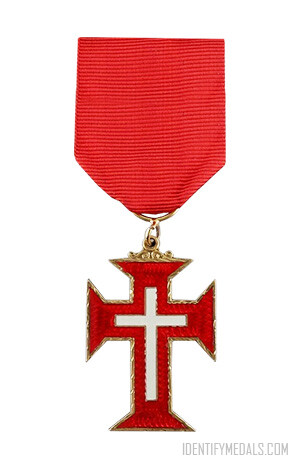
The badge of the Order is a gilt cross with enamel, resembling the Order’s emblem but with a longer lower arm. Historically, civil knights wore a badge with the Sacred Heart of Christ above it, while military knights had a gilt, blue, and white enamel Maltese Cross with shields resembling the Portuguese coat of arms, surrounded by a palm wreath and topped by a gilt crown.

The star of the Order has 22 asymmetrical rays, gilt for Grand Cross and Grand Officer, and silver for Commander. The central disc is white enamel with a miniature of the modern badge. During the monarchy, the Sacred Heart of Christ was at the top of the star.

The ribbon of the Order is plain red.

The Military Order of the Tower and Sword

The Military Order of the Tower and Sword is a Portuguese order of knighthood created by King Afonso V in 1459 as the Order of the Sword.

The Ancient and Most Noble Military Order of the Tower and Sword, of Valor, Loyalty, and Merit, originally established by King Afonso V in 1459 as the Order of the Sword, is the highest honor in the Portuguese honors system.

Initially created to reward those who participated in military conquests in Africa, the order fell into disuse after the conquest of Tangiers and Asilah. It was revived in 1808 by Prince Regent John, later John VI, to commemorate the royal family’s safe arrival in Brazil after Napoleon’s invasion of Portugal, and was renamed the Royal Order of the Tower and Sword. It was available to both Portuguese and foreigners for military, political, or civilian achievements.

The Order of the Tower and Sword's History

In 1832, Peter, Duke of Braganza, reformed the order, giving it its current name. The order saw further modifications, including the addition of the Grand Officer class in 1896 and the retention of the order after the 1910 abolition of other military orders following the establishment of the republic. The President of Portugal became the order’s Grand Master and a member of the Grand Cross. The Grand Collar, added in 1939, was initially for heads of state with notable military deeds but later restricted to former Portuguese presidents, with few exceptions.

The 1986 Organic Law of the Honorary Orders and the 2011 Law of Honorary Orders maintained the exclusivity of the Grand Collar for former Portuguese presidents while also allowing it to be awarded to foreign heads of state and individuals of exceptional achievements.

The Order of the Tower and Sword's Grades

The Order of the Tower and Sword, as currently awarded by the Portuguese government, is divided into six classes:

  • Grand Collar (GColTE): Wears the badge of the Order on a special collar (chain) and the gold star of the Order on the left chest.
  • Grand Cross (GCTE): Wears the badge of the Order on a collar (chain) or on a sash over the right shoulder, and the gold star of the Order on the left chest.
  • Grand Officer (GOTE): Wears the badge of the Order on a necklet and the gold star of the Order on the left chest.
  • Commander (ComTE): Wears the silver star of the Order on the left chest.
  • Officer (OTE): Wears the badge of the Order on a ribbon with a rosette on the left chest.
  • Knight or Dame (CavTE) / Dame (DamTE): Wears the badge of the Order on a plain ribbon on the left chest.
The Order of the Tower and Sword Design

The badge of the Order features a five-pointed gilt star with white enamel and one point directed downward. It includes a wreath of green enamel oak leaves between the star’s points and is topped by a gilt tower.

The obverse central disc displays a sword encircled by oak leaves on a white enamel background, surrounded by a blue enamel ring inscribed with the motto “Valor Lealdade e Mérito” (Valour, Loyalty, and Merit).

The reverse central disc shows the Portuguese coat of arms, encircled by a blue enamel ring with the inscription “República Portuguesa” (Portuguese Republic).

The star of the Order is a five-pointed faceted star, gilt for the Grand Collar, Grand Cross, and Grand Officer, and silver for Commander. It features the front design of the badge (without the oak leaf wreath) superimposed on it. The ribbon of the Order is blue, and the fourragère is solid blue.

The Symbolism and Design of the Purple Heart Medal

We look at the symbolism of the Purple Heart medal, including the meaning of its color and shape, and how they honor courage and sacrifice.

The Purple Heart Medal is widely considered one of the most recognizable and revered military decorations in the United States and the world. Awarded to service members who have been wounded or killed in combat, this medal symbolizes the bravery, sacrifice, and enduring spirit of those who have faced the hardships of war.

But what lies beyond the immediate significance of the prestigious Purple Heart’s design? In this article, I will explain some of its symbolism and how its color and shape are rich with historical and emotional depth. Every element of the Purple Heart tells a story of honor and remembrance. Let’s find out more about them.

Why Does the Purple Heart Look the Way It Does?

The Purple Heart is a distinguished and instantly recognizable military decoration awarded in the name of the President of the United States to those who have been wounded or killed while serving in the U.S. military.

Established originally by General George Washington during the American Revolutionary War, the Purple Heart has a rich history that underscores its importance. The medal acknowledges the physical and emotional toll borne by soldiers, sailors, airmen, and marines in the line of duty.

Each Purple Heart tells a story of courage and resilience, recognizing not only the injuries sustained in battle but also the ultimate sacrifice made by those who have given their lives in service to the United States. It’s no surprise, then, that the medal’s design is both elegant and deeply symbolic. So, let’s take a look at the different elements and their symbolism.

Shape and Material

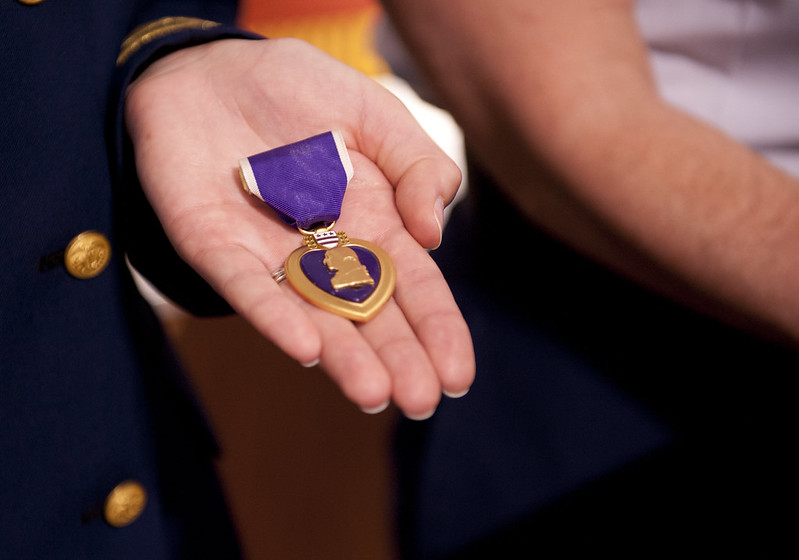
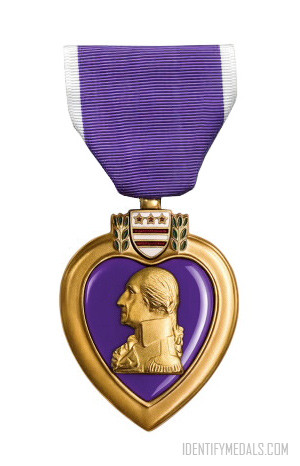
The Purple Heart is heart-shaped, measuring approximately 1.75 inches in height and 1.375 inches in width. The medal is made of gold and enameled in purple, which gives it its distinct and striking appearance.

Profile of George Washington

At the center of the heart is a gold profile of General George Washington, set against a purple background. This profile is surrounded by a gold border.

Shield and Laurel Wreath

Above the heart, there is a gold shield emblazoned with Washington’s coat of arms. The shield is flanked by green enamel laurel leaves, symbolizing victory and honor.

Ribbon

The Purple Heart is suspended from a purple silk ribbon with a narrow white edge on each side. The ribbon is usually worn on the left chest of the recipient’s uniform.

Symbolism of the Purple Heart Elements

The Heart Shape

The heart shape of the medal represents the courage and selflessness of those who have been wounded or sacrificed their lives in service to their country. It is a universal symbol of love and devotion, reflecting the recipient’s dedication and commitment to their nation.

Purple Color

The color purple has long been associated with royalty, nobility, and honor. In the context of the Purple Heart, it symbolizes the valor and sacrifice of military personnel. The use of purple also ties back to the original Badge of Military Merit, established by George Washington during the American Revolutionary War, which was made of purple cloth.

Obverse

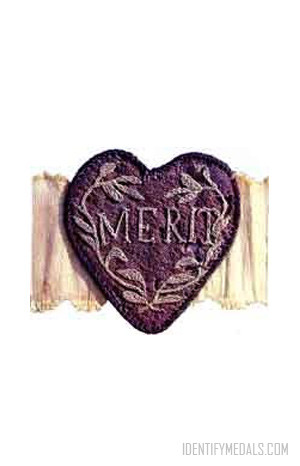
The profile of General George Washington honors the father of the United States and the founder of the original military merit badge (pictured here). It serves as a reminder of the historical significance of the award and the enduring legacy of American military service.

Shield and Laurel Wreath

The gold shield represents protection and defense, embodying the service members’ role in safeguarding the nation. The laurel wreath, a classical symbol of victory and honor, signifies the bravery and achievements of the medal’s recipients.

Ribbon

The purple and white ribbon represents purity and valor. The narrow white edges symbolize the integrity and honor of the recipients, while the purple signifies their courage and sacrifice.

Conclusion

The design of the Purple Heart is rich in symbolism, each element thoughtfully chosen to represent the honor, courage, and sacrifice of the military personnel who receive this distinguished award. From the heart shape to the profile of George Washington, and from the laurel wreath to the purple ribbon, every aspect of the Purple Heart reflects the profound respect and gratitude owed to those who have given so much in service to their country.

This timeless decoration serves not only as a tribute to individual acts of bravery but also as a lasting symbol of the values and principles upheld by the United States military.

The National Service Medals (Norway)

The National Service Medals were established on 1 May 1982 and are awarded in recognition of completed initial service in the armed forces.

The Norwegian National Service Medal (or Forsvarets vernedyktighetsmedaljer in Norwegian) is awarded to individuals upon the completion of their mandatory military service, which typically lasts one year, or six months for those in the Home Guard.

The Norwegian National Service Medal not only recognizes the completion of mandatory military service but also symbolizes the commitment and dedication of individuals to the defense and security of Norway.

The medal is available in four distinct versions, each representing a different branch of the Norwegian Armed Forces: the Army, the Air Force, the Navy, and the Home Guard.

The National Service Medal Design

The obverse design of the Norwegian National Service Medal varies slightly depending on the branch of service it represents. The reverse features the branch’s name along with the armed forces motto, “for fred og frihet” (in Bokmål) or “for fred og fridom” (in Nynorsk), which translates to “for peace and freedom.”

The Norwegian National Service Medal is uniquely designed to represent the distinct branches of the Norwegian Armed Forces. Each version of the medal comes with a distinct ribbon that corresponds to the specific branch of service, too. These ribbons are worn as part of the medal’s insignia and serve to identify the branch in which the recipient served.

The National Service Medals - Awards from Norway

Army Version

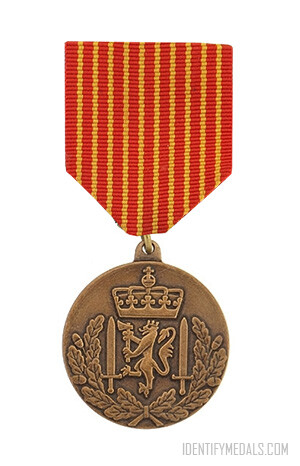
The Army version of the National Service Medal features the crest of the Norwegian Army on the obverse. This emblem is a symbol of the strength, discipline, and commitment required of those who serve in the Army.

The reverse side of the medal includes the name of the Army along with the armed forces motto “for fred og frihet” (for peace and freedom), emphasizing the Army’s role in national defense and peacekeeping.

The ribbon for the Army version is designed in red and yellow.

Air Force Version

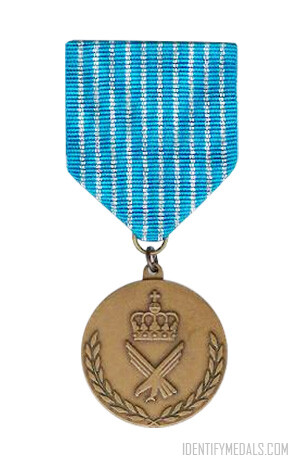
The Air Force version of the National Service Medal displays the crest of the Norwegian Air Force on the obverse. This crest signifies the advanced technology, skill, and strategic importance of the Air Force. The reverse side carries the Air Force’s name and the motto, reinforcing the branch’s dedication to protecting Norway’s airspace and contributing to international peace efforts.

The ribbon accompanying the Air Force medal is blue and silver, reflecting the sky and the innovative spirit of the Air Force.

The National Service Medals - Air Force version, obverse.
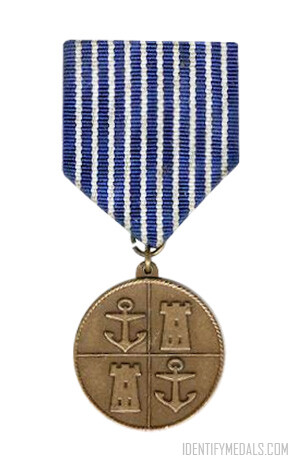
The National Service Medals - Navy version, obverse.

Navy Version

The Navy version of the National Service Medal is adorned with the crest of the Norwegian Navy on the obverse. This emblem represents the maritime heritage, bravery, and tactical expertise of naval personnel. The reverse side includes the name of the Navy and the armed forces motto, highlighting the Navy’s crucial role in securing Norway’s waters and participating in global maritime operations.

The Navy ribbon is designed with nautical colors: navy blue and white, symbolizing the sea and the naval tradition.

Home Guard Version

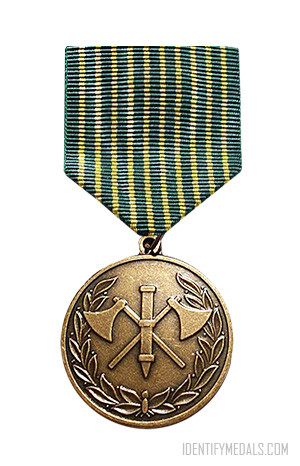
The Home Guard version of the National Service Medal features the crest of the Norwegian Home Guard on the obverse. This crest embodies the readiness, resilience, and community spirit of the Home Guard. The reverse side lists the Home Guard’s name and the motto, reflecting its mission to support and protect local communities in times of need.

The ribbon for the Home Guard medal incorporates colors that are distinct to this branch: Green and yellow.

The National Service Medals - Home Guard version, obverse.