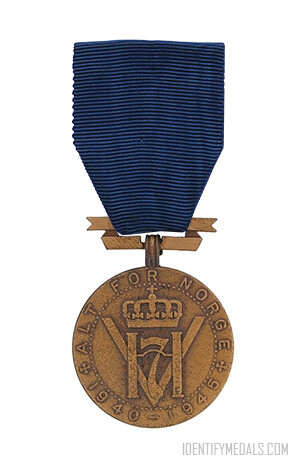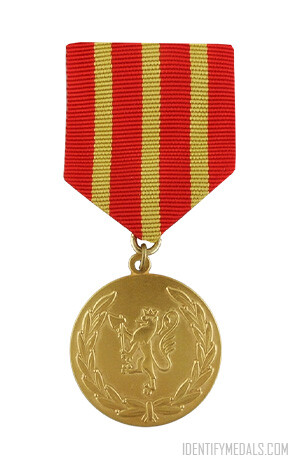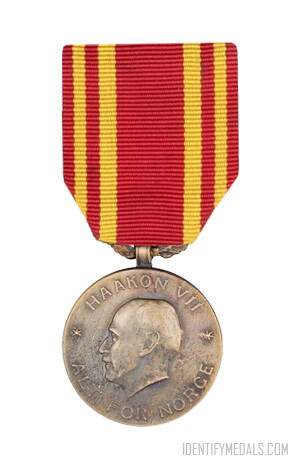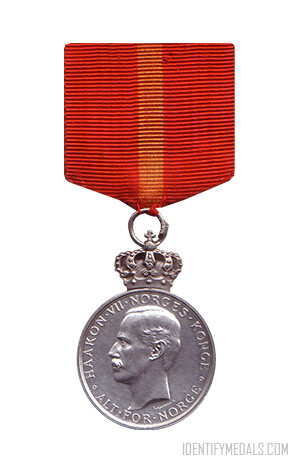
The Medal for Outstanding Civic Service

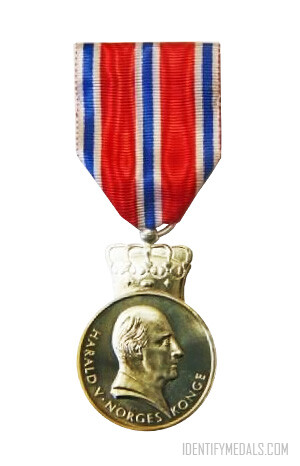
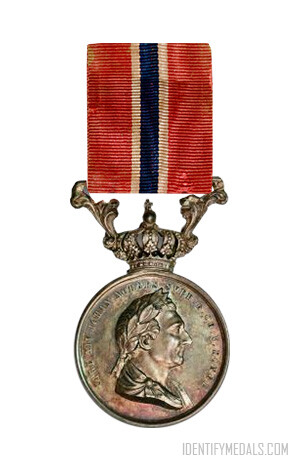
The Medal for Outstanding Civic Service was established in 1819 and is the second highest ranked Norwegian medal.

The Medal for Outstanding Civic Service (or Medaljen for Borgerdåd in Norwegian), is the second highest-ranked medal in Norway. This prestigious award was first established by a Royal Resolution on April 10, 1819, and was subsequently modified by another Royal Resolution on April 13, 1844. The medal was conferred by the cabinet in a meeting presided over by the King, based on recommendations from the Norwegian Ministry of Justice.

The medal was divided into two grades: the first class in gold and the second class in silver. It recognized individuals who rendered exceptional service to society. However, in the spring of 2004, the medal ceased to be awarded.

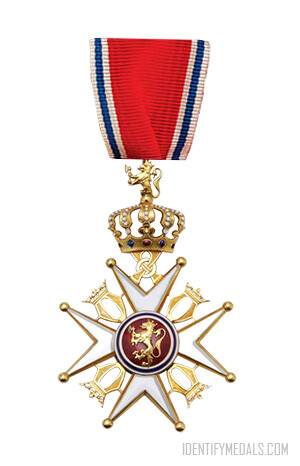
In terms of the Norwegian order of precedence, recipients of the Medal for Outstanding Civic Service are ranked second, positioned after recipients of the War Cross with Sword and before holders of the Royal Norwegian Order of St. Olav.

The Medal for Outstanding Civic Service Design

The medal is circular and comes in two classes: gold for the first class and silver for the second class, symbolizing the level of achievement and distinction of the recipient.

The obverse of the medal features an intricate design, including the image of the reigning monarch at the time of its institution, surrounded by a detailed border.

The medal is suspended from a red ribbon with a central blue and white stripe.

The Royal Family Order of Harald V

The Royal Family Order of Harald V is a prestigious honor conferred by the King of Norway upon female members of the royal family.

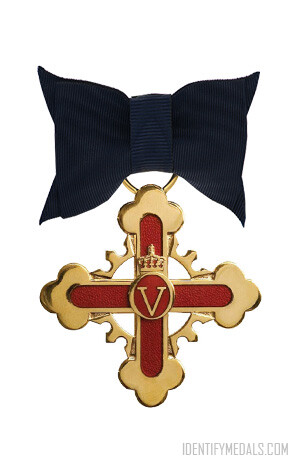
The Royal Family Order of Harald V (or Kong Harald Vs Husorden in Norwegian) is a prestigious honor conferred by the King of Norway specifically upon female members of the Norwegian royal family. Unlike the other two Royal Family Orders, this one is still actively awarded, highlighting its contemporary relevance within the royal household.

King Harald V, who ascended to the throne in 1991, has continued the tradition of awarding family orders as a means of honoring and recognizing the efforts of royal family members. His reign has been characterized by a modern approach to monarchy, balancing tradition with contemporary values, and this order is a testament to that balance.

This order serves as a mark of distinction and recognition for the female members of the royal family, acknowledging their service, dedication, and contributions to the monarchy and the nation. The active bestowal of this order reflects King Harald V’s appreciation and support for the roles played by women in the royal family.

The Royal Family Order of Harald V Design

The insignia of the Royal Family Order of Harald V is both elegant and symbolic. It features a portrait of King Harald V in his middle years, encased within a jeweled frame.

This portrait is suspended from a distinctive red ribbon, which is accented by a blue stripe along the edges, further bordered by a thin white stripe. The combination of these colors and the intricate design of the insignia underscores the honor’s regal significance and the esteem in which it is held.

The Royal Family Order of Haakon VII

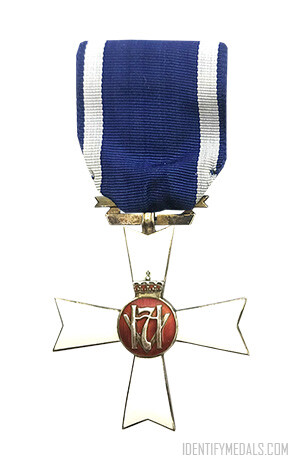
The Royal Family Order of Haakon VII was established in 1906 and bestowed by the Sovereign on members of the Norwegian royal family.

The Royal Family Order of Haakon VII (or Kong Haakon VIIs Husorden in Norwegian) is a distinguished honor that was personally conferred by King Haakon VII on members of the Norwegian royal family.

The Royal Family Order of Haakon VII is not just a ceremonial symbol but also a mark of distinction, reflecting the recipient’s service, dedication, and loyalty to the crown and the country. It serves as a unique honor, highlighting the personal appreciation and acknowledgment from the monarch to the family members who have supported and upheld the values and responsibilities of the monarchy.

King Haakon VII, who reigned from 1905 to 1957, established this order to honor and recognize the support of his family members. During his reign, he guided Norway through significant events, including its transition to independence and the challenging times of World War II.

Among the recipients of this prestigious order are key figures in the Norwegian royal family. For instance:

As of now, Princess Astrid, Mrs. Ferner, is the only living recipient of the Royal Family Order of Haakon VII. Her receipt of the honor underscores her enduring service and contributions to the royal family and Norway.

The Royal Family Order of Haakon VII Design

The insignia of the Royal Family Order includes a portrait of King Haakon VII, set in an ornate frame and suspended from a ribbon.

The ribbon is red with blue borders with a white fimbriation.

The Norwegian War Cross

The Norwegian War Cross was established in 1941 by King Haakon VII and is the highest ranking gallantry decoration of Norway.

The War Cross (or Bokmål: Krigskorset in Norwegian) stands as Norway’s highest gallantry award, recognizing acts of extraordinary bravery or exceptional leadership during combat. Recipients of this prestigious medal may receive additional swords on the ribbon for further acts of valor, though this is exceedingly rare. 

Established on May 23, 1941, by King Haakon VII via royal resolution while he was in exile in London during the German occupation of Norway, the War Cross was initially awarded for both combat and non-combat achievements. Notably, some early recipients included members of the British Royal family and individuals who made significant contributions to Norway’s war effort, with non-combat awards presented without the sword.

On May 18, 1945, the statutes were revised to limit the award to military personnel for combat-related actions exclusively, ensuring all subsequent decorations included the sword. Concurrently, Haakon VII’s Freedom Cross was introduced to honor civilian contributions.

The awarding of the War Cross ceased in 1949 but was revived on June 26, 2009, when the statutes were amended once more to recognize post-1945 actions.

In 2022, the Norwegian Armed Forces commissioned composer Marcus Paus to create a major work celebrating the stories of War Cross recipients. This initiative aims to serve as a significant “identity-building and unifying” project for the Norwegian armed forces, preserving and honoring the legacy of the medal’s recipients.

The War Cross Design

Initially, prior to 1945, the War Cross could be awarded either with or without a sword-shaped clasp on its ribbon. If an individual received the War Cross more than once, a star-shaped clasp was added to the ribbon for each subsequent award.

After 1945, the War Cross was always conferred with a sword-shaped clasp on its ribbon. For additional awards, additional sword-shaped clasps are added to the ribbon.

The Most Glorious Order of the Ojaswi Rajanya

The Most Glorious Order of the Ojaswi Rajanya was established by King Tribhuvan on May 14, 1934 and comprises several ranks.

The Most Glorious Order of the Ojaswi Rajanya (or Ojaswi Rajanyako Manapadvi in Nepali) was established by King Tribhuvan on May 14, 1934. 

The order is conferred upon distinguished individuals, specifically members of the Nepalese royal family, foreign royal families, and foreign Heads of State. It serves as a symbol of honor and recognition for their significant contributions and exceptional service, fostering diplomatic and friendly relations between Nepal and other nations.

The Order of the Ojaswi Rajanya is structured into three distinct classes:

  • Sovereign (Parama-Ojaswi-Rajanya): The highest rank, usually held by the reigning monarch.
  • Grand Master (Ati-Ojaswi-Rajanya): A rank awarded to high-ranking members of the royal family or esteemed foreign royals.
  • Ordinary Members (Ojaswi-Rajanya): Individuals who have rendered notable service or demonstrated significant achievements.

Since its inception, the order has played a crucial role in enhancing Nepal’s diplomatic engagements and recognizing the contributions of key figures in both national and international contexts.

The Order of the Ojaswi Rajanya Design

The ribbon of the order is light yellow with narrow white edge stripes. It features a badge that is worn on the chest as well as another badge attached to a sash ribbon.

The Tribhuvan Order of the Footprint of Democracy

The Tribhuvan Order of the Footprint of Democracy was established by King Mahendra on May 2, 1956, in honor of his father, King Tribhuvan.

  • Time Period: Post-WW2
  • Institution: 16 December 1962
  • Country: Nepal

The Tribhuvan Order of the Footprint of Democracy (or Tribhuvan Prajatantra Shripada in Nepali) was established by King Mahendra on May 2, 1956, in honor of his father, King Tribhuvan.

This prestigious order is conferred exclusively on Nepalese citizens who have provided valuable services to the country, particularly those associated with the revolution that led to the removal of the Rana regime.

The order comprises several ranks:

  • Sovereign: Parama-Gaurabmaya-Tejaswi-Tribhuvan-Prajatantra-Shripada
  • Grand Master: Ati-Gaurabmaya-Tejaswi-Tribhuvan-Prajatantra-Shripada

Additionally, there are five classes for ordinary members:

  1. Maha-Gaurabmaya-Tejaswi-Tribhuvan-Prajatantra-Shripada
  2. Sugaurabmaya-Tejasvi-Tribhuvan-Prajatantra-Shripada
  3. Gaurabmaya-Tejaswi-Tribhuvan-Prajatantra-Shripada
  4. Tejaswi-Tribhuvan-Prajatantra-Shripada
  5. Tribhuvan-Prajatantra-Shripada

The Tribhuvan Order of the Footprint of Democracy Design

The insignia features a circular medallion at its center. The central medallion is surrounded by intricate goldwork and is encircled by a decorative, multi-layered border that radiates outward.

The central part of the insignia contains a detailed and finely crafted footprint, symbolizing the “Footprint of Democracy.” The footprint is set against a richly colored background. Encircling the central medallion, the insignia includes a series of elegant, ornamental designs. 

The Order of the Three Divine Powers

The Order of the Three Divine Powers was established by King Tribhuvan in 1937 and is an order of knighthood of the former Kingdom of Nepal.

The Most Illustrious Order of Tri Shakti Patta (or त्रिशक्ति पट्ट, Tri Shakti Patta in Nepali) is a distinguished order of knighthood from the former Kingdom of Nepal.

This honor is bestowed upon members of the royal family, Nepalese citizens who have made exceptional contributions to the nation, and foreigners who have provided significant benefits to Nepal.

The medal was initially established by King Tribhuvan Bir Bikram Shah Dev in 1936 and was formally instituted as an order on November 27, 1937, by the same monarch.

Following the abolition of the monarchy in 2008, the new government introduced a revised series of awards. The Nepal Ratna Man Padavi became the highest class of these new honors, with the Rastra Gaurav Man Padavi as the second highest. These awards are now conferred by the President of Nepal on Republic Day, May 29.

The Order of Tri Shakti Patta has five classes and a medal:

  • Member First Class (Jyotirmaya-Subikhyat-Tri-Shakti-Patta)
  • Member Second Class (Subikhyat-Tri-Shakti-Patta)
  • Member Third Class (Bikhyat-Tri-Shakti-Patta)
  • Member Fourth Class (Prakhyat-Tri-Shakti-Patta)
  • Member Fifth Class (Tri-Shakti-Patta)
  • Medal (Tri-Shakti-Patta-Padak)

The Order of the Three Divine Powers Design

The ribbon of the order is navy blue with green edges bordered by white.

The Order of the Footprint of Nepal

The Order of the Footprint of Nepal was founded by King Mahendra in 1962. It’s awarded for significant contributions to national prestige.

  • Time Period: Pre-WW1
  • Institution: 16 December 1962
  • Country: Nepal

The Order of the Footprint of Nepal (or Nepal Shripada) was established by King Mahendra on December 16, 1962.

This prestigious award is exclusively conferred upon Nepalese citizens who have made significant contributions to enhancing the national prestige of Nepal.

The order comprises various ranks, including:

  • The Sovereign (Parama-Ujjwala-Kirtimaya-Nepal-Shripada)
  • The Grand Master (Ati-Ujjwala-Kirtimaya-Nepal-Shripada).

Additionally, there are five classes of ordinary members:

  • Maha-Ujjwala-Kirtimaya-Nepal-Shripada
  • Ujjwala-Kirtimaya-Nepal-Shripada
  • Sukirtmaya-Nepal-Shripada
  • Kirtimaya-Nepal-Shripada
  • Nepal-Shripada.

Each class reflects a different level of recognition for the recipient’s service and dedication to the country, symbolizing their esteemed contributions to Nepal’s honor and reputation.

The Order of the Footprint of Nepal Design

The ribbon is red with a narrow blue central stripe and 2 white edge stripes on each side.

The Most Puissant Order of the Gurkha Right Hand

The Most Puissant Order of the Gurkha Right Hand was originally established by King Prithvi in 1896 and is composed of several ranks.

The Most Puissant Order of the Gurkha Right Hand (or गोरखा दक्षिण बाहु; Gorkha-Dakshina Bahu in Nepali) was originally an order of knighthood established by King Prithvi in 1896. It was later revived and reformed by King Tribhuvan on September 7, 1932.

The award was conferred upon both military personnel and civilians, including foreign nationals, for distinguished contributions to the nation in various fields such as arts, literature, sports, science, and social service. It held the status of the second highest honor in the Kingdom of Nepal, following the Order of Tri Shakti Patta.

This order is composed of several ranks, including:

  • The Sovereign (Parama-Suprasidha-Prabala-Gorkha-Dakshina-Bahu)
  • The Grand Master (Ati-Suprasidha-Prabala-Gorkha-Dakshina-Bahu)
  • Ordinary members, who are classified into five levels:
    • 1. Suprasidha-Prabala-Gorkha-Dakshina-Bahu
    • 2. Prasidha-Prabala-Gorkha-Dakshina-Bahu
    • 3. Suprabala-Gorkha-Dakshina-Bahu
    • 4. Prabala-Gorkha-Dakshina-Bahu
    • 5. Gorkha-Dakshina-Bahu.

Additionally, the order includes a medal (Gorkha-Dakshina-Bahu-Padak) which was introduced by King Tribhuvan in 1936.

The Most Puissant Order of the Gurkha Right Hand Design

The ribbon associated with the order is officially designated as saffron in color. This distinctive hue not only adds to the ceremonial prestige of the award but also carries cultural and symbolic significance.

Saffron is a color deeply rooted in various traditions, often representing sacrifice, valor, and dedication, thus aligning perfectly with the honor’s purpose of recognizing distinguished contributions to the nation.

The Order of Om Ram Patta

The Order of Om Ram Patta was established by King Tribhuvan in 1946 and bestowed upon both Nepalese and foreign nationals of Hindu faith.

The Order of Om Ram Patta was established by King Tribhuvan on October 31, 1946.

This honor is bestowed upon both Nepalese and foreign nationals who follow the Hindu faith and who set bright examples of national service.

The order includes three ranks:

  • The Sovereign (Parama-Pravitra-Om-Ram-Patta)
  • The Grand Master (Pravitra-Om-Ram-Patta)
  • Ordinary members (Om-Ram-Patta)

The Order of Om Ram Patta Design

The front side bears an inscription in Nepalese, which translates to: “NATIONAL SERVICE IS THE HIGHEST VIRTUE.