The Permanent Force Good Service Medal

The Permanent Force Good Service Medal was established by the Republic of South Africa in 1961 as a replacement for the Union Medal.

The Permanent Force Good Service Medal was established by the Republic of South Africa in 1961, coinciding with South Africa’s transition to a republic, as a replacement for the Union Medal. It was bestowed upon Permanent Force members of the South African Defence Force in recognition of eighteen years of commendable service and conduct.

This medal honored Permanent Force members of the South African Defence Force for their eighteen years of dedicated service. Additionally, a clasp could be conferred for thirty years of service.

The Permanent Force Good Service Medal Design

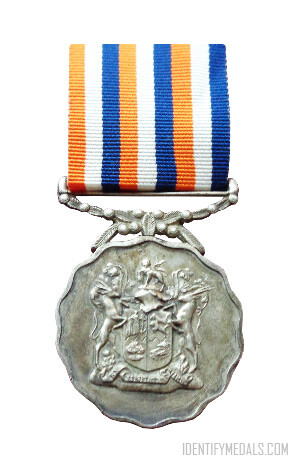
The Permanent Force Good Service Medal is a circular medallion featuring a scalloped edge and raised rim, measuring 38 millimeters in diameter and 3 millimeters thick at the rim. Crafted in silver, it showcases the pre-1994 South African Coat of Arms. Adorning the ribbon suspender are decorations of proteas and leaves.

On the reverse side, inscriptions read “VIR LANGDURIGE DIENS EN GOEIE GEDRAG” and “FOR LONG SERVICE AND GOOD CONDUCT”, with a raised rim and decorated ribbon suspender mirroring those on the obverse. The medals and ribbon suspenders were separately minted and later joined by soldering. The medal number was either stamped or engraved at the bottom of the rim.

The ribbon measures 32 millimeters in width, featuring three bands of orange, white, and blue, repeated three times. The outer orange and blue bands are each 4 millimeters wide, while the seven inner bands are approximately 3½ millimeters wide. These colors—orange, white, and blue—are taken from the pre-1994 national flag. It bears an identical resemblance to the ribbon of the Union Medal.
The South African Union Medal

The South African Union Medal honored Permanent Force members who exhibited eighteen years of exemplary service and conduct.

The Union Medal was established by the Union of South Africa in 1952. It honored Permanent Force members of the South African Defence Force who exhibited eighteen years of exemplary service and conduct.

This medal recognized Permanent Force members of the South African Defence Force for their dedicated eighteen years of service. Additionally, a clasp could be awarded for thirty years of service.

The South African Union Medal Design

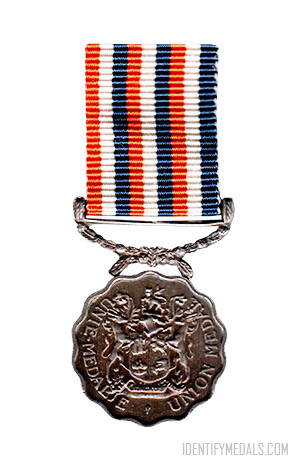
The Union Medal is a circular medallion with a scalloped edge and raised rim, measuring 38 millimeters in diameter and 3 millimeters thick at the rim. Crafted in silver, it features the pre-1994 South African coat of arms surrounded by the inscription “UNIE-MEDALJE • UNION MEDAL”. The ribbon suspender is adorned with proteas and leaves.

On the reverse side, Queen Elizabeth II’s royal cipher, represented by a crown over “E II R”, is depicted, also with a raised rim and decorated ribbon suspender similar to those on the obverse. The medals and ribbon suspenders were produced separately and later joined by soldering. The medal number was impressed at the bottom of the rim.

The ribbon is 32 millimeters wide, featuring repeated bands of orange, white, and blue, each appearing three times. The outer orange and blue bands are each 4 millimeters wide, while the seven inner bands are approximately 3½ millimeters wide. These colors—orange, white, and blue—are drawn from the pre-1994 national flag.

The Jack Hindon Medal

The Jack Hindon Medal is a military honor bestowed upon other ranks in recognition of diligent service within the Commandos.

The Jack Hindon Medal, denoted by the post-nominal letters JHM, is a military honor established in the Republic of South Africa in 1970 but was only utilized until 1975. It was bestowed upon other ranks in recognition of diligent service within the Commandos, the rural defense sector of the South African Defence Force.

This medal was conferred upon other ranks of the Commandos for exceptionally diligent and outstanding service. Named after Jack Hindon, a Scottish-born Afrikaner hailed as a hero of the Second Boer War, the medal honored individuals who demonstrated exceptional dedication.

The use of post-nominal letters was permitted from 1993, eighteen years following the medal’s discontinuation.

The Jack Hindon Medal Design

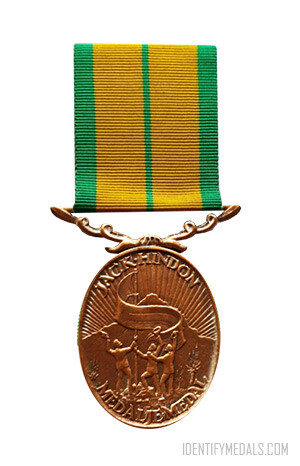
The Jack Hindon Medal is a bronze oval-shaped medal, designed to fit within a 38-millimeter diameter circle. It portrays three Burghers hoisting the Vierkleur flag atop Spioenkop following the Boer triumph over British forces in 1900, during the Second Boer War. Inscriptions include “JACK • HINDON” at the top and “MEDALJE • MEDAL” at the bottom.

The reverse side features the pre-1994 South African Coat of Arms.

The ribbon measures 32 millimeters in width and is primarily yellow, featuring 4½ millimeters wide green bands along the edges and a 1 millimeter wide green band positioned in the center. These green and yellow hues are derived from the ribbon colors of three awards that were instituted in 1920.

The Danie Theron Medal

The Danie Theron Medal s a military honor established by the Republic of South Africa in 1970 and initially reserved for officers.

The Danie Theron Medal, designated by the post-nominal letters DTM, is a military honor established by the Republic of South Africa in 1970 and remained in use until 1993. Initially reserved for officers, it was made available to all ranks from 1975. This medal was conferred upon members of the Commandos, the rural defense component of the South African Defense Force, in recognition of exceptional diligence and outstanding service during times of peace or war.

Named after Danie Theron, a renowned Boer scout and guerrilla warrior distinguished for his valor during the Second Boer War, the medal honored individuals who demonstrated remarkable dedication in their service.

Eligibility criteria required recipients to be South African citizens with at least ten years of service in the South African Defense Force (SADF) and no previous awards for devotion to duty or diligent service.

The Danie Theron Medal Design

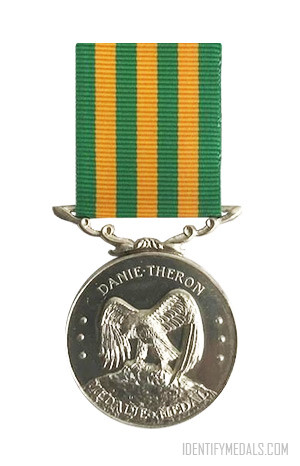
The Danie Theron Medal is a silver medallion, 38 millimeters in diameter and 3 millimeters thick. Its obverse side depicts an eagle with raised wings, with the inscription “DANIE THERON” around the top perimeter and “MEDALJE • MEDAL” at the bottom.

On the reverse side, the pre-1994 South African Coat of Arms is featured, with the decoration number impressed at the bottom of the medal on the rim.

The ribbon measures 32 millimeters in width and is green, with three 4 millimeters wide yellow bands spaced 5 millimeters apart in the center. The green and yellow colors originate from the ribbon colors of the three awards instituted in 1920.

The South African Pro Merito Medal

The South African Pro Merito Medal was conferred upon the South African Defence Force in recognition of exceptional devotion to duty.

The Pro Merito Medal of 1967, identified by the post-nominal letters PMM, is a military honor established by the Republic of South Africa in 1967. It was conferred upon other ranks of the South African Defence Force in recognition of exceptional devotion to duty.

Serving as the counterpart to the Southern Cross Medal of 1952 (SM), which was previously accessible to all ranks, the Pro Merito Medal specifically honored non-commissioned officers. Prior to the introduction of the Pro Merito Medal, other ranks were eligible for the Southern Cross Medal.

The South African Pro Merito Medal Design

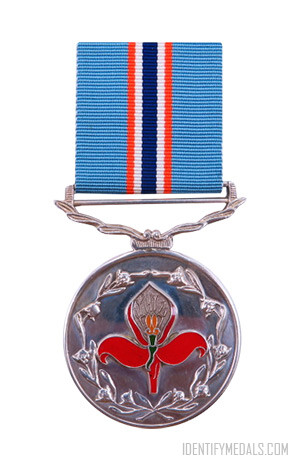
The Pro Merito Medal of 1967 is a silver medallion measuring 38 millimeters in diameter and 3 millimeters thick. It features a depiction of a disa uniflora encircled by a wreath of protea flowers.

The reverse side displays the embossed pre-1994 South African Coat of Arms, with the decoration number impressed at the bottom of the medallion on the rim.

Initially, the ribbon measured 32 millimeters in width and consisted of dark blue, orange, white, and dark blue bands, each 3¼ millimeters wide, with an orange band measuring 1½ millimeters wide. These bands were repeated in reverse order and separated by a white band in the center, which was 3 millimeters wide. However, due to its resemblance to the ribbon of the Permanent Force Good Service Medal, a new ribbon was introduced, as announced in Government Gazette No. 2047 dated April 19, 1968.

The South African Southern Cross Medal

The South African Southern Cross Medal is a military honor established in 1952 and granted for exceptional devotion to duty.

The Southern Cross Medal of 1952, known by the post-nominal letters SM, is a South African military honor established by the Union of South Africa in 1952. Initially, it was granted for exceptional devotion to duty and was accessible to all ranks. However, from 1967 until its discontinuation in July 1975, the award was exclusively reserved for officers.

Originally, the Southern Cross Medal could be bestowed upon members of the South African Defence Force for exceptional dedication to duty. Between 1952 and 1967, eligibility extended to all ranks. However, in 1967, an equivalent award for other ranks, the Pro Merito Medal, was introduced, leading to the restriction of the Southern Cross Medal’s presentation to officers. The inaugural awards were conferred on the occasion of the fiftieth anniversary of the Union of South Africa in 1960.

The South African Southern Cross Medal Design

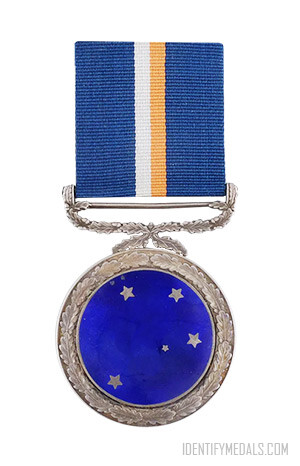
The Southern Cross Medal of 1952 is a silver medallion measuring 38 millimeters in diameter and 3 millimeters thick. It features the stars of the Southern Cross set against a dark blue enameled background, encircled by a ring of oak leaves.

On the reverse side, the decoration displays the pre-1994 South African coat of arms. Versions minted before South Africa became a republic in 1961 include Queen Elizabeth’s royal cypher (E II R) positioned above the coat of arms. The decoration number is impressed at the bottom of the medallion on the rim.

The ribbon measures 32 millimeters in width and consists of a dark blue band measuring 13 millimeters wide, flanked by one orange and one white band, both 3 millimeters wide, followed by another 13-millimeter-wide dark blue band.

The South African Honoris Crux Medal

The South African Honoris Crux Medal was a military honor established by the Union of South Africa in 1952. It remained in use until 1975.

The Honoris Crux (Cross of Honor) of 1952, identified by the post-nominal letters HC, was a military honor established by the Union of South Africa in 1952.

It remained in use from 1952 to 1975 and was bestowed upon members of the South African Defence Force for acts of gallantry in combat against the enemy. However, it was phased out on July 1, 1975, when it was succeeded by a new series of four Honoris Crux decorations, each in a different class.

The Honoris Crux of 1952 recognized acts of gallantry in combat against the enemy. A Bar could be added for subsequent acts of bravery.
Only five decorations were conferred, with the first awarded in 1973 and the others in 1974 and 1975. All recipients were helicopter pilots and flight engineers of the South African Air Force, with Captain A.P. (Aap) Möller receiving the first decoration. Notably, no bars were ever added to the decoration.

The South African Honoris Crux Medal Design

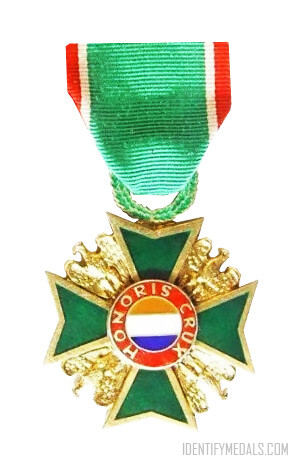
The Honoris Crux of 1952 is a silver-gilt Maltese cross designed to fit within a 45-millimeter diameter circle. The cross features arms adorned with green enamel and four eagles positioned between the arms, all facing towards their right. At the center, there is a roundel divided horizontally into enameled orange, white, and blue bands, symbolizing the national flag. Encircling this roundel is a red ring inscribed with “HONORIS CRUX.” The cross is suspended from a laurel wreath, forming a circular ribbon hanger, with the leaves depicted in green enamel.

The reverse side displays the pre-1994 South African coat of arms, with the decoration number stamped at the bottom of the rim. Prior to South Africa becoming a republic in 1961, specimens featured Queen Elizabeth’s royal cipher (E II R) above the coat of arms. However, the royal cipher was removed in 1961 without relocating the coat of arms to the center of the decoration.

The ribbon measures 32 millimeters in width and features a pattern consisting of a 3-millimeter-wide red band, followed by a 2-millimeter-wide white band, a 22-millimeter-wide dark green band, another 2-millimeter-wide white band, and finally, another 3-millimeter-wide red band.

The Van Riebeeck Decoration

The Van Riebeeck Decoration is a South African military honor for acts of bravery, established by the Union of South Africa in 1952.

The Van Riebeeck Decoration, designated by the post-nominal letters DVR, is a South African military honor for acts of bravery, established by the Union of South Africa in 1952. It was conferred upon officers for distinguished service in combat against an adversary.

The Van Riebeeck Decoration was established by Queen Elizabeth II on April 6, 1952, coinciding with the Tercentenary Van Riebeeck Festival. Originally, the logical post-nominal letters would have been VRD. However, these letters were already assigned to the Decoration for Officers of the Royal Naval Volunteer Reserve, which had also been conferred upon South Africans. Therefore, the letters DVR were selected instead.

Only two decorations were ever awarded, both in 1972.

The Van Riebeeck Decoration Design

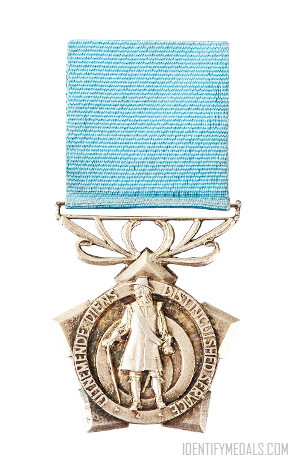
Crafted in silver-gilt, the Van Riebeeck Decoration takes the form of the five-pointed outline of the Castle of Good Hope, fitting within a 38-millimeter diameter circle. The suspension features a cluster of eight protea leaves. In relief, the statue of Jan van Riebeeck, located in the Heerengracht in Cape Town, is depicted against a backdrop of three rings representing Van Riebeeck’s ships. The outer ring is inscribed “UITNEMENDE DIENS” on the left and “DISTINGUISHED SERVICE” on the right.

The reverse side displays the pre-1994 South African Coat of Arms. Versions produced before May 31, 1961, bore Queen Elizabeth II’s royal cipher (E II R) above the coat of arms, which was subsequently removed from subsequent awards.

Measuring 32 millimeters wide, the ribbon is sky blue in color.

The Star of South Africa Medal

The Star of South Africa Medal was a military honor established by the Union of South Africa to recognize exceptional merit.

The Star of South Africa, denoted by the post-nominal letters SSA, was a military honor established by the Union of South Africa between 1952 and 1975 to recognize exceptional merit. It was conferred upon general and flag officers of the South African Defence Force for their exceptionally meritorious service. However, it was discontinued on July 1, 1975, coinciding with the introduction of a new set of orders, decorations, and medals.

The Star of South Africa was granted to general and flag officers in recognition of their remarkable service. Essentially, it replaced the Commander of the Order of the British Empire (CBE), which had been awarded to senior South African officers during World War II.

The Star of South Africa Medal Design

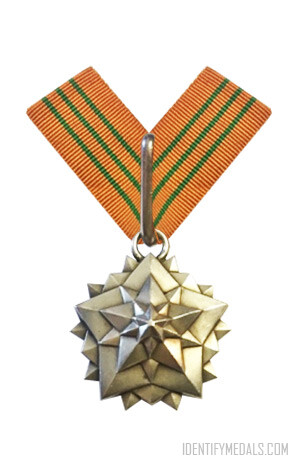
The Star of South Africa was crafted in silver and comprised eight five-pointed stars of various sizes, arranged in layers to fit within a 50-millimeter diameter circle.

On the reverse side, the decoration displayed the pre-1994 South African coat of arms. Specimens awarded before South Africa’s republic status on May 31, 1961, featured Queen Elizabeth’s royal cipher (E II R) above the coat of arms.

The decoration was worn around the neck on an orange ribbon, measuring 44 millimeters in width. It featured three green bands in the center, each 3 millimeters wide and spaced 6 millimeters apart.

The Louw Wepener Decoration

The Louw Wepener Decoration is a military honor established by the Union of South Africa in 1952 to recognize acts of remarkable bravery.

The Louw Wepener Decoration, denoted by the post-nominal letters LWD, is a military honor established by the Union of South Africa in 1952 to recognize acts of remarkable bravery and heroism displayed by members of the South African Defence Force. However, it was discontinued on July 1, 1975, with the introduction of a new series of decorations and medals.

The Louw Wepener Decoration was granted to individuals of all ranks for displaying remarkable courage or heroism in situations of great peril, primarily outside of combat contexts. It could be accompanied by a Bar for additional acts of bravery. The decoration was established in tribute to Louw Wepener, who lost his life in 1865 while leading his troops in an assault on a Basotho stronghold during the Basuto Wars of 1858 to 1865.

Only seven decorations were conferred, with the first awarded in 1961 and the last in 1974. No bars were ever added to the decoration.

The Louw Wepener Decoration Design

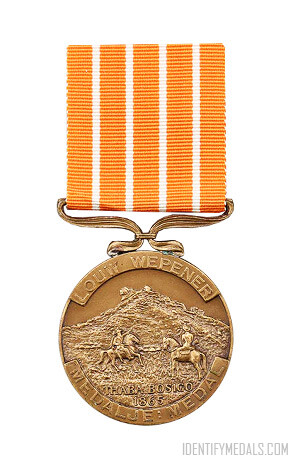
The Louw Wepener Decoration features a 38-millimeter medallion depicting the Thaba Bosigo mountain peak, with two horsemen positioned at its base. Below the riders, the inscription “THABA BOSIGO, 1865” is displayed, while around the circumference, the words “LOUW WEPENER” appear at the top and “DECORATION • DEKORASIE” at the bottom.

On the reverse side, the decoration showcases the pre-1994 South African coat of arms, with the decoration number impressed at the bottom of the rim. Specimens awarded before South Africa’s republic status on May 31, 1961, featured Queen Elizabeth’s royal cipher (E II R) above the coat of arms.

The ribbon measures 1+3⁄8 inches (35 millimeters) in width and is orange, adorned with five white bands spaced 1⁄8 inch (3.2 millimeters) apart.