The Royal Order of Kalākaua I

The Royal Order of Kalākaua I is a Hawaiian order instituted in 1874 by King Kalākaua I to commemorate his accession to the throne.

The Royal Order of Kalākaua I is a Hawaiian order instituted on 28 September 1874 by King Kalākaua I to commemorate his accession to the throne of the Kingdom of Hawaiʻi on 12 February 1874.

This order was granted to both native Hawaiians and foreigners for superlative service to the monarch and to the kingdom. It was last conferred by Queen Liliʻuokalani on 1 August 1892.

In the duration of the Order, it was granted 239 times by King Kalākaua I, and 15 times by his sister Queen Liliʻuokalani. In 1893, the Order became abeyant.

The Order was awarded in four grades:

  • The Royal Order of Kalakaua I Grand Cross.gif Knights Grand Cross with Collar (only given for head of states)
  • The Royal Order of Kalakaua I Grand Cross.gif Knights Grand Cross – 12 individuals
  • Order of Kalakaua Companion.gif Grand Officer – 20 individuals
  • Order of Kalakaua Companion.gif Commander – 50 individuals
  • Order of Kalakaua Companion.gif Companion – 60 individuals

The Royal Order of Kalākaua I Design

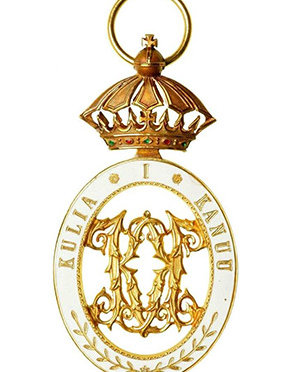
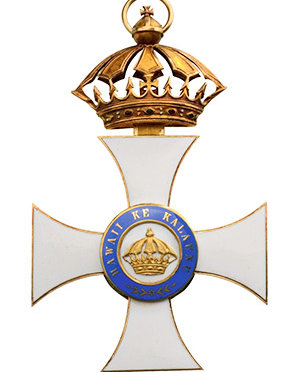
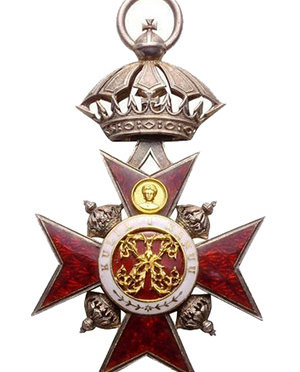
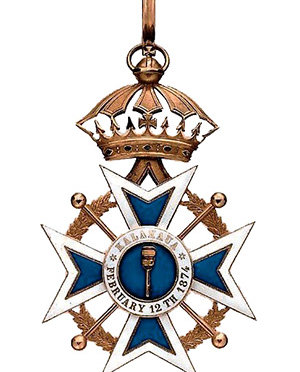
The badge of the order is a Maltese cross in gold or silver.

The obverse is decorated with Prussian blue and white enamel, surmounted by a Hawaiian crown. The arms of the cross have a border strip of white enamel, with a blue centre separated by a thin band of gold or silver. There is a gold or silver wreath and a pūloʻuloʻu (kapu sticks – ball and stick insignia) between the arms connecting them. On the cross is a blue and white enamel locket. On a white stripe, the inscription KALAKAUA FEBRUARY 12 1874 circles a kāhili (feathered standard of royalty) on a background of blue.

The reverse comprises a locket of blue and white. At the centre of the locket is the date 1874, surrounded by the inscription KEOLA (eternal life) – both in gold.

The insignia for the Knights Grand Cross with Collar is a collar chain composed of alternating monograms “K.I.K.” and kahili of red and yellow enamel and a breast star. The breast star is identical to that of the Knights Grands Cross – an octagonal silver star to which is affixed the badge of Order without the crown and struck in gold. The sash is deep blue. The badge of the Order is fastened to a bow on the sash on a bow, resting on the left hip.

The insignia of Grand Officer Star is only a breast star. The wreath of Grand Officer Star is silver. The insignia of the Commander Cross is identical to that of the Grand Officer Star, except it is worn on a neck ribbon of five alternating white and blue stripes. The Companion Cross comprises a breast badge suspended by a ribbon of white and blue stripes.

The Royal Order of Kamehameha I

The Order of Kamehameha I is an order of knighthood established by Kamehameha V in 1865 to promote and defend the sovereignty of Hawaiʻi.

The Order of Kamehameha I is an order of knighthood established by Kamehameha V in 1865 to promote and defend the sovereignty of the Kingdom of Hawaiʻi.

After Lot Kapuāiwa took the throne as King Kamehameha V, he established the Order of Kamehameha I by special decree on April 11, 1865. The name is in recognition of his grandfather Kamehameha I, who was the founder of the Kingdom of Hawaii and the House of Kamehameha. The Order was awarded 57 times by King Kamehameha V, and 82 times by King Kalākaua.

Both native Hawaiians and foreigners could be appointed to the Order. Its purpose ise to promote and defend the sovereignty of the Kingdom of Hawaii.

The grades of the Order were determined by the number of living members in each of them. At any given time there could only be:

  • Royal Order of Kamehameha I Grand Cross.gif Knight Grand Cross with Collar (CGCOK) – Only for heads of state.
  • Royal Order of Kamehameha I Grand Cross.gif Knight Grand Cross (KGCOK) – 10 individuals.
  • Royal Order of Kamehameha I Commander and Companion.gif Knights Commander (KCOK) – 30 individuals.
  • Royal Order of Kamehameha I Commander and Companion.gif Knights Companion (KOK) – 50 individuals.

The Royal Order of Kamehameha I Design

The badge/medal is a Maltese cross in gold or silver with white enamel, surmounted by the Hawaiian crown. Rays of gold or silver are placed between the arms of the cross.

A white-enamelled disc imposed upon the cross bears an elaborate golden “K” at its centre; the blue-enamelled band surrounding the disc is inscribed “KAMEHAMEHA I” in golden letters, together with two golden laurel branches. A comparable disc on the reverse of the badge is inscribed “E HOOKANAKA” (“Order of Fraternity”, in Hawaiian).

Members of this grade wore the badge of the Order attached to a golden collar, the decorative links of which alternated the monogram “K”, surrounded by a green-enamelled laurel crown, with the royal crown and a small enamelled badge of the Order. The breast star was identical to that worn by Knights Grands Cross, suspended from a broad red sash edged by a narrow white stripe on each side.

The sash is worn over the bearer’s right shoulder, its bow (from which the badge, sometimes decorated with brilliants, depended) resting on his left hip. The breast star was an octagonal silver star bearing the uncrowned badge of Order in gold and enamels.

Knights Commander wore the badge of the Order dependent from a red neck ribbon, which was edged in white and bore three white stripes. Knights of the Order wore the badge on the left breast, suspended from a ribbon of red and white stripes.

The Order Of The Imperial Dragon or Bao Xing Merit Medal

The Order Of The Imperial Dragon or Bao Xing Merit Medal is a military award given to British and French government officials and civilians.

The Order Of The Imperial Dragon, also known as the Bao Xing Merit Medal is a Chinese military award given to British and French government officials and civilians. The medal was authorized by Imperial Decree in 1862, designed in the Western Style and awarded to those who contributed to the defeat of the Taiping Rebellion between 1850 to 1864.

The Bao Xing Merit Medal was influential in the design and creation of the later instituted Order of the Double Dragon in 1882.

The Bao Xing Merit Medal Design

The medal is struck in 24ct gold and it has a unique high handcrafted quality with exquisite attention to detail. All figures and characters are hand-carved from a single gold disc.

For the First Class, the obverse depicts two dragons pursuing a central red cabochon. The outer border is a stylized “thunder scroll” design. The reverse features the Chinese characters for Da Qing Yu Xi (Great Qing Imperially Awarded First Class Award).

The medal measures 381. mm (w) by 54 mm (including the suspension) and weights 46.6 grams. It was awarded with a tassel consisting of a green braided knot (Yun Tou or Cloud Head knot) with parallel blue and red tassels, upper suspension composed of a secondary braided blue Yun Tou.

The Wu Pei Fu Qualification Award For Public Affairs

The Wu Pei Fu Qualification Award For Public Affairs is a Chinese medal established c. 1912 and awarded for “virtuous behavior”.

The Wu Pei Fu Qualification Award For Public Affairs is a Chinese medal established c. 1912 and awarded for “virtuous behavior”.

Wu Peifu was an important figure and warlord who played a significant role in the Republic of China (in the struggles between the warlords who dominated Republican China) between 1916 and 1927.

This medal was issued in the region of Hebei during the War Lords Era (1912-1928).

The Wu Pei Fu Qualification Award For Public Affairs Design

The medal is a three-piece construction, struck in silver and decorated with enamels. It measures 50.7 by 51 millimeters.

The obverse features Chinese characters, which changes depending on what the medal was awarded for.

The Air Force Distinguished Service Medal (Taiwan)

The Air Force Distinguished Service Medal is a Taiwanese medal established in 1980. The medal is decorated in gilt and enamels.

The Air Force Distinguished Service Medal is a Taiwanese medal established in 1980. The medal is decorated in gilt and enamels and measures 45 by 50 millimeters.

The Anzac Commemorative Medal

The Anzac Commemorative Medallion was instituted in 1967 and awarded to surviving members of the Australian forces who served on the Gallipoli Peninsula, or in direct support of the operations from close offshore. The time frame is any time during the period from the first Anzac Day in April 1915 to the date of final evacuation in January 1916.

Next of kin, or other entitled persons, are entitled to receive the medallion on behalf of their relatives if the medallion has not been issued.

The Anzac Commemorative Medallion Design

The medal is cast in bronze and measures approximately 75 millimeters high and 50 millimeters wide.

The obverse depicts Simpson and his donkey carrying a wounded soldier to safety. It is bordered on the lower half by a laurel wreath above the word ANZAC. The reverse shows a map in relief of Australia and New Zealand superimposed by the Southern Cross. The lower half is bordered by New Zealand fern leaves.

Surviving members were also issued with a lapel badge in the form of a small replica of the medallion to recognise their Gallipoli service.

The name and initials of the recipient is engraved on the reverse. The medallion is issued in a presentation box.

The Order of Brilliant Jade

The Order of Brilliant Jade is a civilian order established in 22 December 1933 and that can be worn only by the head of a nation.

The Order of Brilliant Jade (or 采玉大勳章 in Chinese) is a civilian order of the Republic of China instituted on 22 December 1933 and that can be worn only by the head of a nation.

According to regulations, the order can only be presented by the president of the country or an emissary expressly dispatched to friendly nations for the conferment. The Chinese official name of the order was claimed to be named after President Chiang Kai-shek’s mother, Wang Caiyu (王采玉) by Democratic Progressive Party members of Legislative Yuan. There are suggestions from the pan-green coalition to rename the order to suit Taiwanese locality as “Order of Taiwan”, but this was not passed at the Legislative Yuan in April 2007 because it faced opposition from the Kuomintang.

Previously, the Order of the Brilliant Jade was divided into two, namely Grand Order of Brilliant Jade (current) and Order of Brilliant Jade with nine ranks.

The Order of Brilliant Jade Design

The Order has a star-patterned face of inlaid jade bordered with gold and pearls. In the center, there is white sun surrounded by a blue sky, the national emblem.

The Order of the Cloud and Banner

The Order of the Cloud and Banner is a military award of the Republic of China awarded for contributions to national security.

The Order of the Cloud and Banner (or 雲麾勳章/雲麾勛章 in Chinese) also known as the Order of the Resplendent Banner is a military award of the Republic of China.

It was instituted on June 15, 1935 and is awarded in nine grades for contributions to national security such as putting down civil strife or for military exploits.

The Order is awarded in nine classes:

The order is organized into nine grades:

  • 1st, with Special Grand Cordon.
  • 2nd, with Grand Cordon.
  • 3rd, with Yellow Grand Cordon.
  • 4th, with Special Cravat.
  • 5th, with Cravat.
  • 6th, with Special Rosette.
  • 7th, with Rosette.
  • 8th, with Special Ribbon.
  • 9th, with Ribbon.

The Order of the Cloud and Banner Design

The insignia of the order features a fluttering yellow flag, surrounded by white clouds on a blue field. This image is surrounded by golden rays.

The Order of the Sacred Tripod

The Order of the Sacred Tripod or Pao Ting is a military award of the Rep. of China created in 1929 for contributions to national security.

The Order of the Sacred Tripod (or 寶鼎勳章 in Chinese), also referred to as the Order of the Precious Tripod or Pao Ting, is a military award of the Republic of China created on 15 May 1929 and awarded for significant contributions to national security.

The medal is the general medal of the three services of the Republic of China to commend those who defend against foreign aggression. Its rank is lower than the Blue Sky and White Sun Medal and higher than the Yun Yun Medal.

The order is organized into nine grades:

  • 1st, with Special Grand Cordon.
  • 2nd, with Grand Cordon.
  • 3rd, with Red Grand Cordon.
  • 4th, with Special Cravat.
  • 5th, with Cravat.
  • 6th, with Special Rosette.
  • 7th, with Rosette.
  • 8th, with Special Ribbon.
  • 9th, with Ribbon.

The grade received vary according to military rank. The first to fourth are awarded to general officers. The third to sixth ranks are awarded to school officers. The fourth to seventh ranks are awarded to lieutenants. Waiting officers, warrant officers, and soldiers are awarded the sixth to ninth class.

The Order of the Sacred Tripod Design

The central design of the order’s insignia is an image of a tripod surrounded by golden rays. The symbolism of this is that as the tripod is considered a national treasure, so too is the recipient of the order.

The Order of Loyalty and Valor

The Order of Loyalty and Valor s a military award created on 23 September 1944 and awarded for outstanding command in battle.

The Order of Loyalty and Valor (忠勇勳章 in Chinese) is a military award from the Republic of China created on 23 September 1944 and awarded for outstanding command in battle.

The Order is awarded by the President to soldiers who have killed the enemy bravely, for being wounded and not treating, or for commanding battle in danger. It can also be given tho those that defend the people, are loyal to duties, or perform heroic acts beyond the ordinary during a peace period.

The Order only has one grade.

The Order of Loyalty and Valor Design

The ribbon is dark blue with narrow red and yellow edge stripes.