The Medal for the Capture of Berlin

The Medal for the Capture of Berlin was awarded to Soviet service personnel who took part in the capture of Berlin in 1945.

The Medal for the Capture of Berlin (or Медаль «За взятие Берлина», Medal «Za vzjatie Berlina» in Russian) was established on 9 June 1945 by decree of the Presidium of the Supreme Soviet of the USSR and awarded to Soviet service personnel who took part in the capture of Berlin from 22 April and 2 May 1945.

The medal was awarded to soldiers of the Red Army, Navy, and troops of the NKVD, direct participants of the assault and capture of Berlin as well as to the organizers and leaders of combat operations in the capture of this city. Serving military personnel received the medal from their unit commander, retirees from military service received the medal from a regional, municipal, or district military commissioner in the recipient’s community.

The medal’s statute was amended on July 18, 1980, by decree of the Presidium of the Supreme Soviet of the USSR № 2523-X.

The Medal for the Capture of Berlin Design

The medal was 32mm in diameter, circular, and made of brass, with a raised rim on the obverse. It was worn on the left side of the chest.

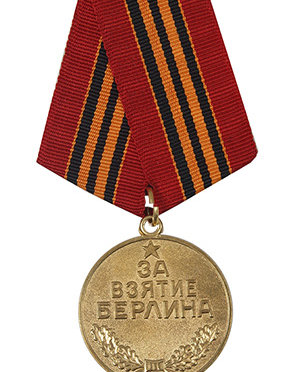
On its pebbled obverse at the top, a plain five-pointed star, its top point touching the medal upper rim. Below the star, the relief inscription in bold letters on three rows «ЗА ВЗЯТИЕ БЕРЛИНА» (“FOR THE CAPTURE OF BERLIN”) ending halfway down the medal. At the bottom, the relief image of a wreath of oak branches going up the left and right circumference of the medal up to the lower row of the inscription. On the reverse near the top, the relief date on three rows over a relief plain five-pointed star «2 МАЯ 1945» (“2 MAY 1945”).

The medal was secured by a ring through the medal suspension loop to a standard Soviet pentagonal mount covered by a 24mm wide red silk moiré ribbon with a 12mm wide Ribbon of St. George in the center.

The Medal for the Tapping of the Subsoil and Expansion of the Petrochemical Complex of Western Siberia

The Medal for the Tapping of the Subsoil and Expansion of the Petrochemical Complex was awarded for 3 years outstanding service.

The Medal for the Tapping of the Subsoil and Expansion of the Petrochemical Complex of Western Siberia (or Медаль «За освоение недр и развитие нефтегазового комплекса Западной Сибири», Medal «Za osvoenie nedr i razvitie neftegazovogo kompleksa Zapadnoj Sibiri» in Russian) was established on 28 July 1978 and awarded for 3 years outstanding service in the Petrochemical Complex Of Western Siberia.

The medal was awarded to active members in the underground exploration and development of the oil and gas complex of Western Siberia for selfless labor in the identification, exploration, and development of the mining and industrial processing of oil and gas, for work in construction, in manufacturing, in housing and other civilian facilities, in building highways, in electricity, transport or other services to the oil and gas industries, as well as to employees of scientific, research or design organizations, of institutions and organizations, of the service sector, Party, Soviet, trade union or Komsomol organs of the oil and gas industry, who produced conscientious work and contributed to the development of the petrochemical complex of Western Siberia over a period of at least three years.

Recommendations for the award were made by the administrative heads of enterprises, institutions, organizations, parties, trade unions or Komsomol organizations or labor collectives, and the executive committees of the District or City Council of People’s Deputies.

The Medal for the Tapping of the Subsoil and Expansion of the Petrochemical Complex of Western Siberia Design

The medal is circular, struck in brass, and measures 32 millimeters in diameter.

On its obverse, in the right half, the relief image of a sickle over a vertical hammer, in the background, the relief images of two oil rigs at the center, two gas tanks at left, a tractor and piping at lower center, at the bottom a small relief five-pointed star, along the medal circumference, the relief inscription «За освоение недр и развитие нефтегазового комплекса Западной Сибири» (“For the tapping of the subsoil and expansion of the petrochemical complex of Western Siberia”).

On the reverse, in the central upper half, a relief five-pointed star emitting rays from between its arms forming an inversed pentagon, superimposed over the star, the relief inscription «СССР» (“USSR”), at the bottom, crossed laurel and oak branches.

The medal was secured to a standard Soviet pentagonal mount by a ring through the medal suspension loop. The mount was covered by a 24 mm wide overlapping green silk moiré ribbon with a 6 mm wide central blue stripe bordered on both sides by 2 mm black stripes themselves bordered on the outside by 1 mm wide white stripes.

The Veteran of the Armed Forces of the USSR Medal

The Veteran of the Armed Forces of the USSR Medal was awarded for 25 years of impeccable military service.

The Veteran of the Armed Forces of the USSR Medal (or Медаль «Ветеран Вооружённых Сил СССР», Medal «Veteran Vooruzhennyh Sil SSSR» in Russian) was established on 20 May 1976 and awarded on behalf of the Presidium of the Supreme Soviet of the USSR for 25 years of impeccable military service to troops of the army, navy, of internal forces and of border troops. 

The medal was awarded to soldiers of the Soviet Army, of the Soviet Navy, of Border Troops, and of Internal Troops, who impeccably served in the Armed Forces of the USSR for 25 years or more. The medal could also be awarded to persons already retired from the service prior to the issuance of the Decree establishing it, who impeccably served in the Armed Forces of the USSR for 25 years or more.

The medal’s statute was twice amended by further decrees of the Presidium of the Supreme Soviet of the USSR, first on July 18, 1980 and lastly on January 10, 1984.

The Veteran of the Armed Forces of the USSR Medal Design

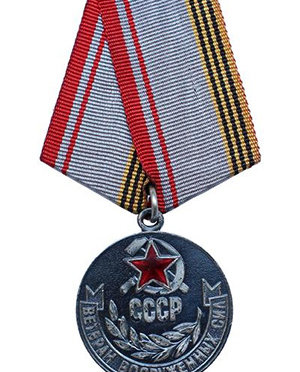
The medal is circular and struck in silver-plated tombac, measuring 32 millimeters in diameter and with a raised rim.

The obverse was oxidized and bore at its upper section a ruby-red enameled five-pointed star superimposed on the relief image of the hammer and sickle, just below in the center, the relief inscription «СССР» (“USSR”) over a curled laurel branch; at the bottom along the medal circumference, a relief scroll with the inscription in prominent letters «ВЕТЕРАН ВООРУЖЕННЫХ СИЛ» (“VETERAN OF THE ARMED FORCES”). The reverse was plain with a matte finish.

The medal was secured to a standard Soviet pentagonal mount by a ring through the medal suspension loop. The mount was covered by a 24mm wide grey silk moiré ribbon with four orange and three black stripes alternating along its right edge and two red stripes along its left edge. The width of the orange and black stripes was 1mm except for the outermost orange stripe which was 2mm, the red stripes were respectively 3mm and 1mm with a spacing of 2mm.

The Medal for Impeccable Service

The Medal for Impeccable Service was established on 25 January 1958 and awarded for long service of excellent military service.

The Medal for Impeccable Service (or Медаль «За безупречную службу», Medal «Za bezuprechnuju sluzhbu» in Russian) was established on 25 January 1958 by decree of the Presidium of the Supreme Soviet of the USSR and awarded for long service of excellent military service.

The Soviet military award was given to deserving members of the military personnel of the armed forces of the USSR, of the Interior Ministry of the USSR and of the Ministry for the Protection of Public Order of the USSR, to recognize ten, fifteen and twenty years of faithful and impeccable service to the state.

Prior to the establishment of the Medal “For Impeccable Service“, existing state Orders meant for feats of valor or for extraordinary services to the state were conferred to military personnel for long service. An Order of Lenin for twenty-five years of service, the Order of the Red Banner for twenty, the Order of the Red Star for fifteen, hundreds of thousands of such awards seriously devaluated the awards of the same Orders earned for their original criteria.

The intent to encourage the establishment of a ministerial/departmental level medal “For Impeccable Service” emphasized the then devaluation of certain Soviet high military Orders used as long service awards instead of their originally intended criteria.

The medal was established in three classes. The first class was awarded for twenty years of excellent service, the second class for fifteen, and the third class for ten.

The Medal for Impeccable Service Design

The medal is circular, struck in silver or silver-plated brass, and measures 32 millimeters in diameter. It has a raised rim on both sides. The first-class medal was initially struck from silver but after 1965 it changed to silver-plated brass. The central star on its obverse was enameled in red. The second-class medal from its inception was also constructed from silver-plated brass, with the exception of the central star on its obverse (which was left bare). The third-class medal was always struck from solid brass.

On the obverse at the center, the relief outline of a large five-pointed star with the hammer and sickle at its center, between the arms, rays radiating at an obtuse angle forming a point. Along the circumference of the medal, passing between the raised rim and the points of the star, a laurel wreath. This design was common to all three services bestowing it, Defence, Interior, and the KGB, the only exception being the second variant of the medal bestowed by the KGB, which bore the Roman numerals “XX”, “XV” or “X” in the lower part of the obverse, between the lower rays of the star.

On the reverse, the circular relief inscription along the upper medal circumference, «ВООРУЖЕННЫЕ СИЛЫ» (“ARMED FORCES”), at the bottom, the inscription «СССР» (“USSR”). In the center, the relief inscription on four lines «ЗА (10, 15, 20) ЛЕТ БЕЗУПРЕЧНОЙ СЛУЖБЫ» (“FOR (10, 15 or 20) YEARS OF IMPECCABLE SERVICE”) over a small five-pointed star. On the reverse of the Interior Ministry medal the inscription reads «МВД СССР» (“MVD USSR”). On the reverse of the Ministry for the Protection of Public Order medal, it’s «МООП» (“MOOP”).  There are other lower reverse inscriptions from multiple variants of various Soviet republics, including «МВД БССР», «МВД УССР», «МВД КАЗ», «МООП РСФСР», «МООП БССР», and «МООП ГССР».

The medal was secured by a ring through the medal suspension loop to a standard Soviet pentagonal mount covered by a 24-millimeter-wide red silk moiré ribbon with 2-millimeter-wide green edge stripes. The ribbon for the medal 1st class had a single 2-millimeter-wide central yellow stripe; the ribbon for the medal 2nd class and two 2-millimeter-wide central yellow stripes 2 mm apart; the ribbon for the medal 3rd class had three 2-millimeter-wide central yellow stripes 2 mm apart.

The Medal for Strengthening of Brotherhood in Arms

The Medal for Strengthening of Brotherhood in Arms was awarded to military personnel and citizens that participated in the Warsaw Pact.

The Medal for Strengthening of Brotherhood in Arms (or Медаль «За укрепление боевого содружества», Medal «Za ukreplenie boevogo sodruzhestva» in Russian) was established on 25 May 1979 by Decree of the Presidium of the Supreme Soviet and awarded to military personnel, to employees of state security, of internal affairs, and to other citizens of the states that participated in the Warsaw Pact, as well as other socialist and other friendly nations for merit in strengthening military “Brotherhood in Arms“.

The conferring authority was the Presidium of the Supreme Soviet of the USSR based on recommendations from the Minister of Defence or the USSR, the Minister of Internal Affairs of the USSR, or from the Chairman of the State Security Committee of the USSR. The medal could be earned multiple times. Its statute was later confirmed and slightly amended by Decree of the Presidium of the Supreme Soviet № 2523-X of July 18, 1980.

The Medal for Strengthening of Brotherhood in Arms Design

The medal is circular, struck in gilt tombac, and measures 32 millimeters in diameter. 

On the obverse, a red enameled five-pointed star with a shield at its center. The shield is not enameled and bears the relief inscription in five rows «ЗА УКРЕПЛЕНИЕ БОЕВОГО СОДРУЖЕСТВА» )“FOR STRENGTHENING MILITARY COOPERATION”) and «СССР» (“USSR”). Two relief laurel branches follow the left and right circumference of the medal passing under the points of the star. At the bottom of the obverse, crossed swords, their hilts below the star, their blades passing under the lower arms of the star and protruding over the laurels to the medal rim. The reverse of the medal is plain.

The medal is secured to a standard Russian pentagonal mount by a ring through the suspension loop. The mount is covered by a 24 mm wide silk moiré ribbon in the colors of the flags of the Warsaw Pact countries.: The stripes alternate from left to right in the following widths: green 4 mm, white 1 mm, red 5.5 mm, yellow 1 mm, black 1 mm, yellow 1 mm, red 5.5 mm, white 1 mm, and blue 4 mm.

The Medal for Distinction in Military Service

The Medal for Distinction in Military Service was awarded to soldiers of the Soviet Army, Navy, border and internal troops.

The Medal for Distinction in Military Service (or Медаль «За отличие в воинской службе», Medal «Za otlichie v voinskoj sluzhbe» in Russian) was established on 28 October 1974 by Decree of the Presidium of the Supreme Soviet and awarded to soldiers of the Soviet Army, Navy, border and internal troops: for excellent performance in combat and political training; for special distinction in exercises and maneuvers in combat service and combat duty; for bravery, selflessness, and other services, shown during military service.

The award was one of the very few Soviet decorations to be retained “as is” following the dissolution of the USSR. The award was divided into two classes, first and second, the first class being the highest. They were awarded sequentially for continued merit. Each medal came with an attestation of award, this attestation came in the form of a small 8 cm by 11 cm cardboard booklet bearing the award’s name, the recipient’s particulars and an official stamp and signature on the inside.

The Medal for Distinction in Military Service Design

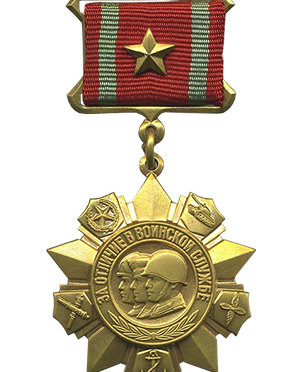
The medal is a five-pointed convex star measuring 38 millimeters wide and made of brass for the first class and cupronickel for the second class. Five shields bearing the emblems of the main branches of the service fill the gaps between its arms. 

The obverse bears a central concave medallion bearing the relief images of a soldier, sailor, and airman. The central medallion was framed by a ring bearing the relief inscription «За отличие в воинской службе» (“For Distinction in Military Service”) on the sides and top, at the bottom of the ring, two laurel branches. The plain reverse only bore the mark of the Moscow Mint «ММД» (“MMD”) at the bottom.

The medal was secured to a 29,5mm wide by 27,5mm square mount by a ring through the suspension loop. The mount was covered by a red silk moiré ribbon with two 3mm green stripes located 3mm from the ribbon edges.

The Medal for Distinction in the Protection of Public Order

The Medal for Distinction in the Protection of Public Order was awarded to members of the Ministry of Internal Affairs.

The Medal for Distinction in the Protection of Public Order (or Медаль «За отличную службу по охране общественного порядка», Medal «Za otlichnuyu sluzhbu po ohrane obschestvennogo porjadka» in Russian) was established on 1 November 1950 and awarded to members of the Ministry of Internal Affairs (MVD) and its Internal Troops for aiding in preserving public order and to all service personnel of the militsiya for courage shown during the liquidation of criminal groups and arrest of criminal or for excellence in organizing and coordinating militia in combating crime or for selfless acts during the prevention of hooliganism/alcoholism/theft.

The Medal “For Distinction in the Protection of Public Order” was awarded for:

  • bravery and dedication displayed during the dismantling of criminal groups and the detention of criminals;
  • bold, expertly prepared and conducted covert operations aimed at preventing criminal offenses;
  • active work and research on the causes and conditions conducive to criminal offenses;
  • skillful organization of internal affairs units and internal forces for the protection of public order and the fight against crime;
  • excellent performance of duties in the organs of internal affairs or in the units internal forces;
  • active participation in the protection of public order and for displaying courage and selflessness,
  • active participation in the fight against hooliganism, drunkenness, theft of socialist and personal property, violation of the rules of trade, speculation, distilling, and other offenses, harmful to society.

The Medal for Distinction in the Protection of Public Order Design

The medal is circular, struck in silver and measures 32 mm in diameter.

On its obverse, the inscription on five lines “ЗА ОТЛИЧИЕ В ОХРАНЕ ОБЩЕСТВЕННОГО ПОРЯДКА” (“FOR DISTINCTION IN THE PROTECTION OF PUBLIC ORDER”), the inscription is surrounded by a wreath of oak and laurel branches following the medal’s circumference laced together with a ribbon, at the bottom over the ribbon, a shield. The reverse is plain except for the relief “№” with a horizontal line for the award serial number.

The medal is suspended to a standard Russian pentagonal mount by a ring through the medal’s suspension loop. The mount is covered by an overlapping 24mm wide blue silk moiré ribbon with 5mm red edge stripes and two 1mm red central stripes.

The Medal for Distinction in Guarding the State Border of the USSR

The Medal for Distinction in Guarding the State Border of the USSR was awarded to K.G.B. Border Troops personnel.

The Medal for Distinction in Guarding the State Border of the USSR (or Медаль «За отличие в охране государственной границы СССР», Medal «Za otlichie v okhrane gosudarstvennoj granitsy SSSR» in Russian) was established on 13 July 1950 and awarded to K.G.B. Border Troops personnel for military or other actions displaying excellence in guarding the Soviet borders.

The medal was awarded to soldiers of Border Troops and other military personnel as well as to Soviet citizens for military exploits and special services displayed in the protection of the state borders of the USSR:

  • for bravery and selflessness displayed during combat operations aimed at the arrest of violators of the State Border of the USSR;
  • for the leadership of border protection units while ensuring the inviolability of the borders of the USSR;
  • for a high degree of vigilance and proactive actions which resulted in the arrest of violators of the State Border of the USSR;
  • for the skillful organization of border service units and exemplary work to strengthen the borders of the USSR;
  • for the excellent performance of military duties associated with the protection of the state borders of the USSR;
  • for active assistance to border protection forces in their combat assignments aimed at the protection of the state borders of the USSR.

The Medal for Distinction in Guarding the State Border of the USSR Design

The medal was originally struck in silver, after 1966 it was constructed of silver-plated nickel and later of cupro-nickel. It’s circular and measures 32 mm with a raised rim on both sides.

The obverse bears the relief image of an erect border guard holding a PPSh-41 submachine gun standing guard beside a border marker with high mountains in the background. The reverse shows a relief inscription on six lines “For Distinction in the Protection of the State Border of the «За отличие в охране государственной границы СССР» (“USSR”), at the top, the relief image of a five-pointed star, at the bottom, a relief hammer and sickle over laurel and oak branches.

The medal was secured by a ring through the medal suspension loop to a standard Soviet pentagonal mount covered by a 24 mm wide green silk moiré ribbon with 3 mm wide red edge stripes.

The Order for Personal Courage (USSR)

The Order for Personal Courage was awarded to any USSR citizen showing outstanding courage and bravery during keeping of public order.

The Order for Personal Courage (or Орден «За личное мужество», Orden «Za lichnoe muzhestvo» in Russian) was established on 28 December 1988 and awarded to any USSR citizen showing outstanding courage and bravery during life-saving, keeping of public order and safeguard of State property, as well as for fighting crime, environmental catastrophes, and other exceptional events.

The order was first awarded on February 3, 1989, to a teacher of school No. 42 in the city of Ordzhonikidze (now Vladikavkaz) Natalia Vladimirovna Efimova. Her class was taken hostage and later freed in a police operation.

The Order for Personal Courage Design

The award was designed by Alexander Zhuk and represents a silver gilded silver star with the words «За личное мужество» (“For Personal Courage”) and CCCP (“USSR”) written on it.

Many medals were made but were mostly unissued.

The ribbon is red with three thin white lines on each side.

The Order of Labor Glory (USSR)

The Order of Labor Glory (or Орден Трудовой Славы) was established on 18 January 1974 and awarded for exceptional labor achievements.

The Order of Labor Glory (or Орден Трудовой Славы, Orden Trudovoj Slavy in Russian) was established on 18 January 1974 by the decision of the Praesidium of Supreme Soviet of the USSR and awarded for exceptional labor achievements.

It was divided in three classes (the highest being the 1st class), with a person initially received the third degree, and subsequently promoted to higher degrees for further achievements. It also gave a certain number of material benefits to their owners, such as an increased pension raises and free public transport.

In 1991, the following number of awards were made:

  • 1st class – 952
  • 2nd class – 50,000+
  • 3rd class – 650,000+

The Order of Labor Glory Design

The medal is struck in silvered bronze and enamels and measures 41 mm by 44 mm.

The obverse consists of an eight-pointed radiant star, bearing a raised depiction of a factory overlaid by a sickle and hammer, circumscribed by a Cyrillic inscription of “ТРУДОВАЯ СЛАВА” (“LABOUR GLORY”) on a cogwheel, topped by a five-pointed red enameled star, above a red enameled banner bearing a gilt inscription of “СССР”, flanked by wheat stalks. The reverse sometimes bears a raised maker’s mark.

The medal is mounted to a five-sided aluminum suspension with pinback. The ribbon is has a large grey stripe, and thinner yellow, red, and yellow stripes.