The Yorkshire Imperial Yeomanry Medal

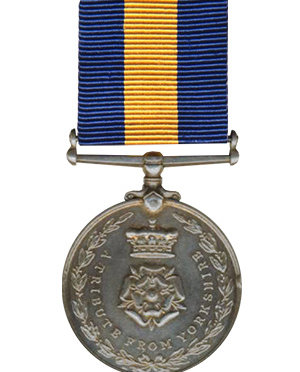
The Yorkshire Imperial Yeomanry Medal is an unofficial British Empire campaign medal instituted in 1900 and presented by the ‘people of Yorkshire’ to members of the Yorkshire Imperial Yeomanry that served in South Africa during the Second Boer War.

The original proposal to organize Regiments of Yeomanry for service in the Boer War was made by Lord Chesham and other Yeomanry officers in October 1899. On 13 December 1899, the War Office decided it would allow a contingent of volunteer forces based on the standing Yeomanry regiments to serve overseas. Simultaneously, with the establishment of the Imperial Yeomanry, Volunteer Service Companies, each of which contained 116 men, territorially affiliated with the Infantry, were also established.

A total of 66 Volunteer Service Companies served during the Boer War. Many medals were produced locally and awarded to officers and men of county regiments.

The Yorkshire Imperial Yeomanry Medal Design

The medal is a circular, struck in silver and measures 38 millimeters in diameter. Three versions of this medal were produced.

The obverse of the first two medals featured the numeral 3 below the Prince of Wales’s feathers and may be found with the dates 1900-1901 or 1901-1902. The third type has the figure “66”, denoting the two battalions that were involved.

The reverse is the same for the three versions of this medal: The white rose of Yorkshire surmounted by an imperial crown and enclosed in a laurel wreath with the inscription “A TRIBUTE FROM YORKSHIRE“.

The ribbon is dark blue with a central yellow stripe. The suspender for the first two medals was a plain ring that surmounts the medal. The third issue is of the plain, straight and swiveling style attached to the medal by a claw mount.
The recipient’s details can be found on the medal’s rim.

The Kimberley Star and Kimberley Medal

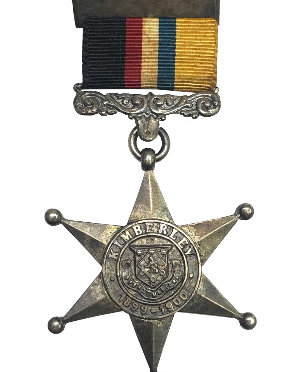
The Kimberley Star and Kimberley Medal were instituted in 1900 and awarded by the Mayor and Council of Kimberley to the defenders of the mining town against the Boer forces.

Two medals were struck in gold but about 5000 were produced in silver. The Kimberley medal (as opposed to the star) is a much scarcer award.

The Kimberley Star and Medal Design

The Star

The Kimberley Star is a six-pointed star with ball finials and a circular center and measures 43 millimeters high and 41 millimeters wide.

On the obverse is the inscription “KIMBERLEY 1899-1900” with the civic arms in the middle. The reverse is plain, except for the inscription “MAYOR’S SIEGE MEDAL 1900”. The medal’s ribbon is half yellow, half black, separated by narrow stripes of red, white and blue.

The suspension is a plain ring from a scrolled bar.

The Medal

The Kimberley Medal is a circular, struck in silver and measures 38 millimeters in diameter.

The obverse features the figure of Victory above the Kimberley Town Hall, with the dates 1899-1900 in the exergue. The reverse bears two shields with the inscription “INVESTED 15 OCT. 1899” and “RELIEVED 15 FEB. 1900”. The imperial crown appears above and the royal cipher underneath, with the legend “TO THE GALLANT DEFENDERS OF KIMBERLEY” around the circumference.

The Sultan of Zanzibar’s Medal

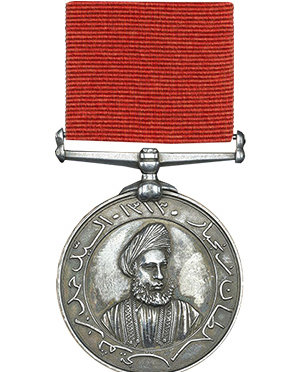
The Sultan of Zanzibar’s Medal was established in 1896 and awarded to the Zanzibari contingent who served under Lieut. Lloyd-Matthews RN in East Africa alongside British and Imperial forces.

The medal was awarded with the following clasps:

  • Pumwani
  • Jongeni
  • Takaungu
  • Mwele (inscribed only in Arabic)

The Sultan of Zanzibar’s Medal Design

The medal is circular, struck in silver and measures 36 millimeters in diameter.

The obverse shows a facing bust of Sultan Hamid bin Thwain surrounded by a Suaheli inscription in Arabic. The reverse has the same inscription in four lines.

The medal’s ribbon is plain bright scarlet.

The British North Borneo Company’s Medal 1888-1916

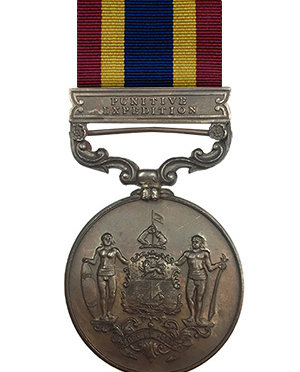
The British North Borneo Company’s Medal 1888-1916 is a British campaign medal established in 1897 and awarded for service in the 15 minor expeditions between 1883 and 1915, excluding the major action at Tambunan.

The manufacturers, Spink, supplied 12 silver medals in 1898-89 for award to officers, only three of which were named. In 1906 a further 74 silver medals were issued to be exchanged for the bronze ones initially awarded to other ranks. A further 11 silver medals were supplied unnamed later on. A total of 75 bronze medals were supplied, of which 25 were stamped with a name and sometimes rank and number.

The medal was awarded with the following clasps:

  • Punitive Expedition (1897)
  • Punitive Expeditions (1898-1915)
  • Rundum (1915)

The British North Borneo Company’s Medal 1888-1916 Design

The medal is circular, struck in silver or bronze and measures 38mm in diameter and 5mm thick.

The obverse shows the shield of the Company, supported by a warrior on either side. The company motto at the foot reads “ERGO ET PERAGO” (or “I carry and accomplish“). The reverse bears the British lion facing left, standing in front of a bush adorned with the Company flag, with a small wreath in the exergue.

The medal’s ribbon was initially gold (later yellow), watery silk and measuring 32 millimeters. It was replaced in 1917 by a 32mm ribbon with maroon edges, two yellow stripes and a dark blue central stripe. The central stripe was originally 6mm wide, although modern ones have a 10mm stripe.

The Uganda Star

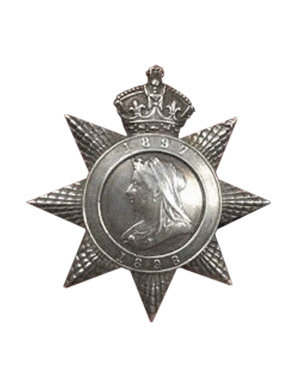
The Uganda Star is a British campaign medal approved by the Foreign Office and sanctioned by Queen Victoria in 1897 to acknowledge the loyalty of African tribal leaders.

In a few cases, the medal was also awarded to Sudanese troops (one Tunisian) who fought gallantry in quelling the serious mutiny of Sudanese troops of the Uganda Rifles.

It was for this action that British, Indian and Local forces were awarded to East and Central Africa Medal with the bar for Lubwa’s.

Only a total of 39 stars were awarded.

The Uganda Star Design

The medal is an eight-pointed uniface star struck in silver and surmounted by a crown. It was manufactured by Carrington of London and issues in a blue plush-lined case.

The obverse shows the dates 1897 and 1898 on a circular rim enclosing the Old Head or Veiled Bust of Queen Victoria. The reverse is plain.

The medal was awarded without a ribbon and was brooch-mounted.

The Khedive’s Sudan Medal 1896-1908

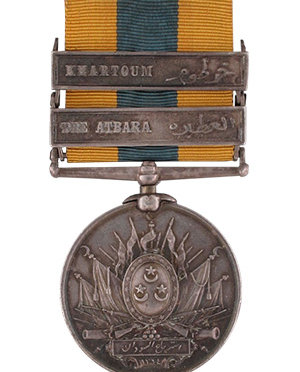
The Khedive’s Sudan Medal is a campaign medal established 12 February 1897 by Khedive Abbas Hilmi Pasha and awarded to Egyptian and British forces for service during the reconquest of Sudan and the final part of the Mahdist War.

The medal was initially created to commemorate the reconquest of the Dongola province in 1896, but subsequently authorized for later campaigns and actions until 1908. 

All those who received the Khedive’s Sudan Medal for service on the Nile during 1896-98 also received the Queen’s Sudan Medal.

The medal was awarded with fifteen different clasps, although it’s seldom seen with more than two:

  • Firket (7 June 1896)
  • Hafir (19-26 September 1896)
  • Abu Hamed (7 July 1897)
  • Sudan 1897
  • The Atbara (8 April 1898)
  • Khartoum (2 September 1898) (For the Battle of Omdurman)
  • Gedaref (7 September to 26 December 1898)
  • Gedid (22 November 1899)
  • Sudan 1899
  • Bahar-ed-Ghazal 1900-02
  • Jerok (January to March 1902
  • Nyam-Nyam (January to May 1905)
  • Talodi (2-15 June 1905)
  • Katfia (April 1908)
  • Nyima (1-21 November 1908)

The Khedive’s Sudan Medal 1896-1908 Design

The medal is circular and measures 39 millimeters in diameter. It was awarded in silver to soldiers of the Egyptian and British armies, and in bronze to a small number of non-combatants, mainly grooms from the Indian Army and officers’ servants.

The obverse of the medal shows the Arabic cipher of the Khedive, and the Hijri year 1314. The reverse features an oval shield superimposed over a trophy of flags and arms.

The ribbon is 38 mm wide, yellow with a broad center stripe of blue, representing the Nile flowing through the desert.

The medal hangs from a straight bar suspension. For British troops, the recipient’s name and details were engraved on the medal’s edge.

The Jummoo and Kashmir Medal

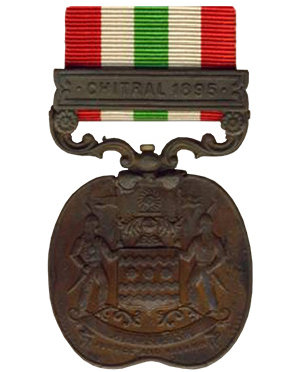
The Jummoo and Kashmir Medal is a British campaign medal established in 1895 and awarded by the Maharajah of Jummoo (Jammu) and Kashmir to the Indian troops who participated in the defense of Chitral, a dependency of Kashmir, during the siege of 4 March to 20 April by Chitralis and Afghans led by Umra Khan and Sher Afzur.

The medal always comes with the clasp and has the name of the maker (GURNEY LONDON) on the reverse. The medal in silver was presumably awarded to officers and the medal in bronze to other ranks.

The Jummoo and Kashmir Medal Design

The medal has a unique kidney shape and measures 35 millimeters high and 38 millimeters wide.

The obverse shows the arms of Jummoo (Jammu) and Kashmir. The reverse bears a view of Chitral fort with troops in the foreground.

The ribbon is white with red stripes at the edges and a central green stripe. 

The India Medal

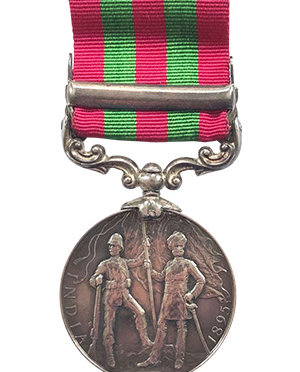
The India Medal was approved in 1896 and issued as an award to officers and men of the British and Indian armies.

The India Medal is a campaign medal approved in 1896 for issue to officers and men of the British and Indian armies. This medal replaced the India General Service Medal (1854).

The India Medal was awarded for various minor military campaigns in India, chiefly for service on the North-West Frontier from 1895 to 1902.

Each campaign was represented by a clasp on the ribbon of the medals. Seven were sanctioned:

  • Defense of Chitral 1895 (3 March – 13 April 1895)
  • Relief of Chitral 1895 (7 March – 15 August 1895)
  • Punjab Frontier 1897-98 (10 June 1897 – 6 April 1898)
  • Malakand 1897 (26 July – 2 August 1897)
  • Samana 1897 2 (August – 2 October 1897)
  • Tirah 1897-98 (2 October 1897 – 6 April 1898)
  • Waziristan 1901-02 (23 November 1901 – 10 March 1902)

The India Medal Design

The medal is circular, struck in silver for soldiers of the British and Indian armies, and in bronze to native bearers and servants. It measures 36 millimeters (1.4 in) in diameter.

The obverse bears the profile of Queen Victoria or, for those awarded the medal with the Waziristan 1901–02 clasp, King Edward VII, both with a suitable inscription. The reverse portrays a British and an Indian soldier together carrying a standard with the inscription “India 1895“, and the Edward VII version omits the date. The reverse was designed by G. W. de Saulles.

The ribbon measures 1.25 inches (32 mm) wide and has five equal stripes of red, green, red, green, red.

The name and details of the recipient were engraved on the edge of the medal, normally in running script.

The Hong Kong Plague Medal

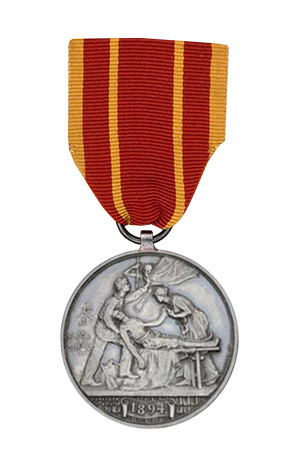
The Hong Kong Plague Medal was established in 1894 and awarded by the colonial authorities in Hong Kong to nurses, civil servants, police, British Army and Royal Navy personnel who rendered assistance when the crown colony was stricken by a severe epidemic of bubonic plague in 1894.

Even though stringent measures were taken, bubonic plague swept through Hong Kong from May to September 1894, claiming 2,500 lives. To deal with such a deadly epidemic, the Sanitary Board passed bye-laws on 11 May 1894 that permitted house-to-house searches to discover and isolate as soon as possible persons suffering from plague and to clean the houses in which plague was present. Initially, the work was carried out by the local European police inspectors and sergeants accompanied by Chinese constables and detectives, but as the epidemic spread like wildfire, the work soon exceeded the capacity of the local police.

About 400 medals were issued in silver and awarded to 300 men of the King’s Shropshire Light Infantry, 50 petty officers and ratings of the Royal Navy and NCOs and other ranks of the Royal Engineers, as well as about the same number of police and junior officials. Exactly 45 medals were struck in gold for award to officers, nursing sisters and senior officials.

The medal was not authorized for wear on uniform by the British troops.

The Hong Kong Plague Medal Design

The medal is circular, struck in silver or gold and measures 36 millimeters (1.4 in) in diameter.

The obverse shows a Chinese man lying on a bed being tended to by a female nurse while a man holds off the winged figure of Death. The figure of Death is aiming his spear at a plague-stricken Chinese man laid on a table. The woman, symbolizing Charity, has her right hand on the patient’s heart and her left hand holding a bottle of medicine. On the left the words ‘Hong Kong‘ are inscribed in Chinese characters, while a scroll shows the date 1894.

The reverse bears two inscriptions: ‘For services rendered during the plague of 1894‘ and ‘Presented by the Hong Kong Community‘.

The ribbon is red with yellow edges and two thin yellow stripes down the center. The naming is in impressed capitals giving the recipients rank, name, and regiment.

Notes

This page was updated on 21 March 2023. The medal showed an image that belonged to Liverpool Medals but didn’t show the correct attribution. 

The Central Africa Medal

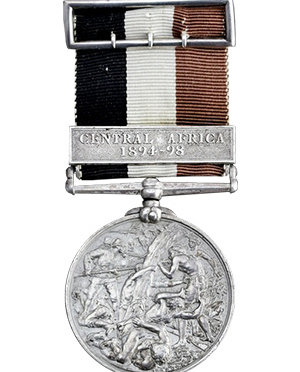
The Central Africa Medal is a campaign medal awarded for service in Eastern and Central Africa and 1894-1898 in British Central Africa.

The Central Africa Medal is a British campaign medal awarded for service 1891-1894 in Eastern and Central Africa, and 1894-1898 in British Central Africa.

Award of the medal was approved by Queen Victoria in Army Order No. 66, 1 April 1895. The initial decoration was for various military expeditions from July 1891 to June 1894, but was subsequently extended to the Unyoro Expedition in 1895 and later authorized for service in British Central Africa 1895-1898.

Most medals were awarded to members of the Indian Army and British-led local forces for suppressing slave-trading or to punish raids on neighboring tribes.

No British Army units were present, although some British officers and non commissioned officers seconded to local units received the medal, as did a small number of Royal Navy personnel.

The Central Africa Medal Design

The medal is circular, measures 36 millimeters (1.4 in) in diameter and was struck in silver to combatants and in bronze to native porters and authorized servants. The medal uses the same design as the Ashantee Medal and the East and West Africa Medal, although with a different ribbon.

The obverse shows the left-facing effigy of Queen Victoria wearing a diadem with a veil behind. On either side is the inscription VICTORIA on the left and REGINA on the right. The designer for the obverse was Leonard Charles WyonThe reverse shows a scene, inspired by the Ashanti War, of British soldiers fighting the Ashanti in the jungle. It was designed by Sir Edward John Poynter.

The ribbon measures 31.7 millimeters (1.25 in) wide, and has three equal stripes of black, white and pale brown, also described as copper or terra cotta. It was worn with the black to the left when facing the wearer and the colors symbolize the troops who took part – African, European, and Indian.

The recipient’s name and unit were usually engraved or impressed on the rim of the medal, although some were issued unnamed.