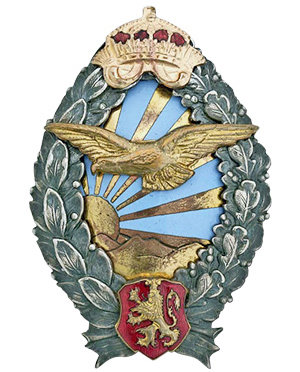
The Royal Bulgarian Pilot’s Badge

The Royal Bulgarian Pilot’s Badge was instituted in 1936 and often awarded to German pilots serving on the Balkans alongside Bulgarian airmen.

The badge is made in silvered bronze, white metal, and enamels. It measures 36 millimeters by 52 millimeters and is made of multiple pieces with a backing plate and fastening screw on the reverse. It was manufactured by Bulgarian and German manufacturers.

The Royal Bulgarian Pilot’s Badge was discontinued in 1944.
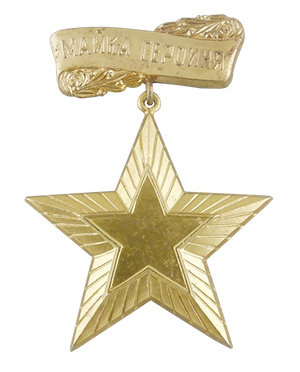
The Hero of Maternal Glory Medal

Time Period: Post-WW2
Year of Institution: 1950
Country: Bulgaria

The Hero of Maternal Glory Medal is a Bulgarian honorary title awarded to mothers who gave birth to and raised ten or more children. It was established by a decree of the Presidium of the First National Assembly on December 13, 1950, and until June 9, 1952. Originally named Hero Of Maternal Glory, this award was renamed Mother Heroine on 9 June 1952.

The medal is the sixth of ten honorary titles in the award system of the People’s Republic of Bulgaria. The change of the original name was dictated by the establishment of the three-degree Mother’s Glory Order, which has a different status of the honorary title.

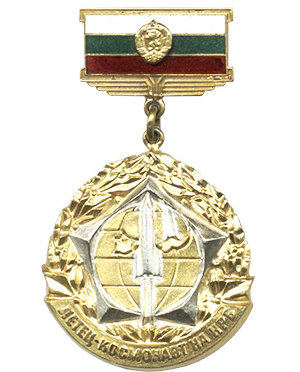
The Pilot-Cosmonaut Of The People’s Republic Of Bulgaria

The Pilot-Cosmonaut Of The People’s Republic Of Bulgaria was awarded to Bulgarian Cosmonauts, the only two being Georgi Ivanov, 1979 and Aleksandar Panayotov Aleksandrov, 1988.

Major general Georgi Ivanov Kakalov (Георги Иванов Какалов; born July 2, 1940) is a former military officer who was the first Bulgarian cosmonaut. He was selected to participate in the Soviet International Space Program Interkosmos in 1978 and to follow the Soyuz spaceship training program.

Aleksandr Panayotov Aleksandrov was the second Bulgarian to have flown to space. He launched aboard TM-5 as a Research Cosmonaut along with mission commander Anatoly Solovyev and Viktor Savinykh.

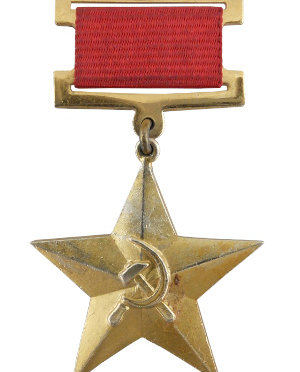
The Hero of Socialist Labor Medal (Bulgaria)

The Hero of Socialist Labour Medal is a Bulgarian Honorary Title awarded for exceptional achievements in the sphere of agriculture, science, education, culture, arts as well as for contributing to technical progress.

People awarded with this also received the Order Of George Dimitrov. The medal was renamed Hero Of Socialist Labor from Hero Of Labor on 13 December 1950.

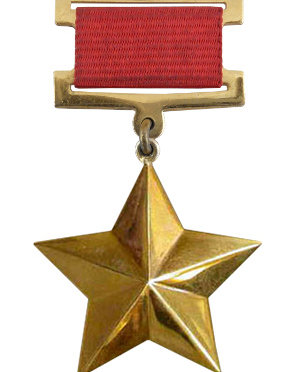
The Hero of the People’s Republic of Bulgaria Medal

The Hero of the People’s Republic of Bulgaria (or “Герой на Народна република България” in Bulgarian) is an honorary title awarded to Bulgarian and foreign citizens for merits in defending Bulgaria and other countries allied to Bulgaria.

The medal was established on 15 June 1948, and awarded until 1990. It was the highest honor of the People’s Republic of Bulgaria.

The Cross for the Proclamation of Bulgarian Independence in 1908

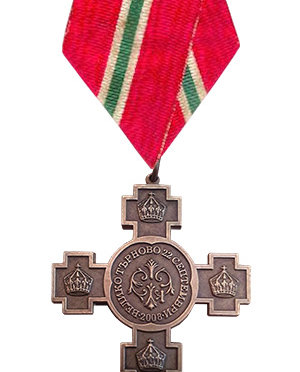
The Cross for the Proclamation of Bulgarian Independence in 1908 is a Bulgarian award given as a commemoration of the declaration of Bulgarian independence in 1908. The cross was only approved and minted during the second half of 1909 – a year after the events.

The cross was awarded to all generals, officers, and junkers who were serving at the time of the declaration of independence, as well as to various civil servants such as war veterans, clergy, local government officials and others.

The commemorative award was intended to be widely given among the Bulgarian nation. According to the registers, more than 11,000 people received the decoration, although the number of minted medals might have been even larger.

The Cross for the Proclamation of Bulgarian Independence in 1908 Design

The medal is a long crosslet cross measuring 40mm with a circular center and raised edges. It was designed by Paul Telge and produced in Germany. There are known very rare variations of the cross where the crowns are positioned towards the central medallion of the cross (possibly trial issues of the medal).

The obverse bears the royal cipher of King Ferdinand I, circumscribed by the text “ТЪРНОВО 22 СЕПТЕМВРИЙ 1908” (“Tarnovo 22 September 1908“), commemorating the place and the date of the declaration of the Independence. Crows are depicted in the four cross-sections of the cross arms.

The reverse bears a Bulgarian lion with a superimposed Saxon shield, circumscribed by “БЪЛГАРСКО ЦАРСТВО” (“Bulgarian Tsardom (Kingdom)”).

The ribbon is red with two white and one green thin stripes through the middle.

The Medal for the Incentive of Philanthropy

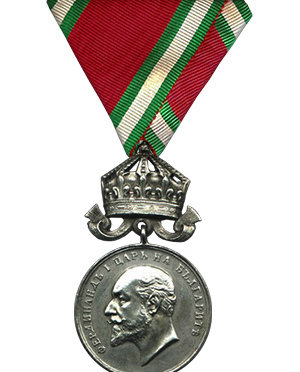
The Medal for the Incentive of Philanthropy is a Bulgarian award established on 15th/ 28th October 1908 and given as an incentive or reward for humanitarian and charitable activity, and one of the first decorations to be established after the declared Bulgarian independence in September 1908 (the other one being the Life-Saving Medal).

The medal was issued in three classes: Gold (made of yellowish metal alloy or gilded silver), Silver (made of solid silver) and Bronze (made of copper). All medals are being awarded with a crown suspension.

Awarded rather rarely, the stock of the medal with his effigy were used for decorations throughout the reign of His son, King Boris III, and even during the regency period, up until 1947.

The Medal for the Incentive of Philanthropy Design

The medal is circular and measures 29 millimeters in diameter. It was designed by Paul Telge and minted in Germany and Austro-Hungary.

The obverse bears the effigy of King Ferdinand I circumscribed by the text: “ФЕРДИНАНДЪ I ЦАРЬ НА БЪЛГАРИТѢ” (“Ferdinand I Tsar (King) of the Bulgarians“).

The reverse bears a circular laurel wreath with the motto of the medal inscribed on four lines: “ЗА НАСЪРДЧЕНИЕ КЪМЪ ЧЕЛОВѢКОЛЮБИЕ” (“For incentive of philanthropy.“)

The ribbon is red, with two green stripes and one white one on the edges.

The Medal for the Wedding of Knyaz Ferdinand and Marie-Louise

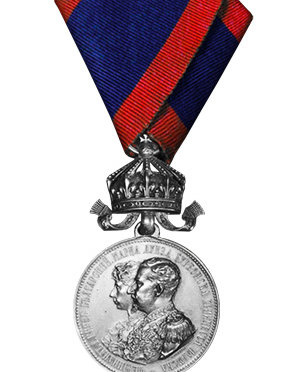
The Medal for the Wedding of Knyaz Ferdinand and Marie-Louise is a commemorative Bulgarian medal established on 3rd/15th May 1893 to celebrate the Prince’s wedding ceremony. The medal was instituted by the Monarch in the first days after his arrival back to Bulgaria as a married man.

There were three classes:

  • Gold (gilt) was awarded to senior Bulgarian statesmen and to foreign nationals, such as members of other European royal courts.
  • Silver with crown suspension was bestowed upon senior governmental officials, archbishops, army generals/senior officers, and foreign nationals.
  • Silver without crown suspension was given to members of Parliament, army officers, regional governors and officials.
  • Bronze with crown, rather rare, was awarded to a very small number of lower-ranking members of the Prince suite.
  • Bronze without crown, the most common variant, was awarded to a wide variety of mid and low-ranking governmental or army officials, ranging from municipality mayors, through army NCOs, down to mayors of small villages, through which the Prince and Princess have passed while traveling the country.

The Medal for the Wedding of Knyaz Ferdinand and Marie-Louise Design

The medal is circular and measures 32 millimeters in diameter. It was engraved by Anton Scharff and its production delegated to the famous Viennese company of Rothe & Neffe. More than 6,000 medals were minted and awarded. Some larger table-top variations of the medal exist.

The obverse bears the effigies of Prince Ferdinand I and Princess Marie-Louise of Bourbon-Parma, his spouse. Around them is inscribed: “ФЕРДИНАНДЪ I. КНЯЗЬ БЪЛГАРСКИЙ. МАРИА ЛУИЗА БУРБОНСКА ПРИНЦЕССА ПАРМСКА” (“Ferdinand I. Knyaz (Prince) of Bulgaria. Maria Louisa of Bourbon Princess of Parma”). A small five-pointed star sits at the bottom.

The reverse bears a decorative element with an imbued torch, two shields bearing the coat of arms of the two newlyweds, jointly crowned with the Bulgarian royal crown with elevated and embowed lappets. A scroll above it reads the motto “ВѢРNОСТЬ И ПОСТОЯNСТВО” (“Fidelity and Continuity“). Circumscribed are the dates of the wedding ceremony (8th April) and the date of the arrival of the royal couple in Bulgaria (30th April), with the year 1893 inscribed at the bottom.

The ribbon is navy blue with red bars on the edges.

The Medal for The 25th Anniversary of the April Insurrection of 1876

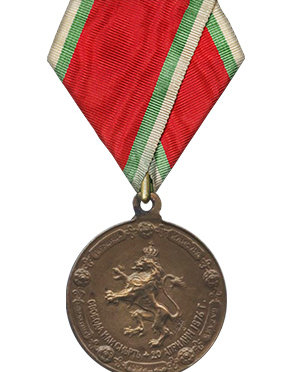
The Medal for The 25th Anniversary of the April Insurrection of 1876 is a Bulgarian medal founded by a royal decree and awarded to all the veterans who participated in the events of the spring of 1876.

While the first decorations were given personally by the Prince during the official ceremony held in the town of Panagyurishte, the rest were distributed to the local Veterans’ organizations in order to be awarded to the living participants of the insurgence.

The Medal for The 25th Anniversary of the April Insurrection of 1876 Design

The medal is circular and measures 34 millimeters in diameter. It was designed and manufactured in Bulgaria by the Nikola Sabev’s jewelry factory, and engraved by Boris Schatz.

The obverse bears a crowned lion with the motto of the insurgent and the day of its start inscribed in a semi-circle beneath it: “СВОБОДА ИЛИ СМЪРТЬ + 20 АПРИЛИЙ 1876 Г.” (“Freedom or death + 20 April 1876“). Along the edge there is a decorative ring made up of floral elements and rectangular plates, each bearing a name of a town that took a major part in the revolt: ПЕРУЩИЦА, КЛИСУРА, БАТАКЪ, КОПРИВЩИЦА and ПАНАГЮРИЩЕ.

The reverse bears a verse by the Bulgarian poet Hristo Botyov on six lines with a laurel branch beneath it: “ТОЗЪ КОЙТО ПАДНЕ ВЪ БОЙ ЗА СВОБОДА, ТОЙ НЕ УМИРА” (“They, who have fallen while fighting for their freedom, shall never die“). Along the edge and separated via four-pointed stars is inscribed: “ФЕРДИНАНДЪ Iй КНЯЗЬ БЪЛГАРСКИЙ НА ПОБОРНИЦИТѢ. 20 АПРИЛИИ 1901 Г.” (“Ferdinand Ist Knyaz (Prince) of Bulgaria [Gift] To the insurgents [veterans]. 20 April 1901“).

The ribbon is red, with green and white stripes n both edges.