The Life-Saving Medal

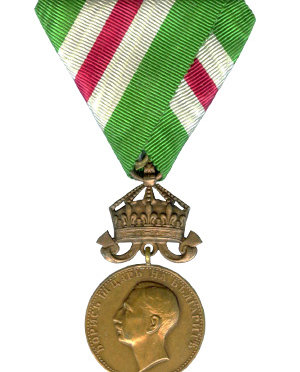
The Life-Saving Medal is a Bulgarian medal awarded to all Bulgarians for the rescue of people from natural (or other) disasters. There are 2 variations of this award: A Ferdinand I version and a version of his son, Boris III, who became king in late 1918.

This was one of the first decorations to be established after the declared Bulgarian independence in September 1908. It has three classes: gold, silver, and bronze.

The Life-Saving Medal Design

The medal is circular and measures 29 millimeters in diameter. It was initially engraved by designed by Paul Telge and produced in Germany. The golden medals were minted either of yellowing metal alloy or of gilt silver. The silver class was made of solid silver, and the bronze medals of bronze or bronze-colored metal alloy.

The obverse bears the effigy of King Ferdinand I or King Boris III circumscribed by the titles “ФЕРДИНАНДЪ I ЦАРЬ НА БЪЛГАРИТѢ” (“Ferdinand I Tsar (King) of the Bulgarians“) or “БОРИСЪ III ЦАРЬ НА БЪЛГАРИТѢ” (“Boris III Tsar (King) of the Bulgarians“).

The reverse bears a circular laurel wreath with the motto “ЗА СПАСЯВАНЕ ПОГИБАЮЩИ” (“For saving dying ones“) inscribed on three lines.

The ribbon is green, with small white stripes and one crimson stripe running through the middle.
The Medal For the Completion of the Yambol-Burgas Railway

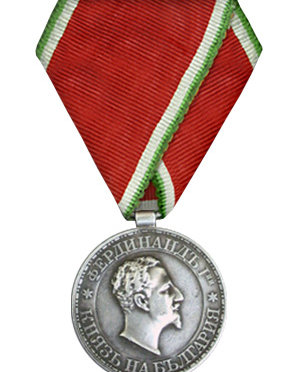
The Medal For the Completion of the Yambol-Burgas Railway is a commemorative Bulgarian medal established 14th/26th May and awarded to members of the Pioneer regiment who was responsible for the construction of the Yambol-Burgas railway in memory of the successful completion of the construction of the line.

While officers of the regiment were decorated with the silver medal, officer candidates, NCOs and enlisted men received the bronze medal.

The Medal For the Completion of the Yambol-Burgas Railway Design

The medal is circular and measures 30 millimeters in diameter. It was engraved by Joseph Cristlebauer and produced in Austro-Hungary.

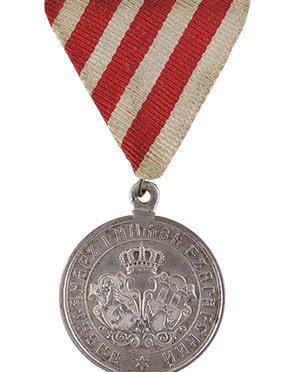
The obverse bears the effigy of Prince Ferdinand I circumscribed with the inscription “ФЕРДИНАНДЪ Iий КНЯЗЬ НА БЪЛГАРИЯ” (“Ferdinand Ist Knyaz (Prince) of Bulgaria“). The sections are separated with two six-pointed stars.

The reverse bears a winged wheel with lightning bolts positioned below a smaller badge of a crossed spade and axe, surmounted by a roulette. The inscription along the edge reads “ЯМБОЛЪ – БУРГАСЪ 14. МАЙ 1890” (“Yambol – Burgas 14. May 1890“).

The ribbon is red and has a thin white border and thin green stripes on both edges.

The Medal For The Accession Of Knjaz Ferdinand I

The Medal For The Accession Of Knjaz Ferdinand I is the first decoration that newly elected Prince Ferdinand I implemented, and he did so in order to commemorate his accession to the Throne. Around 2000 awards of this type were given to low ranking clerks, local mayors, senior officers, archbishops, ministers, generals, and foreign nationals.

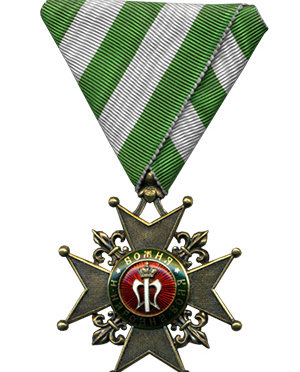
The designs on the reverse of the medal indicate the background of the new Monarch: The Saxon shield for his dynastical past, and the Maltese cross with lilies as an allusion to His French royal bloodline. The colors of the ribbon reference the Saxe-Coburg-Gotha duchy.

The Medal For The Accession Of Knjaz Ferdinand I Design

The medal is a maltese cross with beaded points, circular center and fleurs-de-lis in between the arms, and measures 42 millimeters in diameter. It manufactured by C. F. Rothe in Vienna.

The obverse of the first class depicts a circle enameled in red, with the royal cipher of Prince Ferdinand I in white with a gilded crown. Inscribed on the green enameled outer ring is “БОЖИЯ И НАРОДНА ВОЛЯ” (“By the will of God and nation“). The second class doesn’t have any enamel on the central medallion, and the third class is silvered instead of gilded.

The reverse has a circular central medallion, enameled in black and golden horizontal stripes (the Saxon coat of arms) with an inscription on the outer ring enameled in green: “25 ЮЛIЙ 2 АВГУСТЪ 1887” (“25th July 2nd August 1887“). 2nd class is gilded and 3rd is silvered.

The ribbon consists of three light-green and two white alternating stripes, triangular when awarded to men and bow-shaped when presented to ladies.

The Medal For Participation In The Serbo-Bulgarian War 1885

The Medal For Participation In The Serbo-Bulgarian War 1885 is a Bulgarian medal awarded to Bulgarian veterans of the 14–28 November 1885 war with the Kingdom of Serbia in late 1885. Due to the Prince’s forced abdication, these decorations were suspended in September 1886.

The medal was minted in two classes: Silver, for the soldiers and officers who took part in the battles with the Serbian military, and Bronze, for all military men who did not participate in the battles directly or to civilians who helped the army during this conflict.

The Medal For Participation In The Serbo-Bulgarian War 1885 Design

The medal is circular and measures 33 millimeters in diameter.

Version 1:

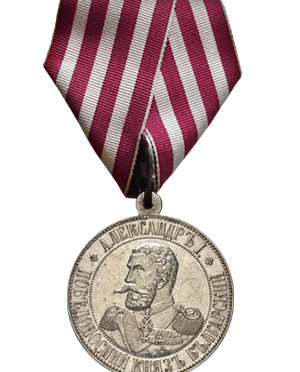
The obverse depicts Prince Alexander I in a semi-profile, dressed in full parade uniform. Circumscribed is a text (of which there are two variations). In Russian: “АЛЕКСАНДРЪ I ПОБѢДОНОСНЫЙ КНЯЗЬ БЪЛГАРIИ” (“Alexander I Victorious Knyaz (Prince) of Bulgaria“). In Bulgarian: “АЛЕКСАНДРЪ I. ПОБѢДОНОСНИЙ КНЯЗЪ БЪЛГАРСКИЙ” (“Alexander I Victorious Bulgarian Knyaz (Prince)“).

The reverse features the Greek goddess of victory Nike mounted upon a flying eagle. She holds a palm leaf on her left hand, and her right one is elevated and holding a laurel wreath. Along the edge of the medal is inscribed one of the following. In Russian: “ВЪ ПАМЯТЬ СЛАВНОЙ 1885 КАМПАНIИ“ and a five-pointed star. In Bulgarian: “ВЪ ПАМЯТЪ НАСЛАВНАТА ВОЙНА ВЪ 1885 ГОД“ and a decorative beaded flower of six foils. Both texts are translated as “In memory of the glorious campaign (or war) of 1885”.

Version 2:

The obverse bears the coats of arms of Bulgaria and Eastern Rumelia, conjoined together with the Hessen royal crown on top. In a circle along the edge is inscribed, in a Slavonic script: “АЛЕКСАНДРЪ I КНЯЗЬ БЪЛГАРСКИЙ” (“Alexander I Bulgarian Knyaz (Prince)“) and a six-pointed star.

The reverse has the inscription “БЛАГОДАРНОТО ОТЕЧЕСТВО НА СВОИТѢ ХРАБРИ СИНОВЕ 1885” (“The grateful fatherland to its brave sons 1885“) written on four lines and positioned within a circular laurel wreath entwined with a ribbon. Its sections bear the names of the towns or locations, where the battles of the Serbo-Bulgarian war took place (ДРАГОМАНЪ, ЦАРИБРОДЪ, ПИРОТЪ, ВИДИНЪ, СЛИВНИЦА, ГОРГУЛЯТА, БРѢЗНИКЪ).

For both versions, the ribbon consists of four purple and three white equally-sized alternating stripes.

The Medal For The Coronation of Knjaz Alexander of Battenberg

The Medal For The Coronation of Knjaz Alexander of Battenberg is a rare commemorative Bulgarian medal established during the second half of 1879.

It was a personal award, given on behalf of the newly elected Monarch to members of the first Bulgarian cabinet, members of the Prince’s private suite, his relatives from the Grand Duchy of Hesse, and Imperial Russian generals serving in Bulgaria among others.

The Medal For The Coronation of Knjaz Alexander of Battenberg Design

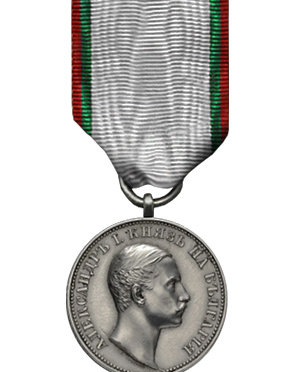
The medal is circular and measures 27 millimeters in diameter. The obverse depicts the effigy of Prince Alexander I in profile, circumscribed by His royal title: “АЛЕКСАНДРЪ I. КНЯЗЬ НА БЪЛГАРIЯ” (translation: “Alexander I. Knyaz (Prince) of Bulgaria“). The reverse bears an engraving of the Bulgarian coat of arms with two lion-supporters standing upon a decorative floral element and a scroll stating “ЗА СПОМЕНЪ 1879“ (translation: “In memory 1879“).

The medal was designed by the famous engraver Karl Schwenzer and struck in Austro-Hungary.

The ribbon is white, edged with thin green and red stripes on both sides.

The Medal in Memory of the Glorious 1885 Campaign

The Medal in Memory of the Glorious 1885 Campaign is a Bulgarian medal established in 1886 and awarded to Bulgarian veterans of the 14–28 November 1885 war with the Kingdom of Serbia during the reign of Alexander I.

This medal was replaced by the “For Participation In The Serbo-Bulgarian War 1885” medal after the abdication of Alexander I (the last ones were issued in September 1886).

The Medal in Memory of the Glorious 1885 Campaign Design

The medal is circular and measures 33 millimiters in diameter. It was issued in two variations: one with Russian text and one with Bulgarian text.

The Medal of Merit (Bulgaria)

The Medal of Merit was established by Prince Alexander on 25th December 1881 for merits to the Bulgarian nation and the Crown.

The medal was awarded in three possible classes: Golden, silver and bronze. The gold medal, awarded only a handful of times, as it could only be given to people who already had been distinguished with a Grand cross or First class of a Bulgarian order. Silver and bronze medals were more common, usually intended for army officers and civil servants. The bronze medal was usually awarded to enlisted men, NCOs, clerks, and other low-ranking civil servants.

The Medal of Merit Design

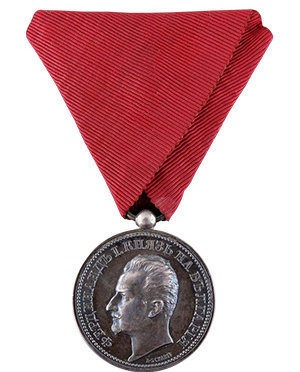
The medal is circular and measures 27 millimeters in diameter. The golden classes were produced of a silver base (or another metal alloy) and then gilded.

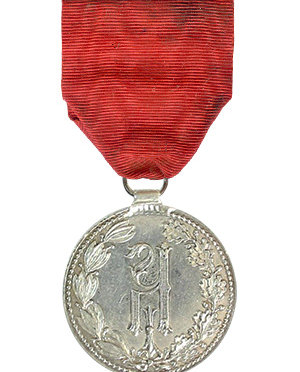
The obverse depicts the effigy of the ruling monarch with His royal title circumscribed (Knjaz Alexander, Knjaz Ferdinand, Tsar Ferdinand I, Tsar Boris III or Tsar Boris III). The reverse features in the middle the inscription “ЗА ЗАСЛУГА” (Translated “For merit“), with a five-pointed star beneath it. Both are placed within a circular wreath of oak and laurel twigs bound together with a ribbon at the bottom.

The ribbon is in the crimson color of the Royal Order of St Alexander.

The Medal For The Allocation Of War Banners To The Bulgarian Army

The Medal for The Allocation of War Banners To The Bulgarian Army is a Bulgarian medal established on 30 August 1881 and personally awarded by Knjaz Alexander during a solemn ceremony on the same day to the senior officers of the Bulgarian Army, the high-ranking officials, the battalion commanders, and their aide-de-camp and standard bearers.

There are two variations of this medal, one with a Royal Hessen type crown between the ribbon and medal and one without.

The Medal For The Allocation Of War Banners To The Bulgarian Army Design

The medal has a diameter of 20 millimeters. The ribbon was narrow and red.

The Medal for Participation in the Patriotic War of 1944-1945

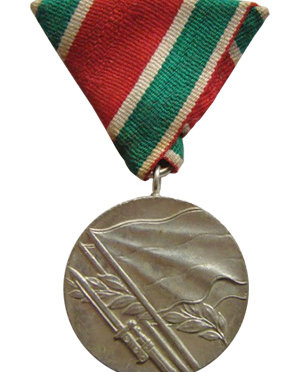
The Medal for Participation in the Patriotic War of 1944-1945 (or За Участие В Отечествената Война 1944–1945 г) was instituted on 9 September 1945 and awarded to those who participated in fighting Nazi German and other fascist forces between 9 September 1944 and 9 May 1945 (following the Soviet invasion of Bulgaria in September 1944 Bulgarian troops fought with the Soviet army against the Germans).

The medal was awarded over 195,000 times and was canceled in 1991.

The Medal for Participation in the Balkan Wars 1912-1913

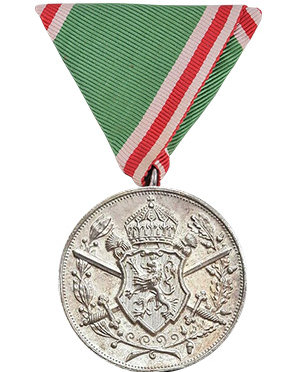
The Medal for Participation in the Balkan Wars 1912-1913 (or За Участие В Балканските Войни 1912-913 г) was instituted on 9 December 1933 and awarded to Bulgarian participants of the 1912-1913 Balkan wars.

The medal was created by decree and awarded to both military and civilians until 31 December 1939. The First Balkan War ended with the Treaty of London on 30 May 1913. However, the victors fell out over the division of the spoils, with Serbia and Greece forming an alliance against Bulgaria and the Second Balkan War broke out at the end of June. An armistice was agreed on 31 July with Bulgaria losing most of her gains from the First War, Serbia becoming the dominant Balkan power and a lingering sense of Bulgarian grievance that would lead to her participation in both World Wars on the side of the Central Powers.

About 300,000 medals were awarded.

The Medal for Participation in the Balcan Wars 1912-1913 Design

The medal is circular, 2.8mm thick, made of silver, and has a loop for ribbon suspension.

The obverse bears the crowned state coat of arms imposed on crossed swords and encircled by a wreath of oak and laurel. The reverse shows the dates ‘1912-1913’ encircled by a wreath of wheat, oak, roses and laurel.

There are 3 variations in this medal, each indicated by a different ribbon. Additional white or black stripes were included for civilians and participants killed in action.