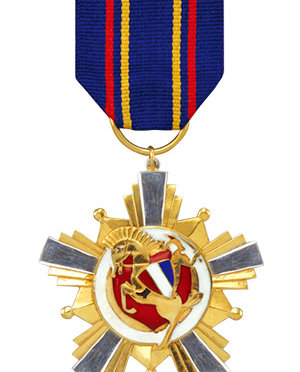
The Order Of The Imperial Dragon or Bao Xing Merit Medal

The Order Of The Imperial Dragon or Bao Xing Merit Medal is a military award given to British and French government officials and civilians.

The Order Of The Imperial Dragon, also known as the Bao Xing Merit Medal is a Chinese military award given to British and French government officials and civilians. The medal was authorized by Imperial Decree in 1862, designed in the Western Style and awarded to those who contributed to the defeat of the Taiping Rebellion between 1850 to 1864.

The Bao Xing Merit Medal was influential in the design and creation of the later instituted Order of the Double Dragon in 1882.

The Bao Xing Merit Medal Design

The medal is struck in 24ct gold and it has a unique high handcrafted quality with exquisite attention to detail. All figures and characters are hand-carved from a single gold disc.

For the First Class, the obverse depicts two dragons pursuing a central red cabochon. The outer border is a stylized “thunder scroll” design. The reverse features the Chinese characters for Da Qing Yu Xi (Great Qing Imperially Awarded First Class Award).

The medal measures 381. mm (w) by 54 mm (including the suspension) and weights 46.6 grams. It was awarded with a tassel consisting of a green braided knot (Yun Tou or Cloud Head knot) with parallel blue and red tassels, upper suspension composed of a secondary braided blue Yun Tou.

The Wu Pei Fu Qualification Award For Public Affairs

The Wu Pei Fu Qualification Award For Public Affairs is a Chinese medal established c. 1912 and awarded for “virtuous behavior”.

The Wu Pei Fu Qualification Award For Public Affairs is a Chinese medal established c. 1912 and awarded for “virtuous behavior”.

Wu Peifu was an important figure and warlord who played a significant role in the Republic of China (in the struggles between the warlords who dominated Republican China) between 1916 and 1927.

This medal was issued in the region of Hebei during the War Lords Era (1912-1928).

The Wu Pei Fu Qualification Award For Public Affairs Design

The medal is a three-piece construction, struck in silver and decorated with enamels. It measures 50.7 by 51 millimeters.

The obverse features Chinese characters, which changes depending on what the medal was awarded for.

The Air Force Distinguished Service Medal (Taiwan)

The Air Force Distinguished Service Medal is a Taiwanese medal established in 1980. The medal is decorated in gilt and enamels.

The Air Force Distinguished Service Medal is a Taiwanese medal established in 1980. The medal is decorated in gilt and enamels and measures 45 by 50 millimeters.

The Order of Brilliant Jade

The Order of Brilliant Jade is a civilian order established in 22 December 1933 and that can be worn only by the head of a nation.

The Order of Brilliant Jade (or 采玉大勳章 in Chinese) is a civilian order of the Republic of China instituted on 22 December 1933 and that can be worn only by the head of a nation.

According to regulations, the order can only be presented by the president of the country or an emissary expressly dispatched to friendly nations for the conferment. The Chinese official name of the order was claimed to be named after President Chiang Kai-shek’s mother, Wang Caiyu (王采玉) by Democratic Progressive Party members of Legislative Yuan. There are suggestions from the pan-green coalition to rename the order to suit Taiwanese locality as “Order of Taiwan”, but this was not passed at the Legislative Yuan in April 2007 because it faced opposition from the Kuomintang.

Previously, the Order of the Brilliant Jade was divided into two, namely Grand Order of Brilliant Jade (current) and Order of Brilliant Jade with nine ranks.

The Order of Brilliant Jade Design

The Order has a star-patterned face of inlaid jade bordered with gold and pearls. In the center, there is white sun surrounded by a blue sky, the national emblem.

The Order of the Cloud and Banner

The Order of the Cloud and Banner is a military award of the Republic of China awarded for contributions to national security.

The Order of the Cloud and Banner (or 雲麾勳章/雲麾勛章 in Chinese) also known as the Order of the Resplendent Banner is a military award of the Republic of China.

It was instituted on June 15, 1935 and is awarded in nine grades for contributions to national security such as putting down civil strife or for military exploits.

The Order is awarded in nine classes:

The order is organized into nine grades:

  • 1st, with Special Grand Cordon.
  • 2nd, with Grand Cordon.
  • 3rd, with Yellow Grand Cordon.
  • 4th, with Special Cravat.
  • 5th, with Cravat.
  • 6th, with Special Rosette.
  • 7th, with Rosette.
  • 8th, with Special Ribbon.
  • 9th, with Ribbon.

The Order of the Cloud and Banner Design

The insignia of the order features a fluttering yellow flag, surrounded by white clouds on a blue field. This image is surrounded by golden rays.

The Order of the Sacred Tripod

The Order of the Sacred Tripod or Pao Ting is a military award of the Rep. of China created in 1929 for contributions to national security.

The Order of the Sacred Tripod (or 寶鼎勳章 in Chinese), also referred to as the Order of the Precious Tripod or Pao Ting, is a military award of the Republic of China created on 15 May 1929 and awarded for significant contributions to national security.

The medal is the general medal of the three services of the Republic of China to commend those who defend against foreign aggression. Its rank is lower than the Blue Sky and White Sun Medal and higher than the Yun Yun Medal.

The order is organized into nine grades:

  • 1st, with Special Grand Cordon.
  • 2nd, with Grand Cordon.
  • 3rd, with Red Grand Cordon.
  • 4th, with Special Cravat.
  • 5th, with Cravat.
  • 6th, with Special Rosette.
  • 7th, with Rosette.
  • 8th, with Special Ribbon.
  • 9th, with Ribbon.

The grade received vary according to military rank. The first to fourth are awarded to general officers. The third to sixth ranks are awarded to school officers. The fourth to seventh ranks are awarded to lieutenants. Waiting officers, warrant officers, and soldiers are awarded the sixth to ninth class.

The Order of the Sacred Tripod Design

The central design of the order’s insignia is an image of a tripod surrounded by golden rays. The symbolism of this is that as the tripod is considered a national treasure, so too is the recipient of the order.

The Order of Loyalty and Valor

The Order of Loyalty and Valor s a military award created on 23 September 1944 and awarded for outstanding command in battle.

The Order of Loyalty and Valor (忠勇勳章 in Chinese) is a military award from the Republic of China created on 23 September 1944 and awarded for outstanding command in battle.

The Order is awarded by the President to soldiers who have killed the enemy bravely, for being wounded and not treating, or for commanding battle in danger. It can also be given tho those that defend the people, are loyal to duties, or perform heroic acts beyond the ordinary during a peace period.

The Order only has one grade.

The Order of Loyalty and Valor Design

The ribbon is dark blue with narrow red and yellow edge stripes.

The Imperial Grand Order

The Imperial Grand Order is a Chinese Order established in 1911 alongside four other medals to replace the Order of the Double Dragon.

The Imperial Grand Order is a Chinese Order established on 20 March 20 1911 (alongside four other ones) to replace the Order of the Double Dragon. Given its origins and history, it was felt that the Double Dragon was no longer adequate to meet the needs of China as a modern nation. A new system of national honors was needed to serve diplomatic protocol and, more importantly, the needs of Chinese citizens including the Emperor.

On April 2, 1909 the boy Emperor Puyi (or the regent Prince Chun) directed the Ministry of Foreign Affairs, the Army Ministry, and the Administration Bureau to develop a new system of awards. Two years later on 20 March 1911, the Emperor approved the establishment of five new awards:

  • The Grand Precious Order (Da Bao Zhang, 大宝章, also known in the West as the “Grand Order of the Throne”) intended for the Emperor.
  • The Orders of the Red Dragon and the Yellow Dragon, for members of royal families.
  • The Orders of the Blue Dragon and the Black Dragon, for nobles and high officials.

The first four existed in one class only, while the Black Dragon existed in eight classes.

The Imperial Grand Order Design

There are illustrations of this badge in the book Xun Zhang Tu (“Pictures of Orders”) or Ordres Imperiaux de Chine, which was printed for the Qing government by the royal press in Vienna.

The Order was a star comprising two rings of eight rays, one blue and one red, for a total of 16 points. The center medallion was bordered with pearls.

On the obverse, the Twelve Symbols of Imperial Authority are clearly visible as are the circle of pearls bordering the center medallion. According to the Book of Rites, one of the Five Classics of the Confucian canon, “Twelve is the number of Heaven”. The reverse bears the name of the Order (Da Bao Zhang, 大宝章) in the Chinese seal script. The breast star was the badge mounted on a star composed of eight groups of ascending diamond-cut rays.

The ribbon was Imperial yellow.

The Order of the Double Dragon

The Order of the Double Dragon was an order founded by the Guangxu Emperor on 7 February 1882 and awarded in the late Qing Dynasty.

  • Time Period: Pre-WW1 Period
  • Year of Institution: 7 February 1882
  • Country: China (Qing Dynasty)

The Imperial Order of the Double Dragon or ‘Double Dragon Precious Star’ (双龙宝星 in simplified Chinese, 雙龍寶星 in Chinese and Shuānglóng Bǎoxīng in pinyin) was an order awarded in the late Qing dynasty.

The Order was founded by the Guangxu Emperor on 7 February 1882 and awarded for outstanding services to the throne and the Qing court. It was the first Western-style Chinese order, established in the wake of the Second Opium War as part of efforts to engage with the West and adopt Western-style diplomatic practices.

Originally, the Order was bestowed only on foreigners but was extended to Chinese subjects from 1908. Traditionally the Chinese court did not have an honors system in the Western sense; however hat buttons, rank badges, feathers and plumes were routinely awarded by the Emperor to subjects and foreigners alike prior to and after the introduction of the Order of the Double Dragon.

The order was replaced in 1911 during the last days of the Qing dynasty by the Grand Order of the Throne, although this replacement was never fully implemented and the Republic of China discontinued the imperial orders after its establishment in 1912.

The order consisted of five classes, the first three of which were divided into three grades.

  • First Class, First Grade: for emperors and kings of foreign nations.
  • First Class, Second Grade: for princes, and royal family members and relatives (later limited to royal family members who had earned, and not inherited, senior positions in government).
  • First Class, Third Grade: for ministers of who had inherited their position, general ministers, and diplomatic envoys of the first rank.
  • Second Class, First Grade: for diplomatic envoys of the second rank.
  • Second Class, Second Grade: for diplomatic envoys of the third rank and customs commissioners.
  • Second Class, Third Grade: for counselors of the first rank, consul-generals and military generals.
  • Third Class, First Grade: for counselors of the second and third rank, the entourage of consul-generals, and second-tier military officers.
  • Third Class, Second Grade: for deputy consuls, and third-tier military officers.
  • Third Class, Third Grade: for translators and military officers of the fourth and fifth tiers.
  • Fourth Class: for soldiers and non-commissioned officers.
  • Fifth Class: for businessmen and traders.

The Order of the Double Dragon Design

The order took on many different designs and forms, mostly differentiated by the type and size of precious stones inlaid, the shape of the medallion, the length of the ribbon, and the material used to construct the medallion until its abolition in 1911. Gold and pearl were reserved for the higher classes of the Order, and enamel and coral for the lowest classes.

The original designs were similar in style and appearance to traditional Chinese insignia, but they proved cumbersome for many to wear and in 1897 they were redesigned in the form of a Western-style breast-badge, although the original designs were still awarded for some time afterward. Similar symbolic motifs accompanied all designs over the award’s history, most notably two dragons surrounding a central precious stone and flames which were connotative symbols of imperial authority. Other symbols of imperial authority – mountains, clouds, plum blossoms, and characters with providential meanings – were added to variations of the designs over time.

The Order of Liberation

The Order of Liberation is a Chinese military award given to heroes of the Liberation of mainland China during the Second Chinese Civil War.

The Order of Liberation (解放勋章 in Chinese, Jiěfàng Xūnzhāng in pinyin) was a Chinese military award awarded to heroes of the Liberation of mainland China during the Second Chinese Civil War between 3 September 1945 and 30 June 1950.

The Order was established by the Standing Committee of the National People’s Congress and awarded by the President of the People’s Republic of China. The recipients of the award were the soldiers and civilian personnel of the Chinese People’s Liberation Army and the former members of the Republic of China Army who participated in the uprising.

The medal was awarded in three grades:

  • First Class Medal.
  • Second Class Medal.
  • Third Class Medal.

The Order of Liberation Design

The liberation medals bear a central red star and Tiananmen Square. It’s rumored that the First Class Liberation Medal is struck in pure gold.

The ribbon has one, two, or three red vertical red bars on a yellow background, depending on the class.