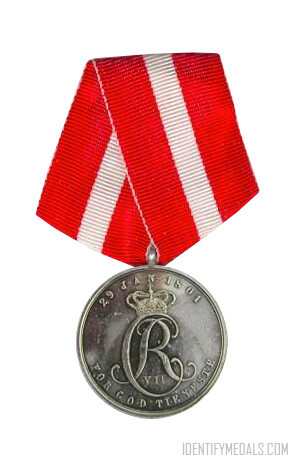
The Long Service Awards (Denmark)

The Danish Long Service Medals (Navy, Army, Air Force, and Department of Defense) may be awarded after 25 years of service.

Denmark’s primary governmental uniformed services offer long service medals for 25 years of service, with additional honors for extended service.

The awards include medals for the Navy, Army, Air Force, and other defense services, each instituted by Danish monarchs at various times. For instance:

  • Navy: Established in 1801 for 25 years of service.
  • Army: Established in 1945 for 25 years of service.
  • Air Force: Established in 1953 for 25 years of service.
  • Department of Defense: Established in 1953 for 25 years of service.
  • Armed Forces Reserves: Established in 1978 for 25 years of service.
  • Home Guard: Established in 1988, awarded for 25, 40, 50, and 60 years of service.
  • Civil Defense: Established in 1963 for 25 years of service.
  • Municipal Fire Departments: Established in 1973 for 25 years of service.
  • Police: Established in 1959 for 25 years of service.

High-ranking officers may receive the Order of Dannebrog after 25 years, while the Medal of Merit can be awarded after 40 years of public service. These medals recognize dedication and commitment, providing official acknowledgment and benefits to long-serving personnel.

The Long Service Awards Design

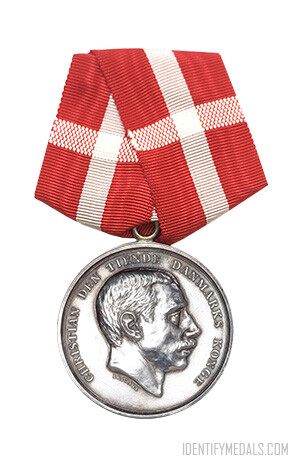
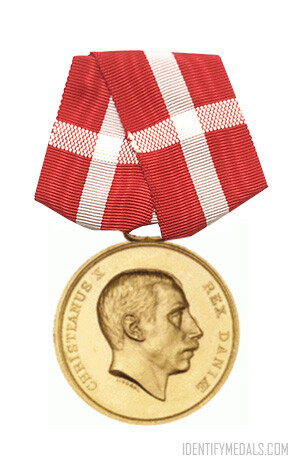
The medal is round and features a profile of the reigning monarch on the obverse. The reverse side often includes an inscription indicating the years of service and the specific branch.

The ribbon color and pattern vary by  service branch, often incorporating the national colors of Denmark. For extended service, such as 40 years, additional elements like gold or silver oak leaves are added to the ribbon.
The Defense Medal for Bravery

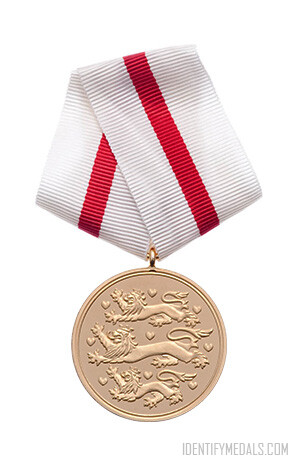
The Defense Medal for Bravery was established in 1996 and is awarded for actions during combat or terrorist activities.

The Defense Medal for Bravery (or Forsvarets Medalje for Tapperhed in Danish) is a distinguished award that can be given to both civilian and military personnel for their actions during combat or terrorist activities.

Established on 30 October 1996, the medal was first awarded on 13 May 1997. It is presented as the personal property of the recipient and does not need to be returned upon their death. The medal can also be awarded posthumously. 

Following the deployment of Danish soldiers during the civil war in the former Yugoslavia, members of the UNPROFOR force exhibited acts of heroism. To honor their bravery, the Danish State and Armed Forces sought to create a new bravery decoration. This led to the establishment of the Defense Medal for Bravery in 1996 by Queen Margrethe II. The first presentation took place on 13 May 1997, where seven soldiers were honored at a parade at Kastellet.

The Defense Medal for Bravery Design

Multiple awards of the medal are indicated by silver oak leaves for the second award and gold oak leaves for the third.

The Valor Cross (Denmark)

The Valor Cross or Tapperhedskorset was established in 2011 and is awarded for outstanding acts of courage in combat.

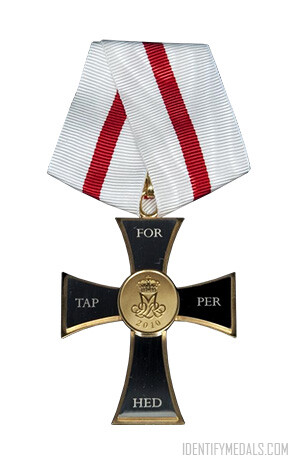
The Valor Cross (or Tapperhedskorset in Danish) is Denmark’s highest military decoration, established on 14 November 2011 and first awarded on 18 November 2011.

The Valor Cross is awarded for extraordinary courage demonstrated during combat, where the soldier acts selflessly in a clearly dangerous situation. The actions must either contribute significantly to accomplishing an important mission or save the lives of others. It is Denmark’s highest military honor, equivalent to the British Victoria Cross or the United States’ Medal of Honor.

Since its inception, the Valor Cross has been awarded only once. The first recipient, Sergeant Casper Westphalen Mathiesen of the Engineer Regiment in Skive, Denmark, was honored for his actions on 19 February 2010 while serving with ISAF in Afghanistan. During a firefight, Sergeant Mathiesen risked his life to protect a wounded comrade, successfully holding off the enemy and enabling his comrade to receive medical attention.

The Valor Cross Design

The Valor Cross is a silver cross pattée with a gilded edge, featuring a longer lower arm.

The obverse side displays a gold medallion at the center, adorned with the Queen’s monogram above the year 2010. Each arm of the cross carries three letters of the inscription “FOR TAPPERHED” (meaning “for valour”). The reverse side is engraved with the recipient’s name, rank, and the location and year of the honored event.

The cross is suspended from a white ribbon with a red center stripe. When worn as a ribbon bar, it resembles the Defence Medal for Bravery but includes a miniature of the gold medallion from the center of the cross.

The Greenland Medal for Meritorious Service 

The Greenland Medal for Meritorious Service is the highest award based in Greenland. It was first established on 1 May 1989.

The Greenland Medal for Meritorious Service (or Nersornaat, meaning ‘Deserved’ in Greenlandic; Grønlands Hjemmestyres Fortjenstmedalje in Danish) is the highest award given by the Greenland Home Rule government.

Instituted on 1 May 1989 to mark the tenth anniversary of Greenlandic home rule, this medal honors individuals who have rendered exceptional service to Greenland in areas such as public service, business, art, or science. 

The Nersornaat Design

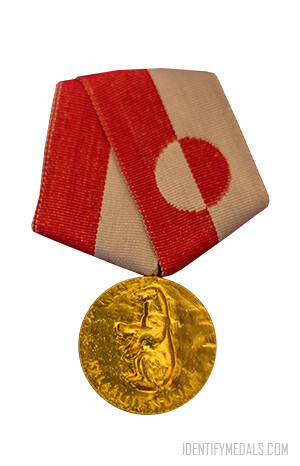
The medal shows a bear and the inscription “Kalaallit Nunaat” in the obverse.

The ribbon features the Greenlandic colors, with red symbolizing the sun and white symbolizing the snow, and is awarded in two grades: gold and silver.

The Medal for Noble Deeds

The Medal for Noble Deeds was established in 1793 to recognize the saving of a life at great risk to the rescuer and the rescued.

The Medal for Noble Deeds (or Medaljen for Ædel Dåd in Danish) is a prestigious Danish award given to individuals who have saved a life while putting themselves at great risk.

Established on 12 June 1793 by King Christian VII at the suggestion of the Finance Collegium, the Medal for Noble Deeds recognizes acts of extraordinary bravery. It is currently overseen by the Ministry of Justice.

Due to its stringent criteria, the medal is rarely awarded; as of 2011, there were only eight living recipients. On 25 September 2015, the medal was awarded to three women and a man for their heroic actions during the Præstø Fjord accident on 11 February 2011.

This medal honors those whose selfless acts of courage and bravery exemplify the highest standards of heroism, often resulting in the saving of lives under perilous circumstances. 

The Royal Medal of Recompense

The Royal Medal of Recompense was established in 1865 and is given for 40 or 50 years of service to the same private employer.

The Royal Medal of Recompense (or Den Kongelige Belønningsmedalje in Danish) is a prestigious Danish medal awarded at the discretion of the Monarch. Established by King Christian IX, the medal is currently given to individuals who have dedicated 40 or 50 years of service to the same private employer.

This honor was created by King Christian IX through an ordinance on 4 September 1865. The statutes governing the medal are updated with each new Danish monarch, with the latest statutes adopted on 1 November 1972 and minor amendments made on 28 November 1986 and 25 January 1988.

The Royal Medal of Recompense Design

Produced by the Royal Mint of Denmark, the medal is round and measures 28 millimeters in diameter. It is available in gilded silver (gold medals) or plain silver and comes in versions with or without a crown surmounting the medal.

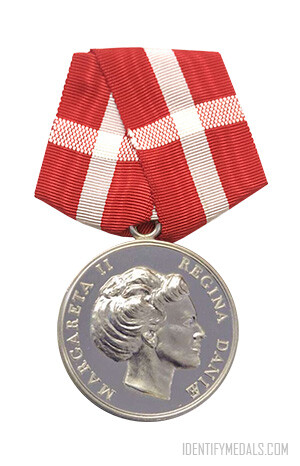
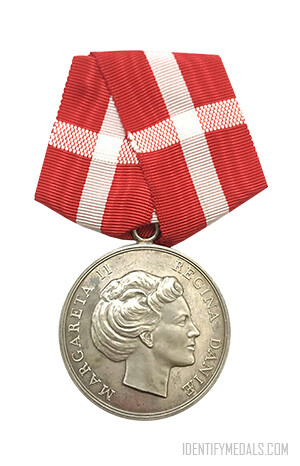
The obverse features a profile effigy of Queen Margrethe II, encircled by the inscription “Margareta II – Regina Daniæ.” The reverse displays a wreath of oak leaves. Each recipient’s name is engraved on the edge, signifying that the medal is their personal property and does not need to be returned upon their death, unlike some chivalric orders.

The medal is suspended from a red ribbon with a white cross.

The Ingenio et Arti Medal

Ingenio et Arti is a Danish medal established in 1841 and awarded to prominent Danish and foreign scientists and artists.

Ingenio et arti, translating from Latin as “For Science and Art,” is a prestigious Danish medal awarded to distinguished Danish and international scientists and artists. Established by King Christian VIII in 1841, this honor reflects the monarch’s personal recognition of exceptional contributions to the fields of science and the arts. Notably, it is awarded to both men and women, highlighting a commitment to inclusivity from its inception.

Awards are given irregularly, averaging fewer than two per year, making it a rare and highly esteemed accolade. As of May 2021, the most recent recipient was John Neumeier, honored after the premiere of his ballet “Mahler’s 3rd Symphony” at the Copenhagen Opera House on 19 May 2021. This infrequency of awards underscores the exceptional level of achievement required to be considered for this honor.

The Ingenio et Arti Medal Design

The medal’s reverse features “The Genius of Light,” an engraving based on the 1841 plaster relief by renowned sculptor Bertel Thorvaldsen. This artistic choice underscores the medal’s dedication to celebrating brilliance and enlightenment in both scientific and artistic endeavors.

The Medal of Merit (Denmark)

The Medal of Merit was established by Christian VII on 16 May 1792 and given as a personal award by the sovereign of Denmark.

The Medal of Merit (or Fortjenstmedaljen in Danish) is the oldest existing award medal given by the Kingdom of Denmark.

It was established by Christian VII on 16 May 1792 and was re-instituted by ordinance of Christian VIII on 24 July 1845. This prestigious medal is a personal award bestowed by the Sovereign.

This decoration highlights the individual achievements and contributions of the recipients, honoring their distinguished service and merit in a manner that is both personal and enduring.

Medal of Merit Design

The Medal of Merit comes in two versions, made of either gold or silver.

The obverse features a profile effigy of the reigning monarch, currently Queen Margrethe II, along with the inscription “Margareta II – Regina Daniæ.

The reverse side bears the word “Fortient” (Merit) encircled by an oak leaf wreath. Uniquely, the recipient’s name is engraved on the edge of the medal, signifying that it is the personal property of the recipient and is not returned upon their death, unlike some chivalric orders.

The medal is suspended from a red ribbon with a white cross, reflecting the national colors of Denmark.

The Order of the Dannebrog

The Order of the Dannebrog is a Danish order of chivalry (with a single class, the “White Knights”) established in 1671 by Christian V.

The Order of the Dannebrog (or Dannebrogordenen in Danish) is a Danish order of chivalry established by Christian V in 1671. Originally, membership was limited to fifty noble or royal individuals, who were known as White Knights, distinguishing them from the Blue Knights of the Order of the Elephant.

In 1808, the Order was reorganized into four classes. A Royal Ordinance in 1951 amended the Order’s statute to allow both men and women to become members. Today, the Order of the Dannebrog honors and rewards individuals for meritorious civil or military service, significant contributions to the arts, sciences, or business, and efforts in promoting Danish interests.

The Order is divided into six grades grouped into four classes:

  • Special class
    • Grand Commander (Storkommandør; S.Kmd.
  • First Order class
    • Grand Cross (Storkors; S.K.)
  • Second Order class
    • Commander 1st Class (Kommandør af 1. grad; K.1
    • Commander (Kommandør; K.)
  • Third Order class
    • Knight 1st Class (Ridder af 1. grad; R.1
    • Knight (Ridder; R.)

The Order of the Dannebrog Design

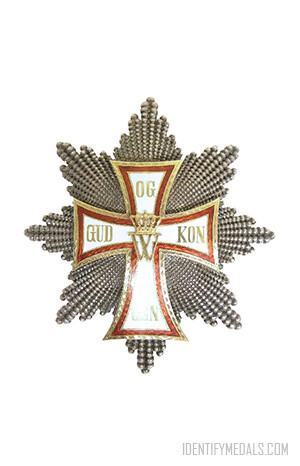
The badge of the Order of the Dannebrog is a white enameled Dannebrog cross, characterized by a longer lower arm and red enameled borders. For Knights, the badge is in silver, while for higher ranks it is in gold or silver gilt. At the top of the cross is the royal cypher of the reigning monarch, crowned with the distinctive Danish royal crown. The obverse of the cross features Christian V’s royal cypher at the center, along with the Order’s motto, “Gud og Kongen” (God and the King), on its arms. The reverse side displays the crowned royal cyphers of Valdemar II Sejr, Christian V, and Frederik VI, alongside the years 1219, 1671, and 1808, marking their respective ascensions to the Danish throne. Each of the four angles of the cross contains a small Danish royal crown.

The star of the Order is an eight-pointed silver star with straight rays, featuring an enamelled Dannebrog cross at the center, similar to the badge but without the royal cypher and crowns. The breast cross resembles the star’s cross but is larger, with faceted silver instead of white enamel, and lacks the silver rays.

The ribbon of the Order is made of white silk moiré with red borders, reflecting Denmark’s national colors.

The Order of the Elephant

The Order of the Elephant is an order of chivalry established in Denmark during the 15th century. The badge is a white elephant.

The Order of the Elephant (or Elefantordenen in Danish) is Denmark’s highest honor and a prestigious order of chivalry. Though it has roots in the 15th century, it was officially established in its current form in 1693.

The Order traces back to a 15th-century religious confraternity, the Fellowship of the Mother of God, limited to Danish aristocrats. The confraternity’s badge depicted the Virgin Mary and Child within a crescent moon, hung from an elephant-themed collar. Although the confraternity dissolved after the Reformation in 1536, King Frederick II continued using an elephant badge, inspired by the confraternity’s chaplain’s insignia.

In its current form, the Order was established on 1 December 1693 by King Christian V, limited to 30 noble knights plus the Grand Master (the king) and his sons. In 1958, the statutes were amended to allow both men and women to join.

The Order’s emblem, featuring an elephant and a castle, is inspired by the Indian howdah, a carriage mounted on an elephant’s back, a design the Danes encountered during their colonial rule in parts of India. The Indian howdah has been replaced with a European castle, but the elephant rider remains.

The Order of the Elephant Design

The Order of the Elephant features a gold collar made up of alternating elephants and towers. The elephants’ covers bear the letter “D” for Dania, the medieval Latin name for Denmark. The collar is typically worn only on New Year’s Day during the Danish monarch’s New Year’s Court and on major occasions like coronations or jubilees.

Originally, knights wore a distinctive habit on very solemn occasions, consisting of a white doublet, breeches, stockings, and shoes, with a red mantle lined in white and embroidered with the Order’s star. A short white shoulder cape with gold flames and the Order’s collar was worn over this. The ensemble was completed with a black hat featuring a plume of white and red ostrich feathers.

The Badge

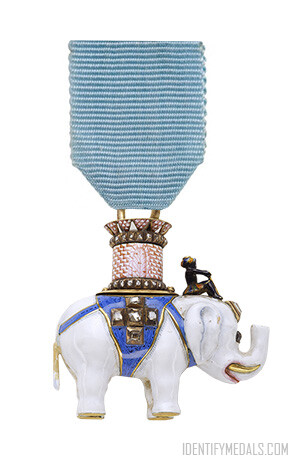
The badge is a white-enameled gold elephant with blue housings, approximately 5 cm high. It carries a pink-enameled watch tower adorned with diamonds. A colorfully attired Moorish mahout sits in front of the tower, holding a golden rod. The elephant has a diamond on its forehead and smaller diamonds for eyes, a cross of five diamonds on its right side, and the reigning monarch’s crowned monogram on its left. The badge can be hung from the collar or tied to the sash via a large enameled gold ring at the top of the tower. About 72 such elephants exist at the Order’s chancery or in circulation, with an estimated total of around 100, including those in museums.

The Star

The star of the Order is an eight-pointed silver star with smooth rays. It features a red enamel disc with a white cross at the center, surrounded by a silver laurel wreath, and is worn on the left side of the chest.

The Sash

The sash is made of light-blue silk moiré, 10 cm wide for men and 6 cm wide for women. It is worn over the left shoulder, with the elephant resting on the right hip. The collar is not worn when the sash is used.