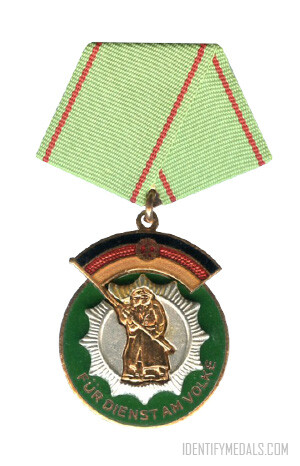
The Decoration of the German People’s Police

The Scharnhorst Order was the highest award for members of the East German National People’s Army (NVA). It was created in 1966.

The Decoration of the German People’s Police (or Auszeichnung der Deutschen Volkspolizei in German) was established in the German Democratic Republic to recognize the dedication and exemplary service of police personnel.

This medal was instituted in 1954 by the Ministry of the Interior to reward the hard work and achievements of the officers in maintaining public order and safety.

The award highlighted the importance of the People’s Police in the socialist state, showcasing their role in protecting the interests of the state and its citizens.

The Award Criteria

The criteria for receiving the Decoration of the German People’s Police included demonstrating outstanding performance in service, exceptional bravery, and significant contributions to public safety.

The medal was awarded to officers who exhibited exemplary conduct, effectiveness in law enforcement, and notable achievements in their duties. It was intended to motivate and acknowledge the police force’s efforts in upholding the law and securing the GDR’s socialist order. The decoration came in multiple classes, which included Bronze, Silver, and Gold, each reflecting the level of merit and service rendered by the recipient.

The Award Design

The design of the Decoration of the German People’s Police featured a circular medal made of bronze, silver, or gold, depending on the class.

The obverse showcased the emblem of the People’s Police, which included a stylized shield with elements representing law enforcement.

The reverse side had an inscription highlighting the award’s purpose and the year of issuance. The medal was attached to a ribbon, usually in green with stripes of black, red, and yellow, reflecting the GDR’s national colors.

This ribbon was worn on the left chest, signifying the recipient’s distinguished service.
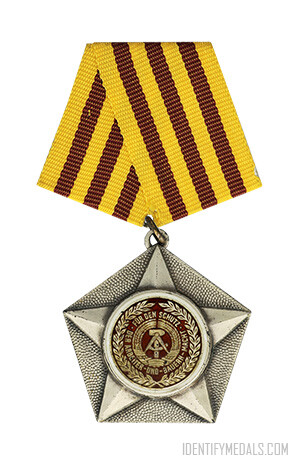
The Combat Order of Merit for the People and the Fatherland

The Combat Order of Merit for the People and the Fatherland was awarded to honor outstanding achievements in enhancing combat.

The Combat Order “For Merit to the People and Fatherland” was a state award in the German Democratic Republic, designed as a merit order to honor outstanding achievements in enhancing the combat strength and readiness of the National People’s Army and protecting the GDR’s borders.

Established on February 17, 1966, the Combat Order was awarded to members of the National People’s Army (NVA), the Border Troops, their respective units, subunits, facilities, and collectives. It was also awarded to individuals outside these organizations. The order could be awarded multiple times in each of its three classes: Gold (highest), Silver (middle), and Bronze (lowest).

The Order Classes and Awarding Process

The order was created in three classes, each signifying different levels of merit:

  • Gold 
  • Silver
  • Bronze 

The Minister of National Defense awarded the Combat Order on significant dates such as Republic Day (October 7), the anniversary of the NVA (March 1), and the anniversary of the Border Troops (December 1), or immediately following notable achievements. Recipients were given a certificate and a monetary reward, except for units and facilities.

Officially, the award recognized exceptional contributions in various areas, including:

  • Socialist military education of youth
  • Leadership and training within military units
  • Personal commitment and readiness
  • Maintenance and development of military equipment and technology
  • Contributions to military science
  • Actions benefiting the construction and protection of socialism in the GDR
  • Strengthening fraternal ties with socialist brother armies

The Banner of Labor Design

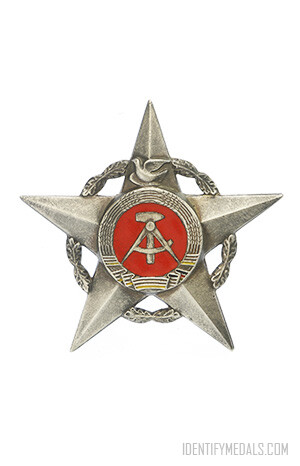
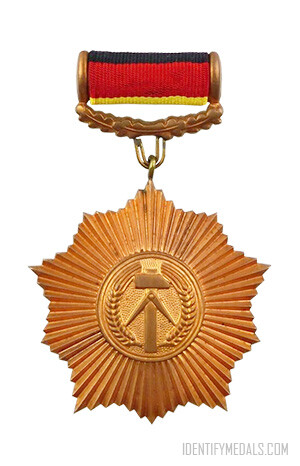
The medal was designed as a pentagonal hammered plate with a five-pointed star of the same size superimposed on it.

At the center was a medallion on a red enameled background, featuring the state emblem of the GDR, surrounded by the inscription “For the Protection of the Workers and Peasants Power” and flanked by laurel branches. The medallion was encircled by a white enameled ring with a diameter of 22 mm.

The order was made from either gilded silver, silver, or bronze, or from hard metals with similar finishes after 1973. It measured 40 mm at its widest point and had a smooth or textured back, depending on the year of manufacture.

The medal was worn on a large pentagonal clasp covered in a gold and reddish-brown striped ribbon, each stripe measuring 3.5 mm wide. The medal was worn on the upper left chest.

The Scharnhorst Order

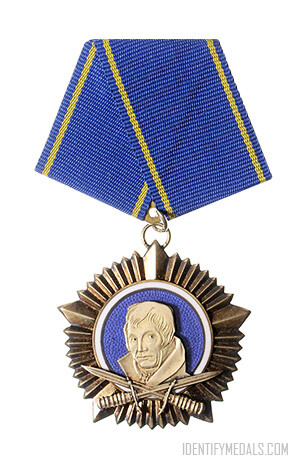
The Scharnhorst Order was the highest award for members of the East German National People’s Army (NVA). It was created in 1966.

The Scharnhorst Order (or Scharnhorst-Orden or Scharnhorstorden in German) was the premier military decoration awarded to members of the East German National People’s Army (NVA). Instituted on February 17, 1966, by the Council of Ministers of the German Democratic Republic (GDR), it honored those who made significant contributions to the military or other areas vital to strengthening the GDR. The decoration was bestowed from its inception until the dissolution of the GDR in 1990.

The Scharnhorst Order commemorates Gerhard Johann David von Scharnhorst (1755-1813), a distinguished soldier who served in the Hanoverian and Prussian armies. Renowned as a military theorist and reformer, Scharnhorst advocated for significant changes in the Prussian military system and emphasized the strategic role of the General Staff. His writings and reforms laid foundational principles that the GDR’s National People’s Army sought to emulate. The GDR authorities celebrated Scharnhorst as a forward-thinking military strategist and a patriot, whose ideals resonated with their vision for a robust and efficient military force.

The Scharnhorst Order Award Criteria

The Scharnhorst Order was awarded for outstanding military service, significant contributions to the protection of the GDR, and efforts in strengthening the national defense. It was primarily conferred upon generals and admirals but also recognized units, associations, and civil bodies within the following contexts:

  • National People’s Army (NVA): Typically awarded on March 1, the anniversary of the NVA.
  • Border Troops of the GDR (Grenztruppen – GT): Presented on December 1, the anniversary of the GT.
  • Civil Defense of the DDR (ZV): Given on February 11, the anniversary of the ZV.
  • Ministry of State Security (Stasi): Bestowed on February 8, the anniversary of the Stasi.

In addition to military personnel, the order could be awarded to members of various other institutions within the GDR, including civil facilities and foreign military figures. An example of a foreign recipient was Marshal Viktor Georgiyevich Kulikov of the Soviet Union.

The Scharnhorst Order Design

The design of the Scharnhorst Order was the work of Klaus Bernsdorf from Berlin, with the portrait of Scharnhorst on the medal sculpted by Fritz Schulz, also from Berlin.

The medal featured a striking depiction of Scharnhorst surrounded by elements that symbolized military strength and strategic acumen, reflecting his legacy and the award’s prestige.

Each award was accompanied by an elaborately crafted document and a one-time cash prize of 5,000 Marks, underscoring the honor and significance of the Scharnhorst Order.

The Blücher Order

The Blücher Order was established in 1965 and supposed to be awarded to NVA soldiers as a valor award in a time of war.

The Blücher Order (or Blücher-Orden in German) was a military decoration in the German Democratic Republic, named after Prussian Field Marshal Gebhard Leberecht von Blücher, celebrated in the GDR for his role in defeating Napoleon Bonaparte’s forces.

Established in 1965 by Walter Ulbricht, Chairman of the Council of State, the Blücher Order was intended to be awarded to soldiers of the National People’s Army (NVA) for acts of valor during wartime. However, the GDR never entered a state of war, and as a result, the decoration was never officially awarded. On January 25, 1985, the National Defence Council ordered the immediate minting of 8,000 medals, but these were never distributed for their intended purpose. Today, some of these medals are exhibited in the Military History Museum of the Bundeswehr, and a bronze medal is displayed at the Canadian War Museum.

The Blücher Order Design And Classes

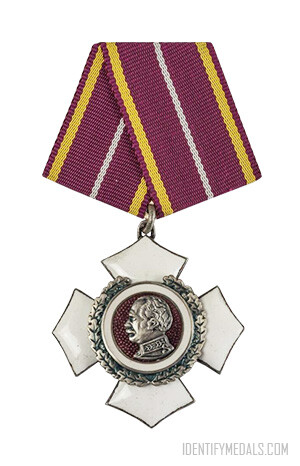
The Blücher Order came in two main types: a cross and a medal, each divided into three classes—bronze, silver, and gold.

The Blücher Cross

The cross was designed as a white cross with a central portrait of Gebhard Leberecht von Blücher, surrounded by a wreath of oak leaves. The color of the oak leaves indicated the class of the award: bronze, silver, or gold. The cross was suspended from a red ribbon with two yellow stripes along its edges. Additionally, the silver class featured a silver stripe in the center of the ribbon, and the gold class featured a gold stripe.

The Blücher Medal

The medal was round, displaying an image of the cross on its front. It was attached to a yellow ribbon, with blue stripes down its center, which varied in color according to the medal class.

The Star of People’s Friendship

The Star of People’s Friendship was established 20 August 1959 and awarded for exceptional merit towards friendship between nations.

The Star of People’s Friendship (or Stern der Völkerfreundschaft in German), also known as the Star of Nations’ Friendship, was a prestigious order awarded by the German Democratic Republic. Established on August 20, 1959, this award was conferred upon individuals of exceptional merit who had significantly contributed to the promotion of understanding and friendship between nations, as well as the preservation of peace.

The award was presented on the recommendation of the presidency of the Council of Ministers (Präsidium des Ministerrates) and conferred by the chairman of the Council of State (Vorsitzender des Staatsrates) or in his name. Each recipient of the Star of People’s Friendship was also given a certificate, underscoring the formal recognition of their contributions.

The Star of People’s Friendship was part of the GDR’s broader strategy to promote its socialist ideals and foster international cooperation. By awarding this order to both domestic and international figures, the GDR sought to highlight and strengthen its diplomatic ties and promote the idea of global socialist solidarity. The award ceremonies were significant events, often held on important state occasions, further emphasizing the GDR’s commitment to peace and international friendship.

Star of People's Friendship Classes

The Star of People’s Friendship was categorized into three classes, each reflecting the level of contribution and distinction of the recipient:

  • 1st Class – Grand Star of People’s Friendship (Großer Stern der Völkerfreundschaft): This was the highest class, reserved for the most distinguished contributions.
  • 2nd Class – Star of People’s Friendship in Gold (Stern der Völkerfreundschaft in Gold): Awarded for significant but slightly lesser contributions than the 1st Class.
  • 3rd Class – Star of People’s Friendship in Silver (Stern der Völkerfreundschaft in Silber): Recognized notable contributions in fostering international friendship and peace.

Star of People's Friendship Design

The design of the Star of People’s Friendship features a five-pointed star, signifying excellence and distinction.

The center of the star displays a prominent emblem of the GDR, surrounded by elements that symbolized peace and international solidarity, such as olive branches or a globe.

The medal’s design varies slightly between the different classes, with the Grand Star often being larger and more elaborately decorated than the gold and silver versions.

The Banner of Labor (DDR)

The Banner of Labor was established in 1954 and awarded for excellent and long-standing service in strengthening and consolidating the GDR.

The Banner of Labor (or Banner der Arbeit in German) was an esteemed order in the German Democratic Republic, established on August 4, 1954. It was designed to honor individuals, collectives, enterprises, and organizations for “excellent and long-standing service in strengthening and consolidating the GDR, especially for achieving outstanding results for the national economy.”

The creation and evolution of the Banner of Labor reflected the GDR’s focus on recognizing and incentivizing productivity and loyalty to socialist ideals. By rewarding outstanding service and economic contributions, the GDR aimed to promote a culture of excellence and collective achievement, which was central to its ideological framework. The award ceremonies, held on a significant day for workers worldwide, reinforced the state’s commitment to labor and its role in building a socialist society.

The Banner of Labor Classes

Initially introduced in a single class, it was later divided into three classes on August 8, 1974, each with associated cash awards.

  • 1st Class: The highest distinction, accompanied by a cash award of 1,000 East German marks. This class was limited to 250 awards per year.
  • 2nd Class: Included a cash award of 750 East German marks, with an annual limit of 500 awards.
  • 3rd Class: Came with a cash award of 500 East German marks, limited to 1,000 awards per year.

For collectives with up to 20 members, the cash awards were scaled to 2,000, 3,500, and 5,000 marks per member, respectively, depending on the class.

The Banner of Labor Criteria

The Banner of Labor was awarded to individuals and collectives across all three classes. Enterprises, collective organizations (Kombinate), institutions, and cooperatives were eligible for the 1st Class award. A prerequisite for receiving this order was that individuals or members of collectives had already received other state awards, ensuring that the recipients had a history of recognized contributions.

The order could be awarded multiple times in any class and could also be granted to citizens of other countries, reflecting its broad scope of recognition.

Awards were presented annually on May 1st, coinciding with International Workers’ Day, by the Chairman of the State Council or his representative. Recipients also received a certificate alongside the medal.

The Banner of Labor Design

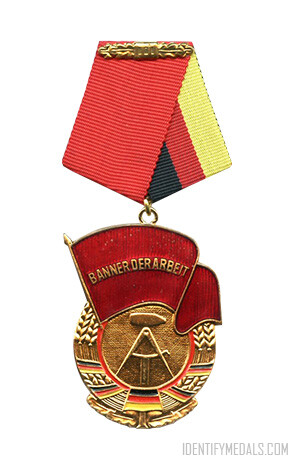
The Banner of Labor medal is gilded and measures 44 x 37 mm. It was designed to be worn on the left chest.

The medal features a prominent red banner with the inscription “Banner der Arbeit,” surrounded by a wreath of oak leaves, symbolizing strength and endurance. At the center, the emblem of the GDR—a hammer and compass, surrounded by a ring of rye—highlights the award’s connection to labor and socialism.

Establishments awarded the Banner of Labor were entitled to display a symbol of the order on their flag and official documents

The Patriotic Order of Merit (DDR)

The Patriotic Order of Merit was a national GDR award established in 1954 and awarded for special services to the state and to society.

The Patriotic Order of Merit (or Vaterländischer Verdienstorden in German) was a prestigious national award in the German Democratic Republic (GDR), established in 1954. It was granted annually to individuals and institutions for exceptional contributions to the state and society across various fields, including politics, economics, culture, and military service.

The Patriotic Order of Merit was often awarded during significant state anniversaries and events, highlighting the recipient’s alignment with socialist values and contributions to the GDR’s development. For instance, in 1968, Party Chief Walter Ulbricht awarded Karin Janz a silver Patriotic Order of Merit, recognizing her contributions to sports and the international prestige of the GDR.

The order served not only as a personal accolade but also as a tool for promoting the state’s values and rewarding loyalty to the socialist cause. It embodied the GDR’s emphasis on collective achievement and the importance of contributing to the state’s socialist ideology.

The Patriotic Order of Merit Criteria

The official language for the award outlined its purpose as being given “for outstanding merit”:

  • In the struggle of the German and international labor movement and in the fight against fascism.
  • In the establishment, consolidation, and fortification of the German Democratic Republic.
  • In the fight to secure peace and advance the international influence of the German Democratic Republic.

Each level of the order could be awarded only once to an individual or institution. With the exception of recipients of the honor clasp, all awardees also received a monetary sum as part of their recognition.

The Patriotic Order of Merit Classes

The Patriotic Order of Merit was structured into several classes, reflecting the level of contribution and achievement:

  • Honor Clasp in Gold: This was the highest distinction, awarded for exceptional merit and typically conferred upon those with an extraordinary impact on the state and society.
  • Gold, 1st Class: Recognized significant contributions across various sectors.
  • Silver, 2nd Class: Awarded for notable achievements, albeit at a slightly lower level than the gold class.
  • Bronze, 3rd Class: Given for commendable service and contributions that were still worthy of national recognition.

The Patriotic Order of Merit Design

The award featured a distinctive design. It was a ten-pointed star, with a central medallion displaying the state crest of the GDR. The medallion was enameled in red for the gold and silver classes, signifying the highest levels of honor. 

The medals were suspended from a ribbon that was red with gold accents, highlighting the importance of the award.

The Order of Karl Marx

The Honored Activist Medal was a state award of the GDR conferred as an honorary title and granted to workers and employees.

The Order of Karl Marx (or Karl-Marx-Orden in German) held the distinction of being the most prestigious decoration in the German Democratic Republic (GDR).

Instituted on May 5, 1953, to commemorate the 135th anniversary of Karl Marx’s birth, this honor marked the “Karl Marx Year” in East Germany and was established based on the recommendation of the GDR Council of Ministers. Recipients of the Order of Karl Marx not only received the medal but were also awarded a monetary prize of 20,000 East German marks, emphasizing the significant recognition associated with this award.

In essence, the Order of Karl Marx served as a powerful emblem of recognition for outstanding service and contributions to the socialist cause, both within the GDR and internationally, embodying the values and aspirations of the East German state.

The Order of Karl Marx Criteria

The medal was bestowed upon individuals, enterprises, organizations, and military groups that demonstrated exceptional merit in various fields such as ideology, culture, economy, and beyond. Not limited to East German citizens, the order could also be conferred upon foreign nationals, reflecting its international prestige and the GDR’s effort to acknowledge global contributions to socialism and related fields.

The Order of Karl Marx Medal Design

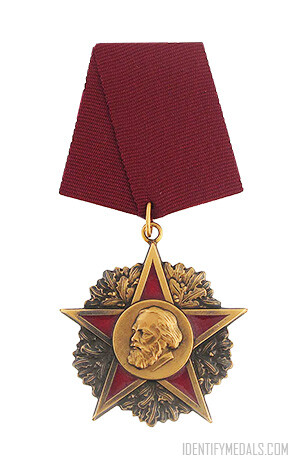
The DDR Order of Karl Marx featured a red enameled five-pointed gold star with oak leaves between the points.

At the center of the star and in the obverse, a gold bust of Karl Marx was prominently displayed on a round gold plaque.

The reverse side of the medal bore either the gold content number or the award number, ensuring authenticity and traceability. This meticulous design symbolized the honor and esteem associated with the award, drawing parallels with the Soviet Order of the October Revolution, but replacing the cruiser “Aurora” with the iconic image of Karl Marx.

The medal was mounted on a plain red ribbon, adhering to the standard East Bloc pentagonal pattern, and the ribbon bar featured a central gold “oak leaf” motif.

The Honored Doctor of the People Medal

The Honored Activist Medal was a state award of the GDR conferred as an honorary title and granted to workers and employees.

The title Honored Doctor of the People (or Verdienter Arzt des Volkes in German) was the highest national award of the German Democratic Republic or GDR for medical professionals, presented in the form of an honorary title with a certificate and a wearable medal.

The honorary title was established on March 31, 1949. The creation of this title was driven by the increasing tendency of doctors to move to West Germany. To retain this essential professional group in the GDR, the German Economic Commission introduced this honorary title along with various privileges.

The Honored Doctor of the People Medal Criteria

The title was awarded for significant and outstanding achievements in scientific medical research, practical medical work, health protection organization, university teaching, and the training of medical personnel in the GDR. It could also be awarded to individuals for exceptional contributions to public health education, exemplary dedication to the service of life and health of GDR citizens, and strengthening the trustful relationships with patients. Besides doctors, dentists could also receive this title. Additionally, the award could be given to individuals promoting international cooperation, particularly with the Soviet Union, in health and social services.

The title could only be awarded to an individual once, with a maximum of 30 titles awarded annually. Recipients received a medal, an honorary certificate, and a cash prize of up to 8000 marks. The awards were typically presented on December 11th, the birthday of Robert Koch and the GDR Health Day, in a formal ceremony by the Minister of Health.

The Honored Doctor of the People Medal Design

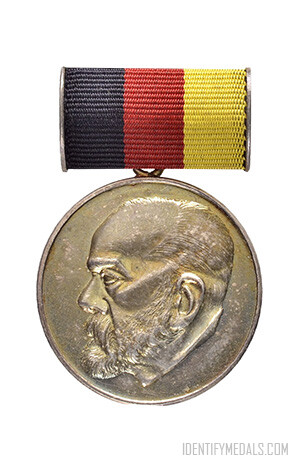
The initial bronze medal had a diameter of 30.5 mm with a ridged edge, featuring a right-facing portrait of Robert Koch with glasses on the obverse. The reverse displayed the two-line inscription “VERDIENTER ARZT / DES VOLKES” (“Meritorious Doctor of the People”) beneath three laurel leaves, along with the year of the award.

Initially, the medal was worn on a black-red-gold ribbon bow. From 1955, it was worn on a 28.5 × 15.5 mm rectangular cloth-covered clasp with black, red, and gold stripes, featuring a 3.5 mm wide horizontal silver stripe.

Appearance

From 1958, the medal was made of silver and featured Koch’s portrait without glasses. In 1973, it was silver-plated. The reverse depicted three upright bound laurel leaves surrounded by the inscription “VERDIENTER ARZT” (top) “DES VOLKES” (bottom). In 1978, the laurel leaves were replaced by the GDR state emblem, while the inscription remained unchanged.

Between 1958 and 1978, the medal was worn on a 25 × 14 mm black-red-gold cloth-covered clasp. The interim clasp displayed a 10 mm miniature of the medal’s obverse. After 1978, the clasp was changed to blue cloth with a white border, and the interim clasp continued to show the miniature of the medal’s obverse.

The Honored Activist Medal

The Honored Activist Medal was a state award of the GDR conferred as an honorary title and granted to workers and employees.

The Meritorious Activist (or Verdienter Aktivist in German) was a state award of the German Democratic Republic or GDR, conferred accompanied by a certificate and a wearable medal.

Initially established in 1950, this honorary title was incorporated into the “Order of Awards in the Activist and Competition Movement” in 1953.

This award could be granted to workers and employees who met the following criteria:

  • Consistently exceeded technical standards over six months.
  • Produced work of exceptional quality.
  • Achieved significant savings in materials, energy, and auxiliary substances.
  • Organized activist schools to teach advanced working methods to underperforming colleagues.
  • Actively contributed to the improvement of production techniques, technology, and work organization.
  • Participated in the development of occupational safety and security measures.

The honorary title was awarded annually on October 13th.

The Honored Activist Medal Design

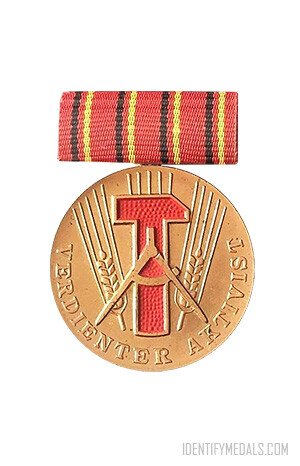
The medal was made of metal and gold-plated. it is round and has a diameter of approximately 35 mm, fitting the standard size for many GDR awards.

The central motif featured the GDR state emblem, which included a hammer and compass surrounded by a wreath of grain, symbolizing the unity of workers and farmers.

Around the central emblem, there was an inscription that read “VERDIENTER AKTIVIST” (Meritorious Activist), emphasizing the purpose of the award.