
The Order of Sidonia

The Order of Sidonia was created on March 14, 1871 by King Johann the German. It’s the Kingdom of Saxony’s chivalric order for women.

The Order of Sidonia was created on March 14, 1871 by King Johann the German. It’s the Kingdom of Saxony’s chivalric order for women, granted to female members of the Saxon nobility until the fall of the monarchy in 1918. By awarding this order, King Johann aimed to reinforce the values and responsibilities associated with the Saxon nobility, encouraging other noblewomen to aspire to such standards.

Named in honor of Saint Sidonia, this order was established to recognize and reward the exemplary service and noble qualities of female members of the Saxon nobility.

The order was granted exclusively to female members of the Saxon nobility. Recipients were typically women who had shown notable service in charitable activities, cultural endeavors, or had supported the monarchy in various capacities.

The Order of Sidonia Design

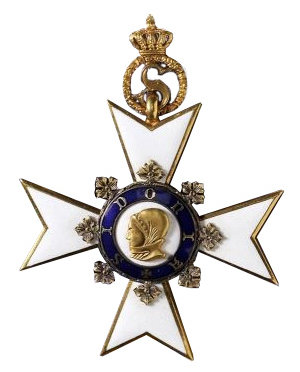
Members of the Sidonian Order wore a Maltese cross of gold and enamel, suspended from a purple bow with white and green stripes.

Members of the royal family wore a sash instead of the bow. At the apex of the Maltese cross, a medallion featured an image of a helmeted female figure, surrounded with the name “Sidonia”.
The Albert Order

The Albert Order was created in 1850 to be awarded to anyone who had served the state well, for civil virtue, science and art.

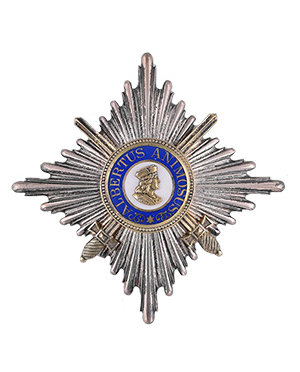
The Albert Order (or Albrechts-Orden in German) was to be awarded to anyone who had served the state well, for civil virtue, science and art, and created on 31 December 1850 by King Frederick Augustus II of Saxony to commemorate Albert III, Duke of Saxony

The grade structure of the Albert Order changed several times. At first, there were five classes: Grand Cross (Großkreuz), Commander’s Cross 1st Class (Komturkreuz I), Commander’s Cross 2nd Class (Komturkreuz II), Knight’s Cross (Ritterkreuz) and Small Cross (Kleinkreuz).

An award of Swords indicated a recipient’s bravery in wartime. If, however, a recipient was subsequently awarded a higher grade in the Order, he could lose the bravery distinction attached to the superseded grade (regulations only allowed the display of the insignia of the highest awarded grade). This anomaly was solved in 1906 by allowing the addition of Swords by replacement of insignia. A recipient, however, had to pay the cost of replacement and this appears to have inhibited the numbers of such replacements.

The Albert Order Design

The design of the insignia is a Christian cross with a bust of Albert the Bold at the centre. In 1875, however, it was discovered the bust was in fact the wrong Albert, Albert the Perennial, and the correct image was substituted and used thereafter.

The Civil Order of Saxony

The Civil Order of Saxony is a general order of merit established on 7 June 1815 by King Frederick Augustus I of Saxony.

The Civil Order of Saxony, also known as the Saxon Order of Merit, is a general order of merit established on 7 June 1815 by King Frederick Augustus I of Saxony for the royal subjects of the Kingdom of Saxony for distinguished civic service and virtue.

Upon its founding in 1815, the order was divided into seven classes of merit:

  • Knight Grand Cross
  • Commander First Class
  • Commander Second Class
  • Knight
  • Small Cross
  • Gold Civil Medal
  • Silver Civil Medal

With an amendment of 18 March 1858, the Small Cross became the Cross of Honour, eventually becoming Knight Second Class on 31 January 1876. The decree also replaced the gold and silver medals with civilian crosses of distinction, in gold and silver. The classes of the order thus became:

  • Knight Grand Cross
  • Commander First Class
  • Commander Second Class
  • Knight First Class
  • Knight Second Class
  • Golden Civil Cross
  • Silver Civil Cross

The Civil Order of Saxony Design

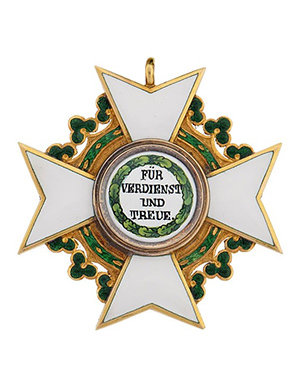
The insignia is a gold Maltese cross with white enameled arms and with green enameled fleur-de-lis between the arms of the cross. It measures 41.63 mm wide x 41.37 mm high and weighs 17.3 grams.

The obverse of the order shows a center white enameled medallion with a Saxon crowned royal monogram painted on the obverse, circumscribed “FRIED.AUG. K. V. SACHSEN. D. 7 JUN. 1815”.

The reverse hjas the inscription “Für Verdiesnt und Treue” (For Merit and Loyalty) within a laurel wreath.

The Military Order of St. Henry

The Military Order of St. Henry is a military order of the Kingdom of Saxony and the oldest military order of the German Empire.

The Military Order of St. Henry (or Militär-St. Heinrichs-Orden in German) is a military order of the Kingdom of Saxony, and the oldest military order of the states of the German Empire.

It was founded on October 7, 1736 by Augustus III, King of Poland and Elector of Saxony. The order underwent several more revisions over the course of the 19th and early 20th centuries, and became obsolete with the fall of the Saxon monarchy in the wake of Germany’s defeat in World War I.

The order came in four classes: Grand Cross (Großkreuz), Commander’s Cross 1st Class (Kommandeurkreuz I. Klasse), Commander’s Cross 2nd Class (Kommandeurkreuz II. Klasse) or sometimes just Commander, and Knight’s Cross (Ritterkreuz). Generally, the rank of the recipient determined which grade he would receive.

The Military Order of St. Henry Design

The badge of the Order of St. Henry is a gold Maltese cross with white enameled edges.

Around the center medallion in the obverse there is a blue-enameled gold ring bearing on the obverse the words “FRIDR AUG D G REX SAX INSTAURAVIT“. The reverse shows the motto “VIRTUTI IN BELLO” (“Bravery in War”). On the obverse, the medallion is yellow-enameled with a painted portrait of St. Henry, the last Saxon Holy Roman Emperor. On the reverse, the medallion bore the Saxon coat of arms (alternating horizontal black and gold stripes with a diagonal rue crown).

Between the arms of the cross were green-enameled rue crowns, a symbol of Saxony. The badge was suspended from a royal crown. 

The star of the order is a silver eight-pointed star featuring a larger version of the medallion with St. Henry of the obverse of the cross, but with the text of the ring of the reverse. 

The ribbon of the order is light blue with yellow stripes near each edge. 

The Order of the Rue Crown

The Order of the Rue Crown is a dynastic order of knighthood of the Kingdom of Saxony created in 1807 by Frederick Augustus I.

The Order of the Rue Crown (or Hausorden der Rautenkrone in German), also known as the Order of the Crown of Saxony is a dynastic order of knighthood of the Kingdom of Saxony created in 1807 by Frederick Augustus I, the first King of Saxony, to be the civil counterpart to the Military Order of St. Henry.

The order takes its name from the green floral crown of rue (crancelin) found in the coat of arms of Saxony. It occupies the highest rank of the former Saxonian honour system.

The order was originally limited to 24 knights, although exceptions were made for members of ruling houses and those whose membership in the order would add to its prestige. The Order of the Rue Crown was presented in a single grade, Knight.

The Order of the Rue Design

The badge of the order is a gold Maltese cross enameled in green with a white border.

The white center medallion features in the obverse the crowned monogram of Frederick Augustus I of Saxony, encircled by a green crown of rue. Between the arms of the cross is a golden crown of rue.

The star of the order is made of silver, and has eight points. The center of the star bears a gold medallion with the motto of the order, PROVIDENTIÆ MEMOR, inside a ring of green rue leaves.

The badge of the order is borne on a ribband of grass green, worn over the right shoulder.