The Württemberg Charlotte Cross

The Württemberg Charlotte Cross was established on January 5, 1916, by King William II of Württemberg. It was named in honor of his wife.

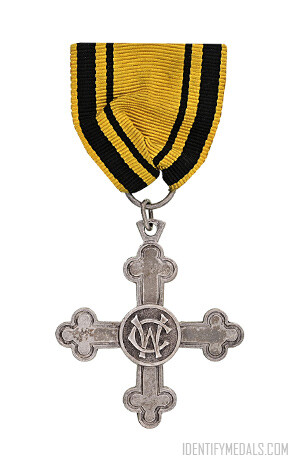
The Charlottenkreuz (“Charlotte Cross“) was established on January 5, 1916, by King William II of Württemberg. It was named in honor of his wife, Queen Charlotte, who was born Princess Charlotte of Schaumburg-Lippe.

This decoration was intended to recognize individuals who demonstrated exceptional merit, either on the battlefield or on the home front, in caring for the wounded and ill, or in providing general war-related aid.

The Charlotte Cross Design

The decoration consists of a silvered white metal cross botonny with a central medallion. The front of the medallion features the intertwined initials C and W (for Charlotte and Wilhelm), while the reverse displays the year 1916.

Recipients wore the decoration on the left breast, suspended from a yellow ribbon with one narrow and one wide black stripe on each side.

Buy This Medal Online

Right Now on eBay 
Clicking a link to eBay may result in a referral commission being paid if a purchase is made.
Loading...

The Württemberg Order of Olga

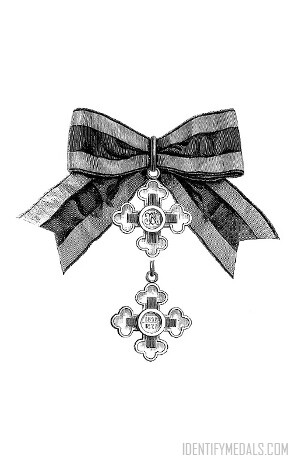
The Württemberg Order of Olga was established by King Karl I of Württemberg on June 27, 1871, in honor of his queen consort.

The Order of Olga (or Olga-Orden in German) was established by King Karl I of Württemberg on June 27, 1871, in honor of his queen consort, Grand Duchess Olga Nikolaevna of Russia.

The order was primarily intended to recognize women who provided care for wounded soldiers during the Franco-Prussian War of 1870-1871. Although it was occasionally awarded to men, it predominantly remained an order for women.

The Order of Olga Design

The insignia of the Order of Olga featured a silver cross with the interlocking ciphers of King Karl and Queen Olga on the obverse and the years 1870-71 on the reverse.

This emblem was suspended from a red and black ribbon. 

The Friedrich Order

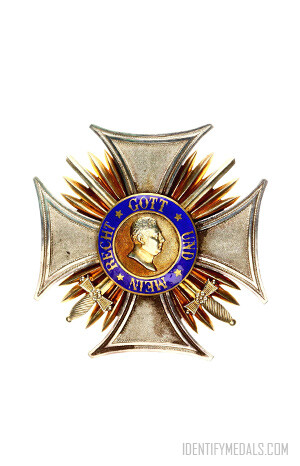
The Friedrich Order was a prestigious order of merit in the German Kingdom of Württemberg. It was instituted on January 1, 1830.

The Friedrich Order (or Friedrichs-Orden or Friedrichsorden in German) was a prestigious order of merit in the German Kingdom of Württemberg. It was instituted on January 1, 1830, by King Wilhelm I in honor of his father, King Friedrich I. The order was abolished in 1918 with the end of the monarchy.

The Friedrich Order Classes

Initially created as a single-class order that conferred nobility, the Friedrich Order was restructured on January 3, 1856, into four classes. On September 29, 1870, a Knight 1st Class and a military division with swords were added, with existing Knights being appointed to the new 1st Class. In 1892, the “Medal of the Order of Frederick” was introduced. An additional rank, the Grand Cross with Crown, was established on March 6, 1899.

The classes were:

  1. Grand Cross with Crown
  2. Grand Cross
  3. Commander 1st Class
  4. Commander 2nd Class
  5. Knight 1st Class
  6. Knight 2nd Class
  7. Medal

Buy This Medal Online

Right Now on eBay 
Clicking a link to eBay may result in a referral commission being paid if a purchase is made.
Loading...

The Württemberg Order of the Crown

The Order of the Crown was initially established in 1702 as the St.-Hubertus-Jagdorden (Hunting Order of St Hubert) but renamed in 1807.

The Order of the Württemberg Crown (or Orden der Württembergischen Krone in German) was a prestigious chivalric order in the Kingdom of Württemberg.

Initially established in 1702 as the St.-Hubertus-Jagdorden (Hunting Order of St Hubert), it was renamed the Ritterorden vom Goldenen Adler (Knightly Order of the Golden Eagle) by Frederick I in 1807.

On September 23, 1818, King William I renewed and restructured the order, naming it the Order of the Württemberg Crown and initially organizing it into three classes: Grand Cross, Commander, and Knight. The order underwent further expansions and modifications in 1889 and 1892.

The Order of the Crown Criteria and Classes

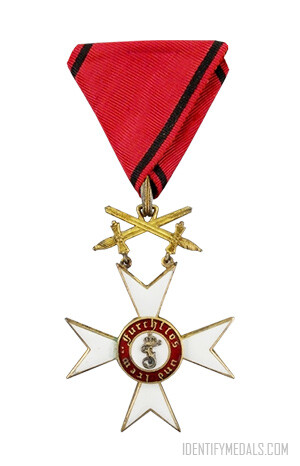
The motto of the order was ‘Furchtlos und treu’ (‘Fearless and Loyal’). Until 1913, the higher ranks of the order were restricted to the nobility. The ranks, in descending order, were:

  1. Knight Grand Cross, Special Class (for sovereigns)
  2. Knight Grand Cross
  3. Knight Commander (since 1889)
  4. Commander
  5. Cross of Honour (Ehrenkreuz; since 1892)
  6. Knight (since 1892 with golden lions, and since 1864 also with a crown, as a special honour)
  7. Gold service medal (Verdienstmedaille)
  8. Silver service medal (Verdienstmedaille, abolished in 1892)

The Order of the Crown Design

The order’s cross was a white enameled Maltese cross with gold lions in its four angles. The lions were standard for the Grand Cross and Commander but were a special honor on the Knight’s crosses. A golden crown was secured on the upper arm by two gold bands, from which the cross hung, except in the case of the Honor Cross in its fixed form. The medallion featured the golden initials of King Frederick I and a crown on the front, and a golden crown on red on the back. Since 1866, all grades could be awarded with swords, and after 1890, swords were only granted in awards of a higher class. From 1892, the lowest grades also featured the special honors of a golden lion and, since 1864, a lion added.

The Grand Cross featured a silver 8-pointed star with a reduced cross in a medallion at its center, surrounded by the circular motto. Sovereigns received the star in gold. The Commander had a 4-pointed silver star with rays extending through the cross angles.

The ribbon was carmine red with black stripes and carmine borders. Members of reigning houses received the Grand Cross insignia with a scarlet ribbon.

Buy This Medal Online

Right Now on eBay 
Clicking a link to eBay may result in a referral commission being paid if a purchase is made.
Loading...

The Württemberg Military Merit Order

The Military Merit Order (Militärverdienstorden) was a military order of the Kingdom of Württemberg, which joined the German Empire in 1871.
The Military Merit Order (or Militärverdienstorden in German) was a military order of the Kingdom of Württemberg, which joined the German Empire in 1871.

The order was one of the older military orders of the states of the German Empire. It was founded on February 11, 1759 by Karl Eugen, Duke of Württemberg as the Militär-Carls-Orden, and was renamed the Militärverdienstorden on November 11, 1806 by King Friedrich I. The order underwent several more revisions over the course of the 19th and early 20th centuries. It became obsolete with the fall of the Württemberg monarchy in the wake of Germany’s defeat in World War I.

The order came in three classes. Generally, the rank of the recipient determined which grade he would receive:

  • Grand Cross (Großkreuz)
  • Commander’s Cross (Kommandeurkreuz) and
  • Knight’s Cross (Ritterkreuz).

Between 1799 and 1919, there were an estimated 95 awards of the Grand Cross, 214 of the Commander’s Cross, and 3,128 of the Knight’s Cross, with the bulk of these awards made in World War I; the numbers may only cover native Württembergers.

The Württemberg Military Merit Order Design

The badge of the order was a white-enameled gold cross pattée with curved arms and slightly concave edges. Around the white-enameled center medallion was a blue-enameled gold ring bearing on both sides the motto “Furchtlos und trew” (“Fearless and loyal”).

On the obverse, the medallion bore a green-enameled gold laurel wreath. On the reverse, the medallion bore the monogram of the king of Württemberg at the time of award. The cross was the same size for the Grand Cross and the Commander’s Cross, and slightly smaller for the Knight’s Cross. The Grand Cross and Commander’s Cross, and from 1870 the Knight’s Cross, were topped with a crown. On September 25, 1914, the crown was removed from all grades.

The star of the order, awarded with the Grand Cross only, was a gold-rimmed silver eight-pointed star featuring the ringed medallion of the obverse of the cross.

The ribbon of the order was, until 1818 and after 1914, yellow with broad black stripes near each edge. After November 1917, when the ribbon was worn without the medal, the ribbon bore a green-enameled wreath to distinguish it from other Württemberg decorations on the same ribbon. The ribbon from 1818 to 1914 was blue.

Buy This Medal Online

Right Now on eBay 
Clicking a link to eBay may result in a referral commission being paid if a purchase is made.
Loading...