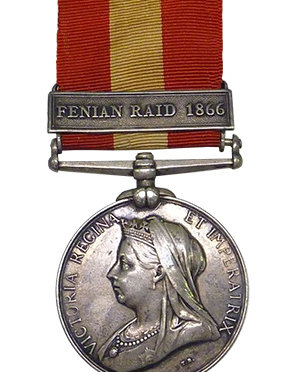
The Canada General Service Medal

The Canada General Service Medal is a campaign medal awarded to both Imperial and Canadian forces for duties related to the Fenian raids.

The Canada General Service Medal is a campaign medal awarded to both Imperial and Canadian forces by the Canadian Government for duties related to the Fenian raids between 1866 and 1871.

The medal was not issued until 1899 and people had to applied for it. The period for applying was first extended to 1907, and then to 1928. With late applications, approximately 16,668 medals were awarded , including 15,300 to members of Canadian units.

The medal was always awarded with a clasp, and 20 medals were awarded with all three clasps. Those were:

  • FENIAN RAID 1866: For services related to the Fenian raids of 1866. 8,591 clasps were awarded.
  • RED RIVER 1870: For services related to the suppression of the Red River Rebellion. 8,606 clasps were awarded.
  • FENIAN RAID 1870: For services related to the Fenian raids of 1870. 565 clasps were awarded.

The Canada General Service Medal Design

The obverse of the medal bears the head of Queen Victoria with the legend “VICTORIA REGINA ET IMPERATRIX”.

The reverse depicts the red ensign of Canada surrounded by a wreath of maple leaves with the word CANADA above.
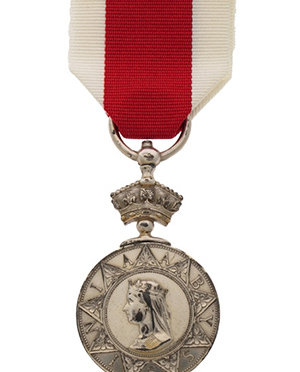
The Abyssinian War Medal

The Abyssinian War Medal is a medal awarded to those who participated in the punitive 1868 Expedition to Abyssinia.

The Abyssinian War Medal is a medal awarded to those who participated in the punitive 1868 Expedition to Abyssinia, led by Lieutenant-General Sir Robert Napier, between 4 October 1867 and 19 April 1868. This expedition was carried out by armed forces of the British Empire against the Ethiopian Empire (Emperor Tewodros II of Ethiopia had imprisoned several missionaries and two representatives of the British government.)

About 14,000 medals were awarded, 12,000 to the British and Indian armies and 1,981 to the Royal Navy.

The Abyssinian Medal Design

The Abyssinian medal is struck in silver an measures 1.25 inches (32 mm) in diameter. It was designed by Joseph and Alfred Wyon, and struck at the Royal Mint.

The medal is unique in that the recipient’s name and unit were embossed on the reverse of the medal. This required that the dies for the reverse had to have a removable center so each recipient’s name and unit could be impressed, with each medal minted individually.

The obverse bears the left facing effigy of a diademed Queen Victoria. Around the edge is a stylized border with indentions, between the indentions are the letters ABYSSINIA. The bust is similar to that on the New Zealand Medal issued in the same year.

The medal is held by a ring suspension attached to a crown surmounting the medal. The medal is borne upon a crimson ribbon 1.5 inches (38 mm) wide, with white borders.

The New Zealand Medal

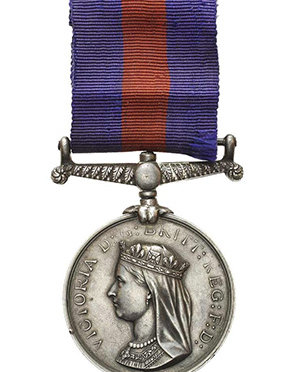
The New Zealand Medal is a campaign medal awarded to Imperial and Colonial troops in the New Zealand Wars of 1845–47 (and 1848) and 1860–66.

The New Zealand Medal is a campaign medal awarded to Imperial and Colonial troops in the New Zealand Wars (previously known as the Māori Wars, Anglo-Māori Wars or Land Wars) of 1845–47 (and 1848) and 1860–66. The medal was authorized in 1869 for award only to survivors.

Imperial forces included the British Army, Royal Navy and Royal Marines. The Colonial militia were recruited locally or in Australia, and included mobile forces like Von Tempskys Forest Rangers and the Arawa Flying Column from a Māori tribe for the guerrilla war in the New Zealand bush.

Colonial militia claimants had to prove that they had been under fire. Claims were finally closed for Europeans in 1915 and Māori in 1916.

The number struck was 1,957 (Imperial government) and 2,500 (Colonial government), total 4,457, of which about 4,400 were issued.

The New Zealand Medal Design

The New Zealand medal was designed by the brothers A. B. and J. S. Wyon. It is struck in silver, circular and measures 36 millimeters (1.4 in) in diameter. It has a straight bar suspender ornamented with New Zealand fern fronds. 

The obverse shows an effigy of Queen Victoria facing left and wearing a diadem and veil, with the legend: “VICTORIA D: G: BRITT : REG : F : D :”

The reverse has a laurel wreath containing the year or years between which the recipient served, with the words “NEW ZEALAND” above and “VIRTUTIS HONOR” (Honor of valor) below.

The ribbon measures 1.25 inches (32 mm) wide, is of blue with a 10mm red center stripe. No clasps (bars) were issued.

The Indian Mutiny Medal

The Indian Mutiny Medal is a campaign medal issued to officers and men who served in operations in suppression of the Indian Mutiny.

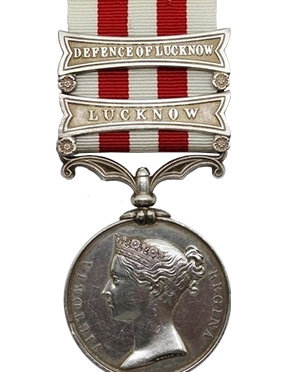
The Indian Mutiny Medal is a campaign medal issued to officers and men of British and Indian units who served in operations in suppression of the Indian Mutiny. The medal was approved in 1858.

The Indian Mutiny Medal was initially sanctioned to those troops who had been engaged in action against the mutineers. However, in 1868 it was extended to all those who had borne arms or who had been under fire, including members of the Indian judiciary and the Indian civil service who were caught up in the fighting.

Five clasps were authorized, though the maximum awarded to any one man was four:

  • Delhi: 30 May – 14 September 1857. Awarded to troops participating in the recapture of Delhi.
  • Defence of Lucknow: 29 June – 22 November 1857. Awarded to original defenders of Lucknow.
  • Lucknow: November 1857 – March 1858. Awarded to troops under command of Sir Colin Campbell who were engaged in final operations leading to the surrender of Lucknow and the clearing of the surrounding areas.
  • Central India: January – June 1858. Awarded to all those who served under Major-General Sir Hugh Rose in actions against Jhansi, Kalpi, and Gwalior. 

Around 290,000 Indian Mutiny medals were awarded.

The Indian Mutiny Medal Design

The medal was designed by William Wyon. The reverse was designed by Leonard Charles Wyon, who also engraved the die of the medal.

The obverse shows the diademed head of a young Queen Victoria with the legend VICTORIA REGINAThe reverse displays a helmeted Britannia holding a wreath in her right hand and a union shield on her left arm. She is standing in front of a lion. Above is the word INDIA, with the dates 1857-1858.

The medal measures 1.25 inches (32 mm) wide and the ribbon is white with two scarlet stripes, with each stripe of equal width.

The Baltic Medal

The Baltic Medal is a campaign medal issued to officers and men who served in Baltic Sea operations in the Baltic theatre of the Crimean War.

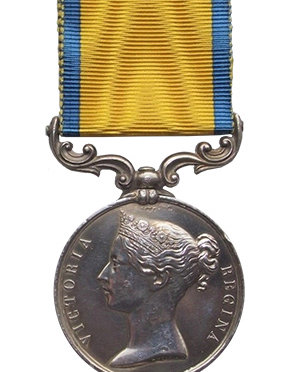
The Baltic Medal is a campaign medal issued to officers and men of the Royal Navy, Royal Marines, and Royal Sappers and Miners who served in Baltic Sea operations against Russia in the Baltic theatre of the Crimean War between March 1854 and August 1855.

The medal was approved in 1856 and covered primarily naval actions – although it was also awarded to 106 men of the Royal Sappers and Miners who were landed to place demolition charges against Russian fortifications at Bomarsund and Sveaborg.

No clasps were authorized for the Baltic medal.

The Baltic Medal Design

The Baltic medal is a circular silver medal measuring 36 millimeters (1.4 in) in diameter. It was designed by Leonard Charles Wyon.

The obverse depicts the diademed head of Queen Victoria with the legend VICTORIA REGINA, designed by William Wyon. The reverse shows a seated figure of Britannia holding a trident with the fortresses at Bomarsund and Sveaborg behind. Above is the word BALTIC and below the dates 1854-1855.

The ribbon measures 31.7 millimeters (1.25 in) wide, and it’s yellow with light blue edges, reversing the colours of the Crimea Medal ribbon.

The Crimea Medal

The Crimea Medal is a campaign medal issued to officers and men of British units who fought in the Crimean War of 1854–56 against Russia.

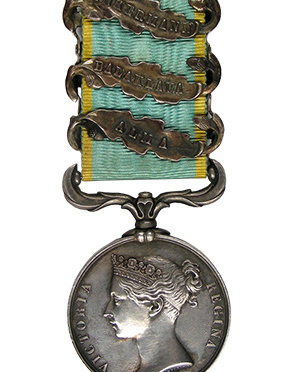
The Crimea Medal is a campaign medal issued to officers and men of British units (land and naval) who had fought in the Crimean War of 1854–56 against Russia. The medal was approved on 15 December 1854.

The Crimea medal was awarded with the British version of the Turkish Crimea Medal, and some troops were issued with the Sardinian version instead. The Crimea medal was also presented to certain members of allied French forces.

Five clasps were authorized:

  • Alma. For the battle of 20 September 1854.
  • Balaklava. For the battle of 25 October 1854.
  • Inkerman. For the battle of 5 November 1854.
  • Sebastopol. For the siege that lasted from 11 September 1854 to 9 September 1855. Anyone who received the Balaklava or Inkerman clasps was also awarded this bar.
  • Azoff. For the Naval expedition in the Sea of Azoff from 25 May to 22 September 1855. It was awarded only to Royal Navy personnel.

The Crimea Medal Design

The Crimea Medal consists of a 36mm diameter silver disk. The obverse displays the diademed head of Queen Victoria and the legend “VICTORIA REGINA” with the date 1854 below.

The reverse shows a depiction of a standing Roman warrior about to receive a laurel crown from a flying figure of victory, the word CRIMEA appearing on the left.

The medal is notable for its unusually ornate clasps, each in the form of an oak leaf with an acorn at each end. This is a style not used on any other British medal. The ornate, floriated, swiveling suspender is also unique to the Crimea Medal. The ribbon measures 27 millimeters (1.1 in) wide and is pale blue with yellow edges.

Find This Medal

Right Now on eBay 
Clicking a link to eBay may result in a referral commission being paid if a purchase is made.
Loading...

The South Africa Medal (1854)

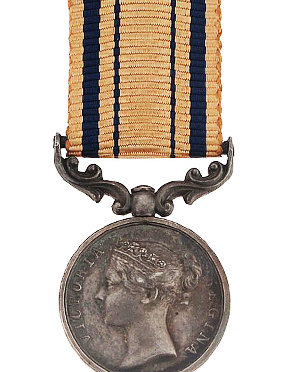
. The South Africa Medal (1853) is a campaign medal awarded to officers and men who served in the Cape of Good Hope during the Xhosa Wars.

The South Africa Medal (1853) is a campaign medal awarded to officers and men of the Royal Navy, British Army and locally recruited Cape Mounted Riflemen who served in the Cape of Good Hope during the Xhosa Wars between 1834 and 1853.

The medal was instituted in 1854 by Queen Victoria. It was awarded to surviving participants in one or more of three campaigns in the eastern Cape of Good Hope:

No clasps were awarded, therefore it is not possible to determine which of the wars any particular medal was awarded for.

The South Africa Service Medal Design

The South Africa Service medal was struck in silver and is a disk measuring 36 millimeters in diameter. The medal has a swiveling suspender. The medal was designed by William Wyon and his son Leonard Charles Wyonwhile the dies for the medal engraved by Leonard Charles Wyon.

The obverse shows the diademed head of Queen Victoria facing left.It’s inscribed “VICTORIA” at left and “REGINA” at right around the perimeter. The name of designer W. Wyon is inscribed on the truncation of the Queen’s neck.

The reverse displays a crouching lion on a plinth in front of a protea bush with a single flower. The medal is inscribed “SOUTH AFRICA” around the top perimeter and has the year “1853” in the exergue. The name of engraver L.C. Wyon is inscribed at the bottom, below the year.

The ribbon measures 32 millimeters wide, and it has a 2½ millimeters wide golden yellow band, a 4 millimeters wide dark blue band, a 3 millimeters wide golden yellow band and a ½ millimeter wide dark blue band, repeated in reverse order and separated by a 12 millimeters wide golden yellow band.

The India General Service Medal (1854)

The India General Service Medal is a campaign medal issued to officers and men of the British and Indian armies for various campaigns.

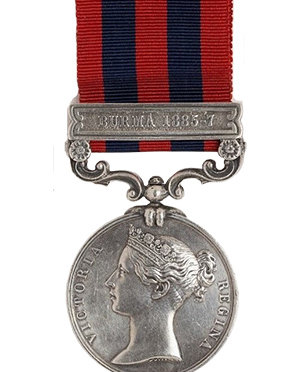
The India General Service Medal (1854 IGSM) is a campaign medal issued to officers and men of the British and Indian armies for various minor military campaigns in India and nearby countries, between 1852 to 1895. The medal was approved on 1 March 1854.

In 1852 Lord Dalhousie had suggested a general service medal for smaller Indian campaigns, in order to limit the number of individual medals awarded (the Indian Army units made up the majority of forces in nearly all campaigns). The expeditions covered by the medal included few formal battles, most of which were undertaken in difficult terrain against local tribesmen.

A total of 24 clasps were awarded for 23 campaigns. The medal was never issued without a clasp, with the maximum number known to be awarded to one individual being seven.

The India General Service Medal Design

The India General Service Medal measures 1.4 inches (36 mm) in diameter, and was struck at the Royal Mint.

The medal was initially awarded only in silver. From the Burma 1885–87 clasp, medals in bronze were awarded to authorized native followers who accompanied the troops, such as bearers, sweepers and drivers.

The obverse of the medal shows a left facing effigy of Queen Victoria wearing a diadem, with the inscription “VICTORIA REGINA” inscribed around it.

The reverse depicts Victory crowning a seated warrior with a laurel wreath. In the exergue are lotus flowers and leaves.

The medal is suspended by a scrolled bar. The 1.25 inches (32 mm) wide ribbon is divided into five stripes, three red and two dark blue, each 0.25 inches (6.4 mm) wide.

The Sutlej Medal

The Sutlej Medal is a campaign medal issued to officers and men of the British Army and East India Company who served in the Sutlej campaign.

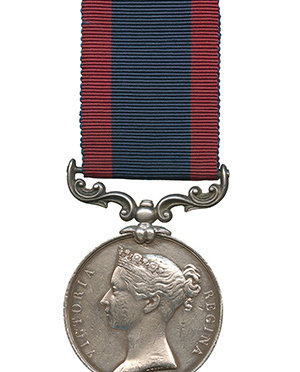
The Sutlej Medal is a campaign medal issued to officers and men of the British Army and Honourable East India Company who served in the Sutlej campaign of 1845-46 (also known as the First Anglo-Sikh War).

This medal was approved in 1846 and was the first one to use clasps to denote soldiers who fought in the major battles of the campaign.

The Sutlej Medal commemorates four battles (the first in which the recipient participated is shown on the reverse of the medal, with any further battles indicated by a clasp).

As there was no battle prior to the battle of Moodkee no clasp was produced for this action. The three clasps awarded were for the battles of FerozeshuhurAliwal and Sobraon.

The Sutlej Medal Design

The Sutlej medal is a circular silver medal measuring 36 millimeters (1.4 in) in diameter. It was designed by William Wyon.

The obverse depicts the diademed head of Queen Victoria with the legend VICTORIA REGINA. The reverse shows a standing figure of victory, facing left and holding a wreath in her outstretched hand, with a collection of trophies at her feet. Around the circumference is the legend ARMY OF THE SUTLEJ, with the name and year of the first battle in which the recipient served below.

The ribbon measures 31.7 millimetres (1.25 in) wide and is dark blue with crimson edges.

The Scinde Medal

The Scinde Medal is a British medal issued to soldiers who participated in Major General Sir Charles Napier’s conquest of Scinde.

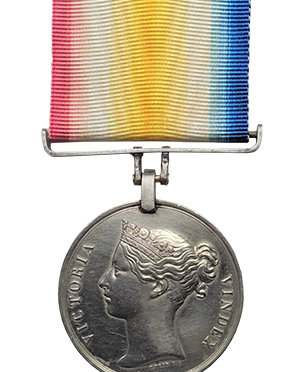
The Scinde Medal is a British medal issued to soldiers of the Honourable East India Company, the 22nd Regiment of Foot of the British Army and members of the Indian Navy, who participated in Major General Sir Charles Napier’s conquest of Scinde between 1842 and 1843.

The Scinde medal was authorized on 22 September 1843. Scinde had made various hostile demonstrations against the British government after the termination of the First Anglo-Afghan War. General Napier’s campaign against these Amirs resulted, after the victories of Miani and Hyderabad, in the complete subjugation of the province of Sindh, and its annexation to the Bombay Presidency of the British Raj.

The Scinde Medal Design

The Scinde Medal was designed by William Wyonand struck in silver. It measures 36 millimeters (1.4 in) wide.

The obverse displays a left facing, diademed bust of Queen Victoria facing left with inscription VICTORIA REGINA. The reverse shows three different versions were issued, all containing the name and year of the battle(s) where the recipient was present, surrounded by a laurel wreath and surmounted by a crown.

  • MEEANEE / 1843. For participation in the Battle of Miani (or Meeanee), 17 February 1843.
  • HYDERABAD / 1843. For participation in the Battle of Hyderabad, 24 March 1843.
  • MEEANEE / HYDERABAD / 1843. For participation in both battles.

The suspender is a straight steel clip with a straight bar suspender. The ribbon measures 45 millimeters (1.8 in) rainbow pattern watered red, white, yellow, white and blue. The medals were impressed or engraved with recipient’s name and regiment around the rim.