The Showa Enthronement Commemorative Medal

The Showa Enthronement Commemorative Medal was created to celebrate the ascension of Emperor Hirohito (the Showa Emperor) to the throne.

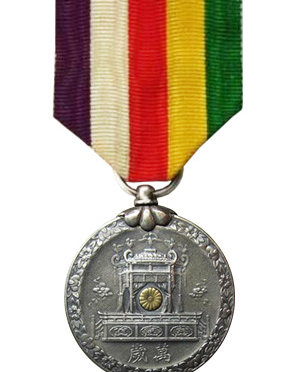
The Showa Enthronement Commemorative Medal was created to celebrate the ascension of Emperor Hirohito (the Showa Emperor) to the throne, who did so upon the death of his father in 1926. The enthronement ceremonies were held in 1928.

The medal was freely issued to people throughout the country who participated in the celebration ceremonies.

The Showa Enthronement Commemorative Medal Design

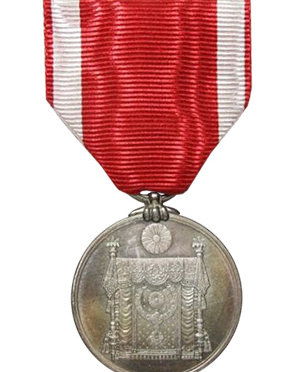
Some Showa Enthronement medals were struck in sharper relief, with the small gold mum crest as an attached piece. The ribbon was apparently designed from the drapes of the enthronement pavilion.

The obverse shows the imperial throne with the words ‘Banzai‘ written below. Cherry and orange blossoms surround the
ring. The reverse has cloud shapes and an inscription reading ‘Showa 3 [1928] November, Enthronement Commemorative
Medal.

The medal was awarded in a purple, red, black or brown (among other colors) cardboard case with gold lettering on the front.
The 1920 Japan Census Medal

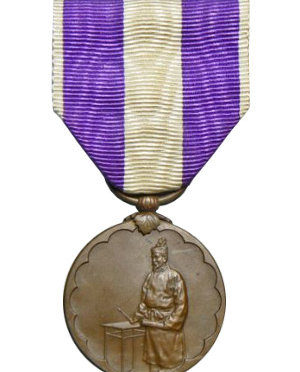
The 1920 Japan Census Medal was given to official census takers or those employed by the census bureau. It was instituted by Imperial Edict.

  • Time Period: Pre-WW1
  • Institution: 17 June 1921
  • Country: Medals from Japan Japan

The 1920 Japan Census Medal was given to official census takers or those employed by the census bureau. The medal was instituted by Imperial Edict on 17 June 1921 to acknowledge those who participated and assisted in the first national Japanese census that began on 1 October 1920.

There is only one official census medal for Japan, although a few censuses were taken from 1920 until the end of the war. Each was taken every five years except for 1945 (because of the war). The official records show that the Japanese national census took place in these years: 1920, 1925, 1930, 1935, 1940, 1947, 1950, and so on every five years.

The 1920 Japan Census Medal Design

The medal is circular, struck in bronze and has a leaf-shaped claw. The suspension is a laterally-pierced cylinder.

The obverse shows the figure of an official of the Taika (Great Reform) era (AD 646) with a brush in his right hand, a rolled scroll in his left, standing before a table, all within a scalloped border representing the outline of a chrysanthemum crest. The reverse has the inscription ‘Taishō 9th Year / National Census / Commemorative Medal / 10th Month, 1st Day’.

The medal was awarded in a paulownia wood case with a white velvet fitted insert.

The Taisho Enthronement Commemorative Medal

The Taisho Enthronement Commemorative Medal was created to celebrate the ascension of the Taisho Emperor to the throne in 1912.

The Taisho Enthronement Commemorative Medal was created to celebrate the ascension of the Taisho Emperor to the throne, who did so upon the death of his father in 1912. The enthronement ceremonies, however, were held in 1915.

The medal was freely issued to people throughout the country who participated in the celebration ceremonies. It was issued in a men’s and a women’s version.

The Taisho Enthronement Commemorative Medal Design

The obverse of the medal shows imperial banners with ‘Banzai’ written within each. Branches of cherry and orange
blossoms. The reverse has the inscription ‘Taisho 4 [1915] November, Enthronement Commemorative Medal.’

It is said that the ribbon was designed from the drapes of the outdoor pavilion used in the ceremonies.

The medal was awarded in a wooden or cardboard box with gold lettering.

The Korean Annexation Commemorative Medal

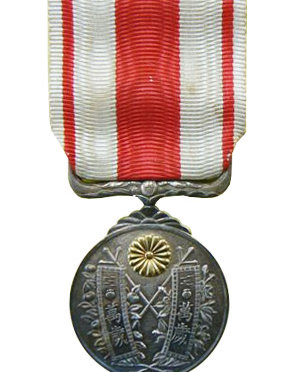
The Korea Annexation Commemorative Medal was first established in 1912 to commemorate the forced occupation of Korea by Japan.

The Korea Annexation Commemorative Medal was first established in 1912 to commemorate the forced
occupation of Korea by Japan. The Japan-Korea Annexation Treaty was signed in 1910.

The Korean Annexation Commemorative Medal Design

The commemorative medallion was made by the Japan Mint in both silver and bronze.

The obverse of the medal shows crossed branches of paulownia (Japan) and plum (Korea). The Imperial mum crest is
above. The reverse has the inscription ‘Korea Annexation Commemorative Medal, Meiji 43 [1910] August 29.’

The medal was awarded in a wooden box with gold lettering.

The Crown Prince’s Visit to Korea Commemorative Medal

The Crown Prince’s Voyage to Korea Medal was established in 1909 to commemorate Prince Yoshihito’s trip to the Korean Empire in 1907.

The Crown Prince’s Visit to Korea Commemorative Medal was established in 1909 to commemorate Prince Yoshihito’s trip to the Korean Empire in 1907. Emperor Taishō (大正天皇Taishō-tennō, 31 August 1879 – 25 December 1926) was the 123rd Emperor of Japan, according to the traditional order of succession, and the second ruler of the Empire of Japan from 30 July 1912 until his death in 1926.

The medal was awarded in gold to Imperial families and in silver to royalty.

The Crown Prince's Visit to Korea Medal Design

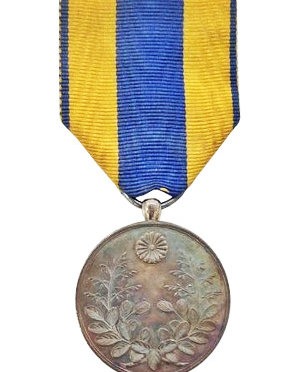
The obverse of the medal shows branches of sandalwood with the Imperial mum crest above. The reverse has the inscription ‘Imperial Japan Crown Prince, Voyage to Korea Commemorative Medal, Meiji 40 [1907] October.’

Notes

This entry was updated on 21 March 2023. The name “The Crown Prince’s Voyage to Korea Commemorative Medal” was replaced by “The Crown Prince’s Visit to Korea Commemorative Medal”. The word “voyage” is not in the inscription on the medal but uses a word 渡 which translates as “crossing”, “trip” or “visit”. This mistake was originally published in “Orders and Medals of Japan and Associated States” by James W. Peterson (OMSA Monograph #1). It was corrected in later editions of the Peterson book. Thank you Don Pfeifer for this information.

The Meiji Emperor 25th Wedding Anniversary Medal

The Meiji Emperor 25th Wedding Anniversary Medal was created to commemorate the wedding anniversary of the Meiji Emperor.

The Meiji Emperor 25th Wedding Anniversary Medal was created to commemorate the wedding anniversary of the Meiji Emperor.

The Meiji Emperor or Meiji the Great (明治大帝Meiji-taitei) was the 122nd emperor of Japan according to the traditional order of succession.  He reigned from 3 February 1867 until his death on 30 July 1912. He was the first monarch of the Empire of Japan and presided over the Meiji era, instigating the Meiji Restoration – a series of rapid changes that witnessed Japan’s transformation from an isolationist, feudal state to industrialized world power.

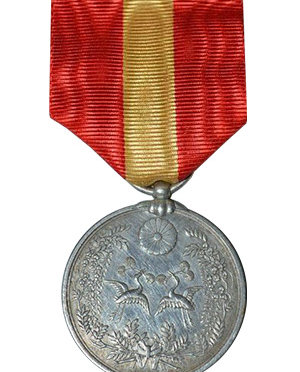
The gold medal was awarded to Imperial princes and the princesses, and the silver to people of noble rank who attended the ceremonies.

The Commemorative Medal for the Imperial Constitution Promulgation

The Commemorative Medal for the Imperial Constitution Promulgation was established in 1889 to celebrate the first constitution of Japan.

The Commemorative Medal for the Imperial Constitution Promulgation was established in 1889 to celebrate the first constitution of Japan (known informally as the Meiji Constitution, 明治憲法Meiji Kenpō, which was proclaimed on February 11, 1889). Enacted after the Meiji Restoration in 1868, it provided for a form of mixed constitutional and absolute monarchy, based jointly on the German and British models.

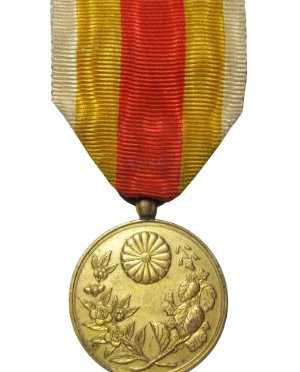
The gold medal was awarded to Imperial princes and the silver to people of chokunin or sonin rank. There was also a women’s version with a bow ribbon.

The Manchukuo Border Incident War Medal

The Manchukuo Border Incident War Medal was instituted in 1940 and commemorates the Nomonhan Incident, a clash with Russia in Manchuria.

The Manchukuo Border Incident War Medal was instituted in 1940 and commemorates the Nomonhan Incident, a clash with Russia that happened in Manchuria.

The Battles of Khalkhyn Gol were fought among the Soviet Union, Mongolia, Japan and Manchukuo in 1939. The conflict was named after the river Khalkhyn Gol, which passes through the battlefield. In Japan, this battle is known as the Nomonhan Incident – named after a nearby village on the border between Mongolia and Manchuria.

The battles resulted in the defeat of the Japanese Sixth Army, which incurred 18,000 casualties.

The Manchukuo Border Incident War Medal Design

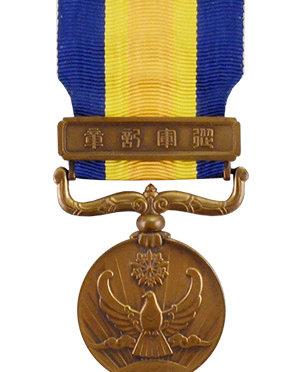
The medal is struck in bronze and measures 30 mm wide. The bar reads ‘War Medal.’

The obverse shows Pu-Yi’s orchid crest above, with a dove with outstretched wings in the center. Below is part of
the globe showing Asia and behind are clouds and rays. The reverse bears the inscription ‘Border Incident.’

The medal was awarded in a red vase with golden lettering.

The Manchukuo Army Dispatch Badge

The Manchukuo Army Dispatch Badge was awarded to commemorate a unit’s service in Manchuria. During the 1930s, these badges were common.

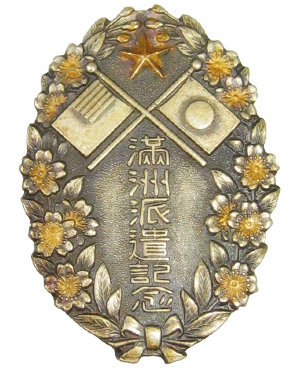
The Manchukuo Army Dispatch Badge was awarded to commemorate a unit’s service in Manchuria. During the 1930s, different regiments and companies made their own badges to motivate and inspire soldiers.

The Manchukuo Army Dispatch Badge Design

The obverse of this badge is decorated with cherry blossom branches (a symbol of Japan) and a gold Army star. The flags are the Japanese national flag and the Manchukuo national flag. The central kanji reads ‘Manchuria Dispatch Commemorative.’

Most likely, these badges were awarded in a simple paulownia wood case.

The Manchukuo National Foundation Imperial Medal

The Manchukuo National Foundation Imperial Medal is one of the rarest Manchukuo medals, believed to be a personal award from Emperor Pu-Yi.

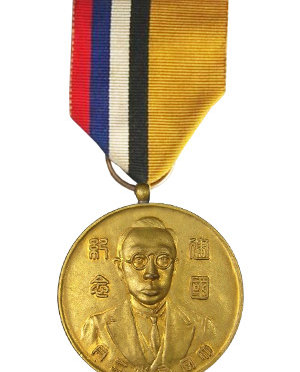
The Manchukuo National Foundation Imperial Medal is one of the rarest Manchukuo medals. It’s believed that this medal may have been a personal award from Emperor Pu-Yi.

Very little is known about this medal. This rarer version must have been limited to a select few awardees.

The Manchukuo National Foundation Imperial Medal Design

The medal is round and struck in gold-plated bronze. The kanji on the obverse reads the inscription ‘National Foundation Commemorative, Daidou Year 1 [1932], March.’ There is also an image depicting Pu-Yi. The era name Daidou refers to 3 years: 1932-1934 (specifically March 1st, 1932 to February 28, 1934). The reverse shows the Manchukuo national flag in the center, and on either side are birds commonly called feng, or fenghuang.

It was awarded in a plush case with velvet exterior and inscription on the inside lid reading ‘National Foundation, Imperial Event Commemorative‘.