The Manchukuo Emperor State Visit to Japan Medal

The Manchukuo Emperor State Visit to Japan medal was established in 1935 to commemorate the Manchukuo Emperor Pu-Yi’s visit to Japan in 1934.

The Manchukuo Emperor State Visit to Japan medal was established in 1935 to commemorate the Manchukuo Emperor Pu-Yi’s visit to Japan in 1934. The Emperor Pu-Yi (often called the Last Emperor) made two state visits to Japan: The first in 1935 and the second in 1940. The first one was the most celebrated because he presented himself as the Manchukuo Emperor to the Showa Emperor.

Four commemorative postage stamps were issued, while many important people assembled to welcome Pu-Yi to Japan. The Japan Mint created this official medal to commemorate the 1935 visit.

The medal was awarded by the government and not put on sale like some other Japan Mint items.

The Manchukuo Emperor State Visit to Japan Medal Design

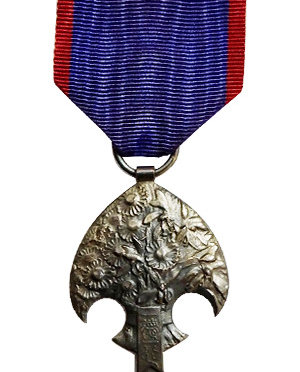
The medal is struck in silver and has the shape of a spearhead.

The obverse is decorated with orchids and chrysanthemums, the Imperial flowers of Manchukuo and Japan. There is an inscription in the banner at the bottom that reads ‘One in virtue and spirit.’ The reverse has the inscription’Kang Te 2 [1934] Manchukuo Empire, Emperor’s Visit to Japan Commemorative Medal, April 6th.’

The medal was awarded in a green case with gold lettering on the front.
The Commemorative Badge for the Foundation of the Manchukuo Empire

The Commemorative Badge for the Foundation of the Manchukuo Empire is a commemorative item made to celebrate its founding.

  • Time Period: WW2
  • Institution: 1930s?
  • Country: Medals from Japan Japan

The Commemorative Badge for the Foundation of the Manchukuo Empire is one of many commemorative items that were made on the occasion of the founding of the Manchukuo Empire. Similar items were also produced on subsequent anniversaries.

Although these badges had a suspension ring, they were probably never actually worn. Their function was more decorative, with most of them probably bought as a gift for others.

The Commemorative Badge for the Foundation of the Manchukuo Empire Design

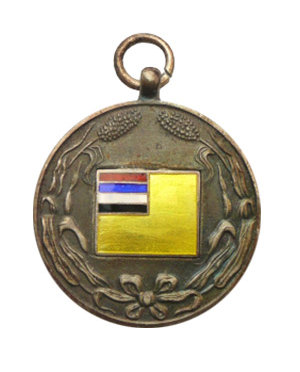
The obverse shows two branches around an enameled national flag. These are sorghum branches and buds, a plant used often on Manchukuo items. Although the official imperial crest is the orchid, the sorghum was used as a symbol of the nation, just as the cherry blossom is used as a symbol of Japan.

The reverse shows the inscription ‘Manchukuo Empire, Daidou 2 [1933] March 1st, National Foundation 1-Year Anniversary Commemorative.’

The badge was kept in a paulownia wood box with an inscription reading ‘Manchukuo Empire, National Foundation 1-Year Anniversary Commemorative.’

The Imperial Japanese Army Koga Regiment Badge

Time Period: WW2

Institution: 1930s?
Country: Medals from Japan Japan

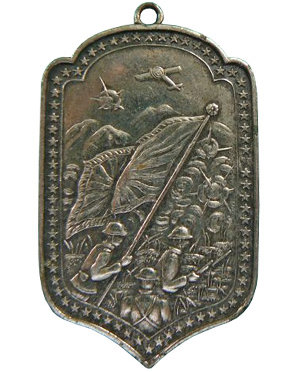
The Imperial Japanese Army Koga Regiment Badge is an example of a small, portable, and inexpensive regiment badge. These awards were usually given to troops by regiment commanders.

The Imperial Japanese Army Koga Regiment Badge Design

These regimental badges usually had the unit name and number inscribed in the obverse, and could also be personalized. However, they rarely had the name of the individual soldier unless they were hand-carved.

The Koga regiment badge has a border covered with Army stars. The obverse shows, it the center, Japanese soldiers battling at the front. One of them is carrying the regiment standard. In the background are clouds of smoke with stylized explosions and some hills. Above is a fighter plane and another explosion. The inscription in the reverse reads ‘Koga Regiment, Blood-Stained Regiment Standard.’

The Japanese Military Wounded Soldier Badge

Time Period: WW2
Institution: From 1938
Country: Medals from Japan Japan

The Japanese Military Wounded Soldier Badge was issued to both army and navy personnel from about 1938. Also translated as the War Wound Badge, this medal was produced in two varieties.

The gilt senshou badge was awarded for a wound sustained in combat. The silver koushou badge was awarded for a wound sustained in the public service (or in a non-combat situation). It was also often given to a soldier when they contracted a disease like malaria or were poisoned, injured in an equipment accident, etc. 

The Japanese Military Wounded Soldier Badge Design

The badge measures approximately 31 mm high. The outer edges on the reverse side read Gunjin Shoui Kishou (Soldier Wound Badge).

The badge was awarded in a red pressed cardboard or wooden box with gold or silver lettering and with an accompanying registration card.

The Patriotic Women’s Association (Aikoku Fujinkai) Distinguished Service Badge

  • Time Period: Pre-WW1
  • Institution: After 1901
  • Country: Medals from Japan Japan

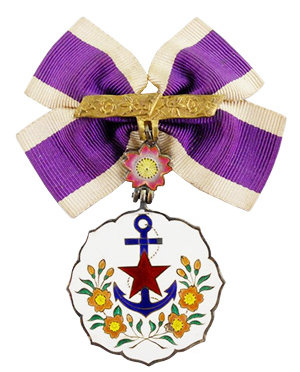
The Patriotic Women’s Association Distinguished Service Badge is a special merit badge awarded by the Patriotic Women’s Association or Aikoku Fujinkai. The Distinguished Service Badge (or Special Merit Badge) was the highest award.

The Patriotic Women’s Association is the oldest of the women’s associations. It was founded on March 2, 1901 by Okumara Ioko and operated under the Ministry of Home Affairs and the Ministry of Health and Welfare.

By 1940, the Association had close to 6,500,000 members in Japan and overseas. Before the outbreak of the Second World War, there were Aikoku Fujinkai branches in Canada, the United States and Brazil, as well as in different territories occupied by the Japanese armed forces. In February 1942, the Asssociation merged with the Greater Japanese Women’s Association for Protection of the Country and the Greater Japan Federation of Women’s Associations into a new association which was called the Greater Japanese Women’s Association.

The Aikoku Fujinkai Distinguished Service Badge Design

The medal is struck in silver and has red, white, blue, orange, green, pink and yellow enamels. It measures 33.5 mm (wide) x 47 mm (high), including its cherry blossom suspension.

The medal is suspended from a silver-gilt bar with pinback and has a bow-tied ribbon with silver-gilt tassels at either end. The badge was awarded in a hard-shelled case made of balsa wood with a black lacquer finish. The box has gilt characters on the lid.

Other badges were as follow:

  • Member Rosette Badge, in yellow, blue and black enamels.
  • Regular Member Badge, in silver with no enamels.
  • Special Member Badge, bronze with yellow enamel.
  • Honor Member Badge, bronze with light blue or white enamel.
  • First Class Exceptional Merit Badge, bronze with colored enamels.
  • Second and Third Class Merit Badges, bronze with a red star.
  • Patron Badge, in reddish bronze with no enamels.

The 1941-45 Great East Asia War Medal

The 1941-45 Great East Asia War Medal (Daitōa sensō jūgun kishō) is a Japanese medal established on June 21, 1944 by Imperial Edict No. 417.

  • Time Period: WW2
  • Institution: 7 December 1944
  • Country: Medals from Japan Japan

The 1941-45 Great East Asia War Medal (or 大東亜戦争従軍記章Daitōa sensō jūgun kishō in Japanese) was a Japanese medal established on June 21, 1944 by Imperial Edict No. 417.

It’s not clear to whom this medal would have been awarded, but it was likely designed to become a common medal
like the China Incident War Medal. After the war ended in defeat, the circa 10,000 struck medals were destroyed by the American occupying forces.

To commemorate the 35th Anniversary of the end of the war, a new series of medals were struck by the Nihon Gouyuu Renmei, which may be translated as Federation of Japan Nationalists. The new medal bears the inscription ‘Great East Asia War, Showa 16 [1941] December 8th to Showa 20 [1945] August 15th.’

The 1941-45 Great East Asia War Medal Design

The medal was designed by the famous sculptor and designer Hinago Jitsuzou (1892-1945). It’s a a tin alloy on jointed suspension bar. The attached bar reads ‘War Medal.’

The obverse has a central Imperial Mum crest imposed on two crossed Japanese swords and, a rayed star and a ring of blossoms on the rim. The reverse a map of East Asia, inscribed with characters meaning ‘Great East Asia War Medal’.

Several post-war replicas made for veterans in the 1960s.

The 1937-45 China Incident War Medal

The China Incident Medal was established in 1939 and awarded for service at any time from the 12th to the 20th years of the Shōwa period.

  • Time Period: WW2
  • Institution: 7 December 1939
  • Country: Medals from Japan Japan

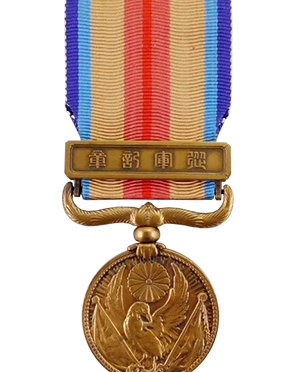
The China Incident Medal (or 支那事変従軍記章Sina jihen jūgun kishō) was established by Imperial Edit No. 496 on July 27, 1939 and awarded for service in China at any time from the 12th through the 20th years of the Shōwa period (1937–1945).

An amendment was promulgated by Imperial Edict No. 418 in 1944, and the decoration was abolished in 1946 by government ordinance No. 177. Although the Japanese government still uses “China Incident” in formal documents, media in Japan often paraphrase it with other expressions like Japan-China Incident (日華事変Nikka jihen) or (日支事変Nisshi jihen). 

This medal is one of the most commonly found Japanese awards. Millions were made for those who served.

The China Incident Medal Design

The medal is struck in bronze and has a swivel grip.

The obverse shows crossed flags, the imperial mum crest, and a crow. The reverse shows mountains, clouds, and waves, as well as the inscription ‘China Incident.’ The ribbon is 37mm wide, watered, of 3 mm blue (the
sea and the Navy), 7.5 mm tan (the soil of China, for the Army), 3.5 mm dark pink (the bloodstained soil of China), and 2 mm bright red (blood and loyalty).

The Inter Allied Victory Medal (Japan)

The Allied Victory Medal was recommended by an inter-allied committee in March 1919. The Japanese Medal was established by Imperial Edict.

The Allied Victory Medal was recommended by an inter-allied committee in March 1919. Fourteen victorius countries finally awarded the medal after World War I, and each allied nation would design a ‘Victory Medal’ for award to their own nationals. Certain features were to be shared: a winged figure of Victory on the obverse and the same ribbon.

The Japanese Allied Victory Medal was established by Imperial Edict #406 on 17 September 1920.

The Japan Inter Allied Victory Medal Design

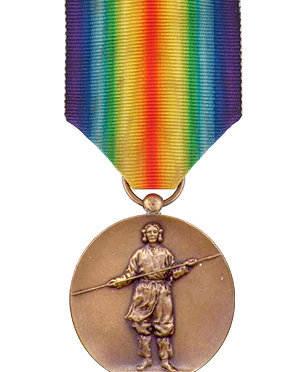
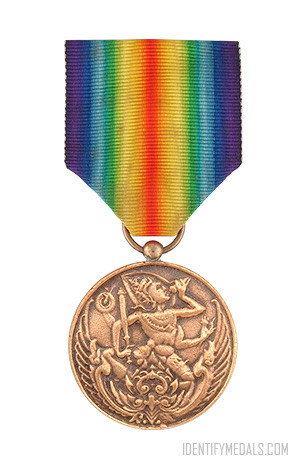
The Victory Medal measures 36 millimetres (1.4 in) in diameter and was designed by William McMillan. The design and ribbon was also adopted by Belgium, Brazil, Cuba, Czechoslovakia, France, Greece, Italy, Japan, Portugal, Romania, Siam, Union of South Africa and the USA. Each allied nation would design a ‘Victory Medal’ for award to their own nationals, all issues having certain common features, including a winged figure of victory on the obverse and the same ribbon.

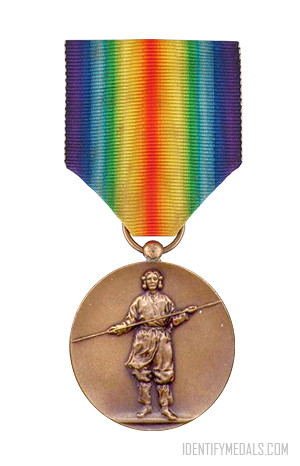
Japan’s obverse design was different from all other versions as it did not depict the goddess Victory. This figure from Roman mythology would have no connection to Japanese culture, so a depiction of Takemikazuchi, the war god in Japanese mythology occupies the obverse of the medal. Takemikazuchi (建御雷/武甕槌) is considered a god of thunder and a sword god.

The reverse shows the words ‘THE GREAT / WAR FOR / CIVILISATION / 1914-1919‘  surrounded by a laurel wreath.

The 39 millimeters (1.5 in) wide watered ribbon has an iridescent color scheme, with the violet moving through to a central red stripe where both schemes meet. It attaches to the medal through a ring suspender. The recipient’s name, rank, service number and unit were impressed on the edge of the medal. The name of the regiment or corps was omitted on medals awarded to Army officers.

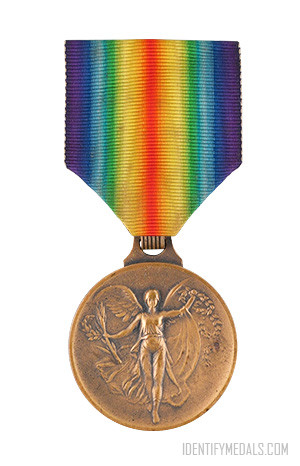
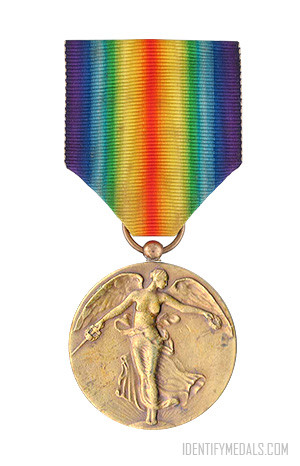
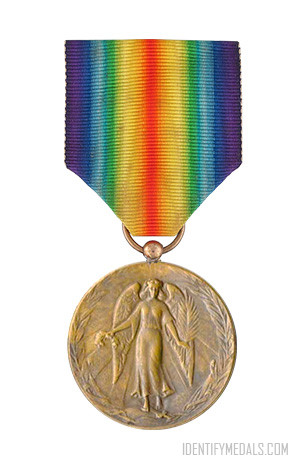
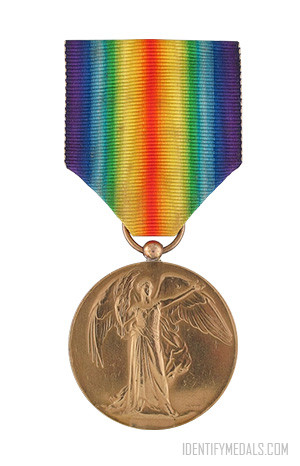
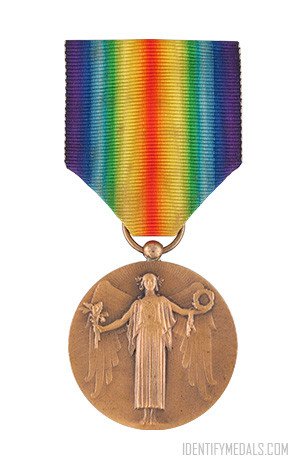
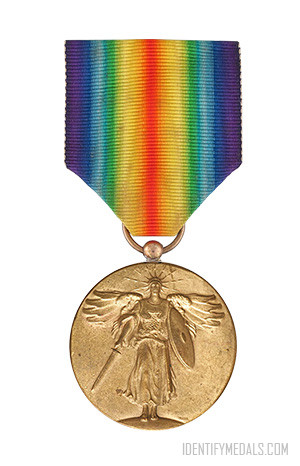
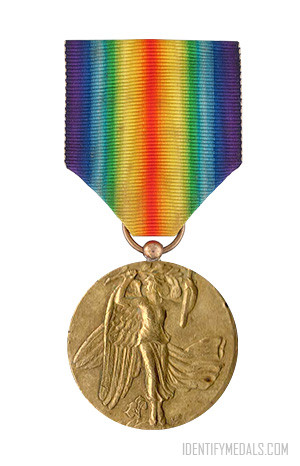
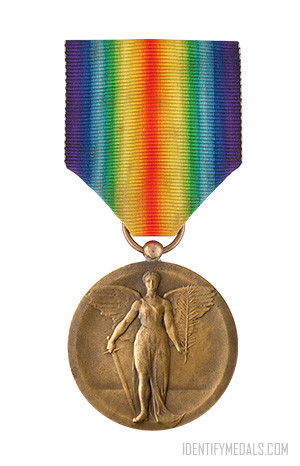
All the Inter-Allied Victory Medal Variations

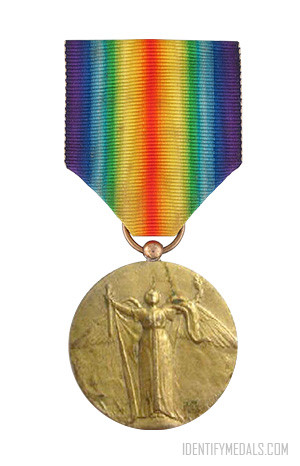
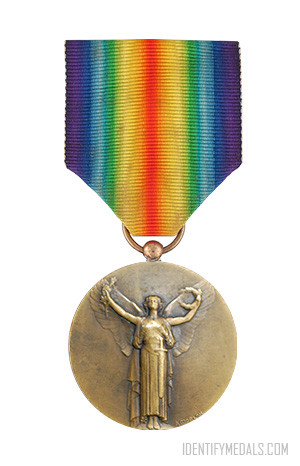
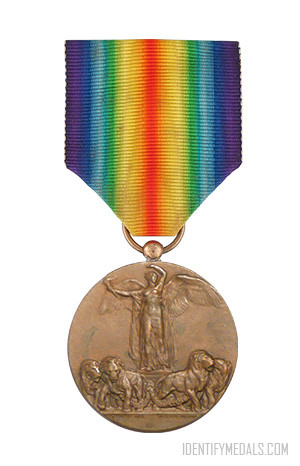
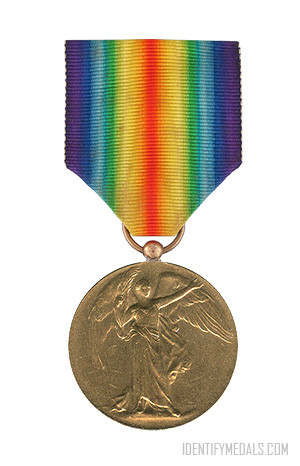
Although each country designed its own version of the Inter-Allied Victory Medal, all of them shared some common elements, such as a winged victory figure on the obverse and a similar ribbon with rainbow colors symbolizing unity among the Allies. Here are the versions for all countries:

Find an Inter-Allied Victory Medal Online

Right Now on eBay 
Clicking a link to eBay may result in a referral commission being paid if a purchase is made.
Loading...

The 1914-20 First World War Medal

The 1914-20 First World War Medal is a Japanese medal established in 1915 to commemorate Japanese participation in World War I.

  • Time Period: WW1
  • Institution: 1915
  • Country: Medals from Japan Japan

The 1914-20 First World War Medal is a Japanese medal established on November 6, 1915 by Imperial Edict No. 203 to commemorate Japanese participation in World War I.

The medal was issued to naval personnel who served in the Japanese fleet in the Mediterranean during the Great War and to the military participating in the Japanese expedition to Siberia from 1918 to 1922 aimed at the Soviet Bolsheviks during the Russian Civil War that followed the October 1917 revolution.

The 1914-20 First World War Medal Design

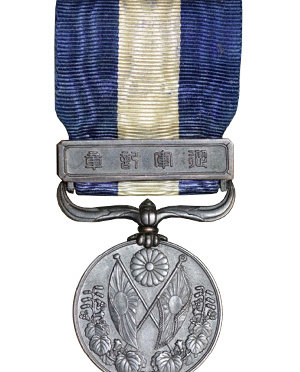
The award is a blackened bronze circular medal with ornate swivel suspension with bar inscribed ‘ju-gun-ki-sho’ (War Medal).

The obverse bears with crossed Imperial army and navy flags, a chrysanthemum crest above, sprays of pauwlona below. The reverse shows ten characters in three columns ‘tai-sho-san-nen-nai-shi-kyu-nen-sen-eki’ (Taisho 3rd Year to 9th Year War’ – Taisho 3 to 9 = AD1914 to 1920).

The ribbon has a hook and eye fittings. The medal was issued in a fitted wooden case with pale cream felt lining, the lid embossed in gilt characters ‘tai-sho-san-nen-nai-shi-kyu-nen-sen-eki-ju-gun-ki-sho’ (Taisho 3-9 War Military Service Medal).

The Russo-Japanese War Medal

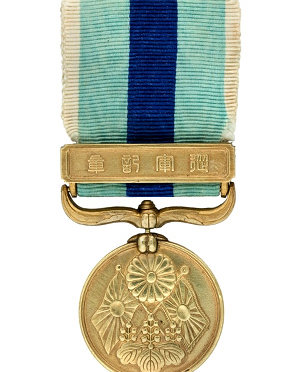
The Russo-Japanese War Medal was established in 1906 in recognition of those who served in the Russo-Japanese War during the Meiji period.

The Russo-Japanese War Medal is a unique Japanese medal, jūgun kishō. It was established on March 31, 1906 by Imperial Edict No. 51 in recognition of those who served in the Russo-Japanese War during the 37th and 38th years of the Meiji period (1904–1905).

The Russo-Japanese War was fought between the Russian Empire and the Empire of Japan over rival imperial ambitions in Manchuria and Korea. The major theatres of operations were the Liaodong Peninsula and Mukden in Southern Manchuria and the seas around Korea, Japan and the Yellow Sea.