The Order of the Chrysanthemum

The Supreme Order of the Chrysanthemum is is the highest possible honor a Japanese citizen can be awarded during his or her lifetime.

The Supreme Order of the Chrysanthemum (大勲位菊花章 Dai-kun’i kikka-shō, literally Grand Order of the Capitulum of the Chrysanthemums) is Japan’s highest order.

The Grand Cordon of the Order was established in 1876 by Emperor Meiji of Japan; the collar of the Order was added on 4 January 1888. Unlike its European counterparts, the order may be conferred posthumously. Apart from the Imperial Family, only six Japanese citizens have ever been decorated with the collar in their lifetimes. Today, only the reigning Emperor holds this dignity as sovereign of the order; however, exceptions are made for foreign heads of state, who can be awarded the collar in friendship.

The grand cordon is the highest possible honor a Japanese citizen can be awarded during his or her lifetime.

The Order of the Chrysanthemum Medal Design

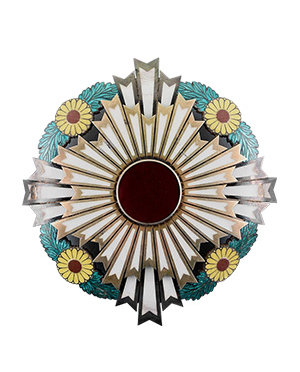
The star of the order is similar to the badge, but in silver, without the chrysanthemum suspension, and with an eight-pointed gilt medallion (with white-enameled rays and red-enameled sun disc) placed at the center. It is worn on the left chest.

The badge of the order is a four-pointed gilt badge with white-enameled rays; the center bears a red enameled sun disc. On each of the four corners of the badge is a yellow-enameled chrysanthemum blossom with green-enameled chrysanthemum leaves. The badge is suspended on a yellow-enameled chrysanthemum, either on the collar or on the grand cordon.

The collar of the order is made of gold, and features the kanji for “Meiji”, in classic form, indicating the era of the order’s establishment. It is decorated with gold chrysanthemum blossoms and green-enameled leaves. The sash of the grand cordon of the order is red with dark blue border stripes. It is worn on the right shoulder.
The Order of the Golden Kite

The Order of the Golden Kite was an order of the Empire of Japan established in 1890 by Emperor Meiji “in commemoration of Jimmu Tennō”.

  • Time Period: Pre-WW1
  • Institution: 12 February 1890
  • Country: Medals from Japan Japan

The Order of the Golden Kite (金鵄勲章 Kinshi Kunshō) was an order of the Empire of Japan established on 12 February 1890 by Emperor Meiji “in commemoration of Jimmu Tennō, the Romulus of Japan”.

The Order of the Golden Kite was an exclusively military award, conferred for bravery, leadership or command in battle. It ranked just below the Order of the Chrysanthemum in precedence and was the military equivalent of the Order of the Paulownia Flowers; therefore, it could be considered analogous to the military division of the Order of the Bath in the United Kingdom. The first three classes were roughly equivalent to the three divisions of the Order of the Bath, the fourth, fifth, sixth and seventh classes were analogous to the DSO, MC/DSC, DCM/CGM and DSM/MM, respectively.

The order consisted of seven classes. Enlisted rank soldiers were eligible for the 7th–5th classes, non-commissioned officers were eligible for the 6th–4th classes, junior officers for the 5th–3rd classes, field grade officers for the 4th–2nd classes and general officers for the 3rd-1st classes. A total of 1,067,492 Order of the Golden Kite awards were made over the history of the order, most of them in the two lower 6th and 7th classes. Only 41 of the 1st class and 201 of the 2nd class were awarded.

The Order was officially abolished by the Supreme Commander of the Allied Powers of Occupied Japan in 1947 after World War II.

The Order of the Golden Kite Medal Design

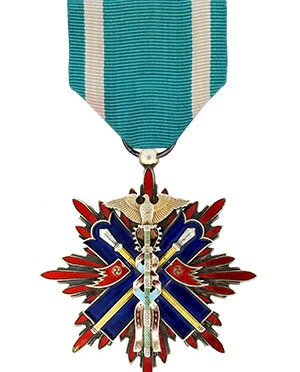
The badge for the Order is a gilt cross with white enameled rays, bearing a central emblem of a red enameled sun disc surrounded by red rays, and with three paulownia blossoms between each arm of the cross. It is suspended from three enameled paulownia leaves on a sash in red with white border stripes, and is worn on the right shoulder.

The star for the Order is the same as the badge, but without the paulownia leaves suspension. It is worn on the left chest.

The Bukochosho Medal

Time Period: WW2

Institution: 7 December 1944
Country: Medals from Japan Japan

The Rikugun Bukōkishō (陸軍武功徽章 “Badge for Military Merit”), commonly called the Bukōshō, was a military decoration of the Empire of Japan established on 7 December 1944 by Imperial edict.

The medal was awarded by the Imperial Japanese Army (IJA) to living soldiers who had performed with exceptional valor in battle. Airmen, especially fighter pilots defending Japan against enemy bombers, were most likely to win the award. Eighty-nine Bukōshō were awarded during the eight months it was actively awarded.

Emperor Hirohito established the award on 7 December 1944, the third anniversary of the attacks on Hong Kong and Pearl Harbor, which had signaled the start of the broader Pacific War.

The Bukōshō was allowed to be given retroactively to soldiers who had distinguished themselves as far back as 1941 or perhaps 1940. In practice, the award was given disproportionately to fighter pilots flying against the American Boeing B-29 Superfortresses bombing the Japanese homeland.

The Bukochosho Medal Design

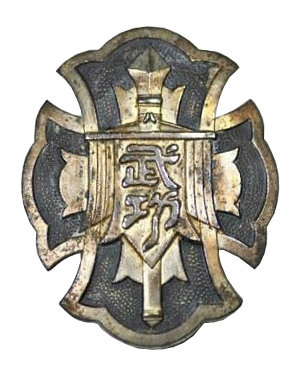
The Bukōshō (as it was popularly known) was presented in two classes, called A and B, or First and Second. The Bukōshō was a pin back badge, cast in iron or steel, featuring two shields (in gilt for A-Class, bronzed for B-Class) forming a cross, with a gilt banner at the center bearing the two kanji characters “Bukō” (Military Merit).

The reverse side (again in gilt for A-Class, bronzed for B-Class) bore the six kanji characters in two columns “Rikugun/Bukōchōshō” (Army/Badge for Military Merit). Both classes were the same size: 50 mm (2.0 in) high and 40 mm (1.6 in) wide.