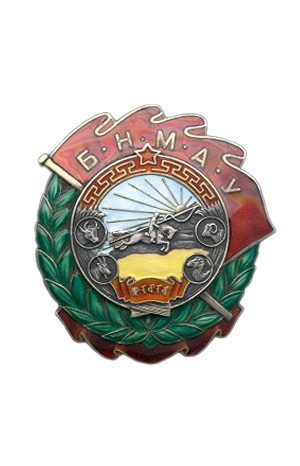
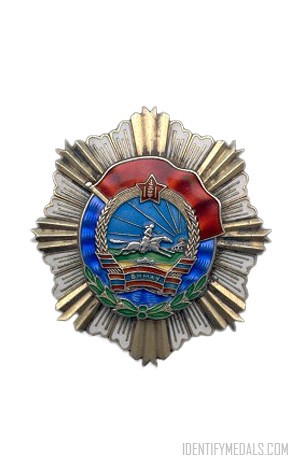

The Order of the Red Banner of Labour Valour (Literacy Labour)

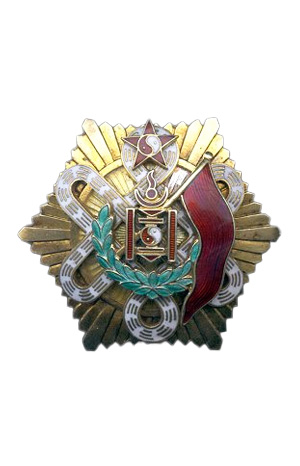
The Order of the Red Banner of Labour Valour is a Mongolian award first instituted in 1926 as the Order of Literacy Valour.

  • Time Period: Interwar
  • Institution: 1926 (as “The Order of Literacy Valour“, renamed to “The Order of Civil Valour” in 1931 and then “The Order of the Red Banner of Labour Valour” in 1945)
  • Country: Mongolia

This award was originally created in 1926 under the name Order of Literacy Valour. In 1931 its name was changed to Order of Civil Valour, and finally in 1945 it became known as the Order of the Red Banner of Labour Valour. It was a civil decoration awarded to individuals for notable service in key areas of society, such as education, agriculture, health, and industry—recognizing contributions to national development and social progress.

Awards like this were part of Mongolia’s system of honours during the socialist period when the government recognised not just military achievements but also significant civil and labour accomplishments that advanced national goals.

The Order of the Red Banner of Labour Valour Medal Design

The obverse of the Order of the Red Banner of Labour Valour has varied with different production types, but core elements remain consistent with its military and symbolic themes. There are several different designs, some of which are listed below.

Mongolian Order of Literacy Valour
Order of Literacy Valour, Obverse.
Mongolian Order of Civil Valour.
Order of Civil Valour. Obverse.
The Order of the Red Banner of Labour Valour (Literacy Labour)
The Order of the Red Banner of Labour Valour. 1970 Version, Obverse.

The ribbon for the order is green with a central red stripe, a design typical of many labour and merit awards from socialist-era states, symbolising dedication and sacrifice.

The Order of Mother Heroine

The Order of Mother Heroine was introduced in 1957 and awarded to mothers for bearing and raising large families.

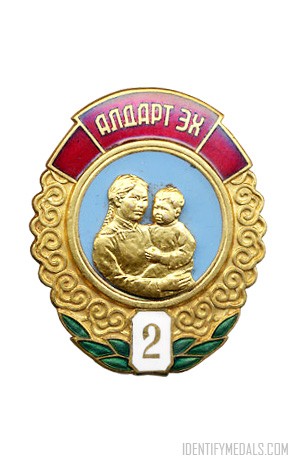
The Order of Mother Heroine was awarded to Mongolian mothers for bearing and raising large families. There medal was given in two classes: 

  • 1st Class: For mothers with eight or more children.
  • 2nd Class: For mothers with five to eight children.

The Order of Mother Heroine Design

The medal is made of bronze gilt with red, white, light blue, and green enamels and measures 39.5 mm (w) x 46.5 mm (h). 

The 1st and 2nd Class medals share the same design: A Mongolian mother holding a child, over a light blue enamel background. The difference lies in the number at the bottom of the award (a “1” for 1st Class and a “2” for 2nd Class).

Mongolian People's Republic: Order of Mother Heroine

1st Class 

Mongolian People's Republic: Order of Mother Heroine

2nd Class 

The Mongolian Order of the Red Banner

The Order of the Red Banner is a Mongolian military decoration originally established as the “Order for Military Merit” in 1926.
  • Time Period: Interwar
  • Institution: 1926 (as “The Order of Military Valour”, renamed to “The Order of the Red Banner in 1931)
  • Country: Mongolia

The Order of the Red Banner (Цэргийн гавьяаны улаан туг одон) is a military decoration of the Mongolian People’s Republic, first established in 1926 as the Order for Military Merit. It was created to recognize heroism in combat and distinguished service contributing to Mongolia’s defense and strengthening its armed forces.

The award could be given to Mongolian and foreign citizens, as well as military units, formations, schools, and institutions, reflecting Mongolia’s recognition of both individual and collective contributions to its military efforts. Over time the Order’s name and design evolved: it was simplified to the Order of the Red Banner in 1945, and in 1993 became known as the Order of the Red Banner for Military Valor (or Military Merit). The medallion design has been changed several times across different versions produced between 1926 and later decades. Around 10,000 awards were made over the years, and the Order remained an important part of Mongolia’s honors system.

The Order of the Red Banner Medal Design

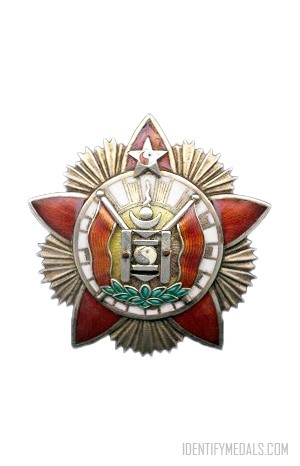
The obverse of the Order of the Red Banner has varied with different production types, but core elements remain consistent with its military and symbolic themes. There are five different designs with four sub-variants for the 1940 and 1945 versions (which have four classes each).

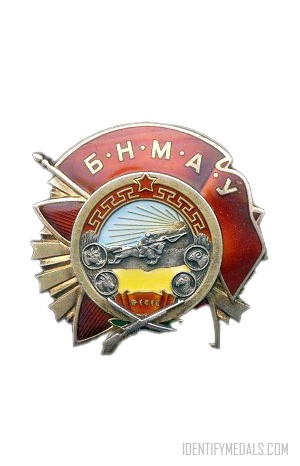
Order of the Red Banner of Military Valour - 1926 Version.
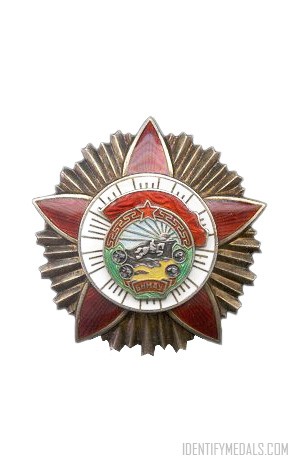
Order of the Red Banner of Military Valour - 1931 Version.
Order of the Red Banner of Military Valour - 1940 Version.
Order of the Red Banner of Military Valour - 1945 Version.

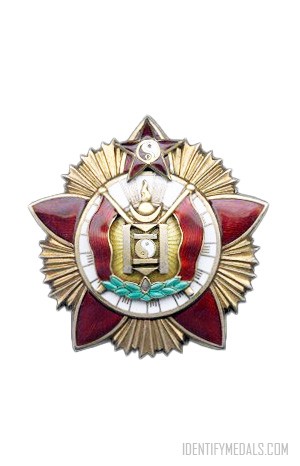
The badge is star-shaped with a prominent central motif and radiating rays — often with enamel and metallic finishes that give the Order a rich, layered appearance. Among earlier types, the central area frequently included a circular enamelled medallion depicting iconic imagery such as a rider on horseback and other figures or state symbols, framed by ornamental details.

Many versions feature a red enamel banner across the top portion of the star; in some examples this banner bears Mongolian Cyrillic initials like БНМАУ (abbreviation for People’s Republic of Mongolia), underscoring the award’s national identity.  The star’s rays and elements are often finished in gilt metal with colored enamels (red, white, yellow, blue and green), giving the insignia distinctive visual contrast. 

Design details changed over the decades — for example the pattern of enamel, the style of the central medallion, and how the banner and motifs were integrated — but the overall form remained recognizably a radiant star with bold military symbolism.

The Order of the Precious Wand

The Order of the Precious Wand was instituted in 1913 (reinstituted 1991) for strengthening democracy and cooperation with Mongolia.

The Order of the Precious Wand, also known as the Order of the Vajra or the Order of the Precious Rod, is a Mongolian state decoration first instituted in 1913 during the era of the Bogd Khanate of Mongolia. Its creation was inspired by Mongolian leaders’ desire to establish a national honours system on the model of Russian imperial awards after Mongolia began asserting independence from Qing China. The first versions were ordered in St. Petersburg and featured multiple classes within three degrees, intended for Mongolian nobles, officials, and foreign dignitaries — especially Russians — as a symbol of diplomatic respect and alliance.

After the Mongolian Revolution of 1921, which overthrew the Bogd Khanate and ushered in a communist government, the original order was abolished as a feudal relic, though some awards were still bestowed briefly during the early revolutionary period.

In 1991, following Mongolia’s democratic transition, the Order of the Precious Wand was re-established as a contemporary state decoration with three degrees but without the older class distinctions. Today it is awarded primarily to foreign statesmen and individuals who have made significant contributions to strengthening democracy and cooperation with Mongolia. Until the establishment of the Order of Chinggis Khaan in 2002, it was once again Mongolia’s highest state award.

The Order of the Precious Wand Medal Design

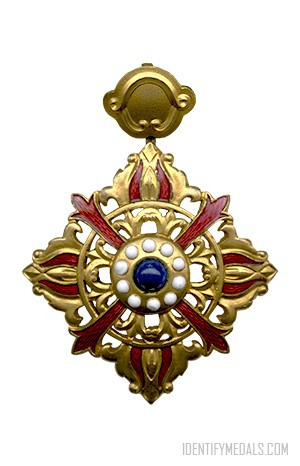
The obverse (front) of earlier versions of the Order of the Precious Wand — particularly the pre-1921 badges — typically featured a central vajra (precious rod or thunderbolt) motif, which in Buddhist symbolism represents indestructibility and spiritual power. Embedded gems or enamel highlighted the vajra and surrounding ornamentation, with gilt metalwork creating a distinguished, radiant badge reflecting the order’s high prestige. These badges were often crafted in multiple classes with differing decorations, colors and metals to indicate rank within the order. 

Modern re-established versions reflect updated state symbolism but preserve the historic emphasis on the vajra/rod motif as the focal point of the obverse. Because current official descriptions do not detail each design element on Wikipedia, visual references from medal collectors are typically used to understand the medallion’s front — which combines traditional emblems with refined metallic and enamel finishes fitting a top diplomatic award.

The Mongolian Order of the Polar Star

The Order of the Polar Star was created in 1936 as a state award of the Mongolian People’s Republic. It comes in four types.

The Order of the Polar Star (Алтан гадас одон, Altan Gadas Odon) is a long-standing state award of Mongolia, first instituted in 1936 and formally regulated by resolution of the Presidium of the Small Khural and the Council of Ministers of the Mongolian People’s Republic on 16 May 1941.

It remains an active honour today, with tens of thousands conferred since its creation. The award is given to both Mongolian and foreign nationals in recognition of special merits to society, which can include contributions to public life, international cooperation, cultural achievement, economic development, and other services benefiting Mongolia. The Order is placed directly below the Order of the Precious Wand in the nation’s order of precedence.

Unlike some medals that are limited to citizens, the Polar Star is frequently presented to foreign recipients for their work strengthening diplomatic, cultural, scientific, or economic ties with Mongolia; past awardees include international politicians, academics, diplomats, and organizational leaders, reflecting its role as one of Mongolia’s highest civilian honours.

The Mongolian Order of the Polar Star Medal Design

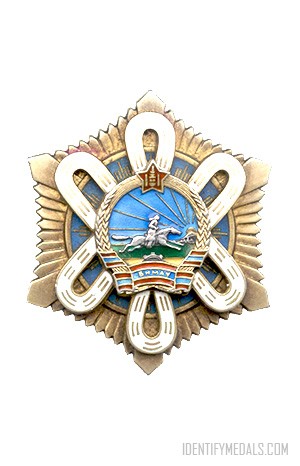
The obverse (front) of the Order of the Polar Star medal is visually striking and rich in symbolic detail, representing both Mongolia’s national identity and the prestige of the award.

At its core, the medal generally takes the form of a multi-pointed starburst with layered rays emanating from the center, often executed in gilded metal and enamel. Superimposed on this backing is a circular central medallion that features a horseman motif, usually depicting a rider across the Mongolian landscape — a common symbol of Mongolian heritage and the nation’s historic ties to horsemanship and freedom. Around this central scene, an enamelled ring and decorative elements (often in colors like blue and red) accentuate the medal’s focal imagery. Interlaced with the star’s rays are curved, repeating shapes — sometimes appearing as enamelled loops — that give the medal a distinctive, almost floral or astral appearance, aligning with the notion of the Polar Star as a guiding light. Many preserved examples show the medal finished with a high level of enamelling and metalwork detail, characteristic of both Soviet-era production and later variations.

The overall aesthetic combines geometric star forms and natural symbolism — encapsulating Mongolia’s cultural legacy and the honour’s role in recognizing exceptional contributions to society.

The Order of Sukhbaatar

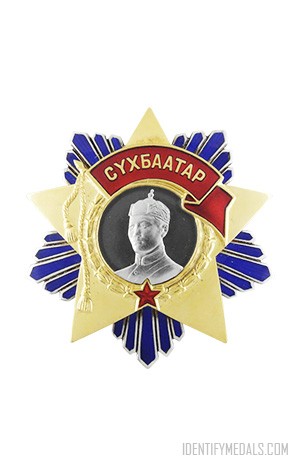
The Order of Sukhbaatar was formally introduced in September 1945 and is a major state order of Mongolia give for exceptional services.

The Order of Sukhbaatar (Сүхбаатарын одон) is a major state order of Mongolia, first established in May 1941 (with some sources citing its formal introduction in September 1945). It is named after Damdin Sükhbaatar, the Mongolian revolutionary hero who played a central role in the country’s struggle for independence in the early 20th century. The award is given to both Mongolian citizens and foreign nationals in recognition of exceptional services to Mongolia’s defense, economic and cultural development, and acts of heroism in protecting the nation against external and internal threats. It continues to be conferred today, and until 2005 it was the highest state order before being superseded by the Order of Chinggis Khaan. Recipients of the Order are accorded various civic privileges, including cultural and social benefits provided by the state.

The Order of Sukhbaatar Medal Design

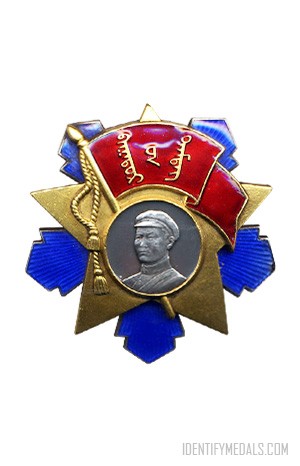
The obverse (front) of the Order of Sukhbaatar is highly symbolic and visually rich, reflecting Mongolia’s revolutionary heritage and state identity. On the front, the medal is dominated by a large five-pointed star that serves as the primary shape of the Order. Between the star’s points are silver or enameled rays of varying lengths, often finished in blue enamel, which create a radiant, layered effect. At the center of the star is a circular medallion featuring a relief portrait (bust) of Damdin Sükhbaatar, traditionally rendered in a contrasting material such as platinum against an enamel background. The central scene is surrounded by a decorative wreath or border, and above the portrait is a revolutionary banner in red enamel bearing the Cyrillic inscription “СҮХБААТАР” (“Sukhbaatar”), symbolizing the award’s namesake and Mongolia’s revolutionary spirit. Below the portrait, a red enamel star often appears as an additional motif, reinforcing the order’s prestige.

The combination of colors (red, blue, and metallic tones), the star motif, and the portrait all emphasize the Order’s association with national pride, heroic service, and the legacy of Sukhbaatar himself.

The Order of Chinggis Khaan Medal

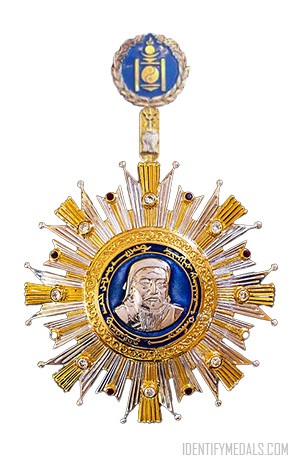
The Order of Chinggis Khaan, established on 17 May 2002, is the highest state decoration of Mongolia. It’s awarded for special merits.

The Order of Chinggis Khaan (Чингис хаан одон) is the highest state decoration of Mongolia, established on 17 May 2002 through a parliamentary resolution supported by the second President of Mongolia, Natsagiin Bagabandi. Its creation was intended to honor individuals and organizations whose contributions significantly strengthened Mongolia’s independence, sovereignty, national unity, economic and social development, cultural heritage, and international reputation.

The first award was presented in 2005, and since then the Order has been conferred on distinguished Mongolian and foreign citizens, musical ensembles, and institutions such as the band The Hu and the Mongolian Armed Forces.
Recipients include political leaders, scholars, athletes, cultural figures, and international dignitaries whose actions have embodied the spirit and legacy of Chinggis Khaan by advancing Mongolia’s interests at home and abroad. Although the award is usually limited to one conferral per year, exceptions have been made in special circumstances, such as awarding two recipients in 2021.

Those honored receive not only the decoration itself but also ceremonial recognition, eligibility for official state events, and other state privileges.

The Order of Chinggis Khaan Medal Design

The obverse of the Order of Chinggis Khaan medal is rich in symbolic imagery reflecting Mongolia’s history and cultural identity. At the heart of the medal’s obverse is a round central medallion featuring a relief depiction of Chinggis Khaan himself, traditionally crafted in white gold against a contrasting enamel background.

Surrounding this central figure is an outer circle of blue enamel, on which the motto “Munkh tengeriin khuchin dor” (“Under the Might of the Eternal Blue Sky”) is inscribed in gold on one side, with “Chinggis Khaan Temuujin” written in traditional Mongolian script on the other.
Encircling this enamel band is a decorative golden border adorned with stylized patterns (often interpreted as horn-shaped motifs), which symbolize the cardinal directions and unity. Emanating from the central medallion are ornate rays and arrow motifs, sometimes embellished with gemstones, representing strength, unity, and the enduring legacy of the Mongol state. Above the main medallion is a pendant section featuring the Golden Soyombo emblem set against a colored enamel backdrop, flanked by elements such as the Great White Banners and lotus motifs, further reinforcing Mongolia’s sovereign and cultural heritage.

The Hero of Labour of Mongolia Medal

The Hero of Labour of Mongolia Medal is one of the country’s highest state honours, originally established during the People’s Republic era.

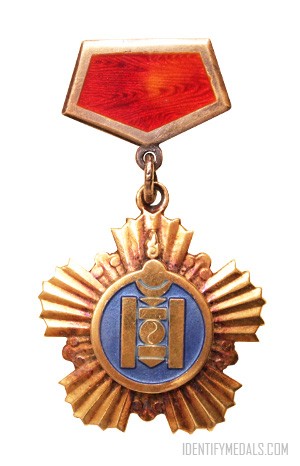
The Hero of Labour of Mongolia (or Хөдөлмөрийн гавьяаны улаан тугийн одон in Mongolian) is one of Mongolia’s highest state honours, originally established during the Mongolian People’s Republic era and retained in modern Mongolia with the same spirit.

It was created by a decree of the Presidium of the Great People’s Khural on 31 December 1956 to recognize exceptional contributions to the nation’s development and prosperity. Winners of this title were not only given the honorary designation but also received the Order of Sukhbaatar and a distinctive insignia known as the “Golden Soyombo” medal, symbolizing the award.

The first person to be honoured under this title was D. Davaajav, an excavator at the Nalaikh mine, in 1957. After the country’s political transition and renaming in the early 1990s, the title continued in the independent state of Mongolia under the updated name Hero of Labour of Mongolia, reflecting outstanding achievements in advancing the country across various fields.

In practice, the award has been conferred on distinguished athletes, cultural figures, workers, and other individuals whose accomplishments have brought honour or significant benefit to Mongolia. Recipients in recent years have included world-class athletes such as wrestlers and Paralympians recognised for their international success, demonstrating how the title continues to celebrate excellence and contribution to national prestige.

The Hero of Labour of Mongolia Medal Design

On the obverse (front), the medal features a prominent Soyombo symbol — the national emblem of Mongolia that represents independence and the nation’s traditional values — rendered in gold at the center of the design. The Soyombo is a tall, vertical emblem composed of abstract elements (such as flame, sun, moon, triangles, and yin-yang), each with symbolic meaning tied to Mongolia’s cultural heritage. This golden emblem is the focal point of the obverse and signifies the high honour being conferred with the title Hero of Labour.

Surrounding or incorporated into this central symbol, the medal’s design typically reflects a formal, solid metallic finish, befitting one of Mongolia’s top state decorations, intended to be worn on ceremonial occasions with other high orders like the Order of Sukhbaatar.

The Hero of the Mongolian People’s Republic Medal

The Hero of the Mongolian People’s Republic, first awarded in 1922, was one of the highest distinctions in the country.
The Hero of the Mongolian People’s Republic was the most prestigious honor in the former Mongolian People’s Republic, created to recognize extraordinary acts done in service to the Mongolian people and state. It was inspired by the Soviet Union’s own Hero of the Soviet Union award.

The title could be given to both Mongolian citizens and foreigners and was first bestowed in September 1922. In the early years after Mongolia’s 1921 revolution, the new government introduced high honors, with initial awards going to key revolutionary figures. Later, a distinctive Gold Star medal was established in 1945 to represent the title.

Recipients of the Hero of the Mongolian People’s Republic medal also received the Sukhbaatar Order.

Over the decades until it was last awarded in 1989, a total of 59 individuals received it, including two posthumously. Recipients ranged from military leaders and political figures in Mongolia to prominent Soviet allies, reflecting the close ties between the two countries during much of the twentieth century.

The Hero of the Mongolian People’s Republic Design

There are two variants of this medal. The first type was issued during 1941 to 1946 and the second from 1946.

The Hero of the Mongolian People's Republic
The Hero of the Mongolian People's Republic - 1st Type (1941-46), Obverse.
The Hero of the Mongolian People's Republic - Mongolian Medals
The Hero of the Mongolian People's Republic - 2nd Type (1946), Obverse.

The obverse of the medal is a gold star-shaped badge with a radiating, multi-faceted design. It appears as a starburst with sharply defined, sculpted rays emanating from the center, giving a three-dimensional, almost geometric look.

Around the edges of the star there are five small, round gemstones (traditionally diamonds) set near the points of the star, one between each pair of major rays, which add sparkle and emphasize the award’s prestige.