The King Haakon VII Freedom Cross

The King Haakon VII Freedom Cross is awarded for for outstanding achievement in wartime and was established in Norway on 18 May 1945.

The King Haakon VII’s Freedom Cross (or Haakon VIIs Frihetskors in Norwegian) was instituted in Norway on May 18, 1945. This distinguished medal is awarded to both Norwegian and foreign military and civilian personnel in recognition of exceptional achievements during wartime.

As a significant honor, it holds the fifth position in the Norwegian order of precedence. The Freedom Cross symbolizes the gratitude and recognition of the Norwegian state for extraordinary contributions to the war effort, reflecting the enduring legacy of King Haakon VII’s leadership during challenging times.

The King Haakon VII Freedom Cross Design

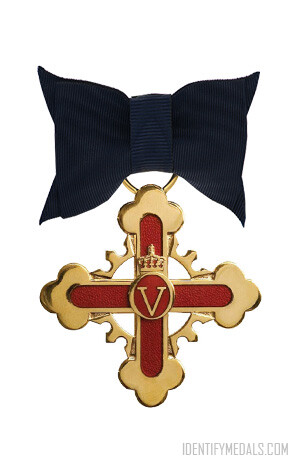
The medal is designed as a Maltese cross. On the obverse, it features a circular red field at the center, displaying the gilded silver monogram of King Haakon VII over the letter V, symbolizing victory.

The reverse side is engraved with the inscription: “Alt for Norge 7 juni 1945” (All for Norway 7 June 1945), marking the date when King Haakon VII returned to Norway after five years of forced exile during World War II. The medal is suspended from a blue ribbon adorned with narrow white stripes along both edges.
The Royal Norwegian Order of Merit

The Royal Norwegian Order of Merit is an award reserved usually for foreigners and diplomats and was instituted by King Olav V in 1985.

The Royal Norwegian Order of Merit (or Den Kongelige Norske Fortjenstorden in Norwegian) was established by King Olav V in 1985.

This prestigious order is awarded to individuals who have rendered exceptional service in the interests of Norway, including foreigners, Norwegian citizens residing abroad, diplomats from the Ministry of Foreign Affairs, foreign civil servants in Norway, and Norway’s honorary consuls. Unlike the Royal Norwegian Order of St. Olav, which is typically awarded to Norwegian citizens living in Norway, the Order of Merit recognizes contributions from those outside the country or those serving Norway in an international capacity.

Nominations for the Order are processed through the Protocol Department of the Royal Ministry of Foreign Affairs. The King grants the Order based on recommendations from the Lord Chamberlain of the Court, the Chief Protocol Officer of the Royal Ministry of Foreign Affairs, and the Head of Chancery of the Royal Norwegian Order of St. Olav.

The Order of Merit Grades

The order has five grades:

  • Grand Cross Commander, subdivided into:
    • Commander with Star 
    • Commander
  • Knight, subdivided into:
    • Knight 1st Class 
    • Knight

The Order of Merit Design

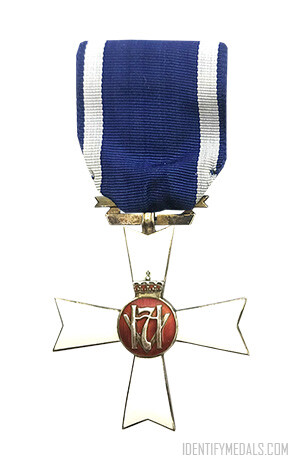
The Order features a distinctive deep blue moiré ribbon. The Grand Cross is worn on a broad sash draped over the right shoulder.

The Commander’s Cross is suspended from a ribbon worn around the neck. The Knight’s Cross is displayed on the left breast, also attached to a ribbon.

For women, both the Commander’s Cross and the Knight’s Cross are worn on the left breast, with the ribbon fashioned into a bow. Unlike the Order of St. Olav, the insignia of the Royal Norwegian Order of Merit is owned by the recipient.

The Order of St. Olav

The Royal Norwegian Order of Saint Olav was instituted by King Oscar I in 1847 and is a Norwegian order of chivalry.

The Royal Norwegian Order of Saint Olav (or Den Kongelige Norske Sankt Olavs Orden; or Sanct Olafs Orden, the old Norwegian name) is a prestigious order of chivalry established by King Oscar I on August 21, 1847. Named after King Olav II, who is venerated as St. Olav, this order honors remarkable achievements for the benefit of Norway and humanity.

In 1904, shortly before the union with Sweden was dissolved in 1905, King Oscar II instituted the Order of the Norwegian Lion. However, no appointments were made by his successor, King Haakon VII, making the Order of St. Olav the sole order of chivalry in Norway for the next 80 years. The reigning monarch of Norway serves as the Grand Master of the order, which has been used to recognize outstanding contributions.

Since 1985, the order has been primarily awarded to Norwegian citizens, though foreign heads of state and royalty may still be honored as a courtesy.

Grades and Classes

The Order of Saint Olav consists of three main grades, with some grades further divided into classes. It recognizes both civilian and military contributions, with the Grand Cross being the highest distinction. The collar is a separate honor awarded to recipients of the Grand Cross who are deemed exceptionally worthy.

  • Grand Cross (Storkors): Awarded to heads of state as a courtesy and, in rare cases, to individuals for merit. Recipients wear the badge on a collar (chain) along with a star on the left chest. If the collar is not worn, the badge may be worn on a sash over the right shoulder.
  • Commander: This grade is divided into two classes:
    • Commander with Star (Kommandør med stjerne): Recipients wear the badge on a necklet and a star on the left chest.
    • Commander (Kommandør): Recipients wear the badge on a necklet.
  • Knight: This grade is also divided into two classes:
    • Knight 1st Class (Ridder av 1. klasse): Recipients wear the badge on a ribbon on the left chest.
    • Knight (Ridder): Recipients wear the badge on a ribbon on the left chest.

The Order of St. Olav Design

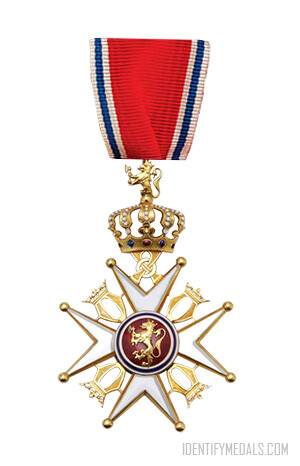
The collar of the Order is made of gold and features a series of decorative elements: five enamelled and crowned “O” monograms, five enamelled and crowned Norwegian coat-of-arms, and ten gold crosses bottony, each flanked by two battle axes with silver blades and golden shafts, a design also seen in the coat of arms of the Church of Norway.

The badge of the Order is a white enamelled Maltese Cross. For the knight class, the cross is silver, while for higher classes it is gilt. Between the arms of the cross are crowned “O” monograms. The central disc on the obverse side is red, showcasing a golden Norwegian lion holding a battle-axe. The reverse disc bears King Oscar’s motto, “Ret og Sandhed” (“Justice and Truth”), and both discs are surrounded by a white-blue-white ring. The cross is topped with a crown, and military awards include crossed swords between the crown and the cross.

The star of the Order for the Grand Cross is an eight-pointed silver star with faceted rays, featuring the badge of the Order minus the crown. The star for the Commander with Star is a silver faceted Maltese Cross with gilt crowned “O” monograms between the arms. The central disc is red with a golden Norwegian lion bearing a battle-axe, surrounded by a white-blue-white ring.

The ribbon of the Order is red with white-blue-white edge stripes.

The Medal for Outstanding Civic Service

The Medal for Outstanding Civic Service was established in 1819 and is the second highest ranked Norwegian medal.

The Medal for Outstanding Civic Service (or Medaljen for Borgerdåd in Norwegian), is the second highest-ranked medal in Norway. This prestigious award was first established by a Royal Resolution on April 10, 1819, and was subsequently modified by another Royal Resolution on April 13, 1844. The medal was conferred by the cabinet in a meeting presided over by the King, based on recommendations from the Norwegian Ministry of Justice.

The medal was divided into two grades: the first class in gold and the second class in silver. It recognized individuals who rendered exceptional service to society. However, in the spring of 2004, the medal ceased to be awarded.

In terms of the Norwegian order of precedence, recipients of the Medal for Outstanding Civic Service are ranked second, positioned after recipients of the War Cross with Sword and before holders of the Royal Norwegian Order of St. Olav.

The Medal for Outstanding Civic Service Design

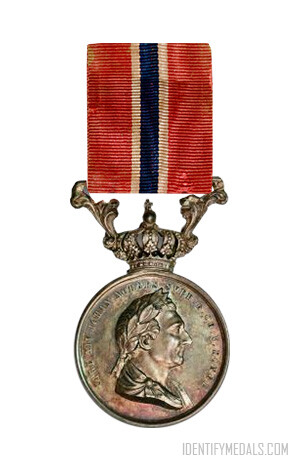
The medal is circular and comes in two classes: gold for the first class and silver for the second class, symbolizing the level of achievement and distinction of the recipient.

The obverse of the medal features an intricate design, including the image of the reigning monarch at the time of its institution, surrounded by a detailed border.

The medal is suspended from a red ribbon with a central blue and white stripe.

The Royal Family Order of Harald V

The Royal Family Order of Harald V is a prestigious honor conferred by the King of Norway upon female members of the royal family.

The Royal Family Order of Harald V (or Kong Harald Vs Husorden in Norwegian) is a prestigious honor conferred by the King of Norway specifically upon female members of the Norwegian royal family. Unlike the other two Royal Family Orders, this one is still actively awarded, highlighting its contemporary relevance within the royal household.

King Harald V, who ascended to the throne in 1991, has continued the tradition of awarding family orders as a means of honoring and recognizing the efforts of royal family members. His reign has been characterized by a modern approach to monarchy, balancing tradition with contemporary values, and this order is a testament to that balance.

This order serves as a mark of distinction and recognition for the female members of the royal family, acknowledging their service, dedication, and contributions to the monarchy and the nation. The active bestowal of this order reflects King Harald V’s appreciation and support for the roles played by women in the royal family.

The Royal Family Order of Harald V Design

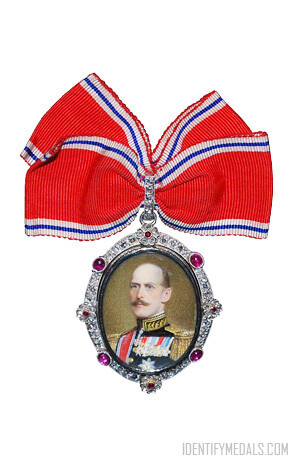
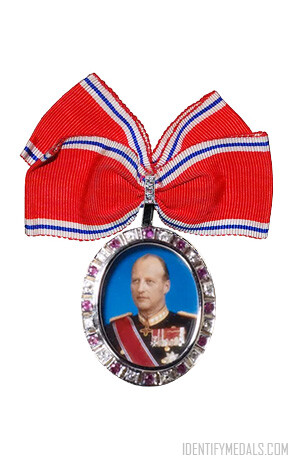
The insignia of the Royal Family Order of Harald V is both elegant and symbolic. It features a portrait of King Harald V in his middle years, encased within a jeweled frame.

This portrait is suspended from a distinctive red ribbon, which is accented by a blue stripe along the edges, further bordered by a thin white stripe. The combination of these colors and the intricate design of the insignia underscores the honor’s regal significance and the esteem in which it is held.

The Royal Family Order of Haakon VII

The Royal Family Order of Haakon VII was established in 1906 and bestowed by the Sovereign on members of the Norwegian royal family.

The Royal Family Order of Haakon VII (or Kong Haakon VIIs Husorden in Norwegian) is a distinguished honor that was personally conferred by King Haakon VII on members of the Norwegian royal family.

The Royal Family Order of Haakon VII is not just a ceremonial symbol but also a mark of distinction, reflecting the recipient’s service, dedication, and loyalty to the crown and the country. It serves as a unique honor, highlighting the personal appreciation and acknowledgment from the monarch to the family members who have supported and upheld the values and responsibilities of the monarchy.

King Haakon VII, who reigned from 1905 to 1957, established this order to honor and recognize the support of his family members. During his reign, he guided Norway through significant events, including its transition to independence and the challenging times of World War II.

Among the recipients of this prestigious order are key figures in the Norwegian royal family. For instance:

As of now, Princess Astrid, Mrs. Ferner, is the only living recipient of the Royal Family Order of Haakon VII. Her receipt of the honor underscores her enduring service and contributions to the royal family and Norway.

The Royal Family Order of Haakon VII Design

The insignia of the Royal Family Order includes a portrait of King Haakon VII, set in an ornate frame and suspended from a ribbon.

The ribbon is red with blue borders with a white fimbriation.

The Norwegian War Cross

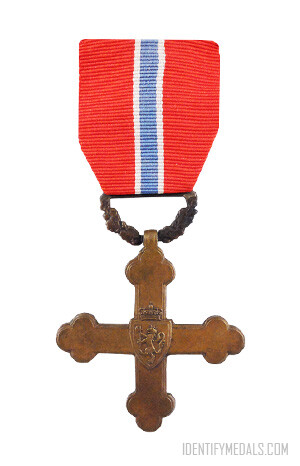
The Norwegian War Cross was established in 1941 by King Haakon VII and is the highest ranking gallantry decoration of Norway.

The War Cross (or Bokmål: Krigskorset in Norwegian) stands as Norway’s highest gallantry award, recognizing acts of extraordinary bravery or exceptional leadership during combat. Recipients of this prestigious medal may receive additional swords on the ribbon for further acts of valor, though this is exceedingly rare. 

Established on May 23, 1941, by King Haakon VII via royal resolution while he was in exile in London during the German occupation of Norway, the War Cross was initially awarded for both combat and non-combat achievements. Notably, some early recipients included members of the British Royal family and individuals who made significant contributions to Norway’s war effort, with non-combat awards presented without the sword.

On May 18, 1945, the statutes were revised to limit the award to military personnel for combat-related actions exclusively, ensuring all subsequent decorations included the sword. Concurrently, Haakon VII’s Freedom Cross was introduced to honor civilian contributions.

The awarding of the War Cross ceased in 1949 but was revived on June 26, 2009, when the statutes were amended once more to recognize post-1945 actions.

In 2022, the Norwegian Armed Forces commissioned composer Marcus Paus to create a major work celebrating the stories of War Cross recipients. This initiative aims to serve as a significant “identity-building and unifying” project for the Norwegian armed forces, preserving and honoring the legacy of the medal’s recipients.

The War Cross Design

Initially, prior to 1945, the War Cross could be awarded either with or without a sword-shaped clasp on its ribbon. If an individual received the War Cross more than once, a star-shaped clasp was added to the ribbon for each subsequent award.

After 1945, the War Cross was always conferred with a sword-shaped clasp on its ribbon. For additional awards, additional sword-shaped clasps are added to the ribbon.

The Medal for Defense Service Abroad (Norway)

The Medal for Defence Service Abroad is a Norwegian military medal originally awarded for service during military operations in the 1990s.

The Medal for Defence Service Abroad (or Forsvarets Innsatsmedalje in Norwegian) is a military medal established 1 January 1993 in Norway and originally awarded for service during military operations that took place in the 1990s. The later establishment of the Medal for Defence Operations Abroad rendered the first obsolete, however in 2009 it was reintroduced as an achievement medal.

It was awarded for distinguished bravery and courage, beyond what is normally required during combat operations. The medal’s color was changed from bronze to gold, and the ribbons of the medal would vary, depending on the area of operations.

The Medal for Defense Service Abroad Design

The medal is round, embossed in gold colored metal. On the obverse is a sword pointing up, with an oak branch on either side. On the reverse are the words FOR DIN INNSATS with oak branches above and below.

The award is suspended from a ribbon in the colors of the Flag of Norway and the Norwegian Armed Forces’ colors. The ribbon is blue with red edges, the red edges are bordered in the inside by a thin white stripe. In the center is a stripe of light blue.

During the first period of its existence, the medal was always awarded with a rosette. Finally, in 2012 the medal was further changed to a single ribbon design for all awards. The medal may be awarded with rosette for particularly meritorious distinction.