The Soviet 40th Anniversary Medal

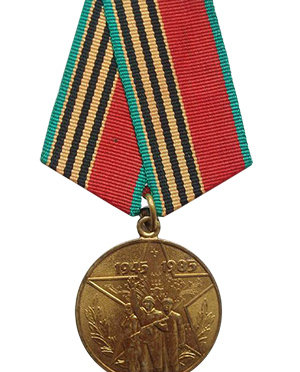
The Soviet 40th Anniversary Medal was established on 12th April 1985 and awarded to British and Canadian forces who served mainly in RN or MN ships on Arctic Convoys. The medal was approved in 1994 by Her Majesty the Queen and first awarded by the Soviet Government to selected ex-Servicemen – in particular surviving veterans of the Arctic Convoys of World War II.

Similar medals were issues for the 50th and subsequent five year anniversaries as well. However, those for the 55th anniversary and above have not been authorized for wear.

The Soviet 40th Anniversary Medal Design

The medal is circular, struck in bronze, and measures 32 mm in diameter.

The obverse features a group of servicemen and women in front of a five-pointed star and flanked by oak leaves and the dates 1945-1985 above. The reverse has the inscription “40th Anniversary of the Victory in the Great Patriotic War 1941-1945” in Russian.

The ribbon is one-half red and the other orange with three black stripes, edged with pale blue. Later issues of the medal have no blue edges.

The medal is worn in the Russian style.

The South Vietnam Campaign Medal

The Republic of Vietnam Campaign Medal (or Chiến Dịch Bội Tinh), is a South Vietnamese military campaign medal created in 1949.

The Republic of Vietnam Campaign Medal (or Chiến Dịch Bội Tinh in Vietnamese), is a South Vietnamese military campaign medal created in 1949 and awarded for two different periods of service in Vietnam.

The medal was first awarded to French military personnel during the First Indochina War (from 8 March 1949 to 20 July 1954). During the Vietnam War (Second Indochina War), the South Vietnamese government awarded the Republic of Vietnam Campaign Medal with Device (1960– ) to members of the South Vietnamese military for wartime service and on March 24, 1966, to members of the U.S. military for support of operations in Vietnam. In May 1966, other allied foreign military personnel became eligible for the award.

On 30 April 1975, Saigon was captured by the North Vietnamese army and South Vietnam surrendered and disbanded. The medal was not awarded after 28 March 1973, when the last U.S. troops left South Vietnam in accordance with the Paris Peace Accords.

In the United States, Public Law 88–257 permits military personnel to accept the medal for service performed in Vietnam from 1 March 1961 to 28 March 1973, inclusive. Since March 1966, the medal may also be awarded to any service member who, while serving outside the geographical limits of the Republic of Vietnam, contributed direct combat support to the Republic of Vietnam Armed Forces for six months.

The Republic of Vietnam Campaign Medal was awarded to Australian military personnel for service in South Vietnam during the period 31 July 1962 to 28 March 1973. The medal was awarded to New Zealand Forces for service in Vietnam for six months between 1964 (arrived Vietnam June 1964) and 1973 (left Vietnam 22 December 1972).

The South Vietnam Campaign Medal Design

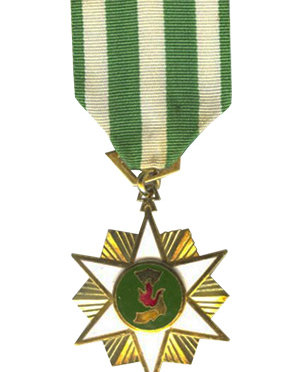
The medal is made of a gold-colored metal in the shape of a 36 mm wide six-pointed white enameled star with six-pointed gold rays between the arms of the star. During the Vietnam War, the Republic of Vietnam Campaign Medal with Device (1960–) was manufactured in the United States.

In the obverse, in the center of the star is an 18 mm green colored disc bearing a gold-colored map of Vietnam with three painted flames in red between North and South Vietnam, signifying the three regions of Vietnam. On the reverse of the medal is a circle bearing the inscription Chiến Dịch (Campaign) above and Bội Tinh (Medal) below the word VIET-NAM in the center.

The suspension ribbon and service ribbon of the medal is stripes in green (to represent freedom) with three vertical white (to represent purity).

Find This Medal Online

Right Now on eBay 
Clicking a link to eBay may result in a referral commission being paid if a purchase is made.
Loading...

The Inter Allied Victory Medal (Siam)

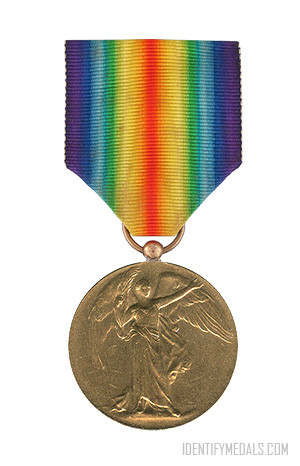
The Siam (or Thailand) Victory Medal was established in 1919, soon after the country declared war on Germany and sent a expeditionary force.

  • Time Period: World War I
  • Institution: 1919
  • Country: Siam

The Allied Victory Medal was recommended by an inter-allied committee in March 1919. Fourteen victorious countries finally awarded the medal after World War I, and each allied nation would design a ‘Victory Medal’ for award to their own nationals. Certain features were to be shared: a winged figure of Victory on the obverse and the same ribbon.

Siam declared war on Germany on 22 June 1917, after the USA’s entry to gain allied recognition of Thailand’s sovereignty in international affairs, and send an expeditionary force to France in July 1918. The official reason was to respond to Germany’s policy of unrestricted submarine warfare.

The medal (about 1,500 of them) were given to all the officers and soldiers of the task force, sailors that transported them and the royalty and staff officers.

The Siam Inter-Allied Victory Medal Design

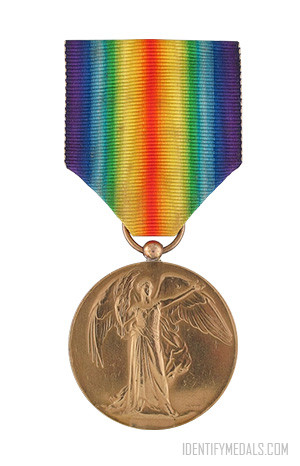
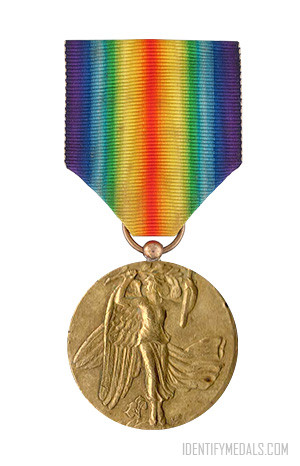
The Victory Medal measures 36 millimetres (1.4 in) in diameter and was designed by William McMillan. The design and ribbon was also adopted by Belgium, Brazil, Cuba, Czechoslovakia, France, Greece, Italy, Japan, Portugal, Romania, Siam, Union of South Africa and the USA. Each allied nation would design a ‘Victory Medal’ for award to their own nationals, all issues having certain common features, including a winged figure of victory on the obverse and the same ribbon.

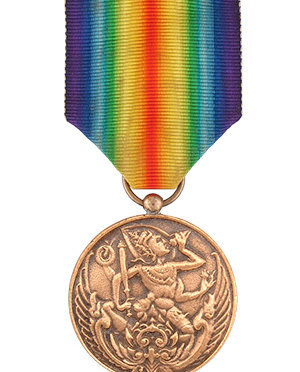
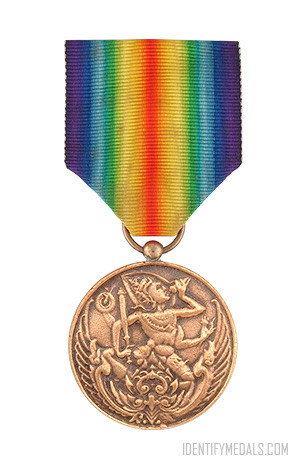
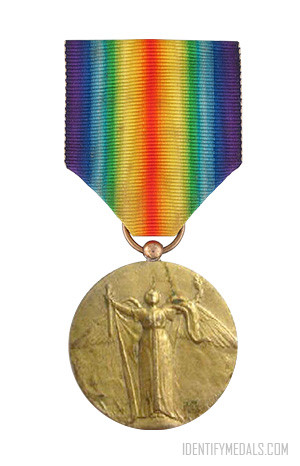
The obverse of the medal was designed by Prince Iddhidebsan Kritakara (1890-1935) and is presumed to have been manufactured at the Royal Thai Mint. There were two contemporary un-official versions, distinguishable by the ear of Vishnu being covered in all. Because Siamese culture didn’t have the traditional Western figure of victory, they instead used the image of a deity based on Vishnu riding the mythical bird Garuda holding, in its four hands, a club, a disk, a conch shell, and a lotus flower.

The reverse bears the inscription in Thai letters for ‘THE GREAT WAR FOR CIVILISATION’, within a lotus-decorated border.

The 39 millimeters (1.5 in) wide watered ribbon has an iridescent color scheme, with the violet moving through to a central red stripe where both schemes meet. It attaches to the medal through a ring suspender. The recipient’s name, rank, service number and unit were impressed on the edge of the medal. The name of the regiment or corps was omitted on medals awarded to Army officers.

All the Inter-Allied Victory Medal Variations

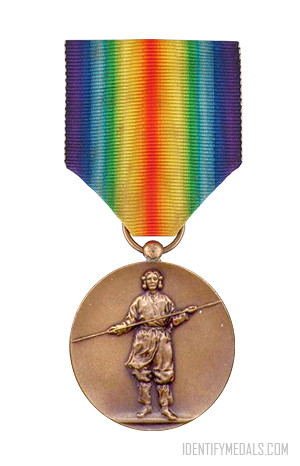
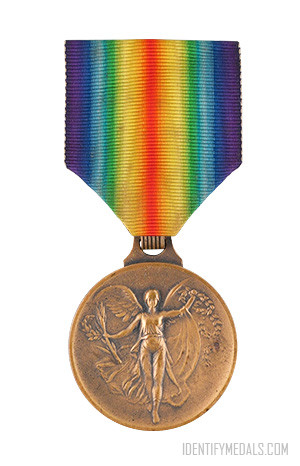
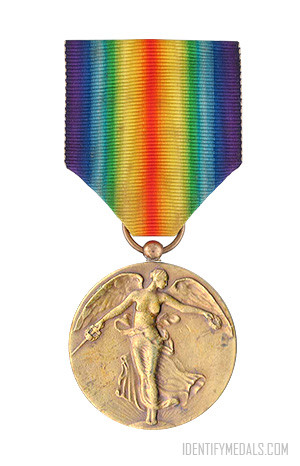
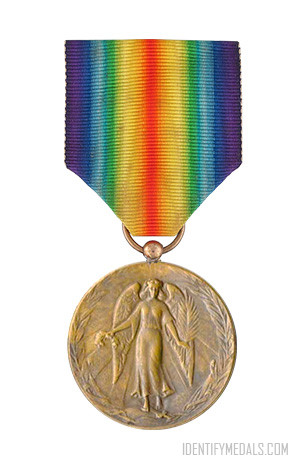
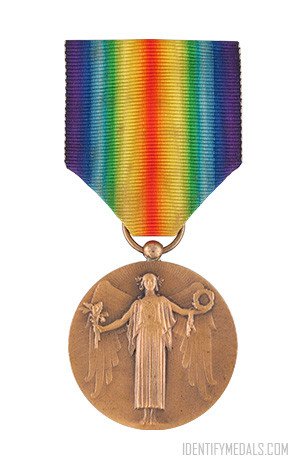
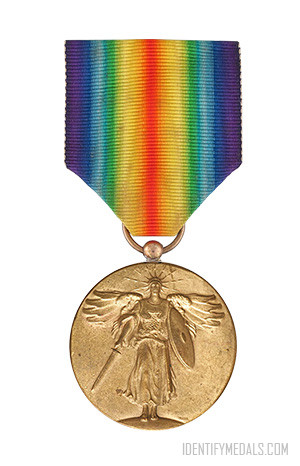
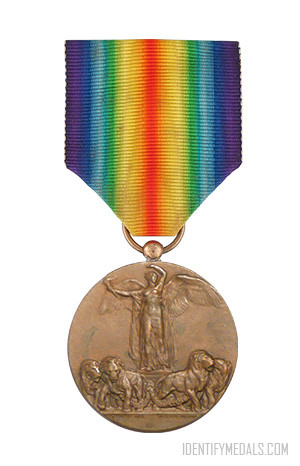
Although each country designed its own version of the Inter-Allied Victory Medal, all of them shared some common elements, such as a winged victory figure on the obverse and a similar ribbon with rainbow colors symbolizing unity among the Allies. Here are the versions for all countries:

Find an Inter-Allied Victory Medal Online

Right Now on eBay 
Clicking a link to eBay may result in a referral commission being paid if a purchase is made.
Loading...

The Inter Allied Victory Medal (Belgium)

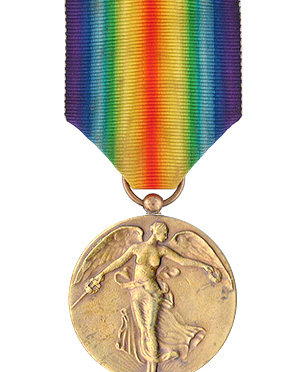
The Belgian Victory Medal was established by royal decree on 15 July 1919 and awarded to all members of the Belgian Armed Forces.

The Allied Victory Medal was recommended by an inter-allied committee in March 1919. Fourteen victorious countries finally awarded the medal after World War I, and each allied nation would design a ‘Victory Medal’ for award to their own nationals. Certain features were to be shared: a winged figure of Victory on the obverse and the same ribbon.

The Belgian Victory Medal was established by royal decree on 15 July 1919 and awarded to all members of the Belgian Armed Forces.

The Belgium Inter Allied Victory Medal Design

The Victory Medal measures 36 millimetres (1.4 in) in diameter and was designed by William McMillan. The design and ribbon was also adopted by Belgium, Brazil, Cuba, Czechoslovakia, France, Greece, Italy, Japan, Portugal, Romania, Siam, Union of South Africa and the USA. Each allied nation would design a ‘Victory Medal’ for award to their own nationals, all issues having certain common features, including a winged figure of victory on the obverse and the same ribbon.

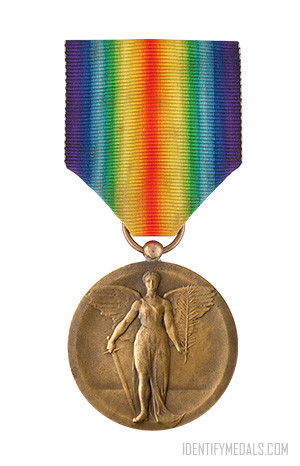
The obverse of the medal was designed by Belgian sculptor Paul Du Bois.

The reverse shows the words ‘THE GREAT / WAR FOR / CIVILISATION / 1914-1919’ surrounded by a laurel wreath.

The 39 millimeters (1.5 in) wide watered ribbon has an iridescent color scheme, with the violet moving through to a central red stripe where both schemes meet. It attaches to the medal through a ring suspender. The recipient’s name, rank, service number and unit were impressed on the edge of the medal. The name of the regiment or corps was omitted on medals awarded to Army officers.

All the Inter-Allied Victory Medal Variations

Although each country designed its own version of the Inter-Allied Victory Medal, all of them shared some common elements, such as a winged victory figure on the obverse and a similar ribbon with rainbow colors symbolizing unity among the Allies. Here are the versions for all countries:

Find an Inter-Allied Victory Medal Online

Right Now on eBay 
Clicking a link to eBay may result in a referral commission being paid if a purchase is made.
Loading...

The Inter Allied Victory Medal (Brazil)

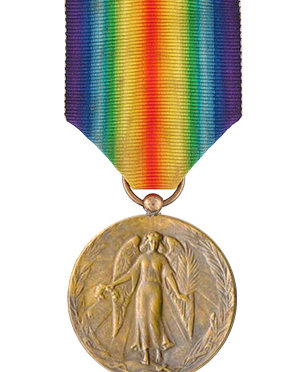
The Brazilian Victory Medal was established in January 24, 1919 and awarded to all military personnel or civilians employed in war service.

The Allied Victory Medal was recommended by an inter-allied committee in March 1919. Fourteen victorious countries finally awarded the medal after World War I, and each allied nation would design a ‘Victory Medal’ for award to their own nationals. Certain features were to be shared: a winged figure of Victory on the obverse and the same ribbon.

The President of the United States of Brazil, adopted the proposal of Marshal Foch in January 24, 1919 so that all the fighters of the Great War received a commemorative medal. Brazil had a sizable merchant fleet and had lost a number of ships to German submarines when it joined the allies in October 1917, contributing with two cruisers and two destroyers and their crews placed under command of the British Admiralty.

Brazilians also sent a medical mission to Europe and a number of soldiers to set up several field medical stations and a 300-bed hospital near Paris. Approximately 2,500 medals were produced for these sailors, soldiers and medical personnel.

The Brazil Inter Allied Victory Medal Design

The Victory Medal measures 36 millimetres (1.4 in) in diameter and was designed by William McMillan. The design and ribbon was also adopted by Belgium, Brazil, Cuba, Czechoslovakia, France, Greece, Italy, Japan, Portugal, Romania, Siam, Union of South Africa and the USA. Each allied nation would design a ‘Victory Medal’ for award to their own nationals, all issues having certain common features, including a winged figure of victory on the obverse and the same ribbon.

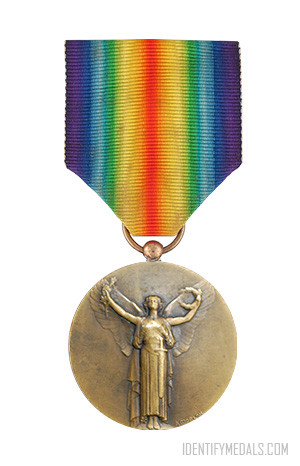
The obverse of the Brazilian Victory Medal featured a symbolic figure of Victoria fringed with two palms on a plain background.

The reverse shows the words ‘THE GREAT / WAR FOR / CIVILISATION / 1914-1919’ surrounded by a laurel wreath.

The 39 millimeters (1.5 in) wide watered ribbon has an iridescent color scheme, with the violet moving through to a central red stripe where both schemes meet. It attaches to the medal through a ring suspender. The recipient’s name, rank, service number and unit were impressed on the edge of the medal. The name of the regiment or corps was omitted on medals awarded to Army officers.

All the Inter-Allied Victory Medal Variations

Although each country designed its own version of the Inter-Allied Victory Medal, all of them shared some common elements, such as a winged victory figure on the obverse and a similar ribbon with rainbow colors symbolizing unity among the Allies. Here are the versions for all countries:

Find an Inter-Allied Victory Medal Online

Right Now on eBay 
Clicking a link to eBay may result in a referral commission being paid if a purchase is made.
Loading...

The Order of the Liberator General San Martin

The Order of the Liberator General San Martin (or Orden del Libertador General San Martín in Spanish) is the highest decoration awarded by the Governement of Argentina. It is given to foreign politicians or military, deemed as worthy of the highest recognition by the country and it’s granted by the sitting President of Argentina.

The order receives its name from José de San Martín, Father of the Land and Liberator. The award was established in 1943 (Decree 5000 from August 17th, 1943) and modified on May 21st 1948 (Decree 16628 from 1957, which creates the Order). The rules used today date from December 18th, 1967.

The Grand Master of the Order presides over a national council and is the President of the Nation, same who confers the award. The Order headquarters is the Ministry of Foreign Relations, International Commerce and Cult.

The grades of the Order are:

  • Collar (Collar)
  • Grand Cross (Gran CruzARG Order of the Liberator San Martin - Grand Cross BAR.png
  • Grand Officer (Gran OficialARG Order of the Liberator San Martin - Grand Officer BAR.png
  • Commander (ComendadorARG Order of the Liberator San Martin - Commander BAR.png
  • Officer (OficialARG Order of the Liberator San Martin - Officer BAR.png
  • Member (CaballeroARG Order of the Liberator San Martin - Knight BAR.png

The Order of the Liberator General San Martin Medal Design

The medal was designed by Ángel Eusebio Ibarra García. It’s struck in gold and shows a condor, the sable and General San Martin’s portrait in a frame made of sun rays.

Only one Order with the Extraordinary grade was awarded: to Eva Perón in 1952. It was made of 3821 pieces of gold and platinum, and 753 precious stones. It was made by the jewelers joyería Ghiso S.A. and designed by Aída Louzao. After the Military Dictatorship of 1955, the collar was disassembled and the pieces went to auction.

The reverse of the Argentinian $5 bill shows the collar of the Order.

The Medal to the Fighters (Argentina)

The Medal to the Fighters is a decoration given by the Argentinian Republic to everyone who fought in the territorial claim of the Falklands, South Georgia and South Sandwich Islands between April 2nd and June 14th 1982.

The medal was established September 30th, 1984, during the government of Raúl Alfonsín and through Decree 3522. It was published in the official bulletin on November 9th, 1984.

A medal and certificate were awarded to everyone who fought in the war. The medal only has one class and can be awarded to civilians and military personnel. It can be awarded posthumously. A golden version of the medal is to be created for the 30th anniversary of the war.

The Medal to the Fighters Design

The medal is made of white metal. The obverse shows the Argentinian flag colors, a relief of the Falklands Islands and the last name of the fighter. The reverse bears the inscription “The Honorable Congress of the Nation to the Fighters”. This same text is repeated in the accompanying certificate.

The Medal for the Liberation of Kuwait (Bahrain)

The Medal for the Liberation of Kuwait (Bahrain) was an award given to members of Bahrain’s military for service during the First Gulf War.

The Medal for the Liberation of Kuwait (Bahrain version) was an award given to members of Bahrain’s military for service during the First Gulf War, 1990–91.

Bahrain played a limited but active role in the gulf war. Its ground forces were among the 3,000 Peninsula Shield force of the GCC (exclusive of Saudi Arabian and Kuwaiti troops) that were assigned to a support role during Operation Desert Storm as part of Joint Forces Command East. Bahrain was the primary coalition naval base and was the point of origin for coalition air operations against Iraqi targets.

Bahraini pilots joined other members of the coalition in flying strikes into Iraq. Three Scud missiles were aimed at Bahrain during the war. Only one landed in the country, and it did not hit a target area. There were no Bahraini combat deaths in the war.

The Medal for the Liberation of Kuwait (Bahrain) Design

The medal is struck in bronze and mounted for wear on broach.

The Medal for the Liberation of Kuwait (UAE)

The Medal for the Liberation of Kuwait was an award given to members of the UAE’s military for service during the First Gulf War, 1990–91.

The Medal for the Liberation of Kuwait (UAE version) was an award given to members of the UAE’s military for service during the First Gulf War, 1990–91. This medal was issued in very limited numbers.

The UAE’s armed forces have engaged in numerous wars since inception. During the Persian Gulf War, UAE troops, reportedly numbering several hundred, participated in the conflict as part of the GCC Peninsula Shield force that advanced into the city of Kuwait. United States aircraft bombed Iraqi positions from the UAE, and United States ships operated out of UAE ports. The UAE Air Force also carried out strikes against Iraqi forces. A total of six UAE combat deaths were reported as a result of the fighting.

The Medal for the Liberation of Kuwait (UAE) Design

The medal is gold-coloured gilt on metal with enamels. It measures 38.3 mm. The ribbon comes with a pinback.

The Medal for the Liberation of Kuwait (Kuwait)

The Medal for the Liberation of Kuwait was an award issued by the government of Kuwait for service during the Liberation of Kuwait campaign.

The Medal for the Liberation of Kuwait (or Wisam Al-Tahrir وسام التحرير‎ in arabic) was an award issued by the government of Kuwait for service during the Liberation of Kuwait campaign, 1990–91.

The medal was approved by the Kuwait Council of Ministers for award in five classes, generally according to the rank of the recipient. The medal was offered by the Chief of Staff of the Kuwait Armed Forces on July 16, 1994.

The Australian Government, as well as the governments of Canada and United Kingdom had decreed that personnel may accept their medals as a keepsake but permission to wear them in uniform has so far been refused. The only country that allowed them to be worn was France, who accepted all grades version for their personnel according to their rank at the time of Operation Desert Storm.

The Medal for the Liberation of Kuwait (Kuwait) Design

A nation of seafarers and ship builders, Kuwait chose as their coat of arms, the traditional dhow. Falconry is the sport of Kings in the Persian Gulf, and the falcon in the arms is seen as a symbol of Kuwaiti prowess. The official symbolism of the colors is that black symbolizes battlefields, white is for deeds, green is for the meadows, and red is for the blood of Kuwait’s enemies.

The medal is awarded in five classes.

5th Class (for non-commissioned personnel): A bronze medal with enamel, 1 9/16 inches (40 mm) in diameter suspended from a bar by a wreath. The obverse bears the Coat of Arms of the State of Kuwait (the shield of the flag design in color superimposed on a falcon with wings displayed). The falcon supports a disk containing a sailing ship with the full name of the State written at the top of the disk. At the top of the medal is the inscription “1991 LIBERATION MEDAL” in Arabic letters. The reverse side is the map of Kuwait on a rayed background. The ribbon consists of three equal stripes 29/64 inch (11.5 mm) each of Old Glory Red 67156; White 67101; and Irish Green 67189. A black trapezium is at the top of the ribbon drape and service ribbon.

4th Class (for warrant and junior commissioned officers): A dull grey metal medal, suspended from a bar engraved with laurel leaves. The obverse bears a fully sized, five pointed star over a pattern of engraved rays with the centre containing the same falcon and dhow emblem as the fifth class medal and the reverse the same map and rayed background.

3th Class (for field-grade and equivalent officers): A bright gilt medal of similar design to the fourth class medal. The points of the star are considerably rounded and, instead of the rayed background, the medal is pierced between the star and the outer circle.

2nd Class (for one and two star officers): A golden star overlaying a laurel wreath. The center emblem is significantly smaller than for the lower classes of medal. There is Arabic writing above and below the center emblem. The star is suspended directly from the ribbon, by a ring attached to the wreath.

1st Class (for three and four star officers): A neck decoration of large pattern. Similar to the second class medal but the star is enameled in with red points and a white circle surrounding the center emblem. The white circle contains a geometric outer pattern in gold and Arabic writing above the center. Pierced rays, of differing lengths, lie behind the wreath. The star is suspended from its high point.