The Order of Ho Chi Minh

The Order of Ho Chi Minh is a decoration of the Socialist Republic of Vietnam that was first instituted in 1947 by president Hồ Chí Minh.

The Order of Ho Chi Minh (or Huân chương Hồ Chí Minh in Vietnamese) is a decoration of the Socialist Republic of Vietnam that was first instituted on 6 June 1947 by president Hồ Chí Minh. Currently, the Ho Chi Minh Order is the second highest national order of the Socialist Republic of Vietnam.

The Order is conferred (can be done posthumously) on individuals who have rendered great meritorious services, recorded numerous outstanding achievements in one of the political, economic, social, literature, art, scientific, technological, defense, security, diplomatic or other domains.

When first instituted, the Ho Chi Minh Order had 3 classes, but since 1981 the Order has become a single one. The Order is bestowed on citizens who have rendered outstanding services to the State, or members of the Vietnamese People’s Armed Forces for acts of bravery in action against an enemy force. The decoration may also be awarded to cities, regions, collectives, military units and ships for the same reasons.

The Order of Ho Chi Minh Design

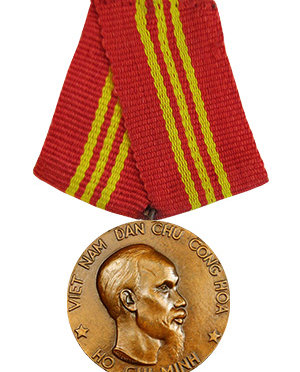
The medal is round and struck in bronze, and features the portrait of President Hồ Chí Minh in profile.

The Vietnam Gallantry Cross (South Vietnam)

All military personnel of all branches were awarded the Vietnam Cross of Gallantry if they had served in Vietnam between 1961 and 1973.

Under the Department of the Army General Order (DAGO) 43, 1970, all military personnel of all branches were awarded the Vietnam Cross of Gallantry if they had served in Vietnam between March 1, 1961 and March 28, 1973.

In addition, according to DAGO 8, 1974, the Vietnam Gallantry Cross, Unit Citation with Palm was awarded to Headquarters U.S. Military Assistance Command (MACV) and all subordinate units during February 8, 1962 to March 28, 1973. This meant that all military personnel who were assigned to units that served in-country Vietnam during this period were considered as assigned to MACV, regardless of service or component.

In other words, the Republic of Vietnam authorized this award for all foreign military personnel and units for valorous achievement and participation during the Vietnam War. Equivalent to the French Croix de Guerre, the medal demonstrates South Vietnam’s gratitude to the American and Allied soldiers who worked, fought, and sacrificed themselves for the freedom of the Republic of Vietnam.

In closing, the Vietnam War has always been a touchy subject. Since the war was quite unpopular, many veterans were not welcomed when they returned, even if they did not personally agree with the conflict. In addition, many Vietnam War vets rarely talked about their experiences during the war and their service—until somewhat recently—went undiscussed.

As a result, besides the Medal of Honor and other prestigious U.S. decorations, many individuals do not know much about the Vietnam War medals, which is unfortunate because they are especially unique.

From the unique device attached to the Republic of Vietnam Campaign Medal to the fact that some medals were issued by a now defunct country—South Vietnam, the medals specifically connected to the Vietnam War have a distinctive story to tell.  

he Republic of Vietnam Gallantry Cross was awarded in four degrees:

  • Gallantry Cross with Palm: cited at the Armed Forces level.
  • Gallantry Cross with Gold Star: cited at the Corps level.
  • Gallantry Cross with Silver Star: cited at the Division level.
  • Gallantry Cross with Bronze Star: cited at the Regiment or Brigade level.

The Gallantry Cross Medal Design

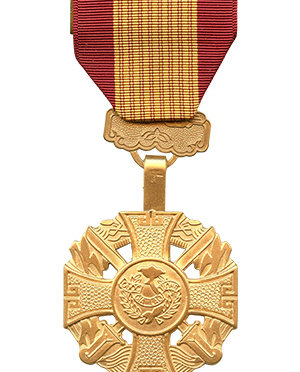
The medal is gold in color, and 35 mm wide. It consists of a Celtic cross with two crossed swords between the arms. The cross is superimposed over a wreath. The center of the cross contains a disc with the outline of the country of Vietnam between two palm branches joined at the bottom. A scroll is on top of the map and is inscribed “QUOC-GIA LAO-TUONG” (Reward of the State).

The suspension ribbon of the medal is 35 mm wide and is made up of the following stripes: 9 mm of Old Glory Red; 17 mm center stripe in Golden Yellow. The center stripe has sixteen strands of Old Glory Red; and 9 mm of Old Glory Red.

The Republic of Vietnam Campaign Medal

The Republic of Vietnam Campaign Medal is a military decoration issued to American troops who aided South Vietnam in a conflict.

The Republic of Vietnam Campaign Medal is a military decoration issued to American troops who aided South Vietnam in a conflict. First introduced during the First Indochina War, the Republic of Vietnam Campaign medal was authorized for wear on American service members as of December 1966 for their service in Vietnam.

In order to receive this medal, military members must have served in the Republic of Vietnam for six months between March 1, 1961 and March 28, 1973 or served outside Vietnam but gave combat support for six months or served less than six months but was wounded, captured and escaped enemy forces, or was killed in action.

The Republic of Vietnam Campaign Medal Design

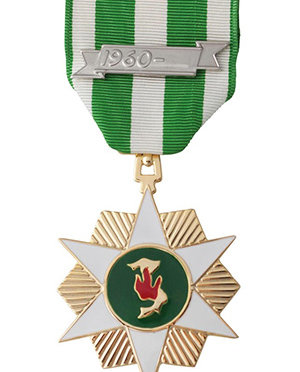
What’s unique about the medal is that it comes with a default device, known as the 1960 device. It reads, “1960-”. Because they were produced and awarded during the war, it reads the start date of the conflict, but no end date was added.
Its design helps to tell the story of the Vietnam War with the colors of the medal—green and white—to represent freedom and purity respectively. In addition, the medallion is made of a gold-colored metal in the shape of a 36 mm wide six-pointed white enamel star, six golden rays between each point in the star, and a map of Vietnam in the center of the medallion. The putative red flames on the map represent the locations of the war.

On the reverse of the medal is a circle bearing the inscription Chiến Dịch (Campaign) above and Bội Tinh (Medal) below the word VIET-NAM in the center. The suspension ribbon and service ribbon of the medal is green (to represent freedom) with three vertical white (to represent purity) stripes.

The Medal of the Hellenic Red Cross

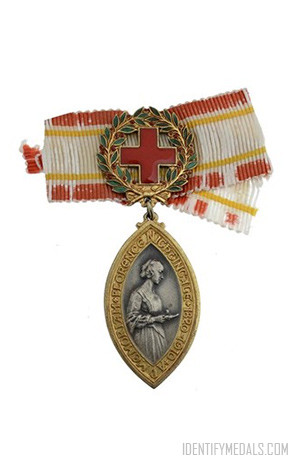
The Medal of the Hellenic Red Cross is medal for service in the ranks during the Italian invasion in 1940 until the Capitulation of Greece.

The Medal of the Hellenic Red Cross is a WW2 medal for service in the Hellenic Red Cross ranks during the Italian invasion in 1940 and until the Capitulation of Greece following the German invasion in April 1941 and the battle of Crete in May of the same year. The medal was awarded to both men and women.

The first initiative for the foundation of the Hellenic Red Cross took place in 1865 as the Kingdom of Greece participated in the 1st Geneva Convention. The Hellenic Red Cross was officially founded in 1877, with the active support of Queen Olga and it was recognized, the same year, by the International Red Cross Committee. Ever since it continues its humanitarian efforts both domestically and abroad whenever and wherever its aid is needed.
The Medal of the Hellenic Red Cross Design

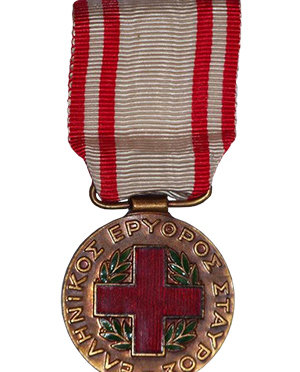
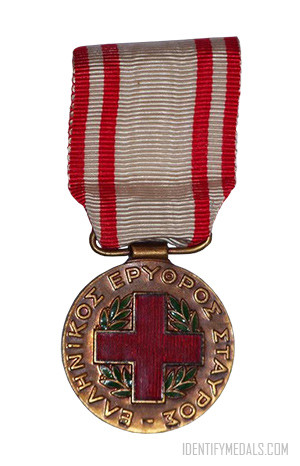
The medal is made of bronze and enamels and measures 30.3 mm in diameter. The obverse depicts a large red cross in finely detailed red enamel, encircled by laurel branches in green enamel; on horizontal loop for suspension.
Find Red Cross Medals Online

More Red Cross Medals

The Henry Dunant Medal

The Henry Dunant Medal is the highest award of the Red Cross. It was created in 1963 and named after the founder of the Red Cross Movement.

The Henry Dunant Medal is the highest award of the Red Cross Movement. It was created in 1963 and named after Henry Dunant, the founder of the Red Cross Movement. In 1963, the idea of creating a medal named in honor of the founder of the International Red Cross was submitted to and approved by the Council of Delegates. This coincided with the 100th anniversary of the Red Cross. In 1965, through the generosity of the Australian Red Cross, the Henry Dunant Medal was established by the International Red Cross Conference in Vienna. The first medals were presented in 1969.

The medal is awarded to “recognize and reward outstanding services and acts of great devotion, mainly of international significance, to the cause of the Red Cross/Red Crescent by any of its members“. 

The medal is presented every two years by the Standing Commission of the Red Cross and Red Crescent, the body that represents the International Committee of the Red Cross, the International Federation of Red Cross and Red Crescent Societies and the various National Red Cross and Red Crescent Societies. This body, representing all of the groups making up the Red Cross Movement, makes five awards of the medal every two years. These limits are placed to ensure the value and prestige of the medal as the highest honour the Red Cross Movement can bestow upon one of its members.

Regulations still allow for the posthumous award of the medal. However, the various groups of the movement have been encouraged to create recognition for those killed in service to the Red Cross. All posthumous nominations for the Henry Dunant Medal should be for, “truly exceptional cases.”

The Henry Dunant Medal Design

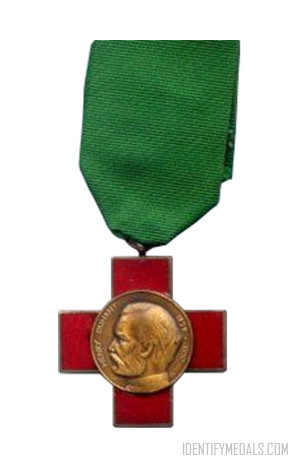
The Henry Dunant Medal is in the shape of a Geneva or Greek cross. The arms of the cross are colored with red enamel. In the center of the cross is a circular bronze medallion bearing effigy of Henry Dunant, facing left. Circumscribed around the effigy are the words HENRY DUNANT 1828-1910. The reverse of the medal is plain. To the top arm of the cross is attached a loop for ribbon suspension.

The ribbon is depicted as either solid green, or green with red edges.

Find Red Cross Medals Online

More Red Cross Medals

The Inter Allied Victory Medal (Romania)

The Romanian Victory Medal was awarded to those who had taken part in a battle between 28 August 1916 and 31 March 1921 or served as a medic.

  • Time Period: World War I
  • Institution: 1919
  • Country: Romania

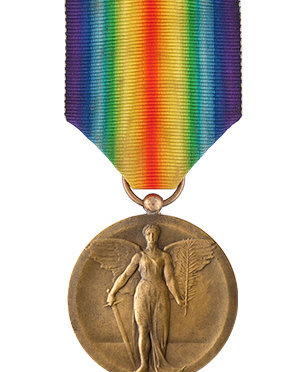
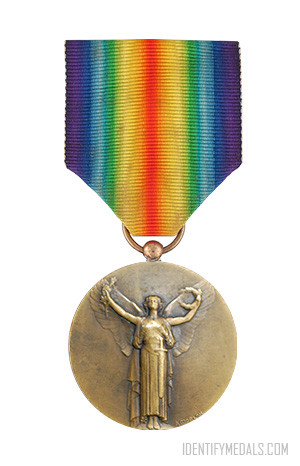
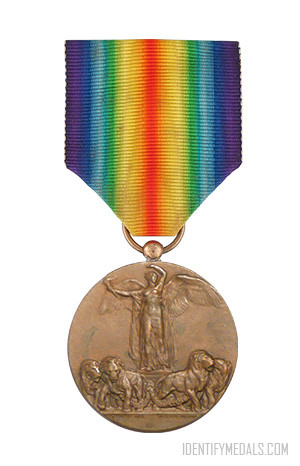
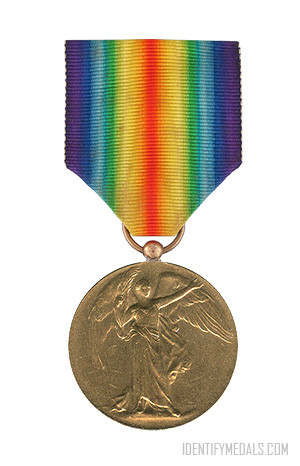
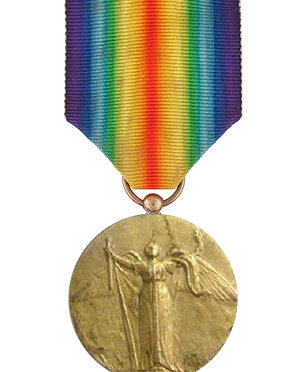
The Allied Victory Medal was recommended by an inter-allied committee in March 1919. Fourteen victorious countries finally awarded the medal after World War I, and each allied nation would design a ‘Victory Medal’ for award to their own nationals. Certain features were to be shared: a winged figure of Victory on the obverse and the same ribbon.

To qualify for the Romanian Victory Medal, recipients of any rank had to be mobilized for war service and to have taken part in a battle between 28 August 1916 and 31 March 1921, or to have served as an army medic. Also included were the combatants from the Hungarian–Romanian War.

The Romania Inter-Allied Victory Medal Design

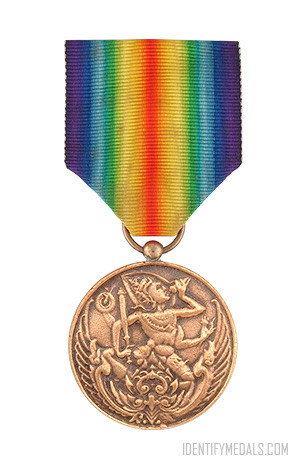
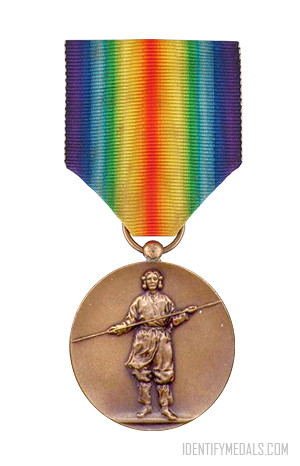
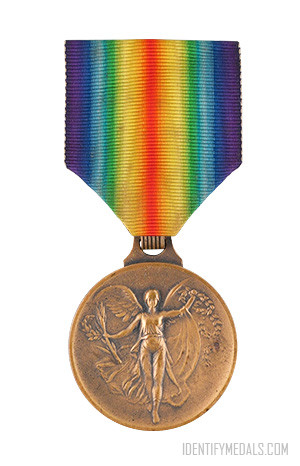
The Victory Medal measures 36 millimetres (1.4 in) in diameter and was designed by William McMillan. The design and ribbon was also adopted by Belgium, Brazil, Cuba, Czechoslovakia, France, Greece, Italy, Japan, Portugal, Romania, Siam, Union of South Africa and the USA. Each allied nation would design a ‘Victory Medal’ for award to their own nationals, all issues having certain common features, including a winged figure of victory on the obverse and the same ribbon.

The obverse of the Romanian medal was selected from a set of proposals submitted to an international jury. The jury selected the design of Lt. Col. Constantin Kristescu, who was also put in charge of its sculpting. The medal was manufactured in Paris, where Kristescu used to work with La Maison Arthus-Bertrand.

The reverse shows the words ‘THE GREAT / WAR FOR / CIVILISATION / 1914-1919’ surrounded by a laurel wreath.

The 39 millimeters (1.5 in) wide watered ribbon has an iridescent color scheme, with the violet moving through to a central red stripe where both schemes meet. It attaches to the medal through a ring suspender. The recipient’s name, rank, service number and unit were impressed on the edge of the medal. The name of the regiment or corps was omitted on medals awarded to Army officers.

All the Inter-Allied Victory Medal Variations

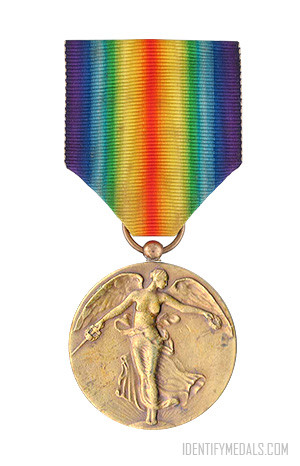
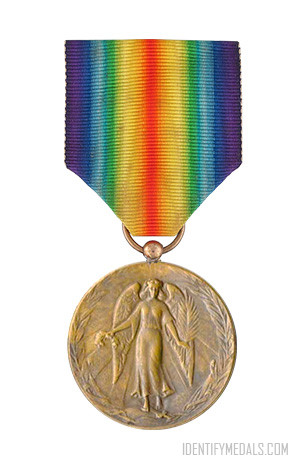
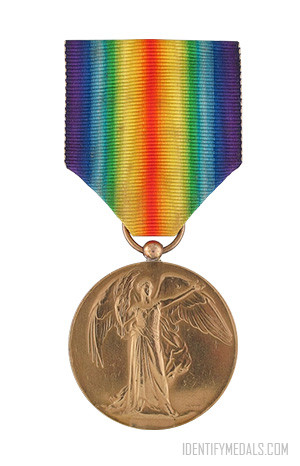
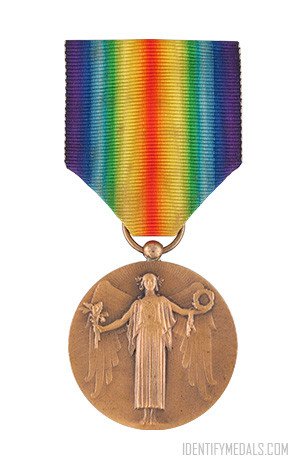
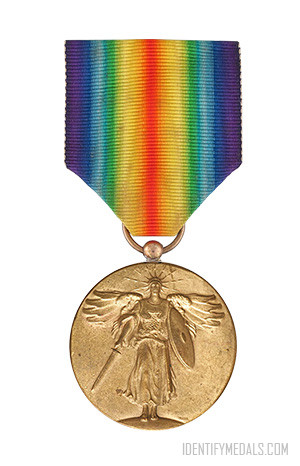
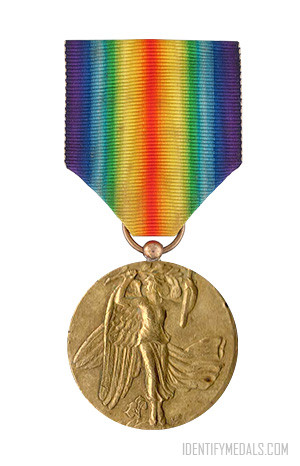
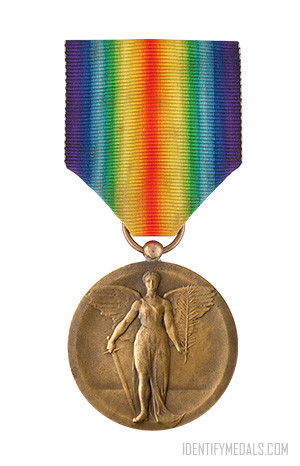
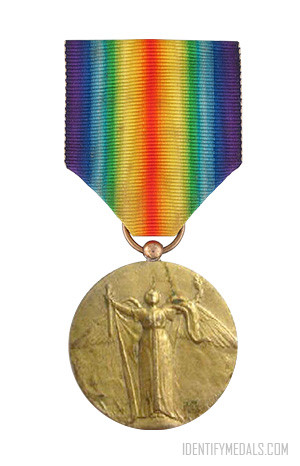
Although each country designed its own version of the Inter-Allied Victory Medal, all of them shared some common elements, such as a winged victory figure on the obverse and a similar ribbon with rainbow colors symbolizing unity among the Allies. Here are the versions for all countries:

Find an Inter-Allied Victory Medal Online

Right Now on eBay 
Clicking a link to eBay may result in a referral commission being paid if a purchase is made.
Loading...

The Inter Allied Victory Medal (Cuba)

The Cuban Victory Medal was awarded to all military personnel or civilians who have been employed in war service between 1917 and 1919.

The Allied Victory Medal was recommended by an inter-allied committee in March 1919. Fourteen victorious countries finally awarded the medal after World War I, and each allied nation would design a ‘Victory Medal’ for award to their own nationals. Certain features were to be shared: a winged figure of Victory on the obverse and the same ribbon.

The President of the United States of Brazil, adopted the proposal of Marshal Foch in January 24, 1919 so that all the fighters of the Great War received a commemorative medal.

The Cuba Inter-Allied Victory Medal Design

The Victory Medal measures 36 millimetres (1.4 in) in diameter and was designed by William McMillan. The design and ribbon was also adopted by Belgium, Brazil, Cuba, Czechoslovakia, France, Greece, Italy, Japan, Portugal, Romania, Siam, Union of South Africa and the USA. Each allied nation would design a ‘Victory Medal’ for award to their own nationals, all issues having certain common features, including a winged figure of victory on the obverse and the same ribbon.

The obverse of the Cuban Victory Medal featured a symbolic figure of Victoria with her hands up on a plain background.

The reverse shows the words ‘THE GREAT / WAR FOR / CIVILISATION / 1914-1919’ surrounded by a laurel wreath.

The 39 millimeters (1.5 in) wide watered ribbon has an iridescent color scheme, with the violet moving through to a central red stripe where both schemes meet. It attaches to the medal through a ring suspender. The recipient’s name, rank, service number and unit were impressed on the edge of the medal. The name of the regiment or corps was omitted on medals awarded to Army officers.

All the Inter-Allied Victory Medal Variations

Although each country designed its own version of the Inter-Allied Victory Medal, all of them shared some common elements, such as a winged victory figure on the obverse and a similar ribbon with rainbow colors symbolizing unity among the Allies. Here are the versions for all countries:

Find an Inter-Allied Victory Medal Online

Right Now on eBay 
Clicking a link to eBay may result in a referral commission being paid if a purchase is made.
Loading...

The Cross of Charity or Mercy

The Cross of Charity or Mercy is a decoration established in the Kingdom of Yugoslavia by King Peter I of Serbia on 7 (19) June 1913. Peter I was the king of Serbia during a period of great Serbian military success, he was remembered by the Serbian people as King Peter the Liberator, and also known as Old King.

The medal was to be awarded to men or women in or out of the military who aided victims of the 1912-13 First Balkan War (which lasted from October 8, 1912 to May 30, 1913), the sick and wounded. It could be awarded to Serbians and non-Serbians alike, to military and civilians, and to Red Cross volunteers. 

During the Balcan War, foreign awards could be granted for service in a red cross or medical capacity. Many women who served with the French or the Serbs were awarded decorations, although there is no gazette entry for them.

The Cross of Charity or Mercy Design

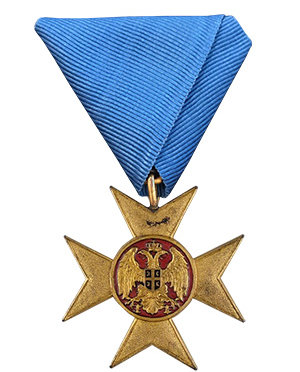
The Cross was manufactured by Arthus Bertrand of Paris and Huguenin Frères of Le Locle, Switzerland. It is made in bronze gilt maltese cross with a loop for ribbon suspension and red and black enamels and measures 39.7 mm.

The obverse bears a central circular red enamel medallion with the inscription in gilt letters ‘For Mercy‘ and circumscribed “For Tending the Wounded and the Sick 1912″.

The reverse shows the Serbian royal arms and the eagle with a fleur de lis beneath its claws.

Men and women versions of this medal are differentiated only by the suspension; a classical light-blue triangular one for men, and a ribbon in a bow shape of the same color for women (although this was not always the case).

The Order of St. Sava

The Order of St. Sava was a decoration of merits established originally to recognize civilians for meritorious achievements to the Church, to arts and sciences, the royal house and the state and awarded by the Kingdom of Serbia, the Kingdom of Serbs, Croats and Slovenes and the Kingdom of Yugoslavia from 1883 to 1945.

The Order of St Sava was then awarded by the king of Yugoslavia until the abolishment of the monarchy in 1945.

Since 1985, the Order has been awarded on the occasion of the 800th anniversary of St. Sava. This order is dedicated to ecclesiastic and secular persons, who have special merits for the Serbian Orthodox Church. According to the ordinance of the church, each person who received a medal of third grade, may receive the medal of the higher grade as well as the first grade for future merits, provided that three years have passed at least since the previous award.

The Order of St. Sava Design

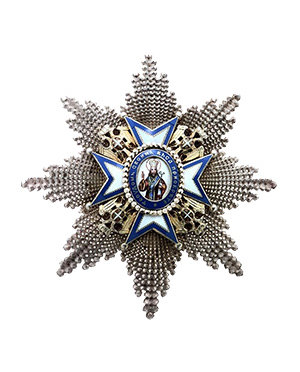
Five grades were awarded: Grand Cross, Grand Officer, Commander, Officer and Knight.

The first grade was a medal, worn with a sash over a shoulder and additionally with a breast star. The second and third grade laureates wore the Order with a neckband. The fourth grade with a triangular suspension, a rosette was attached to the ribbon above the medal. The fifth grade had a triangular suspension without a rosette. The medals of the fourth and fifth grades were worn on the breast. All white ribbons had two light blue stripes.

The order is determined in three grades: the first one is white, the second red and the third blue colored.

The Order of the White Eagle (Serbia)

Order of the White Eagle was a Royal Order in the Kingdom of Serbia (1883–1918) and the Kingdom of Yugoslavia (1918–1945) instituted by King Milan I of Serbia on 23 January 1883. In the period between 1883 and 1898 Order of the White Eagle was the highest award in the Kingdom of Serbia.

The Order had five classes and was conferred on Serbian and Yugoslav citizens for achievements in peace or war, or for special merits to the Crown, the state and nation.  In 1898 the Royal Order of Miloš the Great took precedence over the White Eagle and in 1904 the former was replaced by the Order of the Karađorđe’s Star.

After his accession to the throne in 1903, King Peter I of Serbia continued awarding the Order of the White Eagle, but the reverse of the medallion had the year of the proclamation of the Kingdom (1883) instead of the cipher of Milan I.

The Order is conferred by the Crown. Recent awards include last Grand Master of the Sovereign Order of St. John (Fr. Angelo de Mojana di Cologna), as well as posthumous conferment upon three Crown Council Members.

The Order of the White Eagle Design

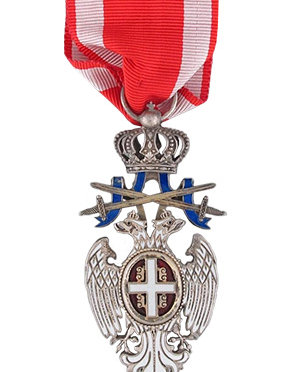
The Order of the White Eagle is made in silver gilt with red, white and blue enamels. It measures 31.8 mm (w) x 68 mm (h) inclusive of its crown suspension.

The Order had five degrees, and could be awarded with swords for the military services, with or without swords for civil merit. The classes were:

  • SRB-SHS-YUG Orden Belog Orla VKrst BAR.svg 1st Class – Grand Cross
  • SRB-SHS-YUG Orden Belog Orla VOficir BAR.svg 2nd Class – Grand Officer’s Cross
  • SRB-SHS-YUG Orden Belog Orla Komandir BAR.svg 3rd Class – Commander’s Cross
  • SRB-SHS-YUG Orden Belog Orla Oficir BAR.svg 4th Class – Officer’s Cross
  • SRB-SHS-YUG Orden Belog Orla Kavalir BAR.svg 5th Class – Knight’s Cross

The sash of the Order is worn from the left shoulder to the right hip.