The Order of Saint Stanislaus

The Order of Saint Stanislaus is a Russian dynastic order of knighthood founded in 1765 by King Stanisław II Augustus.

The Order of Saint Stanislaus (or Order św. Stanisława in Polish, Орденъ Св. Станислава in Russian) is a Russian dynastic order of knighthood founded as Order of the Knights of Saint Stanislaus, Bishop and Martyr in 1765 by King Stanisław II Augustus of the Polish–Lithuanian Commonwealth.

In 1831 after the downfall of the November Uprising, the order was incorporated into the Chapter of Russian Orders as part of the honours system of the Russian Empire by Emperor Nicholas I of Russia. In 1839, the Russian Order of Saint Stanislaus received new statutes, including granting status of nobility on its recipients in all three classes.

As a result of the Russian Revolution 1917, activities were suspended by the Soviet Union, although it has since been awarded by the head of the Imperial House of Romanov as a dynastic order. When in 1918 Poland regained its independence as the Second Polish Republic, a Polish order was introduced as a successor to the Polish Order of Saint Stanislaus, the Order of Polonia Restituta.

The heads of the Russian Imperial House in exile have continued to award Imperial and Royal Order of Saint Stanislaus. H.I.H. Grand Duchess Maria Vladimirovna, pretender to the Russian throne, and head of the Russian Imperial House, continues to award the Russian Imperial Order of Saint Stanislaus as a dynastic order of knighthood.

The Order of Saint Stanislaus Design

On the star and crosses of all classes, non-Christian recipients will have, instead of the cypher of Saint Stanislaus, a black and gold Imperial Russian double-headed Eagle. According to the Imperial Chapter of Orders and other honors, ed. 1892, the Order of Saint Stanislaus has three degrees, for which the insignia are:

Order of Saint Stanislaus 1st Class

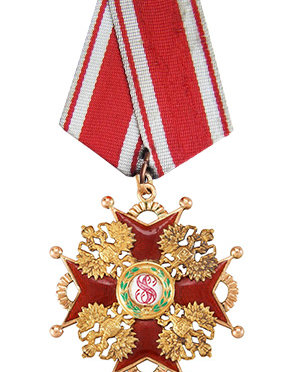
Gold cross, covered with a red enamel face, the four ends of which are further divided in two sharp points; on the edges of the cross a double gold rim; at the eight sharp points golden balls; and among these terminals, bringing them together, are gold semicircles of striped shells; in the center, on a white filigree round shield encircled by a gold border with a green wreath on it, the Latin monogram of Saint Stanislaus, a red “SS”; at each of the axillae, the state symbol of the Russian double-headed eagle in gold. On the rear side of the cross, all gold, with the verso a centered white round enameled shield, which depicts the same monogram “SS”.

It is worn on a moiré red ribbon, the breadth of two and a half inches, double white stripes at the borders, worn over the right shoulder with the star on the left side of the chest.

Silver star, the eight rays centering a white round shield circled with wide green stripes with two gold rims, the external rim wider; on the green enameled band between, gold laurel branches connected in the middle of each by two flowers; center roundel, in white enamel with red letters the cypher of Saint Stanislaus: “SS”; and around the hoop in a white box with gold letters, the motto of the order: Praemiando incitat (“rewarding encourages”) divided at the top with a golden flower.

Order of Saint Stanislaus 2nd Class

Cross of the same form, as for the first class, but of lesser magnitude, worn around the neck, on a ribbon with a width of one or two inches.

Order of Saint Stanislaus 3rd Class

Cross of the same form as the first two classes but worn in the buttonhole on the same ribbon with a width of five-eighths inches.
The Medal of St. George (Russia)

The Medal of St. George for Bravery was established in 1878 and awarded to non-commissioned officers, soldiers, and sailors for acts of valor.

The Medal of St. George for Bravery was established on 3rd August 1878, during the reign of Tsar Alexander II. After the death of Emperor Alexander III in 1894 the Medal was re-issued, wearing the semblance of the new sovereign, Tsar Nicholas II.

The medal was awarded to non-commissioned officers, soldiers, and sailors as well as to civilians for exceptional acts of valor in times of war or peace.

On 10th August 1913, a sweeping amendment was introduced by which the Medal for Bravery was incorporated into the statute of the Order of Saint George and its name was changed to Saint George Medal for Bravery. From 23rd July 1915 the Gold Medals, similarly to the golden Saint George Crosses, were manufactured with a reduced content in gold. From January 1917 they were manufactured with substitute yellow or which metal.

The Cross of St. George Design

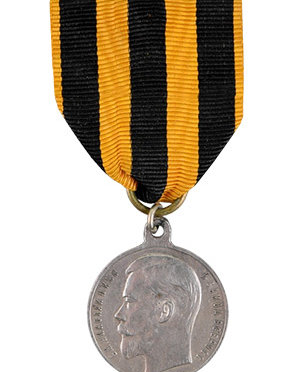
The St. George Medal came in four classes. Gold medallions for 1st and 2nd class (shown above). Silver medallions for 3rd and 4th. A bow on the ribbon denoted 1st class and 3rd. The medal was awarded for merit to other Allied soldiers as well as Russians.

The obverse features the bust of the reigning Emperor with his title. The reverse  bears, in the center, in two lines the wording FOR BRAVERY, below the recipient’s impressed award registration number followed by the class of the award.

The ribbon is the same as the Order of Saint George; orange with three black stripes, commonly called “George’s Ribbon”. It symbolizes fire and gunpowder: the Russian “colors of military glory”, and is also thought to be derived from the colors of the original Russian imperial coat of arms (black eagle on a golden background). It was subsequently associated to the colors of the Russian Guard units.

The Medal for Transforming the Non-Black Earth of the RSFSR

The Medal for Transforming the Non-Black Earth of the RSFSR was awarded for 3 years outstanding service in developing Soviet agriculture.

The Medal for Transforming the Non-Black Earth of the RSFSR (or Медаль «За преобразование Нечерноземья РСФСР», Medal «Za preobrazovanie Тechernozem’ja RSFSR» in Russian) was established on 30 September 1977 by decree of the Presidium of the Supreme Soviet of the USSR and awarded for 3 years outstanding service in developing Soviet agriculture.

The Medal “For Transforming the Non-Black Earth of the RSFSR” was awarded to workers, farmers, and employees who made an impact on the work of implementation of the long-term program for the development for agriculture of the non-black earth zone of the Russian Soviet Federative Socialist Republic, and who worked as a rule, for not less than three years in this field and that was located on state or collective farms, or worked in businesses, organizations or institutions whose activities were directly related to the transformation of the non-black earth.

The medal’s statute was amended on July 18, 1980 by decree of the Presidium of the Supreme Soviet of the USSR № 2523-X.

The Medal for Transforming the Non-Black Earth of the RSFSR Design

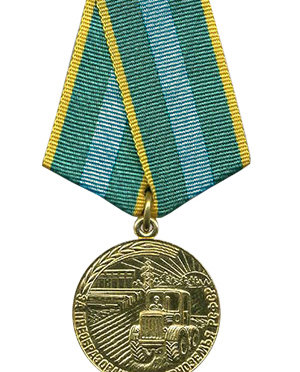
The medal was 32mm in diameter, circular, and made of tombac, with a raised rim on both sides. It was worn on the left side of the chest.

On the obverse, in the right half, the relief image of a tractor pulling a plow through a field below a rising Sun over a distant tree line; at left the relief images of barns, grain elevators, and power transmission towers; along the medal’s lower circumference, the relief inscription «За преобразование Нечерноземья РСФСР» (“For transforming the Non-Black Earth of the RSFSR”), along the upper left circumference, a panicle of wheat; the obverse had a raised rim.

On the reverse, at the center, the relief image of the hammer and sickle with wheat spikes below a relief five-pointed star emitting rays.

The Medal “For Transforming the Non-Black Earth of the RSFSR” was secured to a standard Soviet pentagonal mount by a ring through the medal suspension loop. The mount was covered by a 24 mm wide overlapping green silk moiré ribbon with 2 mm yellow edge stripes and a 6 mm central blue stripe.

The Medal for Construction of the Baikal-Amur Railway

The Medal for Construction of the Baikal-Amur Railway was awarded to workers on the BAM for 2 years outstanding service.

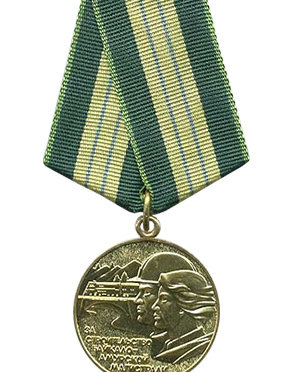
The Medal for Construction of the Baikal-Amur Railway (or Медаль «За строительство Байкало-Амурской магистрали», Medal «Za stroitel’stvo Bajkalo-Amurskoj magistrali in Russian) was established on 8 October 1976 by decree of the Presidium of the Supreme Soviet of the USSR and awarded to workers on the Baikul-Amur Railway (BAM) for 2 years outstanding service between 1974 and 1984.

The medal recognized active participation in the construction of the Baikal-Amur Railway, a huge multi year project under the leadership of then-Soviet premier Leonid Brezhnev. The Medal “For Construction of the Baikal-Amur Railway” was awarded to active participants in the construction of the Baikal-Amur Railway, on the rail section Bam – Tynda – Berkakit, on the second rail section Taishet – Lena, in the production facilities, in the building of housing for the civilian workers, for good work in construction, for high-quality designs and survey work, for honest work at enterprises, institutions and organizations directly supporting the construction efforts and the workers. The medal was usually awarded to workers, engineering-technical workers, and employees who worked on the project in its construction, design, or for its maintenance for at least three years.

The medal’s statute was amended on July 18, 1980 by decree of the Presidium of the Supreme Soviet of the USSR № 2523-X.

The Medal for Construction of the Baikal-Amur Railway Design

The medal was 32 mm in diameter, circular, and made of brass, with a raised rim on both sides. It was worn on the left side of the chest.

On its obverse, in the background in the left half of the medal, the relief image of hills and a train going left across a bridge over a river, under the bridge, the relief inscription on five lines «За строительство Байкало-Амурской магистрали» (“For the construction of the Baikal-Amur Railway”), in the right half of the medal, the left profiles of a man and a woman, the man wearing a construction helmet, the woman being closer and slightly to the right.

On the reverse, the Sun over railroad tracks intersected by a ribbon bearing the inscription «БАМ» (“BAM”) framed by a laurel wreath with the hammer and sickle at the top.

The medal was secured to a standard Soviet pentagonal mount by a ring through the medal suspension loop. The mount was covered by a 24 mm wide overlapping silk moiré ribbon with 1 mm wide light green edge stripes, three 3 mm wide central yellow stripes separated by two 0,5 mm grey stripes, bordered by two 6 mm wide dark green stripes.

The Medal for the Development of Virgin Lands

The Medal for the Development of Virgin Lands was awarded to all Soviet workers who helped cultivate 36,000,000 hectares of land.

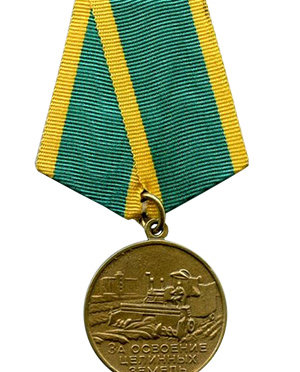
The Medal for the Development of Virgin Lands (or Медаль «За освоение целинных земель», Medal «Za osvoenie tselinnyh zemel» in Russian) was established on 20 October 1956 by decree of the Presidium of the Supreme Soviet of the USSR and awarded to all Soviet workers who helped cultivate 36,000,000 hectares of previously uncultivated lands (started in 1954 by Nikita Khrushchev) in Kazakhstan, Siberia, the Urals, the Volga area and the northern Caucasus for two solid years from 1954–56.

The medal was awarded to farmers, workers of state farms, MTS, construction and other organizations, the Party, government, labor and Komsomol workers for their good work in the development of virgin and fallow lands in Kazakhstan, Siberia, the Ural, the Volga and the North Caucasus for a period of usually at least two years. This Medal was also awarded to Yuri Gagarin right after his space flight (and it became a tradition to award the Medal to many Soviet cosmonauts after that).

The Medal for the Development of Virgin Lands Design

The medal was 32mm in diameter, circular with a raised rim on both sides. It was worn on the left side of the chest.

On its obverse, the image of a C-4 combine harvester in a field with a grain silo in the background on the horizon, at the bottom, the relief inscription on three rows «За освоение целинных земель» (“For the development of virgin lands”).

On the reverse at the bottom, the relief image of the hammer and sickle with sun rays radiating upwards towards a five-pointed star at the top, along the right circumference, ears of corn, along the left circumference, a panicle of wheat.

The medal was secured by a ring through the medal suspension loop to a standard Soviet pentagonal mount covered by an overlapping 24 mm dark green silk moiré ribbon with 3 mm wide yellow edge stripes.

The Medal for the Restoration of the Black Metallurgy Enterprises of the South

The Medal for the Restoration of the Black Metallurgy Enterprises was awarded to Soviet workers of outstanding performance in restorations.

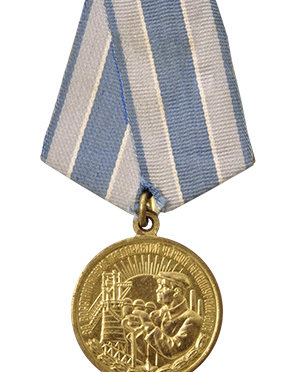
The Medal for the Restoration of the Black Metallurgy Enterprises of the South (or Медаль «За восстановление предприятий чёрной металлургии юга», Medal «Za vosstanovlenie predprijatij chernoj metallurgii yuga» in Russian) was established on 18 May 1948 by decree of the Presidium of the Supreme Soviet of the USSR and awarded to Soviet workers of outstanding performance in restoring the Black Metallurgic Enterprises of the Soviet Union which were destroyed during the Great Patriotic War.

Thirteen blast furnaces, forty-nine open-hearth furnaces, twenty-nine finishing mills, and sixty-eight coke-oven batteries were restored to effective or outstanding production rates.

Lists of potential recipients were reviewed on behalf of the Presidium of the Supreme Soviet of the USSR by the Ministry of Metallurgy of the USSR and the Ministry of Construction of Heavy Industry of the USSR. The medal was to be worn with honor, to serve as an example of high awareness and observance of labor discipline and integrity in the performance of public duties.

The medal’s statute was amended on July 18, 1980 by decree of the Presidium of the Supreme Soviet of the USSR № 2523-X.

The Medal for the Restoration of the Black Metallurgy Enterprises Design

The medal was 32mm in diameter, circular, and made of brass, with a raised rim on both sides. It was worn on the left side of the chest.

On the obverse on the left side, the relief image of a rebuilt blast furnace, at right, a worker with a tool for punching tapholes, in the background at center, the rising Sun with rays going up. Along the medal side and upper circumference, the relief inscription «За восстановление предприятий чёрной металлургии юга» (“For the restoration of the black metallurgy enterprises of the South”), at the bottom, the relief image of a five-pointed star over a laurel wreath.

On the reverse, the relief image of the hammer and sickle over the inscription on two lines in prominent letters «ТРУД В СССР — ДЕЛО ЧЕСТИ» (“LABOUR IN THE USSR – A MATTER OF HONOUR”).

The medal was secured by a ring through the medal suspension loop to a standard Soviet pentagonal mount covered by an overlapping 24 mm silk moiré ribbon. The ribbon had an 8 mm wide central blue stripe bordered by 1 mm wide white stripes themselves bordered by 5 mm wide light blue stripes, 2 mm wide blue edge stripes completed it.

The Medal for the Restoration of the Donbass Coal Mines

The Medal for the Restoration of the Donbass Coal Mines was awarded to workers, clerks, engineering and professionals for outstanding work.

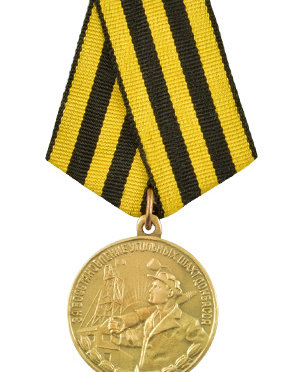
The Medal for the Restoration of the Donbass Coal Mines (or Медаль «За восстановление угольных шахт Донбасса», Medal «Za vosstanovlenie ugl’nyh shaht Donbassa» in Russian) was established on 10 September 1947 by decree of the Presidium of the Supreme Soviet of the USSR and awarded to workers, clerks, engineering and business professionals, for outstanding work, high production performance and achievements in the recovery of the Donbass coal mines.

Lists of potential recipients were reviewed on behalf of the Presidium of the Supreme Soviet of the USSR by the Ministry of the Coal Industry of the USSR, the Ministry of Construction of the USSR or the Ministry of Chemical and Petroleum Industries of the western areas.

The medal’s statute was amended on July 18, 1980 by decree of the Presidium of the Supreme Soviet of the USSR № 2523-X.

The Medal for the Restoration of the Donbass Coal Mines Design

The medal was 32mm in diameter, circular, and made of brass, with a raised rim on both sides. It was worn on the left side of the chest.

On its obverse, in the left half, the relief image of a restored mine, a flag-waving atop the tower; on the right side, the relief image of a helmeted miner facing left carrying a jackhammer on his right shoulder; in the background at center, the Sun with rays going all the way to the top of the medal; along the upper circumference, the relief inscription «За восстановление угольных шахт Донбасса» (“For the Restoration of the Donbass Coal Mines”); along the lower circumference, the relief image of a five-pointed star over a laurel wreath.

On the reverse, the relief image of the hammer and sickle over the inscription on two lines in prominent letters «ТРУД В СССР — ДЕЛО ЧЕСТИ» (“LABOUR IN THE USSR – A MATTER OF HONOUR”).

The medal was secured by a ring through the medal suspension loop to a standard Soviet pentagonal mount covered by an overlapping 24 mm silk moiré ribbon with 0,5 mm black edge stripes and three 5 mm wide gold stripes separated by two 4 mm wide black stripes.

The Medal for Courage in a Fire

The Medal for Courage in a Fire was awarded Soviet citizens for courage and bravery in extinguishing fires or saving lives or state.

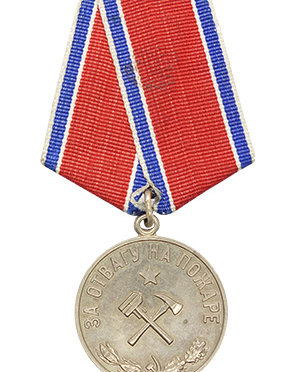
The Medal for Courage in a Fire (or Медаль «За отвагу на пожаре», Medal «Za otvagu na pozhare» in Russian) was established on 30 October 1957 by decree of the Presidium of the Supreme Soviet of the USSR and awarded all Soviet citizens for courage and bravery in extinguishing fires or saving lives/state or private property from fire or for preventing explosions and fires.

The Medal “For Courage in a Fire” was awarded to members of the fire service, members of volunteer fire brigades, the military, and other citizens:

  • for courage, bravery and selflessness displayed during fire fighting, during the rescue of people and the protection of socialist or private property from fire;
  • for the leadership of firefighting units employed in fire protection, in firefighting or in rescue operations;
  • for bravery, courage, and perseverance displayed in order to prevent an explosion or fire.

Each medal came with an attestation of the award, this attestation came in the form of a small 8 cm by 11 cm cardboard booklet bearing the award’s name, the recipient’s particulars, and an official stamp and signature on the inside.

The medal’s statute was amended on July 18, 1980 by decree of the Presidium of the Supreme Soviet of the USSR № 2523-X. It ceased to be awarded following the December 1991 dissolution of the Soviet Union and replaced in 1994 by the Russian Federation’s Medal “For Life Saving” and by ministerial-level awards.

The Medal for Courage in a Fire Design

The medal was circular, originally struck in silver (then silver-plated nickel) with a raised rim on both sides, and measured 32 millimeters in diameter.

On the obverse in the center, the relief image of crossed fire ax and adjustable wrench below a five-pointed star. At the bottom, the relief image of the hammer and sickle over laurel and oak branches, along the side and upper circumference, the relief inscription «ЗА ОТВАГУ НА ПОЖАРЕ» (“FOR COURAGE IN A FIRE”). On the reverse, in the background and to the right, a two-storied house on fire, along the left circumference, a laurel branch, at the forefront and to the left, the relief image of a helmeted firefighter carrying a child.

The medal was secured to a standard Soviet pentagonal mount by a ring through the medal suspension loop. The mount was covered by a 24 mm wide red silk moiré ribbon with 3 mm wide blue edge stripes bordered on both sides by 1 mm white stripes.

The Veteran of Labor Medal

The Veteran of Labor Medal was established in 1974 and awarded to deserving state workers at retirement to honor workers for hard work.

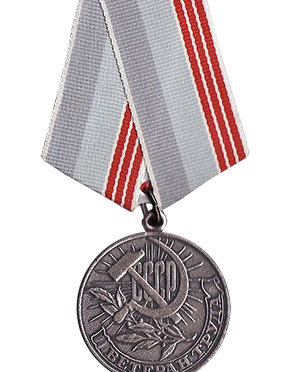
The Veteran of Labor Medal (or Медаль «Ветеран труда», Medal «Veteran truda» in Russian) was established on 18 January 1974 by decree of the Presidium of the Supreme Soviet of the USSR and awarded to deserving state workers at retirement to honor workers for many years of hard work in the national economy, sciences, culture, education, healthcare, government agencies, and public organizations.

The medal was awarded to workers, farmers, and employees in recognition of their lifelong labor on reaching the seniority required for a long-service pension or retirement age. Recommendations for the award were made jointly by administrators of Party and trade union organizations, enterprises, institutions, and organizations based on nominations from working groups or workforce councils. Award ceremonies of the Medal “Veteran of Labor” usually took place in the work place of the recipients.

Although it only had a relatively short eighteen years of existence, it was awarded nearly forty million times. Its regulations were detailed and approved by decree number 5999-VIII of May 20, 1974. The medal ceased to be awarded following the December 1991 dissolution of the Soviet Union.

The Veteran of Labor Medal Design

The medal was designed by artist SA Pomansky. It’s circular, struck in tombac and then silver-plated and oxidized, and measured 34 millimeters in diameter.

The obverse bears the relief image of the hammer and sickle over the inscription «СССР» (“USSR”) with diverging rays, a laurel branch spans the width of the obverse from right to left passing under the sickle’s handle in an upward curve, along the lower and right circumference, a ribbon bearing the relief inscription «ВЕТЕРАН ТРУДА» (“VETERAN OF LABOUR”). The otherwise plain reverse bears the inscription on four lines «ЗА ДОЛГОЛЕТНИЙ ДОБРОСОВЕСТНЫЙ ТРУД» (“FOR LONG DILIGENT WORK”).

The Medal “Veteran of Labor” was secured by a ring through the medal suspension loop to a standard Soviet pentagonal mount covered by a 24mm wide overlapping silk moiré ribbon with 1 mm wide white edge stripes and colored from left to right by a 7 mm wide dark grey stripe, an 8 mm wide light grey stripe, and three 2 mm wide red stripes separated by two 0.5 mm wide white stripes.

The Medal for the Salvation of the Drowning

The Medal for the Salvation of the Drowning was awarded for courage, bravery and selflessness whilst rescuing a person/people from water.

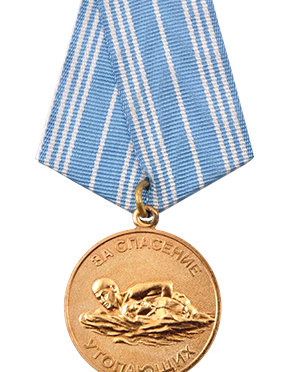
The Medal for the Salvation of the Drowning (or Медаль «За спасение утопающих», Medal «Za spasenie utopayushchikh» in Russian) was established on 16 February 1957 by decree of the Presidium of the Supreme Soviet of the USSR and awarded to any person (of any nationality) for courage, bravery, and selflessness whilst rescuing a person/people from water or for outstanding vigilance and resourcefulness preventing drowning or for excellence in organizing of rescue operations in Soviet waters or of Soviet citizens.

Each medal came with an attestation of award, this attestation came in the form of a small 8 cm by 11 cm cardboard booklet bearing the award’s name, the recipient’s particulars and an official stamp and signature on the inside.

Its statute was twice amended by further decrees of the Presidium of the Supreme Soviet of the USSR, first on August 1, 1967 and lastly on July 18, 1980. The medal ceased to be awarded following the December 1991 dissolution of the Soviet Union and replaced in 1994 by the Russian Federation’s Medal “For Life Saving“.

The Medal for the Salvation of the Drowning Design

The medal is circular and struck in oxidized brass with raised rims on both sides, and measures 32 millimeters in diameter.

On the obverse at the center, the relief image breaking the surface of the water of a rescue swimmer pulling a drowning victim to safety, along the upper circumference, the relief inscription «За спасение» (“For the Salvation”), along the lower circumference, the relief inscription «утопающих» (“of the Drowning”). On the reverse at the center, the relief image of a laurel branch from bottom left to upper right, above it, the relief image of the hammer and sickle, below the branch, the inscription «СССР» (“USSR”).

The medal was secured to a standard Soviet pentagonal mount by a ring through the medal suspension loop. The mount was covered by a 24 mm wide blue silk moiré ribbon with a 1 mm wide central white stripe and three 1 mm wide white stripes separated by 1 mm starting 1,5 mm from both edges.