The Medal for the Defense of Sevastopol

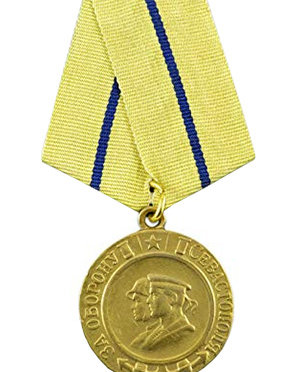
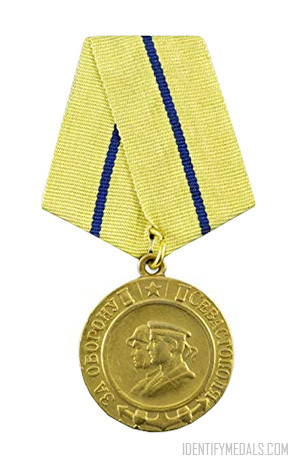
The Medal for the Defense of Sevastopol was awarded to all Soviet military and civilians who participated in the defense of the port city.

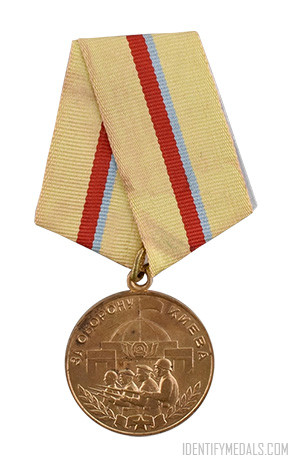
The Medal for the Defense of Sevastopol (or Медаль «За оборону Одессы», Medal «Za oboronu Odessy» in Russian) was established on 22 December 1942 by decree of the Presidium of the Supreme Soviet of the USSR and awarded to all Soviet military and civilians who participated in the defense of Sevastopol between 5 November 1941 and 4 July 1942.

The medal was awarded to soldiers of the Red Army, Navy, and troops of the NKVD, as well as persons from the civilian population who took part in the defense of Sevastopol during its siege by German forces. Award of the medal was made on behalf of the Presidium of the Supreme Soviet of the USSR on the basis of documents attesting to actual participation in the defense of Sevastopol issued by the unit commander, the chief of the military medical establishment, or by a relevant provincial or municipal authority.

The Medal for the Defense of Sevastopol Design

The medal was 32mm in diameter, circular, and made of brass, with a raised rim.

In the center of the obverse, a 22mm in diameter convex medallion bearing the overlapping left profile busts of a red sailor over a helmeted red soldier. At the bottom, protruding below the edge of the central medallion, the bottom of a naval anchor and the breeches or two muzzle-loading cannons (crossing under the medallion); at the top, protruding from the central medallion, the muzzles of the two cannons, in between them, a 5mm wide frame bearing a relief five-pointed star. Along the medal circumference, between the edge of the central medallion and the medal’s rim, the relief inscription, on the left side «ЗА ОБОРОНУ» (“FOR DEFENSE”) and on the right side «СЕВАСТОПОЛЯ» (“SEVASTOPPOL”).

On the reverse near the top, the relief image of the hammer and sickle, below the image, the relief inscription in three rows «ЗА НАШУ СОВЕТСКУЮ РОДИНУ» (“FOR OUR SOVIET MOTHERLAND”).

The medal was secured by a ring through the medal suspension loop to a standard Soviet pentagonal mount covered by a 24mm wide olive green silk moiré ribbon with a 2mm central dark blue stripe.

Other Soviet Defense Medals from WW2

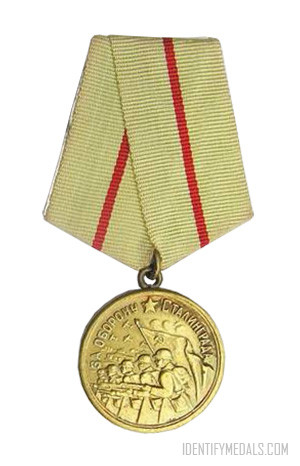
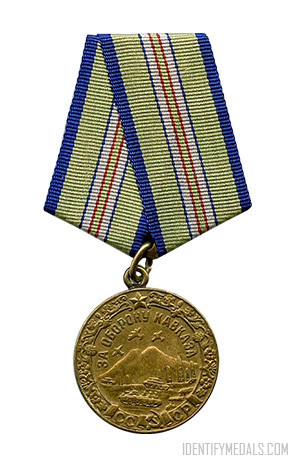
The medals awarded for the defense of various places during World War II belong to a specific group of Soviet campaign medals. These medals were instituted by the Soviet Union to recognize and honor the efforts and sacrifices of those who participated in the defense of key cities and regions against Axis forces. 

Find This Medal

Right Now on eBay 
Clicking a link to eBay may result in a referral commission being paid if a purchase is made.
Loading...

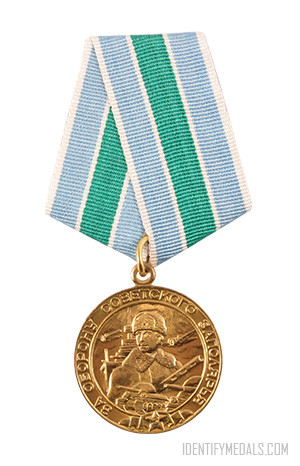
The Medal for the Defense of Odessa

The Medal for the Defense of Odessa was awarded to all Soviet military and civilians who participated in the defense of the port city.

The Medal for the Defense of Odessa (or Медаль «За оборону Одессы», Medal «Za oboronu Odessy» in Russian) was established on 22 December 1942 by decree of the Presidium of the Supreme Soviet of the USSR and awarded to all Soviet military and civilians who participated in the defense of Odessa between 10 August and 16 October 1941.

The medal was awarded to soldiers of the Red Army, Navy, and troops of the NKVD, as well as persons from the civilian population who took part in the defense of the port city of Odessa from the armed forces of Nazi Germany. Award of the medal was made on behalf of the Presidium of the Supreme Soviet of the USSR on the basis of documents attesting to actual participation in the defense of Odessa issued by the unit commander, the chief of the military medical establishment, or by a relevant provincial or municipal authority.

Each medal came with an “attestation of award” certificate.

The Medal for the Defense of Odessa Design

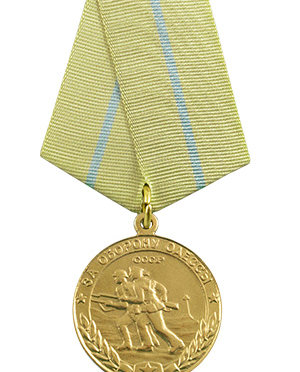
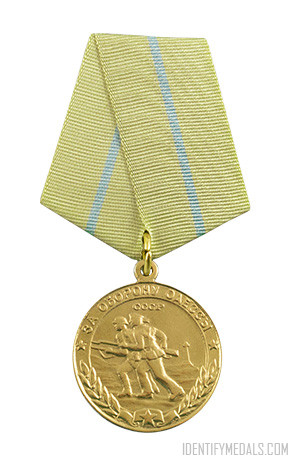
The medal was 32mm in diameter, circular, and made of brass, with a raised rim.

On the obverse in the background, the seashore and a distant lighthouse at right, in the center, the image of a red soldier and a red sailor marching towards the left their rifles at the ready; above the servicemen, the relief inscription «СССР» (“USSR”). A circular band following the medal’s entire circumference bears the relief inscription «ЗА ОБОРОНУ ОДЕССЫ» (“FOR THE DEFENCE OF ODESSA”) at its top, at both ends of the inscription, relief five-pointed stars. On the same band at the bottom center, a five-pointed star over a ribbon superimposed over the crossing point of laurel and oak branches going up the band to the two five-pointed stars near the upper inscription.

On the reverse near the top, the relief image of the hammer and sickle, below the image, the relief inscription in three rows «ЗА НАШУ СОВЕТСКУЮ РОДИНУ» (“FOR OUR SOVIET MOTHERLAND”).

The medal was secured by a ring through the medal suspension loop to a standard Soviet pentagonal mount covered by a 24mm wide olive green silk moiré ribbon with a 2mm central light blue stripe.

Other Soviet Defense Medals from WW2

The medals awarded for the defense of various places during World War II belong to a specific group of Soviet campaign medals. These medals were instituted by the Soviet Union to recognize and honor the efforts and sacrifices of those who participated in the defense of key cities and regions against Axis forces. 

Find This Medal

Right Now on eBay 
Clicking a link to eBay may result in a referral commission being paid if a purchase is made.
Loading...

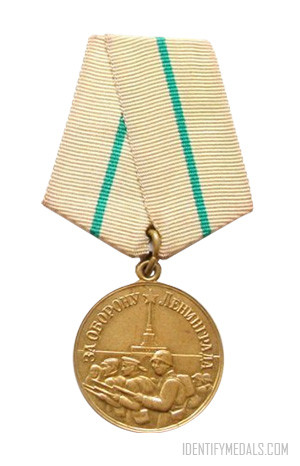
The Medal for the Defense of Leningrad

The Medal for the Defense of Leningrad was awarded to all Soviet military and civilians who participated in the defense of Leningrad in 1944.

The Medal for the Defense of Leningrad (or Медаль «За оборону Ленинграда», Medal «Za oboronu Leningrada» in Russian) was established on 22 December 1942 by decree of the Presidium of the Supreme Soviet of the USSR and awarded to all Soviet military and civilians who participated in the defense of Leningrad between 8 September 1941 and 27 January 1944.

The medal recognizes the valor and hard work of the Soviet civilian and military defenders of Leningrad (soldiers of the Red Army, Navy, and troops of the NKVD, as well as persons from the civilian population) during the 872-day siege of the city by the German armed forces between September 8, 1941, and January 27, 1944.

Award of the medal was made on behalf of the Presidium of the Supreme Soviet of the USSR on the basis of documents attesting to actual participation in the defense of Leningrad issued by the unit commander, the chief of the military medical establishment, or by a relevant provincial or municipal authority.

The Medal for the Defense of Leningrad Design

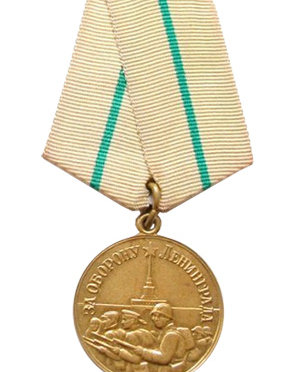
The medal measures 32mm in diameter and is circular and struck in brass. It has a raised rim.

The obverse features, in the lower half, the relief images of a helmeted Red Army soldier (nearest), a sailor (middle), and a worker (farthest), all three with rifles at the ready. In the background is the relief outline of the Leningrad Admiralty building. Along the upper circumference of the medal, an inscription in prominent letters reads  «ЗА ОБОРОНУ ЛЕНИНГРАДА» (“FOR DEFENCE OF LENINGRAD”).

On the reverse near the top, the relief image of the hammer and sickle, below the image, the relief inscription in three rows «ЗА НАШУ СОВЕТСКУЮ РОДИНУ» (“FOR OUR SOVIET MOTHERLAND”).

The medal was secured by a ring through the suspension loop to a standard Soviet pentagonal mount covered by a 24mm wide olive green silk moiré ribbon with a 2mm central green stripe.

Other Soviet Defense Medals from WW2

The medals awarded for the defense of various places during World War II belong to a specific group of Soviet campaign medals. These medals were instituted by the Soviet Union to recognize and honor the efforts and sacrifices of those who participated in the defense of key cities and regions against Axis forces. 

Find This Medal

Right Now on eBay 
Clicking a link to eBay may result in a referral commission being paid if a purchase is made.
Loading...

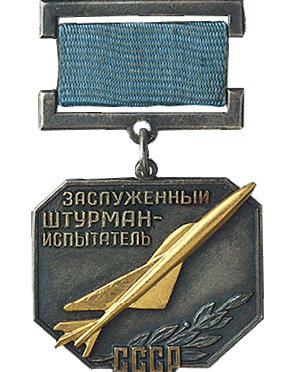
The Honored Test Navigator of the USSR Medal

The Honored Test Navigator of the USSR Medal was established in 1958 and awarded to military and civilian test-navigators 1st class.

The Honored Test Navigator of the USSR Medal (or Заслуженный штурман-испытатель СССР, Zaslužennyj šturman-ispytatel’ SSSR in Russian) was established on 14 August 1958 and awarded to military and civilian test-navigators 1st class of the civilian aircraft industry and of the Ministry of Defence of the USSR, for multiple years of creative work in the field of testing and research of new aviation technologies.

Its statute was confirmed on August 22, 1988, by Decree of the Presidium of the Supreme Soviet № 9441-XI. The title ceased to be awarded following the December 1991 dissolution of the Soviet Union. The Presidium of the Supreme Soviet of the USSR was the main conferring authority of the award based on recommendations from the Ministry of Defence of the USSR (Министерство обороны СССР) or from the Ministry of Aviation Industry of the USSR (Министерство авиационной промышленности СССР).

The Honored Test Navigator of the USSR Medal Design

The badge is a silver and nickel polygon with raised edges and measures 27mm wide by 23mm high.

At the top of the obverse, the relief inscription in three lines covered to the left ЗАСЛУЖЕННЫЙ ШТУРМАН-ИСПЫТАТЕЛЬ (“MERITED TEST NAVIGATOR”), in the center, the gilt tombac image of a jet plane climbing diagonally towards the right its nose and tail slightly protruding over the edges, at the bottom, the relief inscription CCCP (“USSR”) superimposed over a laurel branch.

The badge was secured to a standard Soviet square mount by a silver-plated ring through the suspension loop. The mount was covered by a silk moiré blue ribbon. It was secured to clothing by a threaded stud and nut or by a pin attachment.

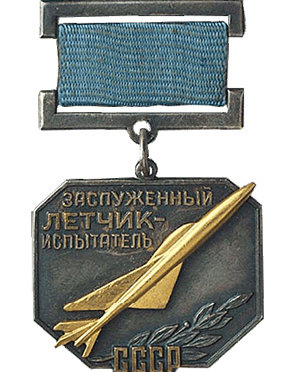
The Honored Test Pilot of the USSR Medal

The Honored Test Pilot of the USSR Medal was established on 14 August 1958 and awarded to military and civilian test-pilots 1st class.

The Honored Test Pilot of the USSR Medal (or Заслуженный лётчик-испытатель СССР, Zaslužennyj Lëtčik-Ispytatel’ SSSR in Russian) was established on 14 August 1958 and awarded to military and civilian test-pilots 1st class of the civilian aircraft industry and of the Ministry of Defence of the USSR, for multiple years of creative work in the field of testing and research of new aviation technologies.

The state award of the Soviet Union was established on August 14, 1958, by Decree of the Presidium of the Supreme Soviet № 2523-X to recognize courage and excellence of military and civilian test pilots in flight research and testing of aircraft. Its statute was confirmed on August 22, 1988, by Decree of the Presidium of the Supreme Soviet № 9441-XI. The title ceased to be awarded following the dissolution of the Soviet Union in 1991.

The Honored Test Pilot of the USSR Medal Design

The badge is a silver and nickel polygon with raised edges and measures 27mm wide by 23mm high.

At the top of the obverse, the relief inscription in three lines covered to the left ЗАСЛУЖЕННЫЙ ЛËТЧИК-ИСПЫТАТЕЛЬ (“HONOURED TEST PILOT”), in the center, the gilt tombac image of a jet plane climbing diagonally towards the right its nose and tail slightly protruding over the edges, at the bottom, the relief inscription CCCP (“USSR”) superimposed over a laurel branch.

The badge was secured to a standard Soviet square mount by a silver-plated ring through the suspension loop. The mount was covered by a silk moiré blue ribbon. It was secured to clothing by a threaded stud and nut or by a pin attachment.

The USSR Mother Heroine Medal

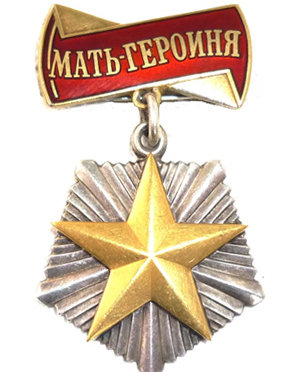
The USSR Mother Heroine Medal was an honorary title established in 1944 and awarded to all mothers bearing and raising 10 or more children.

The USSR Mother Heroine Medal (or Мать-героиняMat’-geroinya in Russian) was an honorary title established on 8 July 1944 and awarded to all mothers bearing and raising 10 or more children.

The title was awarded upon the first birthday of the last child, provided that nine other children (natural or adopted) remained alive. Children who had perished under heroic, military, or other respectful circumstances were also counted. The title was accompanied by the bestowal of the Order “Mother Heroine” and a certificate conferred by the Presidium of the Supreme Soviet of the Soviet Union.

The state’s intent was not only to honor such large families but also to increase financial assistance for pregnant women, mothers of large families, and single mothers, and to promote an increased level of health in mother and child.

The award was established in 1944 and continued to exist until the fall of the Soviet Union in 1991. Approximately 430,000 women were awarded this title during its existence.

The USSR Mother Heroine Design

The medal is a solid gold star superimposed on a silver pentagon with rays facing outwards. It measures 30.74 mm in height including the eyelet and 27.27 mm in width. It weighs 12.1 gram without and 16.2 gram with suspension.

The suspension is a bar decorated in red enamel and bearing the words “Мать-героиня” (Mother Heroine).

The Honored Blood Donor of the USSR Medal

The Honored Blood Donor of the USSR Medal was an honorary title established in the 1950s and awarded to Soviet blood donors.

The Honored Blood Donor of the USSR Medal was an honorary title established in the 1950s and awarded to Soviet blood donors. Not much is known about this medal.

The Honored Blood Donor of the USSR Medal Design

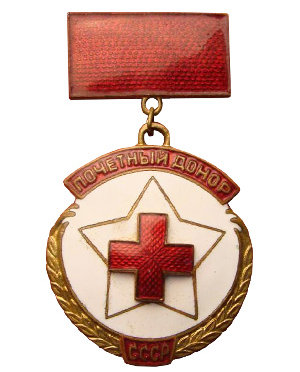
The medal is struck in brass and decorated with red and white enamels. The pendant portion is about 1.5″ in diameter.

The obverse features a round white badge with the outline of a star and a superimposed red cross in the center. The medal bears a gold wreath at the bottom.

The suspension device is made in red enamel.

The People’s Architect of the USSR Medal

The People’s Architect of the USSR Medal was established in 1967 and awarded for stunning results in urban planning or building design.

The People’s Architect of the USSR Medal (or Медаль Народный архитектор СССР, Narodnyj architektor SSSR in Russian) was established on 12 August 1967 by Leonid Brezhnev and awarded for stunning results either in urban planning or in the design of important buildings.

The honorary title was granted to architects of the Soviet Union and bestowed by the Presidium of the Supreme Soviet of the USSR owing proposals addressed by the State Construction Committee or by the Soviet Architects’ Union. The Supreme Soviet had the ability to refuse these designations.

A diploma was given to those who were appointed jointly with the medal and its concerning certificate. The title was bestowed to architects who had achieved stunning results in Soviet architecture’s development either applying their expertise and creativity to urban planning or to the design of important building compounds for civil, industrial, or rural use.

Following the Dissolution of the Soviet Union in 1990, the title of Meritorious Architect of the Russian Federation was created by a decree of the Russian presidency.

The People’s Architect of the USSR Medal Design

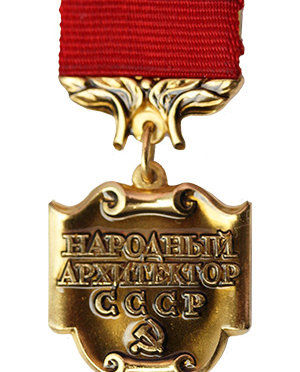
The medal was made of tombac and its shape was quadrangular with twisted corners. It measures 22.5 by 23.5 mm.

The central part is occupied by the inscription “Народный архитектор СССР” and, below, the hammer and sickle symbol. Both the symbol and inscription are embossed, with convex letters.

The medal is suspended to a single red silk fringe measuring 18 mm by 21 mm with an attached metallic buckle decorated with bay laurel leaves.

The People’s Teacher of the USSR Medal

The People’s Teacher of the USSR Medal was awarded for worthwhile contributions to the national education system and in teaching communism.

The People’s Teacher of the USSR Medal (or Народный учитель СССР, Narodnyj učitel’ SSSR in Russian) was established on 30 December 1977 and awarded for worthwhile contributions to the national education system and, mainly, in teaching communism to children and young people.

The title was conferred to teachers of Soviet secondary or vocational schools and also to civil servants employed by educational institutions, for worthwhile contributions to the national education system and mainly in teaching communism to children and young people. It was bestowed owing proposals addressed by the USSR Education Department or by the National Education Committee; together with the medal, a diploma of the Supreme Soviet’s presidency was given to the awarded people.

Following the Dissolution of the Soviet Union (1990) the title was modified in National Teacher of the Russian Federation.

The People’s Teacher of the USSR Medal Design

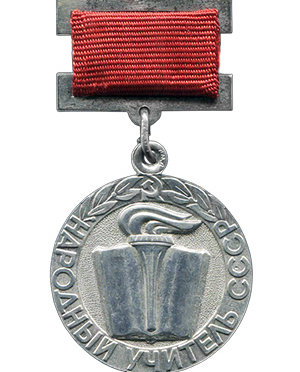
The medal is circular in shape and measures 30 mm in diameter.

The central part of the front side is occupied by an open book and a torch encircled by the inscription “Народный учитель СССР” (People’s Teacher of the USSR) and, above, two bay laurel branches and the hammer and sickle symbol. On the obverse is the inscription Народный учитель СССР — гордость советского общества (National Teacher of the USSR – Pride of sovietic society). Symbols and inscriptions are embossed, with convex letters.

The medal was suspended to a single red silk fringe measuring 18 mm by  21 mm and attached to the suit by a needle.

The People’s Painter of the USSR Medal

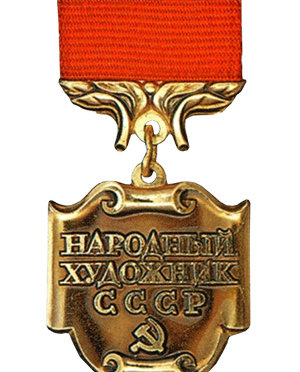
The People’s Painter of the USSR Medal was established on 16 July 1943 and awarded for exceptional achievements in visual arts.

The People’s Painter of the USSR Medal (or Медаль Народный художникin CCCP, Narodnyj chudožnik SSSR in Russian) was established on 16 July 1943 and awarded for exceptional achievements in visual arts as painting, sculpture, drawing, and photography.

The People’s Painter of the USSR Medal Design

The medal is made of tombac and its shape was quadrangular with twisted corners. It measures 22.5 by 23.5 mm.

The central part is occupied by the inscription “Медаль Народный художник СССР” and, below, the hammer and sickle symbol. Both the symbol and inscription are embossed, with convex letters.

The medal is suspended to a single red silk fringe measuring 18 mm by 21 mm with an attached metallic buckle decorated with bay laurel leaves.