The Order of Suvorov

The Order of Suvorov (or Орден Суворова) is a military decoration established in 1942 and named in honor of Count Alexander Suvorov.

The Order of Suvorov (or Орден Суворова in Russian) is a military decoration established on July 29, 1942 and named in honor of Russian Field Marshal Count Alexander Suvorov (1729–1800). The Order was originally a Soviet award, created to reward senior army personnel for exceptional leadership in combat operations.

The Order was divided into three different classes: 1st class, 2nd class, and 3rd class. The Order 1st class was awarded to army commanders for exceptional leadership of combat operations. The Order 2nd class was awarded to corps, division, and brigade commanders for a decisive victory over a numerically superior enemy. The Order 3rd class was awarded to regimental commanders, their chiefs of staff, and battalion and company commanders for outstanding leadership leading to a combat victory. 

Following the 1991 dissolution of the USSR, the Order of Suvorov was retained unchanged but it was not awarded in this form. The Presidential Decree 1099 of September 7, 2010 modernized and reorganized the entire Russian awards system away from its Soviet past changed the statute of the Order to a single-class medal. 

The Order of Suvorov Design

The Order of Suvorov measures 40 mm wide and is a gold plated cross pattée with silver rays protruding from the center outwards between the arms of the cross to form a square.

The obverse center has a circular convex medallion bearing the gilded bust of Alexander Suvorov in profile and facing left. Below, on the medallion lower edge, are crossed branches of oak and laurel. At the upper part and following its circumference is the inscription in red enameled embossed letters “ALEXANDER SUVOROV” (АЛЕКСАНДР СУВОРОВ). The reverse is bare except for the award serial number.

The Order is suspended by a ring through a suspension loop to a standard Russian pentagonal mount covered by a 24mm wide green silk moiré ribbon with a 5mm wide orange central stripe. The Order of Suvorov is to be worn on the left side of the chest and immediately after the Order of Alexander Nevsky.

The Order of Alexander Nevsky

The Order of Alexander Nevsky is an order of merit bestowed to civil servants for twenty years + of highly meritorious service.

The Order of Alexander Nevsky (or орден Александра Невского in Russian) is an order of merit of the Russian Federation bestowed to civil servants for twenty years or more of highly meritorious service and named in honor of saint Alexander Nevsky (1220–1263). It was awarded to Red Army commanders who displayed personal bravery in fighting for their country in World War II, for courage, bravery and skillful leadership that ensured success.

It was originally established by the Soviet Union as a military honor during World War II on July 7, 1942. Its statute was amended by Decree of the Presidium of the Supreme Soviet of the USSR of February 26, 1947.

The Order of Alexander Nevsky was reinstated by the Soviet Union for award to officers of the army for personal courage and resolute leadership. The Order was retained by the new Russian Federation following the dissolution of the USSR but was never awarded. The September 7, 2010 Decree №1099 amended the statute of the Order making it a purely civilian award.

The Order of Alexander Nevsky Design

The Order of Alexander Nevsky (in its Soviet and early Russian Federation version) is made of silver, measures 50 mm wide and is a high ruby-red enameled, five-pointed convex star superimposed on a decagon composed of polished diverging rays. The star had gold-plated rims and edges.

In the center of the star, a central medallion bearing the left profile relief image of a helmeted Alexander Nevsky and the inscription along the left and right circumference in prominent letters “ALEXANDER NEVSKY” («АЛЕКСАНДР НЕВСКИЙ»). The central medallion is surrounded by a gilt laurel wreath bisected at its base by a silver shield bearing the hammer and sickle, the shield is superimposed over gilded sword, spear, bow and quiver of arrows. Two gilt pollaxes cross behind the central medallion, their outward facing blades protruding on either side of the five pointed star’s top arm and extending slightly past the decagon’s outer edge, their base visible just inside of the star’s two lower arms.

The original Order was suspended by a ring through a suspension loop, which was changed in 1943 to a threaded stud and nut attachment on the reverse. The design of the early Russian Federation variant of the Order differed from the Soviet variant only in the abrogation of the hammer and sickle from the silver shield on the obverse.

The Order of the Patriotic War (USSR)

The Order of the Patriotic War (Орден Отечественной войны) is a  Soviet military decoration established in 1942 and awarded for heroic deeds.

The Order of the Patriotic War (or Орден Отечественной войны in Russian) is a  Soviet military decoration established on 20 May 1942 and awarded for heroic deeds during WW2 or the German-Soviet War to all soldiers in the Soviet armed forces, security troops, as well as to partisans.

This was the first Soviet order established during the war, and the first Soviet order divided into classes. Deeds are awarded with the order (shooting down three aircraft as a fighter pilot, destroying two heavy or three medium or four light tanks, capturing a warship, repairing an aircraft under fire after landing on a hostile territory, etc) were awarded with the first class.

The medal was also given to some allied troops and commanders, including western allies. Altogether, over 324,903 of the 1st class and 951,652 of the 2nd class were issued during the war. 

The Order of the Patriotic War Classes

The Order of the Patriotic War had two classes:

  1. First Class: Awarded for acts of bravery and courage displayed in combat against the enemy. It was typically bestowed upon soldiers, sailors, and airmen who demonstrated exceptional valor or leadership on the battlefield. Recipients of the First Class were often recognized for their direct involvement in significant military operations, such as leading successful assaults, repelling enemy attacks, or capturing strategic objectives.

  2. Second Class: Awarded for various contributions to the war effort, including acts of bravery, distinguished service, or significant achievements in support of the Soviet war machine. While the criteria for the Second Class were less stringent than those for the First Class, recipients were still required to demonstrate commendable conduct and dedication to the defense of the Soviet Union. This class of the order was often bestowed upon individuals who displayed courage under fire, rendered valuable assistance to their comrades, or made significant sacrifices for the cause of victory.

The Order of the Patriotic War Medal Design

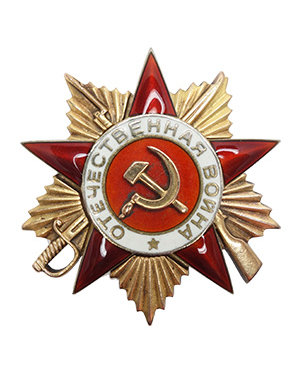
The Order of the Patriotic War medal features a red enamel five-pointed star, made of silver, with straight rays in the background, and crossed sabre and a Mosin rifle. The rays in the background are golden for the First Class and silver for the Second Class.

The central disc has a golden hammer and sickle on a red enamel background, surrounded by a white enamel ring with the words ОТЕЧЕСТВЕННАЯ ВОЙНА (“Patriotic War”). Anniversary orders of 1985 were made cheaper, as a single silver piece, gold-plated in the 1st class.

The ribbon varies slightly depending on the class:

  • Order of the Patriotic War – First Class Ribbon
  • Order of the Patriotic War – Second Class Ribbon
The Order of the Patriotic War - MEDIA

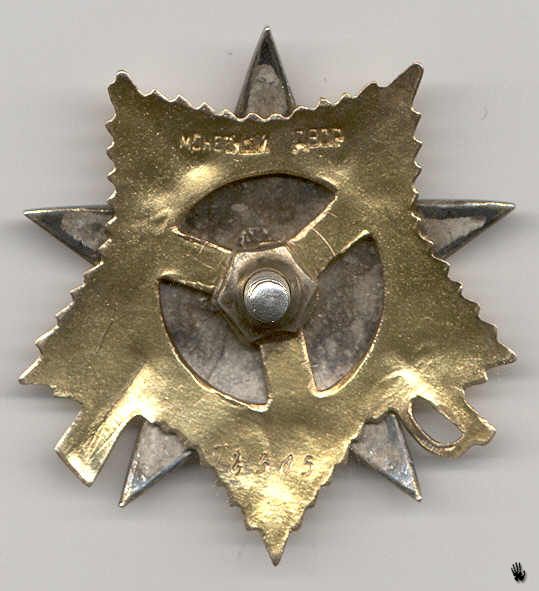
The Order of the Patriotic War, 1st class, reverse.
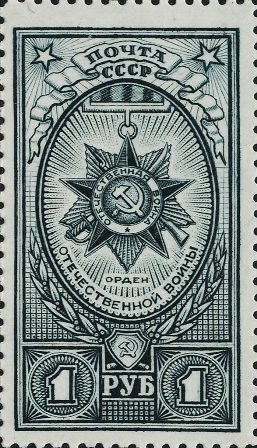
Order of the Patriotic War depicted on a 1943 postage stamp.
The Order of the Patriotic War depicted on a 1943 postage stamp. Wikipedia.

The Hero of Socialist Labor Medal

The Hero of Socialist Labour Medal was the highest Soviet degree of distinction for exceptional achievements in national economy and culture.

The Hero of Socialist Labour Medal (or Геро́й Социалисти́ческого Труда́in Russian) was the highest degree of distinction for exceptional achievements in national economy and culture. It was introduced by decree of the Presidium of the Supreme Soviet of the Soviet Union on December 27, 1938 as an honorary title of the Soviet Union and other Warsaw Pact countries.

The first recipient of the award was Joseph Stalin, awarded by the Presidium of the Supreme Soviet in December 20, 1939. By 1991, at the dissolution of the Soviet Union, over 20,000 people had been awarded the title.

Originally, Heroes of Socialist Labour were awarded the highest decoration of the Soviet Union, the Order of Lenin and a certificate. In order to distinguish it from other Order of Lenin recipients, the “Hammer and Sickle” gold medal was introduced by decree of the Presidium on 22 May 1940. Heroes of Socialist Labour who attained further exceptional achievements were awarded a second “Hammer and Sickle” medal and bronze busts of the Heroes were to be constructed in their hometowns to mark the occasion.

The award provided a similar status to the title Hero of the Soviet Union Medal that was awarded for heroic deeds, but unlike the latter, was not awarded to foreign citizens.

The Hero of Socialist Labor Medal Design

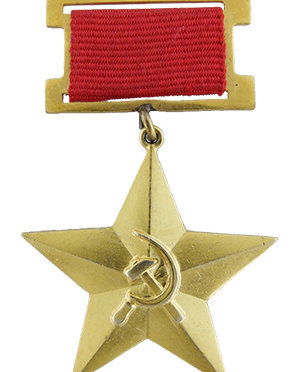
The Honorary title was designed by the artist A. Pomansky as a five-pointed star with smooth dihedral rays on the obverse. The diameter of the star was 33.5 mm. In the center of the obverse, a relief hammer and sickle respectively of 14 and 13 mm. 

The reverse was plain and was surrounded by a slightly raised rim. In the center, the relief inscription “Hero of Socialist Labor” (“Герой Социалистического Труда” in Russian) in 2mm high letters, the award serial number was inscribed just above in 1mm high numbers. The medal weighed 15.25 grams.

The insignia was secured to a standard 25 X 15mm Soviet square mount by a ring through the suspension loop. The mount was covered by a red silk moiré ribbon.

The Hero of the Soviet Union Medal

The title Hero of the Soviet Union Medal was the highest distinction in the Soviet Union. It was established on April 16, 1934.

The title Hero of the Soviet Union Medal (or Герой Советского Союза in Russian) was the highest distinction in the Soviet Union. It was established on April 16, 1934, by the Central Executive Committee of the Soviet Union and was awarded personally or collectively for heroic feats in service to the Soviet state and society.

The first recipients of the title originally received only the Order of Lenin, the highest Soviet award, along with a certificate describing the heroic deed from the Presidium of the Supreme Soviet of the USSR.

Those who received the award were entitled to special privileges, which included a pension with survivor benefits, first priority on the housing list with 50% rent reduction, tax exempt, an annual round-trip first class airline ticket, free bus transportation, and medical and entertainment benefits.

In total, during the existence of the USSR, the title of Hero of the Soviet Union was awarded to 12,777 people, including twice – 154 (9 posthumously), three times – 3 and four – 2. Ninety-five women were awarded the title. The title could also be given to foreigners. In total, forty-four foreign citizens were awarded with it.

The Hero of the Soviet Union title was also given posthumously, though often without the actual Gold Star medal given.

The Hero of the Soviet Union Medal Design

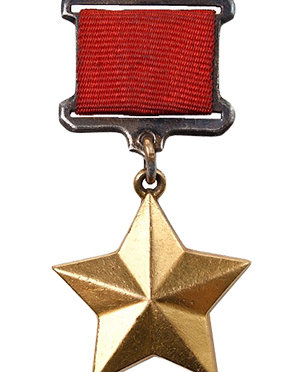
The medal is a gold star hanging from a rectangular suspension device. The medallion measures 32.5 mm in height including the eyelet, 30.3 mm in width; weighs 20.6 g not including the suspension and connecting link. The star is in 23 K gold; the suspension device is in gilded silver.  It has a ribbon in the color(s) of the issuing state (red for the USSR, white/blue/red for the Russian Federation, blue/yellow for Ukraine, red/green for Belarus).

The Hero of the Soviet Union is worn on the left side of the chest above all other orders and medals.

The Medal for Distinguished Labor (Russia)

The Medal For Distinguished Labor was an award of the Soviet Union established in 1938 and bestowed to especially deserving workers.

The Medal “For Distinguished Labor” (or Медаль «За трудовое отличие» in Russian) was a civilian labor award of the Soviet Union established on December 27, 1938 by decree of the Presidium of the Supreme Soviet of the USSR and bestowed to especially deserving workers to recognize and honor high performances in labor or contributions in the fields of science, culture or the manufacturing industry.

In just over fifty years of existence, the medal was bestowed to over two million deserving citizens. The first investiture took place on January 15, 1939 where the Medal “For Distinguished Labor” was presented to 19 employees of the Kalinin armaments plant number 8 for exceptional service to the country in the creation and development of new weapons for the Workers’ and Peasants’ Red Army.

Its statute was amended three times by further decrees and ceased to be awarded following the December 1991 dissolution of the Soviet Union.

The Medal for Distinguished Labor Medal Design

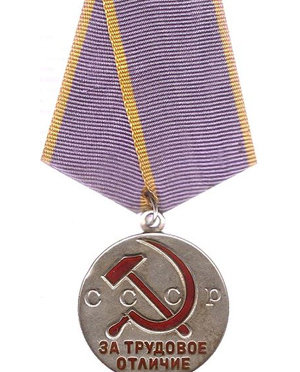
The Medal for Distinguished Labor measured 32 mm in diameter and is circular and struck from .925 silver with a raised rim on both sides.

In the upper 3/4 of the obverse, a 21 mm high by 20 mm wide ruby-red enameled image of the hammer and sickle over the relief inscription “USSR” («СССР») in 3.5 mm high letters. In the lower quarter of the obverse below the hammer and sickle, the sunken and red enameled inscription on two rows “FOR DISTINGUISHED LABOUR” («ЗА ТРУДОВОЕ ОТЛИЧИЕ») in 2 mm high letters. On the otherwise plain reverse, the relief inscription on two rows of 2.5 mm high letters “LABOUR IN THE USSR – A MATTER OF HONOUR” («ТРУД В СССР — ДЕЛО ЧЕСТИ»). The medal was numbered until 1945.

Early awards hung from a small triangular mount covered with a red ribbon with a threaded stub and screw for attachment to clothing. Following the 1943 decree, it was secured by a ring through the medal suspension loop to a standard Soviet pentagonal mount covered by a 24mm wide lilac colored silk moiré ribbon with 2 mm wide yellow edge stripes.

The Medal for Labor Valor (Russia)

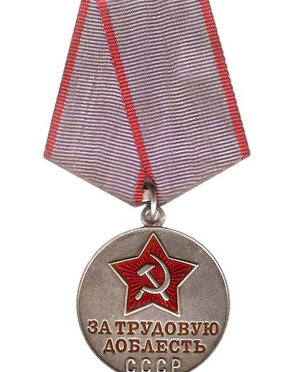
The Medal for Labor Valor (Медаль «За трудовую доблесть») was a civilian labor award of the Soviet Union established on December 27, 1938.

The Medal for Labor Valor (or Медаль «За трудовую доблесть» in Russian) was a civilian labor award of the Soviet Union established on December 27, 1938 by decree of the Presidium of the Supreme Soviet of the USSR and bestowed to especially deserving workers to recognize and honor dedicated and valorous labor or significant contributions in the fields of science, culture or the manufacturing industry.

The medal’s statute was amended three times by further decrees. During its existence of just over fifty years, it was bestowed to almost two million deserving citizens, including workers, farmers, specialists of the national economy, workers of science, culture, education, health and other to citizens of the USSR, and in exceptional cases, to foreign nationals.

The first investiture took place on January 15, 1939 where the Medal “For Labor Valor” was presented to 22 employees of the Kalinin armaments plant number 8 for exceptional service to the country in the creation and development of new weapons for the Workers’ and Peasants’ Red Army. The medal ceased to be awarded following the December 1991 dissolution of the Soviet Union.

The Medal for Labor Valor Medal Design

The medal measured 34 mm in diameter (some struck in 1945 measured 35 mm), was circular and struck from .925 silver with a raised rim on both sides.

In the upper obverse, a ruby-red enameled 19.2 mm wide five pointed star with a silver hammer and sickle at its center. Below the star, the inscription in two rows of sunken and red enameled 2.8 mm high letters “FOR VALOUR LABOUR” («ЗА ТРУДОВУЮ ДОБЛЕСТЬ»), at the very bottom, the relief inscription in 3.3 mm high letters “USSR” («СССР»). On the otherwise plain reverse, the relief inscription on two rows of 2.5 mm high letters “LABOUR IN THE USSR – A MATTER OF HONOUR” («ТРУД В СССР — ДЕЛО ЧЕСТИ»).

Early awards hung from a small triangular mount covered with a red ribbon with a threaded stub and screw for attachment to clothing. Following the 1943 decree, the medal was secured by a ring through the medal suspension loop to a standard Soviet pentagonal mount covered by a 24mm wide lilac coloured silk moiré ribbon with 2 mm wide red edge stripes.

The Medal For Battle Merit (Russia)

The Medal for Battle Merit was a Soviet military medal created in 1938 and awarded for combat action resulting in a military success.

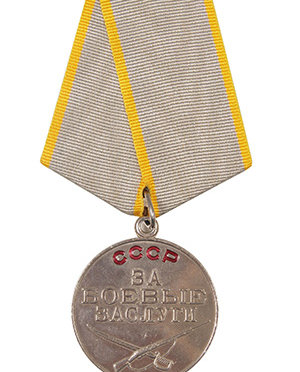
The Medal for Battle Merit (or Медаль «За боевые заслуги» in Russian) was a Soviet military medal created on October 17, 1938 by the decision of the Presidium of the Supreme Soviet of the Soviet Union. It was awarded for “courageous defense of the state borders“, “combat action resulting in a military success” or “successful military and political training and preparation“.

The Medal for Battle Merit was Like the Medal for Courage, its status was revised to prevent the medal from being given for years of service (a practice that was rampant in the USSR) rather than actual bravery during a battle.

More than 5,210,000 medals were awarded between 1938 and 1991.

The Medal For Battle Merit Medal Design

The Medal for Battle Merit  is a 32mm in diameter circular silver color medal with a raised rim on both the obverse and reverse.

The medal is secured to a standard Russian pentagonal mount by a ring through the medal suspension loop. The mount is covered in a 24mm wide grey ribbon with a yellow 2mm edge stripe on each side.

The Medal for Courage (Russia)

The Medal For Courage is a state decoration of the Russian Federation awarded to soldiers of the Soviet Army and other citizens.

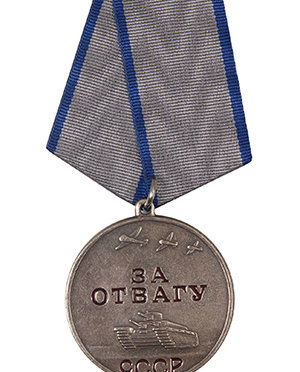
The Medal “For Courage” or Medal “For Valour” (or Медаль «За отвагу» in Russian) is a state decoration of the Russian Federation that was awarded to soldiers of the Soviet Army, Navy, border and internal troops and other citizens (and in some cases non-citizens) of the USSR. The medal was retained from the Soviet awards system following the dissolution of the USSR.

It was created by the decision of the Presidium of the Supreme Soviet of the USSR on October 17, 1938. The first three Medals for Courage were awarded only three days later to three border guards for acts of bravery during the Battle of Lake Khasan. More than 4,2 million were awarded during the Great Patriotic War.

The award criteria was amended on three occasions by three separate Presidential Decrees, № 19 of January 6, 1999, № 444 of April 17, 2003 and № 1099 of September 7, 2010.

From its creation in 1938 to the fall of the Soviet Union in 1991, 4,569,893 medals were awarded, many posthumously.

The Medal for Courage Medal Design

The Medal for Courage measures 34mm in diameter and is a circular silver medal with a raised rim on both the obverse and reverse.

On the obverse are three aircraft flying from right to left. Below the aircraft is the impressed and red enameled inscription in two lines “FOR COURAGE” («ЗА ОТВАГУ») and below is a (T-35) tank with its forward left corner closest to the front.

The medal’s reverse is plain except for an embossed letter “N” followed by an horizontal line in the lower half reserved for the award serial number, and a maker’s mark below it. The medal is secured to a standard Russian pentagonal mount by a ring through the medal suspension loop. The mount is covered in a silk moiré 24mm wide grey ribbon with a blue 2mm edge stripe on each side.

The Medal “For Courage” was retained by the Russian Federation after the dissolution of the Soviet Union, with the same basic design save for the caption “USSR” (CCCP) on the lower obverse.

The Order of the Badge of Honor

The Order of the Badge of Honor (орден «Знак Почёта») was a civilian award of the Soviet Union established on 25 November 1935.

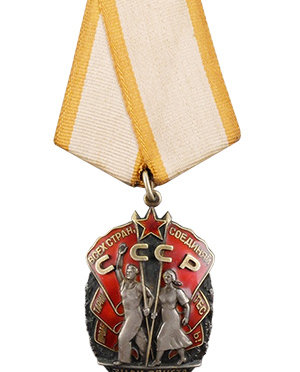
The Order of the Badge of Honor (or орден «Знак Почёта» in Russian) was a civilian award of the Soviet Union established on 25 November 1935.

The order was conferred on citizens of the USSR for outstanding achievements in production, scientific research and social, cultural and other forms of social activity; for promotion of economic, scientific, technological, cultural and other ties between the USSR and other countries; and also for significant contribution to basic and applied research.

The “Order of the Badge of Honor” was awarded 1,574,368 times and later replaced by the “Order of Honor” (Орден Почёта) by a Decree of the Presidium of the USSR on 28 December 1988. Following the USSR dissolution, it was replaced by the “Order of Honor” of the Russian Federation, established by Presidential Decree no. 442 of 2 March 1994.