The Medal of Merit in the Nuth Al-Ma’rkat Combat

The Medal of Merit in the Nuth Al-Ma’rkat Combat was established by the Kingdom of Saudi Arabia in 1971 and given for outstanding service.

The Medal of Merit in the Nuth Al-Ma’rkat Combat (ميدالية الاستحقاق) was established by the Kingdom of Saudi Arabia in 1971 and is given for outstanding service.

There are three classes for this medal.

The Medal of Merit Design

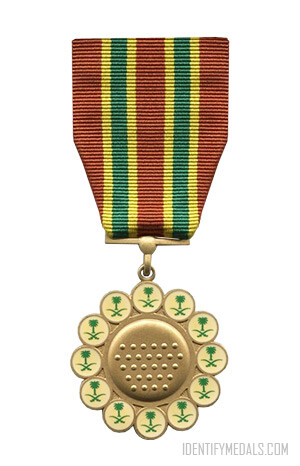
The Order of Merit is circular and measures 35 mm wide. The reverse is plain.

The ribbon has stripes in red, yellow, and green. 
The Order of Merit (Saudi Arabia)

The Order of Merit was instituted by the Kingdom of Saudi Arabia in 1971 and is awarded for outstanding service. It has three classes.

The Order of Merit (ميدالية الاستحقاق) was established on 20th or 21st March 1971 by King Faisal idn Abdulaziz by Council of Minister Decisions of the Kingdom of Saudi Arabia.

The medal is awarded to civilians for outstanding service and exists in three classes. All initial appointments are for the Third (III) Class, with higher ones being achieved by promotion. 

The Order of Merit Medal Design

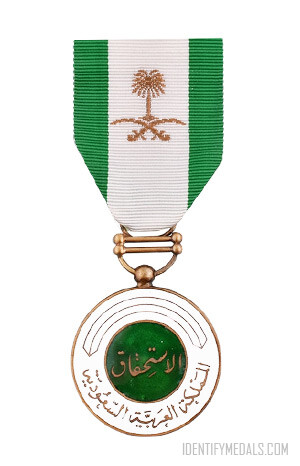
The Order of Merit is circular and measures 35 mm wide. In the obverse is the inscription “Kingdom of Saudi Arabia”.

The ribbon has outer green stripes and a central larger white stripe. The medal in I Class is struck in gold.

The Order of King Abdulaziz

The Order of King Abdulaziz is a Saudi Arabian order instituted by King Faisal on 20 March 1971 (and formerly called Great Chain of Badr).

The Order of King Abdulaziz is an Order of merit of Saudi Arabia named after Abdulaziz Al Saud, the founder of the modern Saudi state. The order was introduced by decree on 20 March 1971 by King Faisal, although the order had been awarded before – albeit unsystematically. Then, it was usually referred to as the Great Chain of Badr.

The order is awarded to both citizens of Saudi Arabia and foreigners that have shown meritorious service to the Kingdom. The nominations are made by the Council of Ministers, although it’s the King that confers awards himself when he determines it appropriate.

The number of Saudi conferments is limited annually. There can be no more than 20 grand sashes of the distinguished class. Up to 40, 60, 80 and 100 awards can be granted to members of the 1st, 2nd, 3rd and 4th classes, respectively.

The collar of the order is regarded as a distinct honor but confers the highest rank in the Order of Abdulaziz Al Saud.

Classes of the Order of King Abdulaziz

There are six classes to the Order of King Abdulaziz. These are:

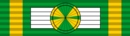
  • Special Class: A sash with a pendant is worn on the right shoulder and a star on the left chest.
  • Distinguished First Class: The insignia is worn on a necklet, plus a golden star on the left chest.
  • First Class: Worn on a necklet, plus a silver star on the left chest.
  • Second Class: Worn on a necklet;
  • Third Class: A badge is worn on a ribbon with a rosette on the left chest;
  • Fourth Class: A badge is worn on a ribbon on the left chest.

The Order of King Abdulaziz Medal Design

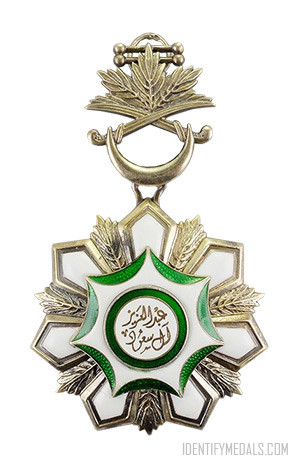
The Order of King Abdulaziz is a seven-pointed gold star with lozenge-shaped arms and white enamel panels with gold laurel branches. 

The suspension is a gold crescent with crossed swords and laurel spray. 

In the center, on the obverse, is a circular white enamel medallion with an inscription in gilt Arabic letters reading ‘Abdul-Aziz al-Saud’ and a gold-edged green enamel ring. 

The reverse is plain gold. 

Earlier versions of the Order of King Abdulaziz were typically produced by Bichay in Cairo, Egypt.

The Medal for the Liberation of Kuwait (Saudi Arabia)

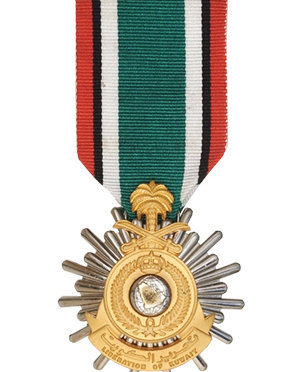
The Medal for the Liberation of Kuwait was instituted by King Fahd ibn Abdulaziz of Saudi Arabia for service during the Gulf War.

The Medal for the Liberation of Kuwait (or Naut Tahrir al-Kuwait نوط تحرير الكويت‎ in Arabic) was instituted by King Fahd ibn Abdulaziz of Saudi Arabia for service during the Liberation of Kuwait campaign.

The Saudi Arabian version of the medal was awarded to members of the Coalition Forces who participated in Operation Desert Storm and the liberation of Kuwait between the dates of January 17, 1991 and February 28, 1991. Unlike other medals, it recognizes service in a relatively short period of time whereas the Kuwaiti version of the medal is granted for service over three years. The Saudi Arabian version is also senior in U.S. precedence, owing to its having been authorized for several years before the Kuwaiti version was offered.

The Medal for the Liberation of Kuwait Design

The Saudi version of the Kuwait Liberation Medal consists of a silver star of fifteen rounded points (with shorter rounded points between them) surmounted by a gilt medallion which contains a wreath tied at its based and a crown at its top. In the center of the gilt medallion is a silver representation of the Earth, over which is superimposed a gilt representation of the Kingdom of Saudi Arabia.

Above the gilt medallion are the crossed swords and palm tree taken from the Royal Cypher. Beneath the gilt medallion is a swallow-tailed scroll with its ends folded back and point upward so they follow the contour of the gilt medallion. On the scroll are the words, LIBERATION OF KUWAIT in English, and the same inscription above it in Arabic.

Buy a Medal for the Liberation of Kuwait

Note: As an eBay partner, I earn from qualifying purchases. This is all done automatically when you use a link and at no extra cost to you.

Right Now on eBay 
Clicking a link to eBay may result in a referral commission being paid if a purchase is made.
Loading...