The Order of Montesa

The Order of Montesa is a Christian military order linked to the old Crown of Aragon (today Spain) and named after the order’s headquarters.

The Order of Montesa (or Orden de Montesa in Spanish) is a Christian military order linked to the old Crown of Aragon and named after the castle of the same name, which was the order’s headquarters. 

The Order of Montesa played a significant role in the ongoing struggle against Muslim forces in the Iberian Peninsula. Its knights participated in military campaigns, fortifications, and border defense, contributing to the Christian reconquest of Spain.

Founded in the 14th century, the order emerged as a merger between two prominent military orders: the Knights Templar and the Order of Saint George of Alfama.

The Order of Montesa traces its origins to the aftermath of the suppression of the Knights Templar in the early 14th century. Seeking to preserve the legacy and assets of the Templars, King James II of Aragon facilitated the transfer of their estates and holdings to the newly formed Order of Montesa in 1317. This merger allowed for the continuation of the Templar tradition within the framework of a new order.

With its headquarters established in the castle of Montesa, located in the province of Valencia, the order quickly garnered royal patronage and papal approval. It adopted the rule of the Knights Templar and pledged itself to the defense of the Kingdom of Valencia and the Christian faith.

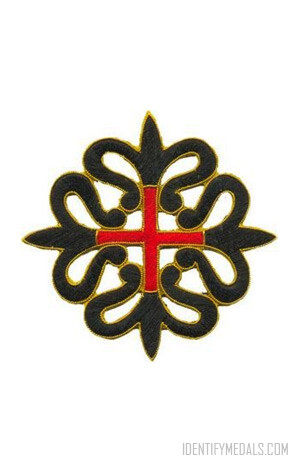
The Order of Montesa Design

At the heart of the insignia is the distinctive cross of Montesa, which serves as the primary emblem of the order. This cross typically features arms of equal length, often adorned with ornate details and embellishments

The Spanish Orders of Knighthood

Collectively, the four Spanish military orders (the Order of Santiago, the Order of Calatrava, the Order of Montesa, and the Order of Alcántara) exemplified the spirit of medieval chivalry and Christian knighthood, dedicating themselves to the defense of the faith and the protection of Christian lands.

Their legacies endure as enduring symbols of Spain’s rich heritage and the enduring ideals of honor, valor, and service.

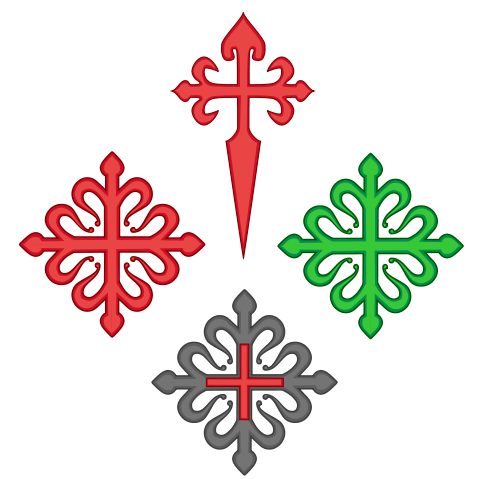
The Spanish military orders.
Badges of the Order of Santiago (top), the Order of Calatrava (left), the Order of Montesa (bottom) and the Order of Alcántara (right).

The Order of Alcántara

The Order of Alcántara or Knights of St. Julian was a military order founded in 1166 and confirmed by Pope Alexander III in 1177.

The Order of Alcántara (or Orden de Alcántara in Spanish), sometimes referred to as the Knights of St. Julian, was a military order of León (today Spain) and was founded in 1166. The Order was then confirmed in 1177 by Pope Alexander III.

Founded in the 12th century during the Reconquista, the order played a pivotal role in the Christian reconquest of the Iberian Peninsula from Muslim rule. 

The origins of this order are shrouded in mystery, yet according to a somewhat dubious tradition, St. Julian de Pereiro, a hermit from the region of Salamanca, played a pivotal role. It is said that upon his counsel, several knights constructed a fortress on the banks of the Tagus River to resist Muslim incursions. References to these knights appear as early as 1176, in a charter issued by King Fernando of León, although their military nature is not explicitly mentioned. It wasn’t until 1177, with the issuance of a papal bull by Pope Alexander III, that they were officially recognized as a military order.

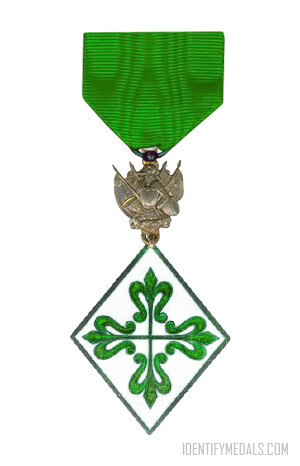
The Order of Alcántara Design

The insignia of the Order of Alcántara is a symbol of the order’s noble ideals and martial heritage. At the heart of the obverse is the distinctive cross of Alcántara, characterized by its unique shape and design. This cross features arms that widen towards the ends, often adorned with intricate details and embellishments. 

Surrounding the cross of Alcántara, the insignia may include additional elements that further enhance its visual appeal and symbolic significance, or inscriptions or mottoes that reflect the order’s ethos and mission.

The Spanish Orders of Knighthood

Collectively, the four Spanish military orders (the Order of Santiago, the Order of Calatrava, the Order of Montesa, and the Order of Alcántara) exemplified the spirit of medieval chivalry and Christian knighthood, dedicating themselves to the defense of the faith and the protection of Christian lands.

Their legacies endure as enduring symbols of Spain’s rich heritage and the enduring ideals of honor, valor, and service.

The Spanish military orders.
Badges of the Order of Santiago (top), the Order of Calatrava (left), the Order of Montesa (bottom) and the Order of Alcántara (right).

The Order of Santiago

The Order of Santiago was a religious and military order founded in the 12th century and one of the four Spanish military orders.

The Order of Santiago (or Orden de Santiago in Spanish) is one of the most renowned and prestigious chivalric orders in Spanish history.

Founded in the 12th century during the Reconquista, its origins are deeply intertwined with the Christian struggle to reclaim the Iberian Peninsula from Moorish rule.

Initially established as a religious and military brotherhood to protect the pilgrims journeying to the shrine of Saint James the Apostle in Santiago de Compostela, the order quickly evolved into a formidable military force. Comprised of noble knights known as Santiago Cavaliers, its members were bound by vows of chivalry, including the defense of the Catholic faith, the protection of pilgrims, and the expulsion of Moors from Christian territories.

Despite experiencing periods of decline and resurgence over the centuries, the Order of Santiago has maintained its status as a symbol of chivalry and honor in Spanish history. Today, it remains active as a dynastic order, preserving its traditions and heritage while continuing to uphold the values of courage, loyalty, and service to the Catholic Church and the Spanish nation.

The Order of Santiago Design

The insignia design of the Military Order of Santiago is rich in symbolism and tradition.

Central to the insignia is the distinctive red cross pattée, which serves as the primary emblem of the order. This cross, often depicted in a vibrant red hue, is characterized by its equal-length arms that taper slightly towards the ends. 

Surrounding the cross pattée, and depending on the insignia, you can often find additional elements of heraldic imagery, such as heraldic lions, castles, or fleur-de-lis, which symbolize various aspects of the order’s history, lineage, and mission.

The Spanish Orders of Knighthood

Collectively, the four Spanish military orders (the Order of Santiago, the Order of Calatrava, the Order of Montesa, and the Order of Alcántara) exemplified the spirit of medieval chivalry and Christian knighthood, dedicating themselves to the defense of the faith and the protection of Christian lands.

Their legacies endure as enduring symbols of Spain’s rich heritage and the enduring ideals of honor, valor, and service.

The Spanish military orders.
Badges of the Order of Santiago (top), the Order of Calatrava (left), the Order of Montesa (bottom) and the Order of Alcántara (right).

The Order of Calatrava

The Order of Calatrava was the first military order founded in Castile and one of the first four Spanish military orders.

The Order of Calatrava, known as Orden de Calatrava in Spanish and Ordem de Calatrava in Portuguese, stood as one of the four Spanish military orders and notably served as the premier military order established in Castile, albeit being the second to gain papal endorsement. Pope Alexander III officially sanctioned the Order of Calatrava through a papal bull issued on September 26, 1164. While much of the order’s political and military influence waned by the late 15th century, its assets were not fully dissolved until 1838.

The Order of Calatrava holds a distinguished place in the history of medieval Spain as one of the foremost military orders. Founded in the 12th century, it played a crucial role in the Reconquista, the centuries-long effort by Christian kingdoms to retake the Iberian Peninsula from Muslim rule.

Initially established as a military brotherhood to protect the Calatrava fortress in the Kingdom of Castile, the order quickly expanded its mission to defend Christian territories and combat Moorish incursions. Its members, known as knights or cavaliers, took vows of poverty, chastity, and obedience, dedicating themselves to the defense of Christendom.

The Order of Calatrava gained papal approval in 1164, solidifying its status as an official institution of the Catholic Church. With the backing of both secular and ecclesiastical authorities, it grew in power and influence, attracting nobles and warriors from across Europe to join its ranks.

In the present day, the fundamental objective of the Spanish Orders remains unchanged from their inception: the protection and promotion of the Catholic faith. While the use of the sword has ceased, their commitment to doctrine, exemplary conduct, spiritual growth, and religious observance persists, alongside their engagement in cultural and social endeavors.

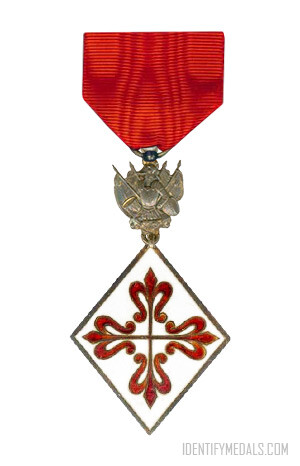
The Order of Calatrava Design

In recognition of their service and valor, members of the Order of Calatrava were awarded various honors and distinctions, including medals and insignia.

These medals often featured the emblem of the order, which typically included symbols such as a cross, sword, and shield, representing the order’s martial and religious mission.

The Spanish Orders of Knighthood

Collectively, the four Spanish military orders (the Order of Santiago, the Order of Calatrava, the Order of Montesa, and the Order of Alcántara) exemplified the spirit of medieval chivalry and Christian knighthood, dedicating themselves to the defense of the faith and the protection of Christian lands.

Their legacies endure as enduring symbols of Spain’s rich heritage and the enduring ideals of honor, valor, and service.

The Spanish military orders.
Badges of the Order of Santiago (top), the Order of Calatrava (left), the Order of Montesa (bottom) and the Order of Alcántara (right).

The Royal Order of Sports Merit

  • Time Period: Post-WW2
  • Institution: 18 June 1982
  • Country: Spain

The Royal Order of Sports Merit (or Real Orden del Mérito Deportivo) is a Spanish civil Order of Merit established 18 June 1982.

The order is indented to recognize distinguished service in sports, in teaching physical education, or the management, organization, promotion and development of physical education and sports. The order may be presented to individuals in one of four classes. It may also be presented to legal personalities, organizations, and other entities in one of three classes.

The Spanish Constitution of 1978 contains in article 43.3, a guiding principle in the conduct of public authorities to promote physical education and sport. The Royal Order of Sports Merit is a tool of this constitutional mandate to promote, advertise, and propagate physical culture and sports.

Individuals may be awarded the Royal Order of Sports Merit in one of four classes:

  • Grand Cross, awarded by Royal Decree in accordance with the Council of Ministers.
  • Gold Medal, awarded by the Minister of Education, Culture and Sport, on the proposal of the President of the Sports Council.
  • Silver Medal, awarded by the President of the Sports Council.
  • Bronze Medal, awarded by the President of the Sports Council.

Groups and organizations may be awarded in one of three different classes:

  • Gold Plaque, awarded by Royal Decree in accordance with the Council of Ministers.
  • Silver Plaque, awarded by the President of the Sports Council.
  • Bronze Plaque, awarded by the President of the Sports Council.

The Western European Union Mission Service Medal

  • Time Period: Post-WW2
  • Institution: 20 December 1994
  • Country: Spain

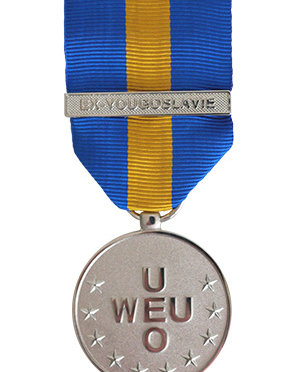
The Western European Union Mission Service Medal, is an international military decoration awarded to individuals, who served with Western European Union (WEU) military missions.

The WEU first acted in military operations in the context of the Iran–Iraq War. In 1987, mines were laid in the Persian Gulf, restricting the freedom of navigation in international waters. A joint mine sweeping effort was undertaken by member nations of the WEU.

The WEU next took part in military operations during the Yugoslav Wars in 1992. The WEU undertook Operation Sharp Fence starting in 1992, in tandem with NATO who was executing Operation Maritime Guard. WEU and NATO joined their operations together in a single command as Operation Sharp Guard in June 1993.

The Western European Union Mission Service Medal Design

The medal is circular, made of silver-colored oxidized metal, 36 mm in diameter.

The obverse of the medal displays the letters WEU arranged horizontally for “Western European Union”. Above the letter E is the letter U and below the letter O. UEO is the acronym for the French equivalent, Union de l’Europe Occidentale. Below the acronyms, arranged along the edge, are ten five pointed stars.

The reverse bears the Latin words in relief, PRO PACE UNUM, meaning “one for peace”, or idiomatically as “united for peace”.

The suspension ribbon of the medal is blue with a central stripe of yellow-gold. Worn on the ribbon are clasps naming the mission for which the medal is awarded. The service ribbon is the same as the suspension ribbon, utilizing miniature versions of the clasps.

The Common Security and Defence Policy Service Medal

  • Time Period: Post-WW2
  • Institution: 1 January 2003
  • Country: Spain

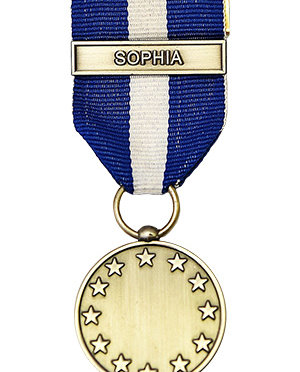
The Common Security and Defence Policy Service Medal (or European Security and Defence Policy Service Medal prior to 2009), is an international military decoration awarded to individuals, both military and civilian, who have served with CSDP missions.

Since the 1990s the European Union has taken a greater role in military missions both in Europe and abroad. These actions were taken under the Common Security and Defence Policy (CSDP), which is implemented by the European Union Military Staff, a department of the EU.

The The Common Security and Defence Policy Service Medal Design

The medal is 36 mm in diameter, made of a silver colored metal. All versions share a common design.

The obverse of the medal is plain except for a circle of twelve five pointed stars around the outside edge of the medal. The reverse contains the Latin phrase, Pro Pace Unum, meaning “United for Peace”.

The words are arranged in three lines one word above the other in the center of the medal. The medal is suspended from a 36 mm ribbon in EU blue with either a wide gold center stripe for headquarters and combat forces, or a wide white stripe for planning and support. Each operation is identified with a different clasp with the name of the operation worn on the ribbon of the medal. A miniature version is worn on the ribbon bar, when medals are not worn.

To recognize service in these missions the EU authorized the creation of a medal with a common obverse and reverse, to which clasps featuring the missions’ name are attached to the ribbon bar.

The Long Military Service Cross (Spain)

The Long Military Service Cross is a military decoration of the Spanish Armed Forces and Civil Guard for long service.

  • Time Period: Post-WW2
  • Institution: 26 December 1958
  • Country: Spain

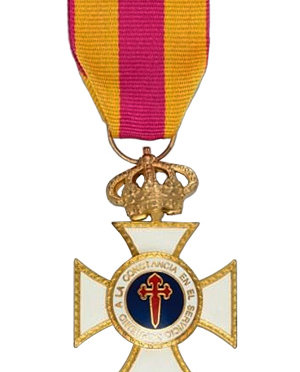
The Long Military Service Cross (or Cruz a la Constancia en el Servicio) is a military decoration of the Spanish Armed Forces and Civil Guard, designed to reward long and meritorious service below the level required for induction into the Royal and Military Order of Saint Hermenegild.

The medal was established by the Spanish government on December 26, 1958, and approved by Juan Carlos I in Royal Decree 682/2002. Regulations for the award were later modified in 2011, by Royal Decree 1385/2011.

The Long Military Service Cross may be awarded to all members of the Spanish Armed Forces, as well as to members of the Civil Guard at or below the rank of Corporal (OR-3). It can be presented in three grades, depending on time of service:

  • Gold for 30 years of meritorious service.
  • Silver for 25 years of meritorious service.
  • Bronze for 15 years of meritorious service.

The Long Military Service Cross Design

The ribbon of the medal is yellow, with a central stripe and thin border of magenta. The medal is a white cross pattée, bordered in either bronze, silver, or gold, and suspended from a crown.

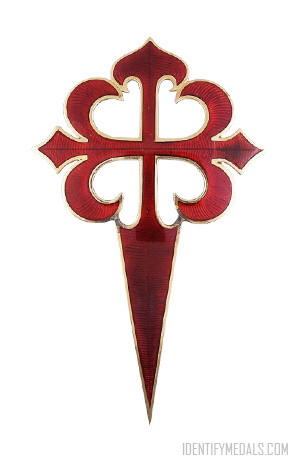
At the center of the cross is a deep-blue enameled medallion, circumscribed by a white-enameled border which reads PREMIO A LA CONSTANCIA EN EL SERVICIO (Award for Constant Service). At the center of the medallion is a red Cross of Saint James, in the style of the Order of Santiago.

The Fidelity Cross (Spain)

The Fidelity Cross (Cruz Fidélitas) is a medal of the Spanish Armed Forces, primarily awarded to military chaplains to reward service.

  • Time Period: Post-WW2
  • Institution: 25 July 2007
  • Country: Spain

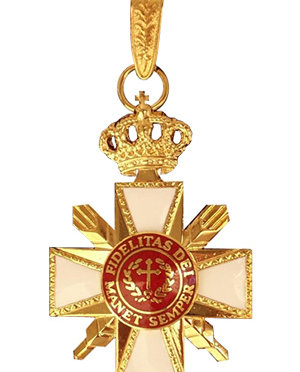
The Fidelity Cross (or Cruz Fidélitas) is a medal of the Spanish Armed Forces, primarily awarded to military chaplains. It is awarded by the military archbishopric to reward faithful service by chaplains, as well as services to the archbishopric by deserving civilians, institutions and other military personnel.

The decree established the award as a decoration of the Archdiocese of Spain, rather than the military, and stipulated that only the current military archbishop had the authority to award grades of the Cruz Fidélitas. However, he may temporarily delegate the power to award any class of the award to any chaplain he sees fit, other than that of Grand Cross.

There are three classes of the Cruz Fidélitas that can be awarded to military chaplains:

  • Cruz de la Cruz Fidélitas (Cross of the Fidelity Cross), awarded for 15 years of service.
  • Encomienda de la Cruz Fidélitas (Commendation of the Fidelity Cross), awarded for 20 years of service.
  • Plata de la Cruz Fidélitas (Plate of the Fidelity Cross), awarded for 25 years of service.

The Fidelity Cross Design

The ribbon of the medal is purple, with two white stripes extending down each side. From the ribbon hands a white-enameled cross bordered in gold, with gold spikes extending between the arms.

In the center of the cross, in the obverse, is the emblem of the Military Archbishopric of Spain, enameled in red. The reverse of the medal features a capital letter “F” relieved in the center of the cross, and the year “2007” on the lower arm, also in relief. A gold crown is used to suspend the cross from the ribbon.

Aside from that of the Cross of Honor, the ribbon bars of each grade also bear a device, dependent on the grade received. The ribbon bars of the Plate, Commendation, and Cross of the Cruz Fidélitas bear a Latin cross fleury, in gold, silver or bronze, respectively. The ribbon bar of the Grand Cross features a Spanish Royal Crown.

The Air Force Medal (Spain)

The Air Force Medal (or Medalla Aérea) is the maximum military award of Spain in peacetime for the air force branch.

The regulation for the issue of this medal is modified by the Royal Decree 1040/2003, 1 August (BOD. Núm. 177).

The Air Force Medal Design

The medal is made of oxidized iron, oval, 42 millimeters (1.7 in) on its vertical axis and 28 millimeters (1.1 in) on its horizontal axis.

On the obverse, surrounded by a silver edge, is a rising sun behind the sea and a matron stands, representing Spain, offering, with the right hand, a laurel wreath and holding a sword with the left. At the top of the oval are the words: “Al mérito distinguido”.

On the reverse is the emblem of the Air Force. The ribbon is 30 millimeters (1.2 in) wide and divided in three parts: the central with the national colors (red and yellow) and at the sides blue. Each medal has a clasp attached to the ribbon with the legend of the action done in black.