The Jerusalem Pilgrim’s Cross

The Jerusalem Pilgrim’s Cross is an honor of the Holy See awarded in the name of the Pope for merit to pilgrims to the Holy Land.

The Jerusalem Pilgrim’s Cross, known in Latin as Signum Sacri Itineris Hierosolymitani, is a distinction bestowed by the Holy See in the name of the Pope, recognizing the merit of pilgrims to the Holy Land.

This decoration is traditionally worn on the left side of the chest and is reserved for religious occasions, processions, pilgrimages, or in the presence of the Pope. Established by Pope Leo XIII on May 2, 1901, the Signum Sacri Itineris Hierosolymitani was created to honor and endorse pilgrimages to the Holy Places of Christianity in Palestine.

Initially, candidates needed a certificate from their parish priest to attest to their moral character and confirm their sincere intent for the pilgrimage. However, as of 2015, this certificate requirement has been abolished. The medal itself is not distributed but rather conferred in person at the office of the Custodian of the Holy Land in Jerusalem, which is under the care of the Franciscan Order. It is presented in the name of the Sovereign Pontiff. The grade of the medal depends on the number of trips the recipient has made to the city and whether they have made appropriate suggested donations to the Franciscans.

The Jerusalem Pilgrim’s Cross Design

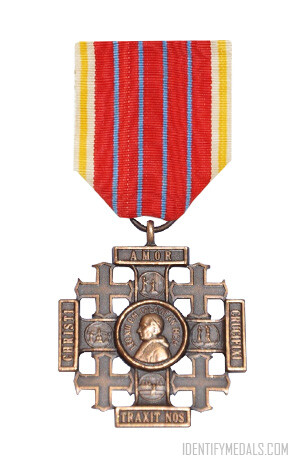
The medal features a Jerusalem cross crafted in gold, silver, or bronze. At the center of the front is a small portrayal of Pope Leo XIII, surrounded by the Latin inscription “LEO XIII CREAVIT ANNO MCM” (Leo XIII created [this medal] in 1900).

Within the crossbars, four biblical scenes depicting the early life and ministry of Jesus are depicted, along with the inscription “CHRISTI AMOR CRUCIFIXI TRAXIT NOS” (The love of Christ crucified has attracted us).
The Benemerenti Medal

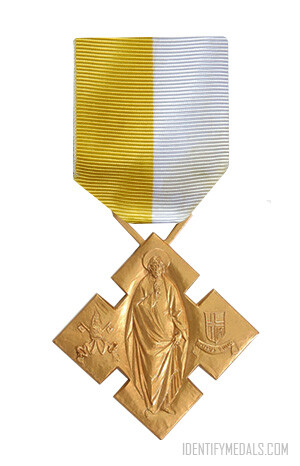
The Pro Ecclesia et Pontifice Medal is awarded by the Pope to members of the clergy and laity for service to the Church and the Pope.

The Benemerenti Medal is bestowed by the Pope upon clergy and laity in recognition of their service to the Catholic Church. Initially established as an honor for soldiers in the Papal Army, it has since evolved into a civil decoration, although it remains eligible for members of the Pontifical Swiss Guard.

Originally instituted by Pope Pius VI (1775–1799) as a military honor, the Benemerenti Medal took on a special significance under Pope Gregory XVI (1831–1846). In 1831, a distinctive Benemerenti medal was created to honor those who demonstrated valor in the Papal army during battles in Ferrara, Bologna, and Vienna.

In 1925, the scope of this award expanded to include individuals serving the Catholic Church, regardless of their military or civilian status, whether lay or clergy. Notably, members of the Swiss Guard may also qualify for the medal after completing three years of faithful service.

The Benemerenti Medal Design

The Benemerenti medal’s present rendition was crafted under the direction of Pope Paul VI. It features a gold Greek Cross portraying Christ with His hand raised in blessing. The left arm of the cross showcases the tiara and crossed keys emblem of the papacy, while the coat of arms of the current Pope adorns the right arm. Suspended from a ribbon of yellow and white—symbolizing the Papacy—the medal exudes a distinctive elegance.

Earlier versions and variations primarily consisted of a round medal bearing the portrait of the reigning Pope on the obverse side and a laurel wreath encircling an inscription of “BENEMERENTI” or “BENE MERENTI” on the reverse.

The Pro Ecclesia et Pontifice Medal

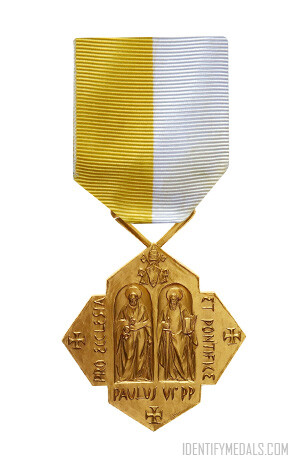
The Pro Ecclesia et Pontifice Medal is awarded by the Pope to members of the clergy and laity for service to the Church and the Pope.

The Pro Ecclesia et Pontifice Medal, which translates to “For Church and Pope” in Latin, is an esteemed decoration of the Holy See. It is currently awarded to individuals, both lay people and clergy, who have rendered distinguished service to the Catholic Church.

Established by Leo XIII on 17 July 1888, the medal initially commemorated his golden sacerdotal jubilee. It was originally conferred upon men and women who contributed to the success of the jubilee and the Vatican Exposition. In 1898, it became a permanent papal distinction, and Pius X streamlined the classes to a single one in 1908.

For nearly a century, until 1993, it held the distinction of being the highest honor attainable by women.

The Pro Ecclesia et Pontifice Medal Design

1888 version of Leo XIII

In the 1888 version established by Leo XIII, the cross was initially crafted in gold and silver, later adding a bronze version. The cross features fleurs-de-lis fixed in its angles, forming an octagonal shape. At the center, there’s a small medal depicting Leo XIII, encircled by the words “Leo XIII P. M. Anno X” (tenth year of his pontificate). The reverse side displays the papal emblems with the motto “Pro Ecclesia et Pontifice” encircling them.

On the obverse side, the cross’s branches are shaped like comets, representing the Pecci family coat of arms. The words “Pridie,” “Kal,” and “Januar” along with the year “1888” are stamped on the reverse side. The ribbon is red with delicate lines of white and yellow on each border. The cross is worn on the left side of the breast.

Current version since Paul VI

The current version, introduced by Pope Paul VI, is only awarded in gold. The obverse depicts the Apostles Saint Peter and Saint Paul in the center, with the inscriptions “Pro Ecclesia” (For Church) on the left arm and “Et Pontifice” (And Pope) on the right. Three small crosses are positioned at the end of the left, bottom, and right cross arms. The ribbon displays yellow and white colors, symbolizing the Papacy.

Under Benedict XVI’s modification, the individual coat of arms on the top arm of the decoration was replaced by a small cross, while the coat of arms of the Holy See took its place on the bottom arm. The name of the reigning pope no longer appears on the front side.

The Sovereign Military Order of Malta

The Sovereign Military Order of Malta is a Catholic lay religious order that claims continuity with the Knights Hospitaller.

The Sovereign Military Order of Malta (SMOM), officially known as the Sovereign Military Hospitaller Order of Saint John of Jerusalem, of Rhodes, and of Malta, is a Catholic lay religious order with a rich history rooted in military and noble traditions. Despite not having its own territory, the order is recognized as a sovereign entity under international law.

Its origins trace back to the Knights Hospitaller, a chivalric order founded around 1099 in the Kingdom of Jerusalem by Blessed Gerard. Led by an elected prince and grand master, the order upholds the motto “Tuitio fidei et obsequium pauperum” (Defense of the faith and assistance to the poor) and reveres the Virgin Mary as its patroness, under the title of Our Lady of Philermos.

Membership in the order comprises approximately 13,500 Knights, Dames, and Chaplains, with a subset of 33 professed religious Knights of Justice. While noble lineage was once a prerequisite for higher ranks, recent changes have allowed individuals without aristocratic ancestry to attain the highest class and hold office within the order.

Today, the Order of Malta focuses primarily on humanitarian efforts and international humanitarian relations, exemplifying its commitment to serving others and upholding its centuries-old values.

The Sovereign Military Order of Malta Design

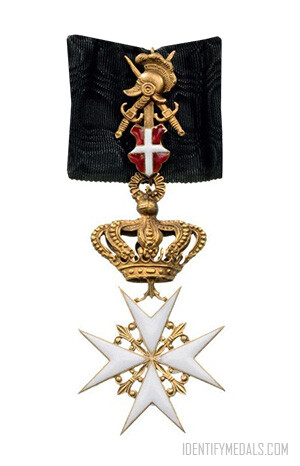
The insignia of the Sovereign Military Order of Malta (SMOM) features a white enameled cross worn on a black ribbon.

The white cross, often referred to as the Maltese Cross, is a powerful symbol of faith, charity, and nobility, representing the virtues upheld by the members of the order throughout history. Worn proudly by knights, dames, and chaplains of the order, this distinctive insignia reflects the dedication of its members to the principles of compassion, justice, and service to others.

The Order of the Holy Sepulchre

The Order of the Holy Sepulchre is a Catholic order of knighthood established in 1099 and under the protection of the Holy See.

The Equestrian Order of the Holy Sepulchre of Jerusalem (OESSH or Ordo Equestris Sancti Sepulcri Hierosolymitani in Latin), commonly known as the Order of the Holy Sepulchre or Knights of the Holy Sepulchre, is a Catholic knighthood order under the patronage of the Holy See, with the Pope serving as its sovereign.

The order, which includes canons as well as knights, is primarily dedicated to supporting the Christian presence in the Holy Land. It holds international recognition as a chivalric order and currently boasts approximately 30,000 knights and dames across 60 jurisdictions worldwide.

Fernando Filoni has served as the Cardinal Grand Master since 2019, while the Latin Patriarch of Jerusalem serves as the Order’s Grand Prior by virtue of office. The headquarters of the order are located at the Palazzo Della Rovere and its official church at Sant’Onofrio al Gianicolo, both situated in Rome near Vatican City.

The Order of the Holy Sepulchre Design

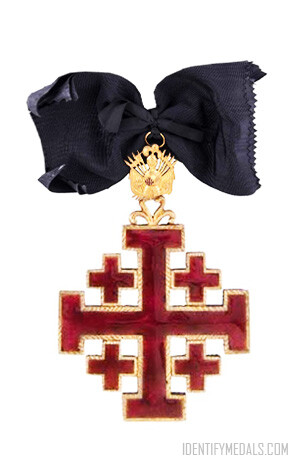
The emblem of the Order follows a time-honored tradition, featuring the Cross Potent, named after Godfrey of Bouillon. Specifically, it is a gold Cross Potent, adorned with enamel resembling the color of blood.

At each of its four sides, red crosslets with gold borders are attached, enhancing its symbolic significance.

The Cross is suspended from a ribbon made of black watered silk, further adding to its distinguished appearance.

The Order of St. Sylvester

The Order of St. Sylvester is one of five orders of knighthood awarded directly by the Pope and intended to honor Catholic laypeople/.

The Pontifical Equestrian Order of Saint Sylvester Pope and Martyr, also known as the Sylvestrine Order or the Pontifical Order of Pope Saint Sylvester, stands as one of the five orders of knighthood directly conferred by the Pope, serving as the Supreme Pontiff and head of the Catholic Church, as well as the Head of State of Vatican City. This distinction aims to recognize Catholic laypeople actively engaged in Church life, particularly those who demonstrate dedication through their professional endeavors and mastery of various arts.

In the past, this Order was united with the Order of the Golden Militia. However, Pope Pius X, through his motu proprio on 7 February 1905, titled Multum ad excitandos, split the Sylvestrine Order into two Orders of Knighthood. One retained the name of St. Sylvester, while the other reverted to the ancient name of the Order, namely the Order of the Golden Militia or the Order of the Golden Spur.

The Order acknowledges Catholic individuals deeply involved in Church affairs, especially those who excel in their professional roles and artistic pursuits. Notably, it is also bestowed upon non-Catholics, including prominent figures such as Anglicans, Muslims, and Jews in the UK.

The Order of St. Sylvester Design

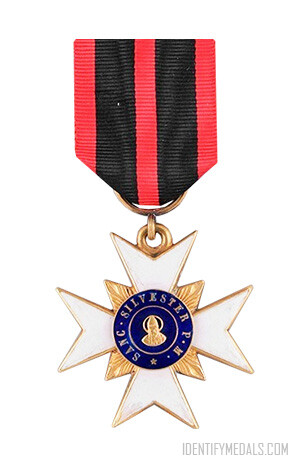
The present insignia of the Order consists of a gold cross with a white enamel surface. In its center lies the image of St. Sylvester, encircled by a blue enamel ring inscribed with “SANC. SYLVESTER P. M.”

On the reverse side, the papal tiara and crossed keys take center stage within a blue circle, featuring the dates of the Order’s restoration under Gregory (MDCCCXXXXR) and its renovation by Pius X (MDCCCCV) in gold characters.

The ribbon adorning the insignia is crafted from black silk, accented with three narrow red stripes. Additionally, the star or badge comprises the Order’s cross affixed to a silver star.

The Order of Pope Pius IX

The Order of Pope Pius IX is a papal order of knighthood founded by Pope Pius IV and the highest honor conferred by the Holy See.

The Order of Pope Pius IX, also known as the Pian Order, is a papal order of knighthood originally established by Pope Pius IV in 1560. Currently, it holds the distinction of being the highest honor bestowed by the Holy See, as the Orders of Christ and the Golden Spur are presently dormant. After falling out of use, the order was reinstated by Pope Pius IX on 17 June 1847.

On June 17, 1847, Pope Pius IX revived the Order with the decree Romanis Pontificibus, tracing its lineage back to the ancient order established by Pope Pius IV in March 1559 through the bull Pii patris amplissimi.

These distinguished knights comprised the lay court of the Roman Pontiff, actively participating in his daily life by providing escort services, residing in the Apostolic Palace, sharing meals with the Pontiff, and accompanying him in his daily duties.

The Ranks of the Order of Pope Pius IX

The Order comprises five classes.

At the apex of the order stands the Collar, reserved for Catholic heads of state during official visits to the Holy See. The Grand Cross, the highest Papal accolade for lay individuals, is typically conferred upon resident Ambassadors accredited to the Holy See after two years in their post. It is also occasionally bestowed upon extraordinary Catholics worldwide for exceptional contributions, particularly in the realms of international affairs and service to the Church and society.

The Knight rank is exceedingly rare and reserved for Catholic faithful of esteemed stature who have provided notable service to the Holy See or the Pontiff personally, often hailing from ancient European noble lineages.

The remaining ranks of Commander and Commander with Star are sparingly granted to lay Catholics, particularly those in diplomatic roles, in recognition of outstanding merit or contributions to the Church and society. While primarily awarded to Catholics, the order may, on diplomatic grounds, be conferred upon non-Catholics and individuals of other faiths.

The Order of Pope Pius IX Design

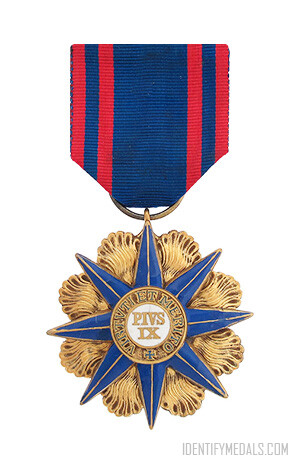
The insignia of the order is a standard octagram crafted from blue enamel, with gold flames filling the gaps between the rays.

Engraved on the white central medallion are the founder’s name surrounded by the words “Virtuti et Merito” (“Virtue and Merit”). The reverse side mirrors this design, replacing “Pius IX” with “Anno 1847.”

The official uniform, seldom worn, comprises a finely embroidered dark blue evening coat adorned with golden epaulettes, paired with white trousers, and topped with a white-plumed bicorne.

The Order of the Golden Spur

The Order of the Golden Spur is a papal order of knighthood awarded for distinguished service in propagating the Catholic faith.

The Order of the Golden Spur (or Ordine dello Speron d’Oro in Italian and Ordre de l’Éperon d’or in French), also officially known as the Order of the Golden Militia (or Ordo Militia Aurata in Latin and Milizia Aurata in Italian), is a papal knighthood bestowed upon individuals who have demonstrated exceptional service in promoting the Catholic faith or enhancing the prestige of the Church through acts of valor, scholarly writings, or other noteworthy achievements.

Following the passing of the last surviving knight, Grand Duke Jean of Luxembourg, in 2019, the order is now considered inactive.

The History of the Order of the Golden Spur

The Order of the Golden Spur has its roots in medieval times and is believed to have been established around the 8th century. Its origins are closely linked to the papacy and the Holy See’s role in recognizing individuals who made significant contributions to the Catholic Church and its mission.

Initially, the order was associated with the accolade of knighthood, often bestowed upon knights who demonstrated exceptional bravery in battle or service to the Church. Over time, its criteria expanded to include individuals who contributed to the glory of the Church through scholarly pursuits, artistic endeavors, or other illustrious acts.

During the Middle Ages, the order gained prominence as one of the highest honors conferred by the papacy. Recipients of the Golden Spur were esteemed members of the nobility and clergy, recognized for their unwavering dedication to the Catholic faith and their exemplary service to the Church.

Throughout its history, the order underwent various reforms and modifications, adapting to the changing political and religious landscape of Europe. Over time, the Golden Spur became associated not only with military valor but also with intellectual and cultural achievements that contributed to the advancement of Christianity.

The Order of the Golden Spur Design

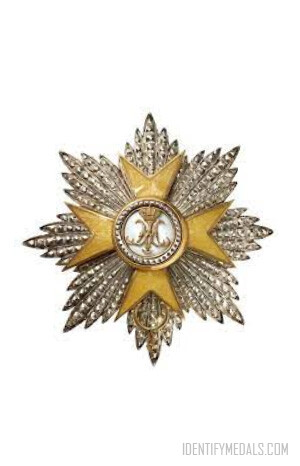
The badge today features an eight-pointed, enamelled gold cross. At its center lies a small white medallion, bearing the word “Maria” encircled by a golden ring. On the reverse side of the medallion, the year MDCCCCV is inscribed, surrounded by the words “Pius X Restituit” in a surrounding circle. Hanging from the bottom of the cross is a small golden spur.

The decoration is suspended from a red ribbon with white borders.

The star, worn on the left breast, retains the same cross design. It is set against the backdrop of silver star rays, enhancing its visual appeal.

The Supreme Order of Christ

The Supreme Order of Christ is the highest order of chivalry that can be awarded by the pope. The order is currently dormant.

The Supreme Order of Christ, known in Italian as the Ordine Supremo del Cristo, holds the distinction as the highest order of chivalry that can be bestowed by the Pope. Since 1987, there have been no new appointments to this prestigious order. Following the passing of the last remaining knight, King Baudouin of Belgium, in 1993, the order entered a period of dormancy.

Scholars suggest that its origins trace back to the Order of Christ of the Knights Templar, which also gave rise to the Order of Christ awarded by the kings of Portugal and the emperors of Brazil. Originally, the Portuguese order had both secular and religious aspects, but by the 18th century, the religious aspect had faded away.

The Portuguese Controversy

The Portuguese Crown has asserted its authority to bestow the Order of Christ. However, the Papacy contends that the Portuguese monarchs’ right to confer the Order was granted by a Pope through the Bull Ad ea ex quibus issued in Avignon in 1319.

Although the Bull itself does not expressly confer upon the Pope the authority to issue the Order, successive popes from Pope John XXII onward have done so. For many years, the Portuguese monarchy contested the Papacy’s right to grant the Order, and in one notable instance, apprehended an individual for wearing the Papal Order.

The stance of the Crown of Portugal was that the sole legitimate fons honorum was the Crown. However, this claim is disputed by the Papacy.

The Supreme Order of Christ Design

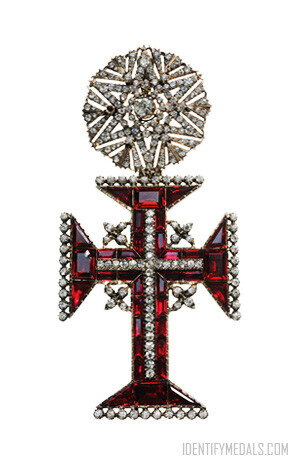
The insignia of the Order is a gilt cross with enamel with a longer lower arm. In the era of monarchy, distinct badges were assigned to civil and military knights: civil knights sported a badge resembling the contemporary version but adorned with the Sacred Heart of Christ above it. Conversely, military knights bore a completely different insignia—a gilt, blue, and white enamelled Maltese Cross, featuring white enamelled oval shields between the cross arms, each bearing a design akin to the Coat of arms of Portugal minus the red border.

The Vatican Cross of Mentana

The Vatican Cross of Mentana is an order created by Pope Pius IX on 14 November 1867 to commemorate the Battle of Mentana.

The Cross of Mentana, also known as the Cross Fidei et Virtuti, was a military decoration established by the Holy See during the Italian unification period.

Pope Pius IX established the cross on November 14, 1867, following the victory of French-Papal troops in the Battle of Mentana. Although initially associated with that battle, it was later awarded to all participants in the campaign against Garibaldi’s volunteers.

On March 3, 1868, the Imperial French government permitted the wearing of the medal with French uniforms.

The Order of St. Gregory the Great Design

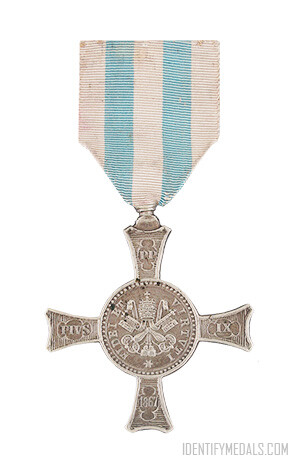
The Vatican Cross of Mentana is a silver cross featuring a cross pattée design with concave ends on the arms.

The obverse is a circular center medallion displaying the Papal coat of arms surrounded by the words ‘FIDEI ET VIRTUTI’. The upper, left, right, and lower arms bear the inscriptions ‘PP’, ‘PIUS’, ‘IX’, and ‘1867’ respectively. The reverse features a Latin cross encircled by a laurel wreath, with the inscription ‘HINC VICTORIA’ above it.

It hangs from a white ribbon with two light blue stripes in the center. Medal bars were affixed to the ribbon to denote the various battles for which each cross was bestowed.