
The Order of the Red Banner of Labour Valour (Literacy Labour)

The Order of the Red Banner of Labour Valour is a Mongolian award first instituted in 1926 as the Order of Literacy Valour.

  • Time Period: Interwar
  • Institution: 1926 (as “The Order of Literacy Valour“, renamed to “The Order of Civil Valour” in 1931 and then “The Order of the Red Banner of Labour Valour” in 1945)
  • Country: Mongolia

This award was originally created in 1926 under the name Order of Literacy Valour. In 1931 its name was changed to Order of Civil Valour, and finally in 1945 it became known as the Order of the Red Banner of Labour Valour. It was a civil decoration awarded to individuals for notable service in key areas of society, such as education, agriculture, health, and industry—recognizing contributions to national development and social progress.

Awards like this were part of Mongolia’s system of honours during the socialist period when the government recognised not just military achievements but also significant civil and labour accomplishments that advanced national goals.

The Order of the Red Banner of Labour Valour Medal Design

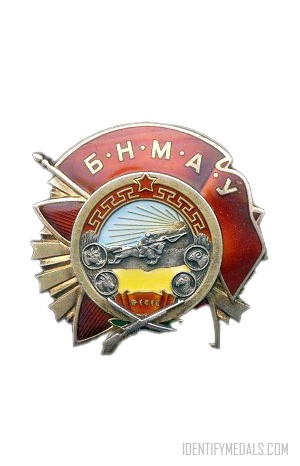
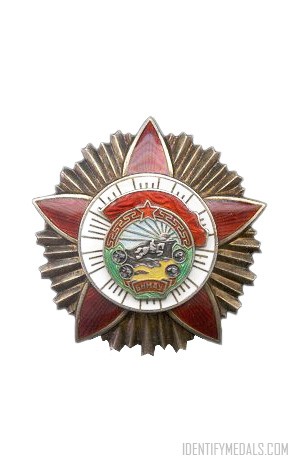
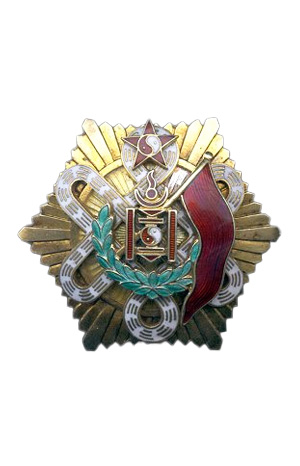
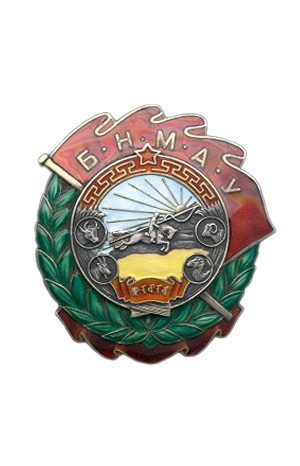
The obverse of the Order of the Red Banner of Labour Valour has varied with different production types, but core elements remain consistent with its military and symbolic themes. There are several different designs, some of which are listed below.

Mongolian Order of Literacy Valour
Order of Literacy Valour, Obverse.
Mongolian Order of Civil Valour.
Order of Civil Valour. Obverse.
The Order of the Red Banner of Labour Valour (Literacy Labour)
The Order of the Red Banner of Labour Valour. 1970 Version, Obverse.

The ribbon for the order is green with a central red stripe, a design typical of many labour and merit awards from socialist-era states, symbolising dedication and sacrifice.

The Mongolian Order of the Red Banner

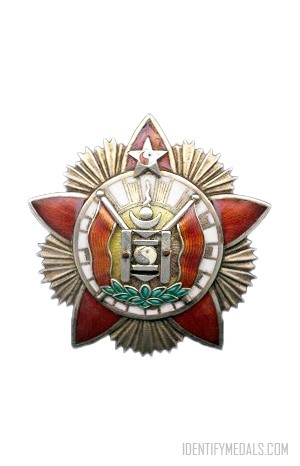
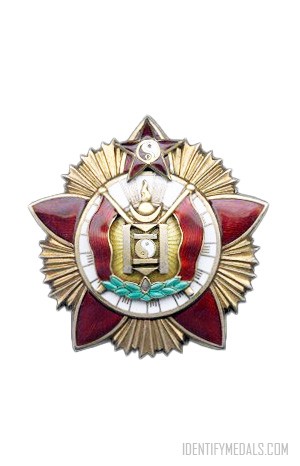
The Order of the Red Banner is a Mongolian military decoration originally established as the “Order for Military Merit” in 1926.
  • Time Period: Interwar
  • Institution: 1926 (as “The Order of Military Valour”, renamed to “The Order of the Red Banner in 1931)
  • Country: Mongolia

The Order of the Red Banner (Цэргийн гавьяаны улаан туг одон) is a military decoration of the Mongolian People’s Republic, first established in 1926 as the Order for Military Merit. It was created to recognize heroism in combat and distinguished service contributing to Mongolia’s defense and strengthening its armed forces.

The award could be given to Mongolian and foreign citizens, as well as military units, formations, schools, and institutions, reflecting Mongolia’s recognition of both individual and collective contributions to its military efforts. Over time the Order’s name and design evolved: it was simplified to the Order of the Red Banner in 1945, and in 1993 became known as the Order of the Red Banner for Military Valor (or Military Merit). The medallion design has been changed several times across different versions produced between 1926 and later decades. Around 10,000 awards were made over the years, and the Order remained an important part of Mongolia’s honors system.

The Order of the Red Banner Medal Design

The obverse of the Order of the Red Banner has varied with different production types, but core elements remain consistent with its military and symbolic themes. There are five different designs with four sub-variants for the 1940 and 1945 versions (which have four classes each).

Order of the Red Banner of Military Valour - 1926 Version.
Order of the Red Banner of Military Valour - 1931 Version.
Order of the Red Banner of Military Valour - 1940 Version.
Order of the Red Banner of Military Valour - 1945 Version.

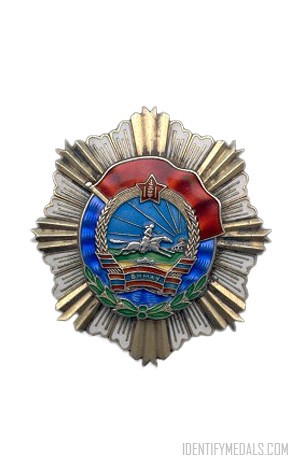
The badge is star-shaped with a prominent central motif and radiating rays — often with enamel and metallic finishes that give the Order a rich, layered appearance. Among earlier types, the central area frequently included a circular enamelled medallion depicting iconic imagery such as a rider on horseback and other figures or state symbols, framed by ornamental details.

Many versions feature a red enamel banner across the top portion of the star; in some examples this banner bears Mongolian Cyrillic initials like БНМАУ (abbreviation for People’s Republic of Mongolia), underscoring the award’s national identity.  The star’s rays and elements are often finished in gilt metal with colored enamels (red, white, yellow, blue and green), giving the insignia distinctive visual contrast. 

Design details changed over the decades — for example the pattern of enamel, the style of the central medallion, and how the banner and motifs were integrated — but the overall form remained recognizably a radiant star with bold military symbolism.

The Mongolian Order of the Polar Star

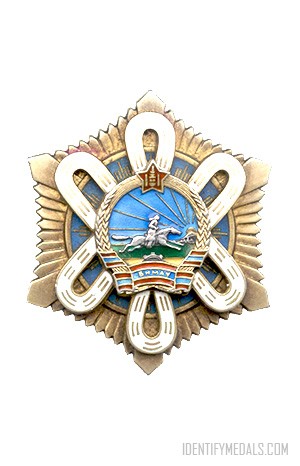
The Order of the Polar Star was created in 1936 as a state award of the Mongolian People’s Republic. It comes in four types.

The Order of the Polar Star (Алтан гадас одон, Altan Gadas Odon) is a long-standing state award of Mongolia, first instituted in 1936 and formally regulated by resolution of the Presidium of the Small Khural and the Council of Ministers of the Mongolian People’s Republic on 16 May 1941.

It remains an active honour today, with tens of thousands conferred since its creation. The award is given to both Mongolian and foreign nationals in recognition of special merits to society, which can include contributions to public life, international cooperation, cultural achievement, economic development, and other services benefiting Mongolia. The Order is placed directly below the Order of the Precious Wand in the nation’s order of precedence.

Unlike some medals that are limited to citizens, the Polar Star is frequently presented to foreign recipients for their work strengthening diplomatic, cultural, scientific, or economic ties with Mongolia; past awardees include international politicians, academics, diplomats, and organizational leaders, reflecting its role as one of Mongolia’s highest civilian honours.

The Mongolian Order of the Polar Star Medal Design

The obverse (front) of the Order of the Polar Star medal is visually striking and rich in symbolic detail, representing both Mongolia’s national identity and the prestige of the award.

At its core, the medal generally takes the form of a multi-pointed starburst with layered rays emanating from the center, often executed in gilded metal and enamel. Superimposed on this backing is a circular central medallion that features a horseman motif, usually depicting a rider across the Mongolian landscape — a common symbol of Mongolian heritage and the nation’s historic ties to horsemanship and freedom. Around this central scene, an enamelled ring and decorative elements (often in colors like blue and red) accentuate the medal’s focal imagery. Interlaced with the star’s rays are curved, repeating shapes — sometimes appearing as enamelled loops — that give the medal a distinctive, almost floral or astral appearance, aligning with the notion of the Polar Star as a guiding light. Many preserved examples show the medal finished with a high level of enamelling and metalwork detail, characteristic of both Soviet-era production and later variations.

The overall aesthetic combines geometric star forms and natural symbolism — encapsulating Mongolia’s cultural legacy and the honour’s role in recognizing exceptional contributions to society.

The Hero of the Mongolian People’s Republic Medal

The Hero of the Mongolian People’s Republic, first awarded in 1922, was one of the highest distinctions in the country.
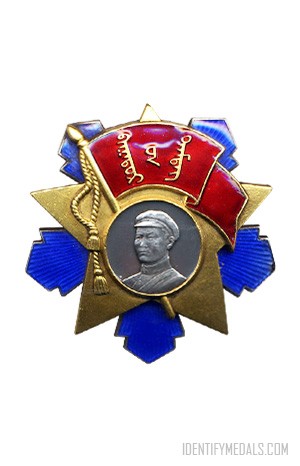
The Hero of the Mongolian People’s Republic was the most prestigious honor in the former Mongolian People’s Republic, created to recognize extraordinary acts done in service to the Mongolian people and state. It was inspired by the Soviet Union’s own Hero of the Soviet Union award.

The title could be given to both Mongolian citizens and foreigners and was first bestowed in September 1922. In the early years after Mongolia’s 1921 revolution, the new government introduced high honors, with initial awards going to key revolutionary figures. Later, a distinctive Gold Star medal was established in 1945 to represent the title.

Recipients of the Hero of the Mongolian People’s Republic medal also received the Sukhbaatar Order.

Over the decades until it was last awarded in 1989, a total of 59 individuals received it, including two posthumously. Recipients ranged from military leaders and political figures in Mongolia to prominent Soviet allies, reflecting the close ties between the two countries during much of the twentieth century.

The Hero of the Mongolian People’s Republic Design

There are two variants of this medal. The first type was issued during 1941 to 1946 and the second from 1946.

The Hero of the Mongolian People's Republic
The Hero of the Mongolian People's Republic - 1st Type (1941-46), Obverse.
The Hero of the Mongolian People's Republic - Mongolian Medals
The Hero of the Mongolian People's Republic - 2nd Type (1946), Obverse.

The obverse of the medal is a gold star-shaped badge with a radiating, multi-faceted design. It appears as a starburst with sharply defined, sculpted rays emanating from the center, giving a three-dimensional, almost geometric look.

Around the edges of the star there are five small, round gemstones (traditionally diamonds) set near the points of the star, one between each pair of major rays, which add sparkle and emphasize the award’s prestige.

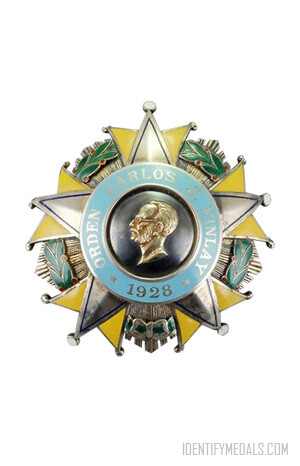
The Order of Carlos J. Finlay

The Order of Carlos Juan Finlay honors Cuban and foreign citizens for their contributions to science, research, and public health.

  • Time Period: Post-WW2
  • Institution: 21 January 1928
  • Country: Cuba

The Order of Carlos Juan Finlay was initially instituted by Decree No. 77 on January 21, 1928, and later ratified with a new design by Decree-Law No. 30 on December 10, 1979. This prestigious order honors both Cuban and foreign citizens for their exceptional contributions to the advancement of science, research, and public health.

The Order of Carlos J. Finlay Criteria

The order is granted to individuals who have demonstrated extraordinary merits in:

  • Advancing natural or social sciences.
  • Conducting scientific research or activities that significantly contribute to the progress of knowledge.
  • Promoting health and well-being, benefiting humanity at large.
  • Efforts in preserving and improving public health.

The award specifically recognizes achievements that contribute to the development of science in ways that improve societal welfare, enhance health systems, and lead to global benefits.

Carlos Juan Finlay: The Namesake

Carlos Juan Finlay (1833–1915) was a renowned Spanish-Cuban physician and epidemiologist. He is celebrated for his groundbreaking research on yellow fever, where he identified mosquitoes as the primary vector for its transmission. Finlay’s work paved the way for effective disease control measures and has saved countless lives. His contributions to epidemiology earned him recognition as one of the most influential figures in the history of public health.

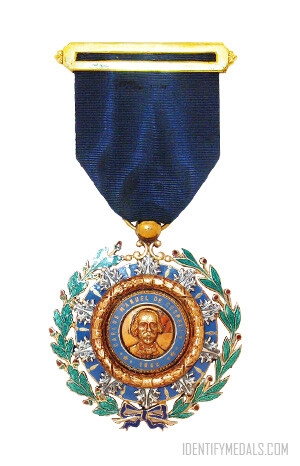
The Order of Carlos Manuel de Céspedes

The Order of Carlos Manuel de Céspedes is a prestigious decoration of the Republic of Cuba, named after the independence leader.

The Order of Carlos Manuel de Céspedes is a prestigious decoration of the Republic of Cuba, named after the independence leader Carlos Manuel de Céspedes (1819–1874).

Established in 1926 by Presidential Decree No. 486 under Gerardo Machado, it recognized services to Cuba or humanity, often in diplomatic or eminent capacities. The President of Cuba served as the order’s Master, with high-ranking officials as Chancellor and Vice Chancellor.

Post-1959, after the Cuban Revolution, the government annulled awards from the Batista era and re-evaluated recipients. Reorganized under Law No. 17, the order honors Cuban and foreign leaders, Heads of State, or individuals contributing to national liberation, international solidarity, or peace.

The Order of Carlos Manuel de Céspedes Criteria

Ranks included Grand Cross (for presidents and heads of state), Grand Officer, Commander, Officer, and Knight or Lady, with specific criteria for diplomats and officials.

The Order of Carlos Manuel de Céspedes Design

The medal consists of a white-enamelled five-point star with a turquoise blue crown, featuring Céspedes’ effigy and the inscription “1868.” The reverse displays the Cuban Coat of Arms. It hangs from a ribbon with turquoise blue, red, and white stripes.

One of a Kind: Amelia Earhart And The Distinguished Flying Cross

Why did Amelia Earhart receive the award (a traditionally a military decoration) in recognition of her 1932 solo transatlantic flight?
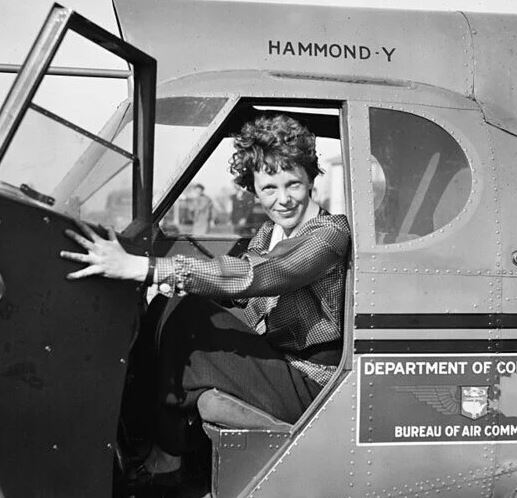
Amelia Earhart (1897–1937) was an American aviation pioneer, author, and advocate for women’s rights. She is also one of the most celebrated and enigmatic figures in the history of aviation and remains a symbol of courage, determination, and breaking barriers. But did you know she was awarded the Distinguished Flying Cross (DFC)?

The cross is traditionally a military decoration. Amelia Earhart, though, was a civilian pilot, and not a member of the armed forces… which makes her receipt of the award even more remarkable and significant! So, let’s learn about her exceptional contributions to aviation, including her famous solo transatlantic flight in 1932.

A Quick View: Who Was Amelia Earhart?

Amelia Earhart’s life story is a testament to her adventurous spirit and pioneering contributions to aviation and women’s equality. She gained international fame as the first woman to fly solo across the Atlantic in 1932. Earhart set numerous other aviation records, too, co-founded the Ninety-Nines to support women pilots, and tirelessly promoted gender equality in aviation. In 1937, she vanished during an attempt to fly around the world, leaving behind a legacy of courage, innovation, and inspiration that continues to resonate.

  • She was the first woman to fly solo across the Atlantic (1932). She flew from Newfoundland to Ireland in 14 hours, battling mechanical issues and severe weather.
  • She also became the first woman to fly solo nonstop across the United States in 1932.
  • She worked tirelessly to promote women in aviation, co-founding the Ninety-Nines 🔗, an organization for female pilots, and advocated for breaking gender barriers in the male-dominated field of aviation.

In 1937, Earhart attempted to become the first person to fly around the world along the equator. On July 2, 1937, during a leg of the journey from New Guinea to Howland Island, she and her navigator, Fred Noonan, vanished. Despite extensive search efforts, they were never found, and her disappearance remains one of the greatest unsolved mysteries of the 20th century.

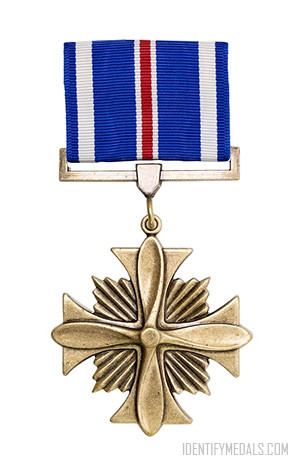
Amelia Earhart's Distinguished Flying Cross

Earhart received the Distinguished Flying Cross in recognition of her 1932 solo transatlantic flight. This accomplishment was not only a testament to her individual courage and skill but also a pivotal moment in aviation history, demonstrating that women were equally capable of achieving remarkable feats in flight. The award symbolized broader societal shifts toward recognizing women’s capabilities in traditionally male-dominated fields. 

The DFC is typically awarded to members of the U.S. military for “heroism or extraordinary achievement while participating in an aerial flight.” It was established in 1926 and is usually conferred on service members demonstrating exceptional courage or accomplishment in combat or non-combat aviation missions.

Amelia Earhart was a civilian pilot, not a member of the armed forces. For her to be honored with an award primarily given to military aviators underscored the extraordinary nature of her achievement. Her solo transatlantic flight in 1932 was considered comparable in courage, skill, and impact to the feats of military aviators.

Awarding the DFC to Earhart showed that the U.S. government recognized exceptional contributions to aviation even from outside the military. It set a precedent that aviation excellence could transcend military boundaries, elevating civilian aviation pioneers to similar levels of recognition.

Earhart’s flight and subsequent recognition helped solidify her as a prominent figure in the promotion of aviation. Her public persona and accomplishments contributed to raising awareness of the potential of air travel and the importance of the aviation industry during its early development.

In the 1920s and 1930s, aviation was still a relatively new field. Recognizing a civilian like Earhart with a military honor bridged the gap between military and civilian aviators, fostering a sense of shared progress and achievement in advancing the possibilities of flight.

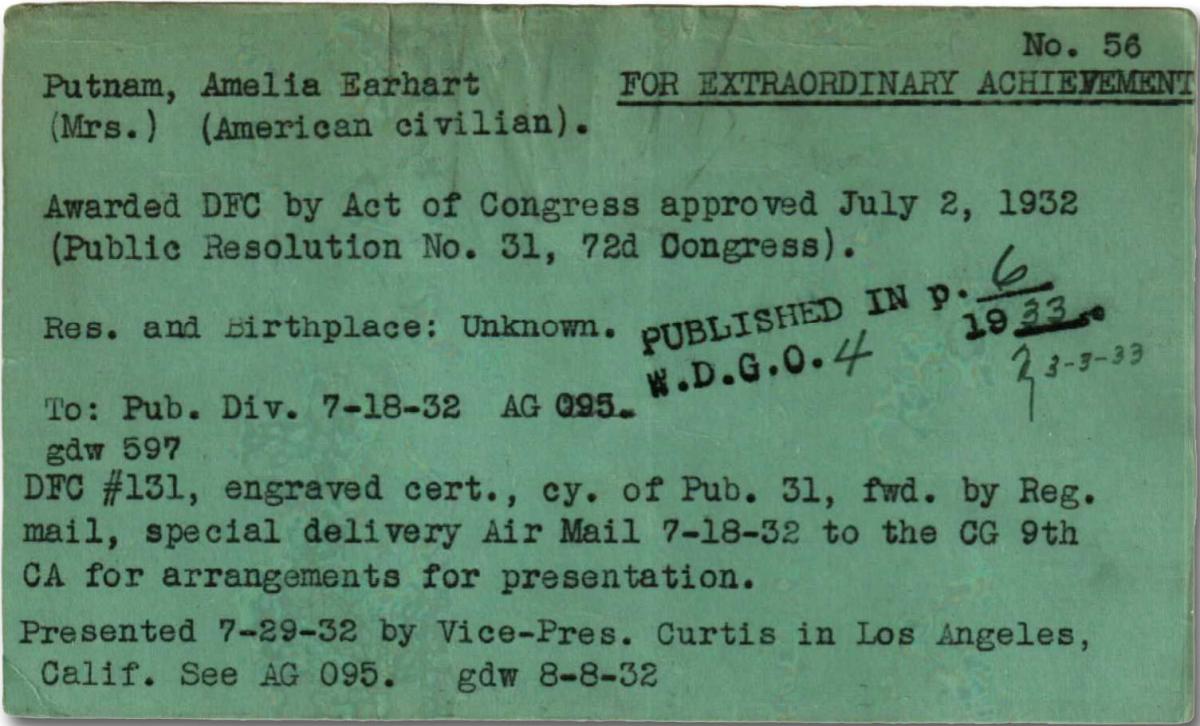
Amelia Earhart's Distinguished Flying Cross Award Card
Amelia Earhart's Distinguished Flying Cross Award Card. Image courtesy of the National Archives.

Message on Earhart's Presentation

July 29, 1932

[Released July 29, 1932. Dated July 22, 1932]

My dear Miss Earhart:

The Vice President has been requested to represent me in presenting to you the Distinguished Flying Cross authorized by the Congress in a Joint Resolution which was approved on July 2nd, 1932.

At the presentation ceremony, I am asking him to hand you this message of congratulations upon the many and well-deserved honors which your knowledge of the science and art of aviation, and your great skill and courageous spirit as a pilot and navigator have brought to you, and through you, to the womanhood of America.

Faithfully yours,

HERBERT HOOVER

[Miss Amelia Earhart, The Ambassador Hotel, Los Angeles, Calif.]

[Source: The American Presidency Project 🔗]

The Germanic Proficiency Runes

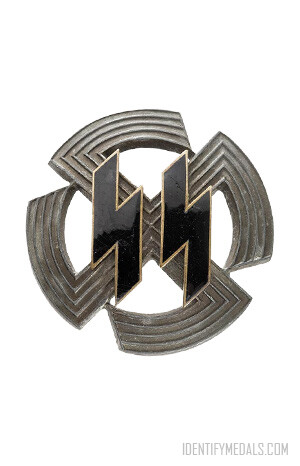
The Nazi regime introduced a sports badge for non-Germans who were part of the Germanic-SS and Waffen-SS, known as the runes.

The Germanic Proficiency Runes Badge, established on August 15, 1943, was awarded to non-German members of the Germanic-SS and Waffen-SS who demonstrated exceptional physical fitness and adherence to Nazi ideology.

The Germanic Proficiency Runes were awarded in two grades: bronze and silver. The distinction between these grades was based on the level of physical achievement demonstrated by the recipients.

The tests for these awards were similar to those required for the SA Sports Badge, ensuring a standardized measure of physical fitness across both German and non-German SS members.

The creation of the Germanic Proficiency Runes served several purposes. It was a tool for promoting physical fitness and readiness among non-German SS members. Additionally, it reinforced the ideology of the Germanic-SS, which sought to include ethnically Germanic volunteers from occupied and neutral countries in Europe.

The Germanic Proficiency Runes Tests

Recipients of the Germanic Proficiency Runes had to undergo rigorous physical tests that were on par with the requirements for the SA Sports Badge. These tests included a variety of athletic and endurance challenges designed to assess overall physical fitness, agility, strength, and stamina. The aim was to maintain a high level of physical preparedness among the SS troops, irrespective of their nationality.

The SS Zivilabzeichen Badge

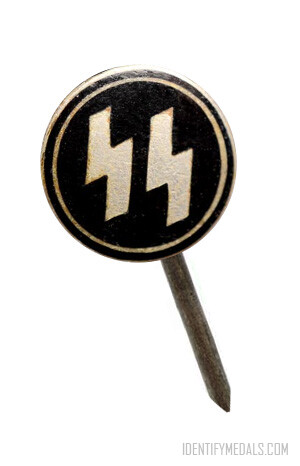
The SS Zivilabzeichen Badge, also known as the SS Civil Badge, was a lapel pin issued to SS members between 1933 and 1938.

The SS Zivilabzeichen, also known as the SS Civil Badge, was a lapel pin issued to SS members between 1933 and 1938. This badge, displaying the SS runes, was worn on civilian clothing to signify membership in the SS.

The badge was predominantly awarded to veteran SS members within the Sicherheitspolizei, though there was no strict criteria for its issuance. Members simply had to apply to the SS-Hauptamt to receive it.

Known Badge Numbers

  • Adolf Hitler: Honorary SS number “1”. His badge was kept in his Munich apartment and later taken by 1st Lieutenant Philip Ben Lieber in 1945. This badge, along with other items owned by Hitler, was sold through Mohawk Arms to collectors Stephen Wolfe and Neil Hardin, and eventually acquired by collector Craig Gottlieb in 2013.
  • Heinrich Himmler: Badge number 2.
  • Adolf Eichmann: Badge number 6,375.
  • Gustav Lombard: Badge number 72,723.
  • Karl Freiherr Michel von Tüßling: Badge number 106,983.
  • Ernst Kaltenbrunner: Badge number 160,180.
  • Hermann Senkowsky: Badge number 169,582.

The SS Membership Runes for Order Police

The SS Membership Runes for Order Police was a badge worn by members of the Ordnungspolizei who were also full members of the SS.

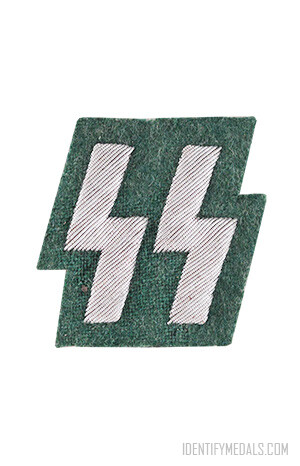
The SS Membership Runes for Order Police was a badge worn by members of the Ordnungspolizei (Orpo) who were also full members of the Schutzstaffel (SS). This badge featured two white Sig Runes, the symbol of the SS, and was centered on the lower left-hand pocket of the jacket.

This badge marked the initial step towards merging the Order Police with the SS, a process supported by Kurt Daluege and Heinrich Himmler. The integration advanced further in 1942, when all Orpo Police Generals were granted equivalent SS ranks and began wearing modified SS-Police rank insignia.

The SS Membership Runes for Order Police Design

The badge was centered on the lower left-hand jacket pocket. It prominently featured two white Sig Runes, which are the iconic symbol of the SS, signifying the wearer’s dual membership in both the Order Police and the SS.

The two white Sig Runes were centrally placed, symbolizing the SS. The runes are in a stylized font typical of Nazi iconography.

The background of the badge is a dark green color, creating a strong contrast with the white runes and ensuring the symbol is easily recognizable from a distance.