The Surgeon General’s Exemplary Service Medal

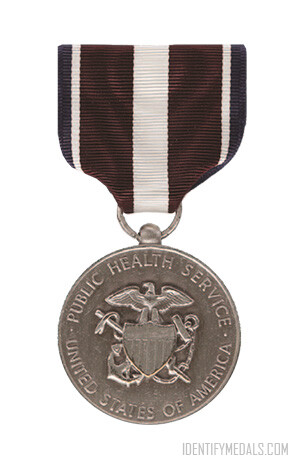
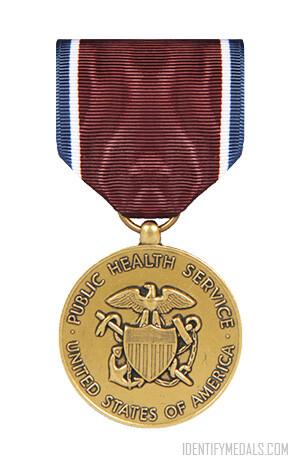
The Surgeon General’s Exemplary Service Medal is a distinguished award presented by the U.S. Public Health Service.

The Surgeon General’s Exemplary Service Medal is a distinguished award presented by the U.S. Public Health Service. It is administered by the Office of the Surgeon General and granted exclusively at the discretion of the Surgeon General of the United States.

This medal recognizes outstanding contributions to the initiatives and priorities of the Surgeon General by members of the U.S. Uniformed Services. Unique among awards, it does not require a formal nomination process or specific criteria, as it is solely awarded based on the Surgeon General’s judgment of exemplary service.

More Medals of the Public Health Service

Find This Medal Online

Right Now on eBay 
Clicking a link to eBay may result in a referral commission being paid if a purchase is made.
Loading...

The Public Health Service Meritorious Service Medal

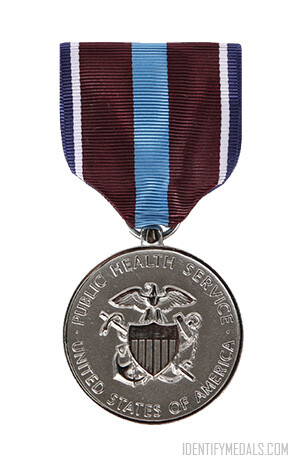
This medal is awarded for exceptional achievements or contributions of significant impact to the Corps’ mission.

The Public Health Service Meritorious Service Medal is awarded to members of the U.S. Public Health Service Commissioned Corps and other Uniformed Services of the United States for exceptional achievements or contributions of significant impact to the Corps’ mission. As the second-highest honor bestowed by the Public Health Service, it recognizes distinguished service that advances public health goals.

Eligibility and Criteria

This medal is awarded for outstanding service in one of the following areas:

  • A single, highly significant achievement in research, program management, or administration.
  • A career marked by remarkable accomplishments in technical or professional fields.
  • Exceptional leadership demonstrated with notable quality and initiative.
  • A period of sustained, meritorious service or a series of major contributions to public health.
  • Acts of great courage or heroism in an emergency.

"With Valor" Designation

The medal can also be awarded With Valor,” denoted by a bronze “V” device, to recognize acts of extraordinary bravery. This designation is reserved for individuals who demonstrate specific acts of courage or heroism that result in saving or preserving life or health. It does not apply to hazardous duties or general exposure to dangerous conditions but requires clear evidence of personal risk, bravery, and selflessness.

More Medals of the Public Health Service

Find This Medal Online

Right Now on eBay 
Clicking a link to eBay may result in a referral commission being paid if a purchase is made.
Loading...

The Surgeon General’s Medallion

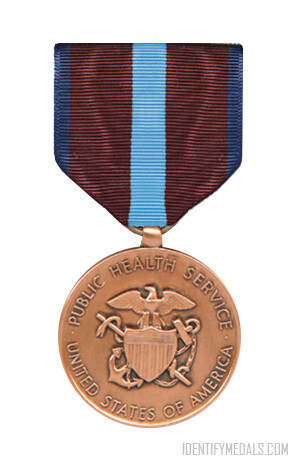
The Surgeon General’s Medallion is the fourth-highest honor within the U.S. Public Health Service. It’s given for exceptional achievements.

The Surgeon General’s Medallion is the fourth-highest honor within the U.S. Public Health Service and the Public Health Service Commissioned Corps. Presented by the U.S. Surgeon General, this prestigious award recognizes exceptional achievements in public health and medicine.

The criteria for the award are determined by the sitting Surgeon General and typically include groundbreaking contributions to public health, advancements in disease prevention and control, or outstanding service in senior roles within the Department of Health and Human Services.

Due to its high regard, the Surgeon General’s Medallion is authorized for wear on active-duty uniforms of the U.S. Armed Forces. For Public Health Service Commissioned Corps members, it is worn after the Public Health Service Meritorious Service Medal and before the Department of Commerce Silver Medal, the Surgeon General’s Exemplary Service Medal, and the Legion of Merit.

More Medals of the Public Health Service

Find This Medal Online

Right Now on eBay 
Clicking a link to eBay may result in a referral commission being paid if a purchase is made.
Loading...

The Humanitarian Medal

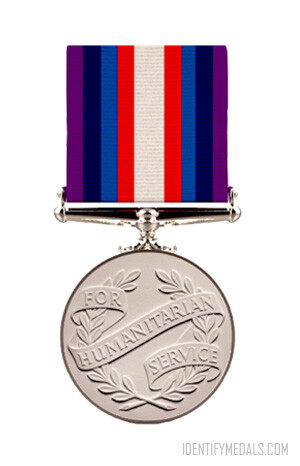
The Humanitarian Medal is a newly established British honor designed to recognize individuals who have demonstrated exceptional bravery and commitment in disaster response efforts. Announced in July 2023, this medal acknowledges the courageous actions of UK citizens who risk their lives to assist others during emergencies, both domestically and internationally.

Key Features of the Humanitarian Medal:

  • Purpose: To honor acts of bravery and selflessness by UK citizens in disaster situations, including natural disasters, humanitarian crises, and other emergencies.

  • Eligibility: Open to both civilians and members of the armed forces who have gone above and beyond in providing aid and relief during critical incidents.

The Humanitarian Medal Design

The medal features laurel wreaths, symbolizing triumph in overcoming crises, intertwined with a banner inscribed with “For humanitarian service.” The obverse showcases the Sovereign’s effigy.

The ribbon design represents the diverse routes and services involved in humanitarian efforts. A central white stripe symbolizes civilians and peace, flanked by four narrow stripes: red for humanitarian organizations, light blue for the NHS, and dark blue and purple for other services.

The Queen’s Commendation for Brave Conduct Medal

This medal was created in 1934 to recognize acts of bravery by civilians and armed forces members in non-combat situations.

The Queen’s Commendation for Brave Conduct, originally the King’s Commendation for Brave Conduct, recognized acts of bravery by civilians and armed forces members in non-combat situations, both in war and peace. Established by King George VI in 1939, it was discontinued in 1994 and replaced by the Queen’s Commendation for Bravery. It represented the lowest tier of bravery awards in the British honors system, alongside a mention in despatches, and did not confer post-nominal letters.

The commendation was created at the onset of World War II to address the lack of recognition for non-combat gallantry, especially among civilians and the Merchant Navy. Awards were published in the London Gazette and described simply as “Commendation for brave conduct” until 1945, when the title “King’s Commendation for Brave Conduct” was formalized. It allowed posthumous recognition, filling a gap left by other gallantry awards, which were typically not awarded posthumously except for the Victoria Cross and George Cross.

The Evolution of the Commendation

The practice of commendations originated during World War I, where it was primarily used to honor acts of bravery by Merchant Navy seamen. The system fell into disuse between the wars but was revived in 1939. After World War II, the commendation continued to recognize non-frontline bravery, often involving civil defense and public service. In 1952, it was renamed the Queen’s Commendation for Brave Conduct following the death of King George VI. The award was officially replaced by the Queen’s Commendation for Bravery in 1994.

Notable recipients ranged from firefighters and air raid wardens to Merchant Navy personnel and civilians who displayed courage in life-threatening situations, often in response to U-boat attacks, bombings, and other wartime emergencies. Recipients were listed in the London Gazette and received certificates, but no medal accompanied the commendation.

The Commendation for Brave Conduct Medal Design

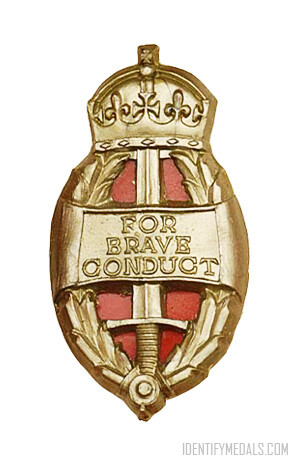
Before 1943, recipients of the Commendation for Brave Conduct received only a certificate. In 1943, a gold and red plastic pin-backed badge, designed by George Kruger Gray 🔗, was introduced for civilian recipients. Measuring 38 mm by 20 mm, it featured an upright sword in a wreath with a crown and was intended for everyday civilian wear, often provided in pairs with a red box.

From 1946, the plastic badge was replaced by a silver metal laurel leaf for civilians, while armed forces personnel and merchant seamen received a bronze oak leaf insignia. Identical to the Mention in Despatches oak leaf, these devices were worn on the ribbon of the appropriate campaign medal—typically the Defence Medal for civilians and War Medal for servicemen—or directly on clothing if no medal had been awarded. For post-1945 campaigns, they could be worn on corresponding campaign medals.

The Humanitarian Service Medal

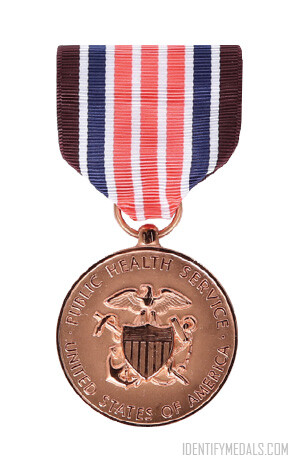
The Humanitarian Service Medal (HSM) is a U.S. military award that recognizes members of the Armed Forces for humanitarian missions.

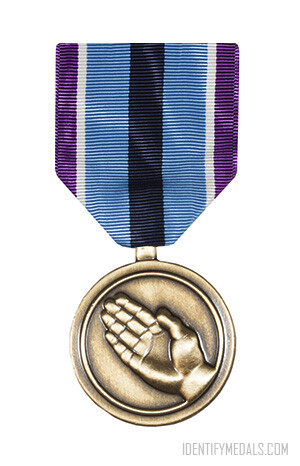
The Humanitarian Service Medal (HSM) is a U.S. military award established on January 19, 1977, by President Gerald Ford 🔗 through Executive Order 11965. It recognizes members of the Armed Forces, including Reserve and National Guard, for meritorious participation in humanitarian missions, such as disaster relief, refugee support, or non-combatant evacuations.

The medal was proposed in 1975 by Julia V. Taft, head of the Interagency Task Force for Indochinese Resettlement, to honor military personnel aiding Vietnamese and Cambodian refugees after the Vietnam War. Despite initial opposition from Army Lieutenant General Harold G. Moore, who favored certificates over medals, Army Lieutenant General John W. Vessey supported the idea, leading to its approval by President Ford.

The Humanitarian Service Medal Criteria

The HSM is awarded for activities designated by the Department of Defense, including natural disaster relief and humanitarian operations. It cannot be given for domestic disturbances or when other military awards like the Armed Forces Service Medal are issued for the same mission. The award is retroactive to April 2, 1975.

For civilians, the Department of the Army offers a similar recognition, the Civilian Award for Humanitarian Service.

The Humanitarian Service Medal Design

The Humanitarian Service Medal (HSM) is crafted from a durable, high-quality metal alloy and features intricate detailing that symbolizes its purpose. The medal is accompanied by a ribbon made of woven fabric, designed to complement the medal’s theme of service and recognition.

The obverse of the medal features a laurel wreath encircling a raised depiction of a helping hand. The hand is symbolic of assistance and support, reflecting the humanitarian mission recognized by the award. This imagery highlights the dedication of U.S. military personnel to aiding those in need. The reverse side bears a simple inscription that reads “For Humanitarian Service,” along with space for additional engraving if required. The clean, understated design emphasizes the selfless nature of the contributions being honored.

The medal is suspended from a ribbon featuring alternating vertical stripes of purple and white. The purple symbolizes dedication and compassion, while white signifies purity of purpose and service. The ribbon’s color scheme reinforces the theme of humanitarian aid and the noble qualities associated with such efforts.

Buy this Medal

Right Now on eBay 
Clicking a link to eBay may result in a referral commission being paid if a purchase is made.
Loading...

The Médaille Militaire (France)

The Médaille Militaire (or French Military Medal) was established in 1952 and awarded for meritorious service and acts of bravery.

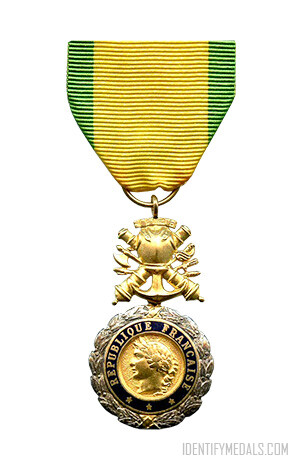
The Médaille Militaire (or Military Medal) is a distinguished military decoration of France, awarded for acts of bravery and meritorious service in action against an enemy. Reserved for non-commissioned ranks, it stands as the third-highest honor in the French Republic, following the Legion of Honour, which serves both civil and military purposes, and the Order of Liberation, an order established solely for the Second World War. This makes the Médaille militaire the highest exclusively military decoration still awarded in France.

During World War I, over 230,000 Médaille militaire honors were conferred, a testament to the sacrifices made, with 1.4 million French soldiers killed and 3 million wounded. By comparison, the British Military Medal was awarded approximately 115,000 times, and the Victoria Cross, the UK’s highest military decoration, was awarded to 627 recipients.

Established in 1852 by Louis-Napoléon Bonaparte, then-President of France, the award may have drawn inspiration from a similar medal created by his father, Louis Bonaparte, King of Holland. Following World War I, the Médaille militaire was briefly awarded to soldiers wounded in combat, adding a unique dimension to its legacy.

The Médaille Militaire Design

The Médaille militaire is a distinguished silver medal adorned with a laurel wreath, measuring 28 mm (1.1 in) across, encircling a central gold medallion. The medallion displays the left-facing profile of Marianne, symbolizing the French Republic, although earlier versions from the Second Empire featured Emperor Napoleon III’s profile instead. Encircling the medallion is a blue enamel ring inscribed in gold with “RÉPUBLIQUE FRANÇAISE” (“FRENCH REPUBLIC”), accompanied by a small gold star at the bottom. The number of stars varies by era, with one star for the Fourth Republic version and three stars for the Fifth Republic; the Third Republic medal bore the year “1870,” while the Second Empire version included “LOUIS-NAPOLEON” instead of “RÉPUBLIQUE FRANÇAISE” and floral embellishments beside the star.

Originally, the medal was topped with a silver imperial eagle, while later versions are adorned with a design combining a breastplate over crossed cannons, an anchor, sabres, swords, and battle axes, with a looped ring for attaching the ribbon. The reverse of the medal remains consistent across all versions, displaying the inscription “VALEUR ET DISCIPLINE” (“VALOUR AND DISCIPLINE”) in relief, surrounded by the blue enamel ring.

The Médaille militaire ribbon is 37 mm (1.5 in) wide, yellow with green edges measuring 6 mm (0.24 in) each. This ribbon design was inspired by the Order of the Iron Crown, which the Médaille militaire succeeded in France.

The Medal for Faithful Fulfillment of Duties in the Civil Defense of the GDR

The Medal for Faithful Fulfillment of Duties in the Civil Defense of the GDR honored individuals who demonstrated exceptional dedication.

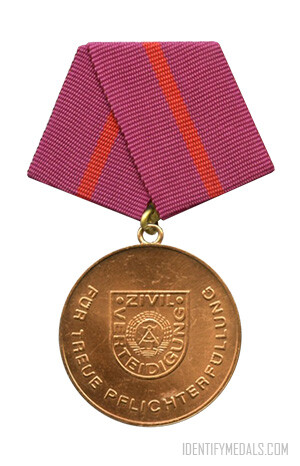
The Medal for Faithful Fulfillment of Duties in the Civil Defense of the GDR (or Medaille für treue Pflichterfüllung in der Zivilverteidigung der DDR in German) was established to honor individuals who demonstrated exceptional dedication and performance in the civil defense sector of the German Democratic Republic.

Created on February 11, 1963, this medal recognized those who contributed significantly to the preparation, coordination, and execution of civil defense measures, ensuring the safety and protection of the population during emergencies and disasters.

The Award Criteria

The criteria for receiving the Medal for Faithful Fulfillment of Duties in the Civil Defense of the GDR included demonstrating consistent dedication, efficiency, and professionalism in civil defense roles.

The medal was awarded in multiple classes based on service duration and performance: bronze for 5 years, silver for 10 years, and gold for 15 years or more. Recipients were expected to have shown exceptional performance in planning and executing civil defense operations, adherence to socialist principles, and significant contributions to the safety and preparedness of the state.

The Award Design

The Medal for Faithful Fulfillment of Duties in the Civil Defense of the GDR featured a circular design made from bronze, silver, or gold, depending on the class.

The obverse side displayed civil defense symbols, such as a shield or a torch, surrounded by laurel leaves. The reverse bore the inscription “Für treue Pflichterfüllung” (For Faithful Fulfillment of Duties) and the number of years of service.

The medal was attached to a crimson ribbon with a central red stripe.

The Medal for Faithful Service in Fighting Groups of the Working Class

The Medal for Faithful Service in Fighting Groups of the Working Class was awarded to paramilitary units composed of workers of the GDR.

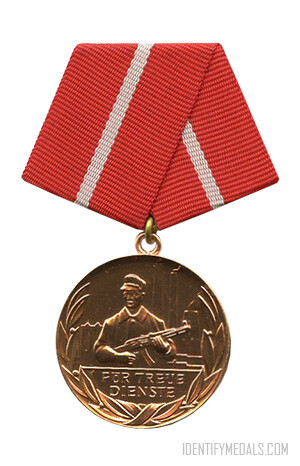
The Medal for Faithful Service in Fighting Groups of the Working Class (or Medaille für treue Dienste in den Kampfgruppen der Arbeiterklasse in German) was established to recognize the long-term dedication and exemplary service of members of the Fighting Groups of the Working Class.

These groups were paramilitary units composed of workers who were trained and organized to defend the German Democratic Republic (GDR) against internal and external threats. The medal was created to honor their commitment to the socialist state and their role in safeguarding its achievements.

The Award Criteria

The criteria for receiving the Medal for Faithful Service in Fighting Groups of the Working Class included demonstrating long-term service and exemplary performance in the duties of the Fighting Groups.

The award was given in multiple classes, typically bronze for 5 years, silver for 10 years, and gold for 15 years or more. Recipients needed to show dedication to their training, readiness to defend the state, and adherence to socialist principles. The medal recognized both individual achievements and collective efforts in maintaining the security and stability of the GDR.

The Award Design

The Medal for Faithful Service in Fighting Groups of the Working Class featured a round design made from bronze, silver, or gold, depending on the class.

The obverse side displayed symbols of the Fighting Groups, such as crossed rifles or a clenched fist, surrounded by laurel leaves. The reverse bore the inscription “Für treue Dienste” (For Faithful Service) and the number of years of service.

The medal was attached to a red ribbon with a central white stripe.

The Medal for Loyal Service in the Customs Administration of the GDR

The Medal for Loyal Service in the Customs Administration of the GDR was established to recognize the dedication of customs officials.
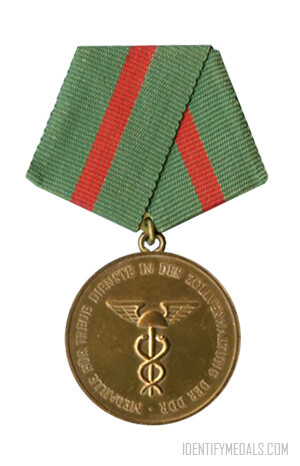
The Medal for Loyal Service in the Customs Administration of the GDR (or Medaille für treue Dienste in der Zollverwaltung der DDR in German) was established to recognize the dedication and long-term service of customs officials within the German Democratic Republic.

Instituted on June 30, 1954, this medal honored customs officers who played a crucial role in regulating trade, preventing smuggling, and ensuring the security and economic interests of the state. The award highlighted the importance of the Customs Administration in maintaining the integrity of the GDR’s borders and economic policies.

The Award Criteria

Recipients of the Medal for Loyal Service in the Customs Administration of the GDR were selected based on their length of service and exemplary conduct.

The medal was awarded in multiple classes, typically bronze for 5 years, silver for 10 years, and gold for 15 years or more. Criteria included consistent performance, adherence to state regulations, and significant contributions to the efficiency and effectiveness of the customs services. The award aimed to motivate customs officials and recognize their commitment to upholding the state’s economic and security measures.

The Award Design

The Medal for Loyal Service in the Customs Administration of the GDR featured a circular design made from bronze, silver, or gold, corresponding to the class.

The obverse displayed an emblem of the Customs Administration, such as crossed keys or a shield, surrounded by laurel branches. The reverse bore the inscription “Für treue Dienste” (For Faithful Service) and the number of years of service.

The medal was attached to a green ribbon with a thick red stripe in the middle.