The Baltic Medal

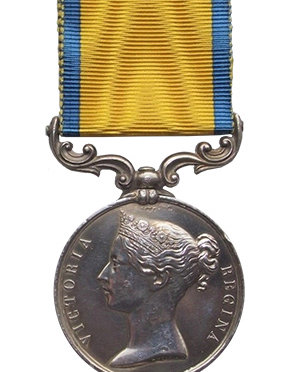
The Baltic Medal is a campaign medal issued to officers and men who served in Baltic Sea operations in the Baltic theatre of the Crimean War.

The Baltic Medal is a campaign medal issued to officers and men of the Royal Navy, Royal Marines, and Royal Sappers and Miners who served in Baltic Sea operations against Russia in the Baltic theatre of the Crimean War between March 1854 and August 1855.

The medal was approved in 1856 and covered primarily naval actions – although it was also awarded to 106 men of the Royal Sappers and Miners who were landed to place demolition charges against Russian fortifications at Bomarsund and Sveaborg.

No clasps were authorized for the Baltic medal.

The Baltic Medal Design

The Baltic medal is a circular silver medal measuring 36 millimeters (1.4 in) in diameter. It was designed by Leonard Charles Wyon.

The obverse depicts the diademed head of Queen Victoria with the legend VICTORIA REGINA, designed by William Wyon. The reverse shows a seated figure of Britannia holding a trident with the fortresses at Bomarsund and Sveaborg behind. Above is the word BALTIC and below the dates 1854-1855.

The ribbon measures 31.7 millimeters (1.25 in) wide, and it’s yellow with light blue edges, reversing the colours of the Crimea Medal ribbon.

The Crimea Medal

The Crimea Medal is a campaign medal issued to officers and men of British units who fought in the Crimean War of 1854–56 against Russia.

The Crimea Medal is a campaign medal issued to officers and men of British units (land and naval) who had fought in the Crimean War of 1854–56 against Russia. The medal was approved on 15 December 1854.

The Crimea medal was awarded with the British version of the Turkish Crimea Medal, and some troops were issued with the Sardinian version instead. The Crimea medal was also presented to certain members of allied French forces.

Five clasps were authorized:

  • Alma. For the battle of 20 September 1854.
  • Balaklava. For the battle of 25 October 1854.
  • Inkerman. For the battle of 5 November 1854.
  • Sebastopol. For the siege that lasted from 11 September 1854 to 9 September 1855. Anyone who received the Balaklava or Inkerman clasps was also awarded this bar.
  • Azoff. For the Naval expedition in the Sea of Azoff from 25 May to 22 September 1855. It was awarded only to Royal Navy personnel.

The Crimea Medal Design

The Crimea Medal consists of a 36mm diameter silver disk. The obverse displays the diademed head of Queen Victoria and the legend “VICTORIA REGINA” with the date 1854 below.

The reverse shows a depiction of a standing Roman warrior about to receive a laurel crown from a flying figure of victory, the word CRIMEA appearing on the left.

The medal is notable for its unusually ornate clasps, each in the form of an oak leaf with an acorn at each end. This is a style not used on any other British medal. The ornate, floriated, swiveling suspender is also unique to the Crimea Medal. The ribbon measures 27 millimeters (1.1 in) wide and is pale blue with yellow edges.

Find This Medal

Right Now on eBay 
Clicking a link to eBay may result in a referral commission being paid if a purchase is made.
Loading...

The South Africa Medal (1854)

. The South Africa Medal (1853) is a campaign medal awarded to officers and men who served in the Cape of Good Hope during the Xhosa Wars.

The South Africa Medal (1853) is a campaign medal awarded to officers and men of the Royal Navy, British Army and locally recruited Cape Mounted Riflemen who served in the Cape of Good Hope during the Xhosa Wars between 1834 and 1853.

The medal was instituted in 1854 by Queen Victoria. It was awarded to surviving participants in one or more of three campaigns in the eastern Cape of Good Hope:

No clasps were awarded, therefore it is not possible to determine which of the wars any particular medal was awarded for.

The South Africa Service Medal Design

The South Africa Service medal was struck in silver and is a disk measuring 36 millimeters in diameter. The medal has a swiveling suspender. The medal was designed by William Wyon and his son Leonard Charles Wyonwhile the dies for the medal engraved by Leonard Charles Wyon.

The obverse shows the diademed head of Queen Victoria facing left.It’s inscribed “VICTORIA” at left and “REGINA” at right around the perimeter. The name of designer W. Wyon is inscribed on the truncation of the Queen’s neck.

The reverse displays a crouching lion on a plinth in front of a protea bush with a single flower. The medal is inscribed “SOUTH AFRICA” around the top perimeter and has the year “1853” in the exergue. The name of engraver L.C. Wyon is inscribed at the bottom, below the year.

The ribbon measures 32 millimeters wide, and it has a 2½ millimeters wide golden yellow band, a 4 millimeters wide dark blue band, a 3 millimeters wide golden yellow band and a ½ millimeter wide dark blue band, repeated in reverse order and separated by a 12 millimeters wide golden yellow band.

The India General Service Medal (1854)

The India General Service Medal is a campaign medal issued to officers and men of the British and Indian armies for various campaigns.

The India General Service Medal (1854 IGSM) is a campaign medal issued to officers and men of the British and Indian armies for various minor military campaigns in India and nearby countries, between 1852 to 1895. The medal was approved on 1 March 1854.

In 1852 Lord Dalhousie had suggested a general service medal for smaller Indian campaigns, in order to limit the number of individual medals awarded (the Indian Army units made up the majority of forces in nearly all campaigns). The expeditions covered by the medal included few formal battles, most of which were undertaken in difficult terrain against local tribesmen.

A total of 24 clasps were awarded for 23 campaigns. The medal was never issued without a clasp, with the maximum number known to be awarded to one individual being seven.

The India General Service Medal Design

The India General Service Medal measures 1.4 inches (36 mm) in diameter, and was struck at the Royal Mint.

The medal was initially awarded only in silver. From the Burma 1885–87 clasp, medals in bronze were awarded to authorized native followers who accompanied the troops, such as bearers, sweepers and drivers.

The obverse of the medal shows a left facing effigy of Queen Victoria wearing a diadem, with the inscription “VICTORIA REGINA” inscribed around it.

The reverse depicts Victory crowning a seated warrior with a laurel wreath. In the exergue are lotus flowers and leaves.

The medal is suspended by a scrolled bar. The 1.25 inches (32 mm) wide ribbon is divided into five stripes, three red and two dark blue, each 0.25 inches (6.4 mm) wide.

The Dewey Medal

The Dewey Medal is a military decoration of the United States Navy established by the United States Congress during the Spanish–American War.

The Dewey Medal is a military decoration of the United States Navy established by the United States Congress on June 3, 1898 to recognize the leadership of Admiral of the Navy George Dewey and the Sailors and Marines under his command during the Spanish–American War, as well as United States Marine Corps who participated in the Battle of Manila Bay.

To be awarded the Dewey Medal, a service member must have served on one of the following naval vessels on May 1, 1898: USS Baltimore, USS Boston, USS Concord, USRC McCulloch, USS Olympia,USS Petrel and USS Raleigh.

The Dewey Medal was a one-time only decoration and there were no devices or campaign stars authorized to the medal. It was recognized as being given for active military duty; but because it recognized a single battle in a single campaign, the Dewey Medal was actually a commemorative medal.

The Dewey Medal Design

The medal consists of a circular medallion, struck by Tiffany & Co, upon which rests an image of Admiral George Dewey (out of modesty, the man himself wore it with the medal’s reverse which depicted a sailor sitting on a gun displayed).

The Dewey medal was designed by celebrated artist Daniel Chester French, the same artist who sculpted the statue of a seated Lincoln in Washington’s Lincoln Memorial.

The obverse depicts a bust of Commodore George Dewey. On the reverse is included the name of the vessel on which the recipient served. The name of the recipient is engraved on the medal’s lower rim.

The medal is suspended from a blue and yellow ribbon.

The Sampson Medal

The Sampson Medal is a commemorative medal of the United States Navy for operations in the waters of the West Indies and Cuba.

The Sampson Medal is a commemorative medal of the United States Navy authorized by an Act of Congress in 1901 for service in the Spanish–American War to those personnel who served on ships in the fleet of Rear Admiral William T. Sampson during combat operations in the waters of the West Indies and Cuba.

The resolution authorized the Secretary of the Navy to have produced bronze medals to commemorate naval engagements in the West Indies and on the shores of Cuba during the Spanish–American War.

The Sampson Medal was also known as the Medal Commemorating Naval Engagements in the West Indies or West Indies Naval Campaign Medal.

The Sampson Medal Design

The Sampson medal was designed by Charles E. Barber (obvser) and George T. Morgan (reverse).

The obverse depicts a bust of Admiral Sampson. The reverse shows a Navy officer, Sailor, and Marine standing upon a block identifying the action for which the medal was awarded.

Suspending the ribbon of the medal is a brooch pin with the name of the recipient’s ship. The recipient’s name is engraved on the lower rim of the medal.

47 engagements or skirmishes campaign clasps or engagement bars were authorized for wear on the ribbon, showing the battles and the ship name which had participated.

The Civil War Campaign Medal

The Civil War Campaign Medal was awarded to members of the U.S. Armed Forces who had served in the American Civil War between 1861 and 1865.

The Civil War Campaign Medal was awarded to members of the United States Armed Forces who had served in the American Civil War between 1861 and 1865 and is considered the first campaign service medal of the United States Armed Forces.

The medal was first authorized in 1905 for the fortieth anniversary of the Civil War’s conclusion by the United States War Department on January 21, 1907, by General Orders Number 12. To qualify, a soldier had to serve between April 15, 1861, and April 9, 1865.

The Civil War Campaign Medal No. 1 was issued to Maj. Gen. Charles F. Humphrey on May 26, 1909.

The Civil War Campaign Medal Design

The blue and grey ribbon denotes the respective uniform colors of the U.S. and Confederate troops. The medal was originally established as a badge, because Congress would not approve a medal due to the costs involved.

The Civil War Campaign medal was designed by Francis D. Millet, a noted sculptor who perished on the RMS Titanic in 1912. The medal was struck at the Philadelphia Mint.

The obverse of the Army Civil War Campaign Medal displayed an engraved image of Abraham Lincoln. The Navy and Marine Corps versions depicted the USS Monitor and CSS Virginia‘s battle at Hampton Roads. In the center of a bronze medallion one and a quarter inches in diameter, the head of Lincoln surrounded by the raised inscription, WITH MALICE TOWARD NONE WITH CHARITY FOR ALL.

The reverse has the words “The Civil War 1861-1865” encircled by a wreath composed of a branch of oak on the left and a branch of laurel on the right, joined at the base by a bow. In the center of a bronze medallion one and a quarter inches in diameter, the words are carved over a bar, under which appear the dates 1861-1865. The oak represents the strength of the United States and the laurel represents victory.

Buy a Civil War Campaign Medal

Note: As an eBay partner, I earn from qualifying purchases. This is all done automatically when you use a link and at no extra cost to you.

Right Now on eBay 
Clicking a link to eBay may result in a referral commission being paid if a purchase is made.
Loading...

The Sutlej Medal

The Sutlej Medal is a campaign medal issued to officers and men of the British Army and East India Company who served in the Sutlej campaign.

The Sutlej Medal is a campaign medal issued to officers and men of the British Army and Honourable East India Company who served in the Sutlej campaign of 1845-46 (also known as the First Anglo-Sikh War).

This medal was approved in 1846 and was the first one to use clasps to denote soldiers who fought in the major battles of the campaign.

The Sutlej Medal commemorates four battles (the first in which the recipient participated is shown on the reverse of the medal, with any further battles indicated by a clasp).

As there was no battle prior to the battle of Moodkee no clasp was produced for this action. The three clasps awarded were for the battles of FerozeshuhurAliwal and Sobraon.

The Sutlej Medal Design

The Sutlej medal is a circular silver medal measuring 36 millimeters (1.4 in) in diameter. It was designed by William Wyon.

The obverse depicts the diademed head of Queen Victoria with the legend VICTORIA REGINA. The reverse shows a standing figure of victory, facing left and holding a wreath in her outstretched hand, with a collection of trophies at her feet. Around the circumference is the legend ARMY OF THE SUTLEJ, with the name and year of the first battle in which the recipient served below.

The ribbon measures 31.7 millimetres (1.25 in) wide and is dark blue with crimson edges.

The Scinde Medal

The Scinde Medal is a British medal issued to soldiers who participated in Major General Sir Charles Napier’s conquest of Scinde.

The Scinde Medal is a British medal issued to soldiers of the Honourable East India Company, the 22nd Regiment of Foot of the British Army and members of the Indian Navy, who participated in Major General Sir Charles Napier’s conquest of Scinde between 1842 and 1843.

The Scinde medal was authorized on 22 September 1843. Scinde had made various hostile demonstrations against the British government after the termination of the First Anglo-Afghan War. General Napier’s campaign against these Amirs resulted, after the victories of Miani and Hyderabad, in the complete subjugation of the province of Sindh, and its annexation to the Bombay Presidency of the British Raj.

The Scinde Medal Design

The Scinde Medal was designed by William Wyonand struck in silver. It measures 36 millimeters (1.4 in) wide.

The obverse displays a left facing, diademed bust of Queen Victoria facing left with inscription VICTORIA REGINA. The reverse shows three different versions were issued, all containing the name and year of the battle(s) where the recipient was present, surrounded by a laurel wreath and surmounted by a crown.

  • MEEANEE / 1843. For participation in the Battle of Miani (or Meeanee), 17 February 1843.
  • HYDERABAD / 1843. For participation in the Battle of Hyderabad, 24 March 1843.
  • MEEANEE / HYDERABAD / 1843. For participation in both battles.

The suspender is a straight steel clip with a straight bar suspender. The ribbon measures 45 millimeters (1.8 in) rainbow pattern watered red, white, yellow, white and blue. The medals were impressed or engraved with recipient’s name and regiment around the rim.

The Punjab Medal

The Punjab Medal is a campaign medal issued to officers and men of the British Army and East India Company who served in the Punjab campaign.

The Punjab Medal is a campaign medal approved on 2 April 1849 and issued to officers and men of the British Army and Honourable East India Company who served in the Punjab campaign of 1848-49 (between 7 September 1848 and 14 March 1849), which ended in the British annexation of the Punjab.

Three clasps were authorized, although no medals were awarded with more than two, since no unit qualified for both the Mooltan and Chilianwala clasps.

The clasps were: Multan (7 September 1848 – 22 January 1849), awarded to troops engaged in the siege of Multan. In total, 18,967 of these clasps were awarded, 2,900 to Europeans and 16,067 to Indian troops; Chilianwala, (13 January 1849) awarded to troops under the command of Lord Gough who engaged with the Sikh army of Sher Singh and Lal Singh near Chilianwala. In total, 21,453 of these clasps were awarded, 4,300 to Europeans and 16,153 to Indian troops; and Goojerat (21 February 1849) awarded to troops under the command of Lord Gough who defeated the Sikh army of Sher Singh at Gujarat. In total, 32,960 of these clasps were awarded, 6,200 to Europeans and 26,760 to Indian troops.

The Punjab Medal Design

The Punjab medal is a circular silver medal measuring 36 millimeters (1.4 in) in diameter and designed by William Wyon

The obverse shows the diademed head of Queen Victoria with the legend VICTORIA REGINA. The reverse depicts a scene showing Sir Walter Gilbert receiving the Sikh surrender with the legend TO THE ARMY OF THE PUNJAB above, and below MDCCCXLIX, the year 1849 in Roman numerals.

The ribbon measures 31.7 millimeters (1.25 in) wide and is dark blue with a yellow stripe towards each edge.