The Military Decoration for Exceptional Service

The Military Decoration (Décoration Militaire / Militaire Ereteken) is a military award of the Kingdom of Belgium established on December 23, 1873 and awarded to non-commissioned officers and other ranks of the Belgian Armed Forces for loyal and uninterrupted service.

The Decoration is awarded in two classes: Military personnel below the rank of Officer are awarded the second class after ten years of service. Five years after the award, they are awarded the first class of the medal.

The Military Decoration for Exceptional Service Design

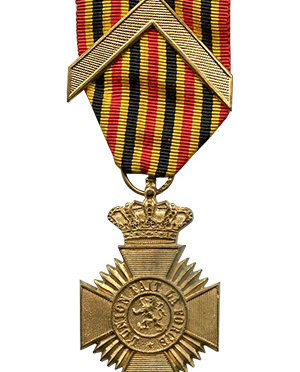
The award is a gilt cross pattée surmounted by the royal crown of Belgium with four rays between the cross arms.

The obverse bears a circular central medallion with a Belgian lion and a circular relief inscription: “Unity makes Strength” in French (“l’union fait la force”) or Dutch (since July, 8, 1952, “eendracht maakt macht”). The reverse is identical except for the central medallion, which bears the royal monogram of the reigning monarch surrounded by the relief inscription “ARMÉE * MÉRITE * ANCIENNETÉ” (“ARMY * MERIT * SENIORITY“).

Since July, 8, 1952, only a Belgian lion is depicted, without surrounding text or reference to the reigning monarch.

The ribbon is silk moiré of seventeen alternating longitudinal stripes of red, yellow and black. The medal is suspended by a ring through the suspension loop. A gilt inverted metal chevron is affixed to the ribbon of the award first class.

The Civic Decoration (Belgium)

The Civic Decoration (Décoration Civique / Burgerlijke Ereteken) is a civilian decoration of the Kingdom of Belgium first established on 21 July 1867 by royal decree to reward exceptional acts of bravery, devotion or humanity.

A second royal decree of 15 January 1885 extended the award to state civil servants for long service, and it was once more amended by royal decree in 1902 to include long service in the Civic Guard and firefighters.

Two wartime variants were created to reward civilians who distinguished themselves during the World Wars.

The Civic Decoration is awarded in two categories:

  • The Civic Cross (First and a Second Class),
  • The Civic Medal (First, Second and Third Class).

The Civic Decoration Design

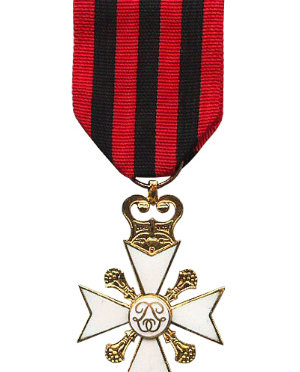
The badge of the Civic Cross is a white enameled maltese cross with the central medallion bearing the monogram of King Leopold I or of King Albert I on the obverse and reverse. Between the arms of the Cross are:

  • Crossed swords for the Civic Cross 1914–1918.
  • Crossed flaming torches for the Civic Cross 1940–1945.
  • A Burgundy Cross for the Civic Cross for administrative services and for services as a firefighter.

The ribbons differ with the type of award:

  • For long and distinguished service in the administration: Red with three vertical black stripes.
  • For exceptional acts of bravery, devotion or humanity: Red with two vertical black stripes bordered on each side by a yellow line.
  • For long and distinguished service as a firefighter: Green with two vertical white stripes.
  • For the 1914–1918 award: Pale green with vertical black, yellow and red stripes on each edge and a central vertical gold stripe.
  • For the 1940–1945 award: Saffron with vertical black, yellow and red stripes on each edge and a central vertical black stripe.

The Deportees’ Cross 1914-1918

The Deportees’ Cross 1914–1918 (Croix des Déportés 1914–1918 / Weggevoerdenkruis 1914–1918) is a Belgian war medal established by royal decree on 27 November 1922 and awarded to Belgian citizens deported to Germany for forced labor during the First World War.

Deportees who died during their deportation were not awarded this cross, instead, they received the Order of Leopold II with the ribbon bearing a central longitudinal gold stripe.

The Deportees’ Cross 1914-1918 Design

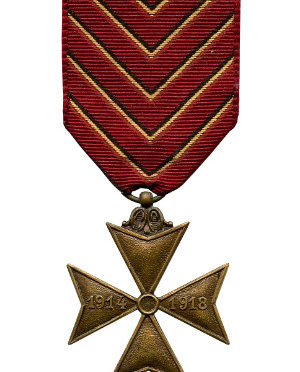
The medal measures 38mm wide and is struck in bronze. It’s a cross pattée with identical plain obverse and reverse. The horizontal arms bear the relief inscription “1914” on the right arm and “1918” on the left arm.

The ribbon is 37mm wide dark red silk moiré adorned with 3mm chevrons in the national colors of Belgium. The cross is suspended by a ring through a suspension loop.

The Maritime Decoration 1914-1918

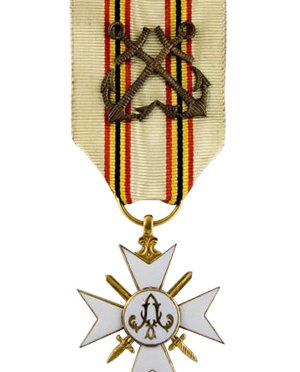
The Maritime Decoration 1914-1918 was established on 19 November 1918. This medal was awarded in five classes to recognize distinguished services at sea, including merchant seamen and fishermen:

  • Cross First Class,
  • Cross Second Class,
  • Gold Medal,
  • Silver Medal,
  • Bronze Medal.

The Maritime Decoration 1914-1918 Design

The medal’s ribbon is pale green with two red-edged yellow stripes each with a black central stripe, bearing crossed anchors in a metal appropriate to the class.

The Fire Cross 1914-1918

The Fire Cross 1914-1918 (Croix du Feu 1914–1918 / Vuurkruis 1914–1918) was a Belgian military decoration established by royal decree on 6 February 1934 and awarded to all holders of the so-called “Fire Card” which was given to all who came under fire at the front during the First World War.

The Fire Cross could not be awarded posthumously.

The Fire Cross 1914-1918 Design

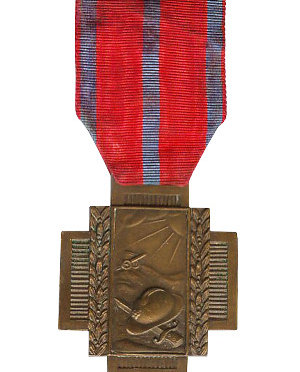
The medal is a 44 mm wide by 54 mm high bronze cross quadrate. Except for a 3 mm wide plain border, the cross arms were striated, horizontally for the lateral arms and vertically for the vertical arms on both the obverse and reverse.

The central rectangle bore on its obverse, 5mm wide vertical laurel branches on either side, at the center, the relief image of a deserted battlefield with at the forefront, the relief image of a World War 1 Belgian helmet over a bayonet, farther and on a slight elevation at left, a 75 mm howitzer, at upper right, the Sun breaking through clouds.

On its reverse, a large laurel branch extending diagonally from bottom left to top right and bisected by the relief inscription on two lines in Latin “SALUS PATRIAE SUPREMA LEX“, translated to “THE NATION’S SALVATION IS OUR HIGHEST DUTY“. In the top left corner, a royal crown from which seven relief rays extend downwards, at bottom right, the relief years on two rows “1914” and “1918”, at the bottom left just below the laurel branch’s stem, the name of the designer of the award, “A. Rombaut”.

The ribbon measures 36mm wide and is red silk moiré, with three 4 mm wide longitudinal blue stripes, one at the centre, the other two on either side 1 mm from the ribbon’s edges.

The Yser Cross

The Yser Cross (Croix de l’Yser / Kruis van de IJzer) replaced the Yser Medal in 1934. The Yser Medal and the Yser Cross could not be worn together, it was one or the other.

The Yser Cross was issued as a replacement to the earlier Yser Medal upon application and payment of a fee, consequently, relatively few were issued as few veterans wanted to trade in their medal, and even fewer wanted to pay the fee.

The Yser Cross Design

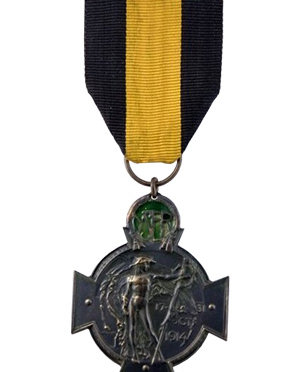
The cross was of similar design to the Yser Medal, displaying the same obverse and reverse except that it was in the form of a cross pattée.

Although issued with the same black and red ribbon as the Yser medal, many Flemish recipients opted for an unofficial black and yellow ribbon identifying them as Dutch-speaking Belgians.

The War Cross (Belgium)

[vc_row][vc_column width=”1/4″][vc_single_image image=”6490″ img_size=”full”][/vc_column][vc_column width=”3/4″][vc_column_text]

The War Cross (Belgium)

[/vc_column_text][vc_column_text]

Institution: 25 October 1915
Country: Belgium

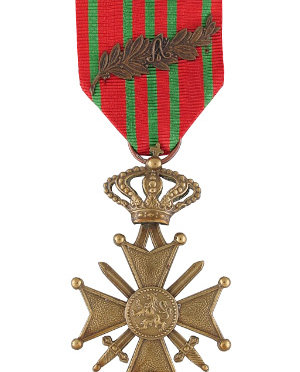
[/vc_column_text][vc_separator css=”.vc_custom_1526473075957{padding-top: 16px !important;padding-bottom: 16px !important;}”][vc_column_text]The War Cross (Croix de guerre / Oorlogskruis) is a military decoration of the Kingdom of Belgium established on 25 October 1915 by royal decree and primarily awarded for bravery or other military virtue on the battlefield, or for three years or more of service on the front line, or good conduct on the battlefield. It was only awarded to individuals.

The award was reestablished on 20 July 1940 by the Belgian government in exile for recognition of bravery and military virtue during World War II. The decoration was again reestablished by royal decree on 3 April 1954 for award during future conflicts.

The War Cross was also awarded to volunteers after a minimum of 18 months of service, to escaped prisoners of war rejoining the armed forces, and to military personnel who were placed on inactive duty because of injury.[/vc_column_text][vc_column_text css=”.vc_custom_1590656067244{padding-top: 24px !important;}”]

The War Cross (1915) Design

WW1

The War Cross from WW1 is a 40mm wide and 65mm high bronze Maltese cross with 3mm balls at its eight points.

On its obverse, it has a 14mm central medallion bearing the relief image of a lion rampant. On its reverse is the royal cypher of King Albert I. Two 37mm long crossed swords point upwards between its arms. A 14mm high “inverted V” between the two points of the top cross arm is secured to the inside of a high royal crown, and the ribbon’s suspension ring passes through the top orb of the crown.

The ribbon of the WW1 War Cross is red and measures 38 mm (1.5 in) wide, with five 2 mm (0.079 in) wide light green longitudinal stripes, three at the center separated by 3 mm (0.12 in) and one on each side 3 mm from the edges.

When the person being awarded was mentioned in despatches, the distinction was denoted by a device worn on the ribbon, either a small lion or a palm adorned with the monogram “A”.

WW2

The WW2 War Cross shows slight changes to the reverse of the central medallion (the royal cypher was that of King Leopold III) and the ribbon. Because the award was now also authorized as a unit award, those presented to a unit were denoted by a ribbon of the war cross being affixed to the unit colors.

The new ribbon was still red with light green stripes but there were now six, 1mm wide, and positioned three on each side 2mm apart beginning 2mm from the edge of the ribbon.[/vc_column_text][vc_raw_html css=”.vc_custom_1590656126997{padding-top: 40px !important;}”]JTNDaW5zJTIwY2xhc3MlM0QlMjJlcG4tcGxhY2VtZW50JTIyJTIwZGF0YS1jb25maWctaWQlM0QlMjI1ZWNmN2M3OGM2NWQ2MDQ3MmIxYTYzY2MlMjIlM0UlM0MlMkZpbnMlM0U=[/vc_raw_html][/vc_column][/vc_row][vc_row][vc_column][vc_column_text css=”.vc_custom_1590504426327{padding-bottom: 24px !important;}”]

Explore More Belgian Medals – See All >

[/vc_column_text][vc_basic_grid post_type=”post” max_items=”18″ style=”pagination” items_per_page=”6″ element_width=”2″ gap=”20″ arrows_design=”vc_arrow-icon-arrow_06_left” arrows_position=”outside” paging_design=”none” item=”masonryGrid_Default” grid_id=”vc_gid:1590655230493-00ce8aa7-b6aa-3″ taxonomies=”127″ el_class=”relatedMedals”][/vc_column][/vc_row][vc_row][vc_column][vc_column_text css=”.vc_custom_1590656143680{padding-bottom: 24px !important;}”]

Explore More Medals from WW1 – See All >

[/vc_column_text][vc_basic_grid post_type=”post” max_items=”18″ style=”pagination” items_per_page=”6″ element_width=”2″ gap=”20″ orderby=”rand” arrows_design=”vc_arrow-icon-arrow_06_left” arrows_position=”outside” paging_design=”none” item=”masonryGrid_Default” grid_id=”vc_gid:1590655230496-c0ab4813-3062-9″ taxonomies=”4″ el_class=”relatedMedals”][/vc_column][/vc_row][vc_row][vc_column][vc_column_text css=”.vc_custom_1590656240664{padding-bottom: 24px !important;}”]

Explore More Medals from WW2 – See All >

[/vc_column_text][vc_basic_grid post_type=”post” max_items=”18″ style=”pagination” items_per_page=”6″ element_width=”2″ gap=”20″ orderby=”rand” arrows_design=”vc_arrow-icon-arrow_06_left” arrows_position=”outside” paging_design=”none” item=”masonryGrid_Default” grid_id=”vc_gid:1590656226877-e32a1611-d274-6″ taxonomies=”8″ el_class=”relatedMedals”][/vc_column][/vc_row]

The 1830 Volunteers’ Commemorative Cross

The 1830 Volunteers’ Commemorative Cross (Croix Commémorative des Volontaires de 1830 / Herinneringskruis voor de Vrijwilligers van 1830) is a Belgian campaign medal established in 1878 by royal decree  and awarded to all members of the Belgian Army and popular militias who served during the 1830-1831 Belgian Revolution (and who had not been awarded the Iron Cross).

In 1833 and following the end of the Belgian Revolution, the Iron Cross was created to recognize wounds received and bravery in battle. Other combatants of 1830-1831 received no pension, and no commemorative medal was struck, which caused growing discontent in veterans’ circles, who eventually formed the “Federation of Volunteer Combatants of 1830“. It would take over forty years until, in 1878, King Leopold II signed the decree creating the 1830 Volunteers’ Commemorative Cross.

The 1830 Volunteers’ Commemorative Cross Design

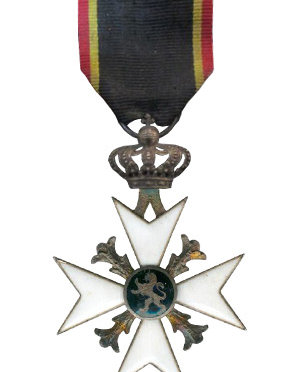
The award is a white enameled Maltese Cross with a gilt Burgundy Cross between its arms and a black enameled central medallion. The two arms converge upwards to a pivot-mounted royal crown. The black enameled central medallion bears, on the obverse, the Belgian lion, a heraldic lion rampant. The reverse bears the year “1830“.

The cross is suspended by a ring through a lateral hole in the royal crown’s orb from a silk moiré ribbon in the national colors of Belgium (a black 2mm width central stripe, and red edge stripes bordered by 2mm yellow stripes on the inside).

The Royal Order of the Lion

The Royal Order of the Lion was established in 1891 by King Leopold II of Belgium and awarded for services to the Congo and its ruler.

The Royal Order of the Lion (Ordre Royal du Lion / Koninklijke orde van de Leeuw) was established on 9 April 1891 by King Leopold II of Belgium in his capacity as ruler of the Congo Free State. It was awarded for services to the Congo and its ruler that did not deserve the award of the Order of the African Star and were not necessarily performed from within Belgian Congo.

The Order was incorporated into the Belgian honors system following the annexation of the Congo Free State by Belgium. The motto of the Order is “Labour and progress”.Following the independence of Congo-Léopoldville in 1960, the Royal Order of the Lion is no longer awarded.

The Royal Order of the Lion Design

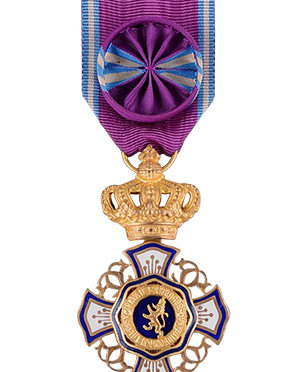
The badge is a white enamel Rupert cross with a perimeter channel of blue enamel and the angles filled with filigree. The central disc depicts the crowned Belgian lion on a blue enamel background surrounded by a silver ring with the motto of the Congo Travail et Progrès and a scalloped channel of blue enamel. The reverse is similar to the obverse but with a red central disca and the crowned royal monogram “L/S/L”. The suspension is a pivoting royal crown and ring.

The medal is round, with a suspension in the form of a royal crown with two pendilia and a ribbon ring. The obverse bears a finely ribbed central area with bead surround and a royal lion, plus the motto of the Belgian Congo: Travail et Progrès (work and progress). The reverse is a stylized ‘double L’ crowned Leopold II monogram within a palm wreath.

The ribbon is amaranth purple, with narrow pale yellow edge stripes bordered with pale blue. It may be adorned with a silver or gold palm when awarded in wartime.

The Order of Leopold II

The Order of Leopold II is an order of Belgium established in 1900 and named in honor of King Leopold II and awarded for meritorious service.

The Order of Leopold II is an order of Belgium established on 24 August 1900 and named in honor of King Leopold II. It’s awarded for meritorious service to the sovereign of Belgium, and as a token of his personal goodwill to both Belgians and foreigners, as well as a diplomatic gift of merit.

The order (awarded by royal decree) has become a long service order for people in the civil service and is awarded alternatively with the Order of the Crown, as the Order of Leopold is awarded under rarer circumstances.

The Order of Leopold II is issued in five classes and three medals (gold, silver and bronze):

  • Grand Cross.
  • Grand Officer.
  • Commander.
  • Officer.
  • Knight.

The Order of Leopold II Design

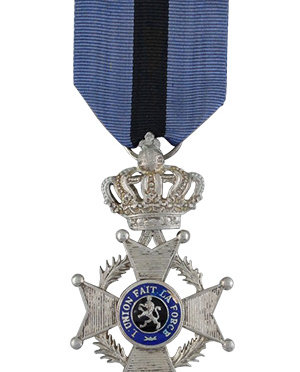
The badge is a silver or gold metal Maltese Cross with a wreath of laurel leaves between the arms of the cross. The obverse bears a lion on a black enamel background surrounded by a blue enamel ring with the motto “Unity Is Strength” in French and Dutch. The badge is topped by a crown.

The medal shows the shape of the Order badge imprinted in a metal shape that is vaguely octagonal and looks like a closed florian cross.

The ribbon is blue with a central black stripe, but there have been variations for special circumstances such as crossed swords added when awarded in wartime and a vertical gold border on both sides for a special act of valor.