The Order of British India

The Order of British India is an order of merit established in 1837 by the East India Company and incorporated into the British Honors System in 1859. It’s awarded for “long, faithful and honorable service“.

The Order was awarded by the Viceroy of India to selected serving officers of between 20 and 30 years of service. It was initially intended as a means of providing recognition for serving Indian officers in the East India Company’s military forces, as the so-called “Native Officers” faced slow promotion under a system that was based on advancement through seniority.

The 1st Class of the Order, limited to a further 100 people, conferred the title of sirdar bahadoor (heroic leader) and an increase in salary of two rupees a day. Appointments to the 2nd Class, entitled the recipient to the title of bahadoor (hero) and a more modest wage increase. Holders of both classes could use the post-nominal letters OBI.

In September 1939 eligibility was extended to include native officers serving in the Indian States Forces, Frontier Corps and Military Police, and further extended in January 1944 to include native officers and Indian Warrant Officers in the Royal Indian Navy and the Hong Kong and Singapore Royal Artillery, as well as foreign officers.

The order became obsolete in 1947, after the partition of British India into the Dominion of India and the Dominion of Pakistan.

The Order of British India Design

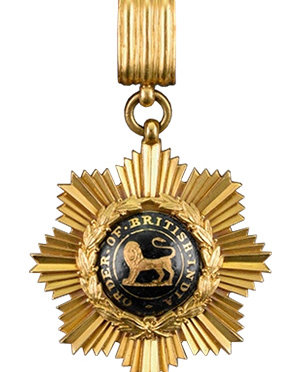
The badge for the First Class consisted of a gold star 1.7 inches (43 mm) in diameter composed of rays of gold. In its center are the words ORDER OF BRITISH INDIA encircling a lion on a background of light blue enamel, surrounded by a laurel wreath and surmounted by a Crown. The enamel behind the wording was dark blue until 1939, when it was changed to the same light blue as appears behind the lion.

The badge for the Second class comprised a slightly smaller gold star 1.5 inches (38 mm) in diameter of similar design to the first class, but without the crown and with the center enamel in dark blue enamel. 

The ribbon was originally sky-blue but changed to dark red in 1838 after it was found that the hair oil favored by Indian soldiers stained the ribbon. From September 1939 the first class ribbon had two thin light blue strips added towards the center of the dark red ribbon, while the second class had one light blue stripe added to the center of the ribbon.

The Order of the Star of India

The Most Exalted Order of the Star of India is an order of chivalry founded by Queen Victoria to honor Indian Princes who served in India. 

The Most Exalted Order of the Star of India is an order of chivalry founded by Queen Victoria in 1861 to honor Indian Princes and Chiefs, as well as British officers and administrators who served in India. Former viceroys and other high officials, as well as those who served in the Department of the Secretary of State for India at least thirty years were eligible for appointment. Rulers of Indian Princely States were also eligible.

The order is the fifth most senior British order of chivalry, following the Order of the GarterOrder of the ThistleOrder of St Patrick, and the Order of the Bath. With the death in 2009 of the last surviving knight, the Maharaja of Alwar, the order became dormant (but still exists). The British Sovereign was, and still is, Sovereign of the Order.

The Order included members of three classes:

  • Knight Grand Commander (GCSI)
  • Knight Commander (KCSI)
  • Companion (CSI)

The Order of the Star of India Design

The mantle was made of light blue satin lined with white silk and was worn only by Knights Grand Commanders. The collar was made of gold and was composed of alternating figures of lotuses, red and white roses, and palm branches, with an imperial crown in the center. It was worn only by Knights Grand Commanders over their military uniform, formal day dress, or evening wear.

The star featured a sunburst, with twenty-six large rays alternating with twenty-six small rays and worn only by Knights Grand Commanders and Knights Commanders. It was in gold and circular for Knights Grand Commanders, and in silver and eight-pointed for Knights Commanders. In the center of the sunburst was a light blue ring bearing the motto of the Order. Within the ribbon was a five-pointed star, decorated with diamonds for Knights Grand Commanders.

The badge was worn on a white-edged light blue riband, or sash, passing from the right shoulder to the left hip by Knights Grand Commanders, and by Knights Commanders and Companions from a white-edged light blue ribbon around the neck. It included an oval, containing the effigy of the Sovereign, surrounded by a light blue ring bearing the motto of the Order. The oval was suspended from a five-pointed star, which may be decorated with diamonds depending on the class.

The Centenary of National Independence Commemorative Medal

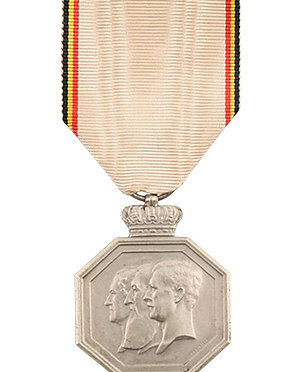
The Centenary of National Independence Commemorative Medal 1830-1930 (Médaille Commémorative du Centenaire de l’Indépendance Nationale 1830-1930 / Herinneringsmedaille van 100 Jaars de Onafhankelijkheid 1830-1930) is a Belgian commemorative medal established on 20 July 1930 by royal decree to commemorate the 100th anniversary of Belgian independence.

It was awarded to serving members of the Belgian Armed Forces and to veterans of the service as well as to civil servants who served honorably for twenty years or more prior to 1 January 1931.

The Centenary of National Independence Commemorative Medal Design

The medal is octagonal, measures 32mm wide by 30mm high and is struck in silvered bronze. It’s surmounted by a crown giving it a total height of 41mm.

The obverse bears the left-facing profiles of kings Leopold I, Leopold II and Albert I of Belgium. The reverse bears the relief years “1830” and “1930” on two rows slightly offset from center superimposed over oak and laurel leaves.

The ribbon is white 38mm wide silk moiré with the national colors of Belgium as 3mm wide edge stripes (1mm black, 1mm yellow and 1mm red). The medal is suspended by a ring through a suspension loop.

The Four Days of the Yser Commemorative Medal

The Four Days of the Yser Commemorative Medal (Médaille commémorative des “Quatre jours de l’Yser” / Herinneringsmedaille van de “Vierdaagse van de IJzer”) was established in 1967.

The Four Days of the Yser is a four-day international march organized since 1967 by the Order of the Horse Fishermen of Oostduinkerke, in order to honor the tradition of shrimping on horseback on the one hand and to emphasize the scenic attractions of the Westhoek, the western part of the Belgian coast.

Since 1972 it is organized by the Belgian Armed Forces to strengthen the bond between the Belgian Armed Forces and society, to commemorate the casualties of both World Wars, particularly those who fell on the battlefields of the Westhoek during the First World War, and to introduce the hikers to the historical and touristic values of the Westhoek.

The march was initially four times thirty-two kilometers long, but now currently has 8,16,24 and 32 km routes including detours for disabled access and pushchairs.

The Four Days of the Yser Commemorative Medal Design

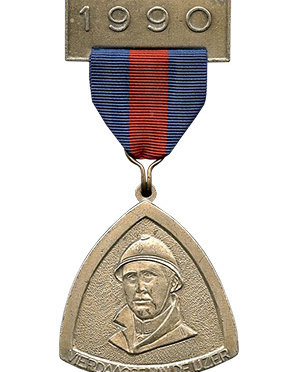
The medal is round or triangular (the shape of the medal can change every five years), and struck in silver or bronze.

The obverse bears the imprint of a World War I Belgian soldier.

The ribbon is dark blue with a large vertical scarlet stripe. Small metal bars are added to the ribbon when the bearer has completed the march more than one time.

The Medal of Belgian Gratitude 1940-1945

The Medal of Belgian Gratitude 1940-1945 (Médaille de la Reconnaissance Belge 1940–1945 / Erkentelijkheidsmedaille 1940–1945) is a Belgian medal instituted on 1 August 1945 by the Prince-Regent Karel, in three classes: gold, silver and bronze.

The medal was awarded to civilians, Belgian or foreign alike, who during the war had shown their patriotism in the humanitarian field by acts of courage. A good example of an award to non-Belgians is the gold medal to the Dutch village of Vught, given in recognition of the inhabitant’s attitude towards the Belgian prisoners held in the German concentration camp there.

The Medal of Belgian Gratitude 1940-1945 Design

The medal measures 34 mm in diameter and is octagonal and struck in silver.

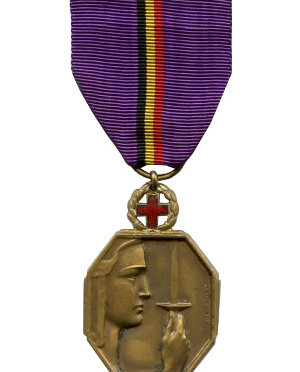
The obverse depicts a veiled woman (representing Belgium) facing to the right, with a rapier in her right hand, raised in salute. The reverse bears the inscription “PATRIA GRATA 1940 1945” with a decorative pattern on either side of the inscription. Above the medal is a laurel wreath.

The ribbon has central stripes of black, yellow, and pink flanked by purple.

Red Cross members who qualified were awarded a medal with a red enamel cross in the open laurel wreath of the medal’s suspension.

The Commemorative Medal of the Ethiopian Campaign

The Commemorative Medal of the Ethiopian Campaign (Médaille Commémorative de la Campagne d’Ethiopie / Herinneringsmedaille van de Ethiopische Veldtocht) was established by royal decree in January 1947 and awarded for participation in the campaign in Abyssinia for at least one year between 6 March and 3 July 1941.

On 11 March 1941, Belgian forces, together with elements of the British King’s African Rifles attacked Asosa, defeating the occupying Italians before moving on to Gambela and Saio. The Belgian forces besides defending the Belgian Colonies of Congo or Ruanda/Urundi served also in Madagascar, Ethiopia, Nigeria, Libya, Egypt, Sudan and Palestine.

This medal is very rare, as the Belgian forces that participated in the campaign were less than 3000 men. There were possibly fewer than 500 medals actually awarded.

The Commemorative Medal of the Ethiopian Campaign Design

The medal was designed by the sculptor Arthur Dupagne. Struck patinated bronze, of trapezoidal form, it measures 45mm high by 31mm wide and has two curved sides.

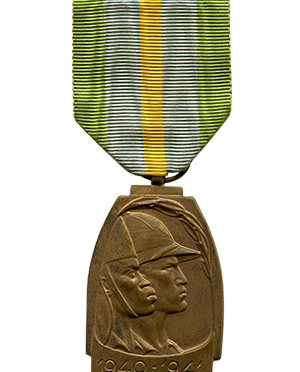
The obverse depicts the overlapping right-facing profiles of the head of a European and an African soldier with the date “1940-1941” at the base. The reverse bears the names of the three major actions of the campaign: SAIO, GAMBELA, and ASOSA, with a star above and below.

The ribbon is light blue with green edges and a yellow central stripe.

The claspNigeria” was awarded to the expeditionary force of 13.000 men of the Force Public (Gendarmery and Military force of Belgian Congo consisted of native Congolese troops under the command of Belgian officers and NCOs) who served under British command from 1942 to 1943 in Nigeria – 9.000 of these troops served in Egypt and Palestine and received also the “Middle East” clasp.

The 1940-1945 Colonial War Effort Medal

The 1940–1945 Colonial War Effort Medal (Médaille de l’Effort de Guerre Colonial 1940-1945 / Medaille voor de Koloniale Oorlogsinspanning 1940-1945) is a Belgian war service medal established on 30 January 1947 by royal decree of the Regent and awarded to government civil servants, magistrates, volunteer members of the female auxiliary service, missionaries, civilian agents of the different departments and civilians who served honorably for at least one year in the Belgian Congo or Ruanda-Urundi colonies of the Kingdom of Belgium in Africa between 10 May 1940 and 7 May 1945.

Those eligible for the award of both the 1940–1945 Colonial War Effort Medal and the 1940–1945 African War Medal could only receive one of the two, usually the one earned for the longest service.

The 1940-1945 Colonial War Effort Medal Design

The medal measures 31mm wide by 52mm high, and is struck bronze. It’s rectangular with sloping upper corners.

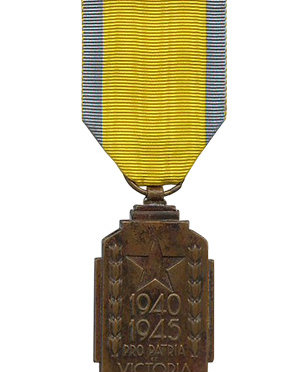
The obverse bears, at its upper center, an embossed five-pointed star above the relief inscription on five rows “1940” “1945” “PRO PATRIA” “ET” “VICTORIA” between vertical laurel leaves. The reverse is plain.

The ribbon is 37mm wide yellow silk moiré with 5mm wide light blue edge stripes. The medal is suspended by a ring through a lateral suspension hole.

The 1940-1945 African War Medal

The 1940–1945 African War Medal (Médaille de la Guerre Africaine 1940-1945 / Afrikaanse Oorlogsmedaille 1940-1945) is a Belgian war service medal established on 30 January 1947 by royal decree of the Regent and awarded to officers and soldiers for at least one year’s service in the Force Publique between 10 May 1940 and 7 May 1945.

Those eligible for the award of both the 1940–1945 Colonial War Effort Medal and the 1940–1945 African War Medal could only receive one of the two, usually the one earned for the longest service.

The service was not limited to the Belgian colonies of the Congo and Ruanda-Urundi. The following four clasps were issued for wear on the ribbon inscribed in French:

  • NIGERIE (for six months service in Nigeria)
  • MOYEN-ORIENT (for six months service in the Middle East)
  • MADAGASCAR (for six months service in Madagascar)
  • BIRMANIE (for six months service in Burma)

The 1940-1945 African War Medal Design

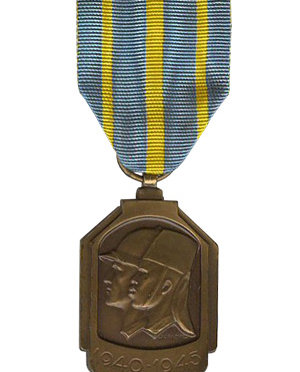
The medal measures 52mm high (including the suspension) by 33mm wide and is rectangular and struck from bronze. It has sloped upper shoulders and rounded lower corners.

The obverse bears the relief images of the left profiles of a native African soldier wearing a fez and of a pith-helmeted Belgian soldier, both within a recessed central area. Under the recess, the embossed years “1940 – 1945”. The reverse is plain.

The 1914-1918 Commemorative War Medal

The Commemorative Medal of the 1914–1918 War (Médaille Commémorative de la Guerre 1914-1918 / Oorlogsherinnerinsmedaille 1914-1918) is a Belgian commemorative war medal established on 21 July 1919 by royal decree and awarded to all members of the Belgian Armed Forces who served during the First World War who were eligible for the Inter-Allied Victory Medal.

The 1914-1918 Commemorative War Medal Design

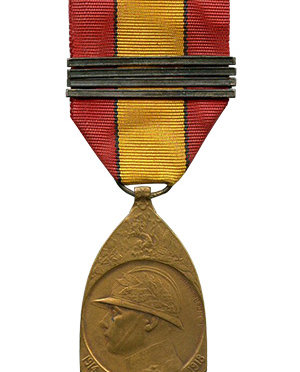
The medal was struck from bronze, and measures 47 mm high by 31 mm wide. It’s triangular shaped and has rounded sides.

Its obverse bears a relief of a helmeted soldier in profile, within a 29 mm in diameter circular recess, and with the helmet adorned with laurels. There are also relief dates “1914” and “1918”. In the upper point of the triangle, above the circular recess, there’s an image of a lion rampant with an oak branch to its left and a laurel branch to its right.

The reverse bears the relief image of a crown surrounded by the same branches as the lion on the obverse, and below the crown, a semi-circular inscription in French on two rows over the large relief dates “1914 – 1918”, “MEDAILLE COMMEMORATIVE / DE LA CAMPAGNE“, the inscription repeated in Dutch below the dates “HERDENKINGSMEDAILLE / VAN DEN VELDTOCHT” (translated to COMMEMORATIVE MEDAL OF THE 1914 – 1918 CAMPAIGN).

The medal is suspended by a ring through the suspension loop to a 39 mm wide red silk moiré ribbon with an 11 mm wide central yellow stripe bordered by 1 mm wide black stripes.

The Iron Cross (Belgium)

The Iron Cross was established in 1833 after the end of the Belgian Revolution and awarded for wounds or bravery in battle.

The Iron Cross (Croix de fer / IJzeren Kruis) was established by law in 1833 after the end of the Belgian Revolution and awarded to those who had received serious wounds and for bravery in battle between 25 August 1830 and 4 February 1831. Recipients were also honored with the right to bear arms and received ever-increasing pensions.

On 22 August 1834, a royal decree created a second class to the Iron Cross for award to all wounded combatants, although it was short-lived and amalgamated to the Iron Cross first class by decree of 21 February 1835.

The award was bestowed to members of the provisional government and to other citizens who were wounded in battle and who elected to stay at their post and keep fighting or who returned to the fight, to the maimed and mutilated, as well as to those who displayed acts of courage in combat and eminent services to the country.

The estimated number of decorated was 1635 in 1835, and 463 decorated living in 1860.

The Iron Cross Design

First Class

The Iron Cross first class is a black Maltese Cross struck from iron with a gold central medallion. The cross is outlined in gold and small gilt orbs were affixed to the eight tips of the cross arms. The obverse bears the gilt relief image of the Belgian lion, a heraldic “lion rampant” and a golden disc. The reverse bears the gilt relief inscription “1830” and is also surrounded by a golden disc.

The cross is suspended by a ring and the ribbon is a 31mm wide red silk moiré with 1.3mm wide yellow edge stripes bordered on the inside by 2.7mm wide black stripes.

Second Class

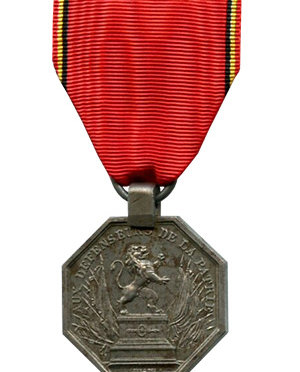
The Iron Cross second class is an octagonal medal struck from iron. The obverse bears the relief image of the Belgian lion, a heraldic “lion rampant” but with banners to the left and right. Along the edge there’s a circular inscription in relief that reads “AUX DEFENSEURS DE LA PATRIE” (TO THE DEFENDERS OF THE COUNTRY“) and the coats of arms of the nine Belgian provinces arranged in a circle around a sun. The reverse bears the year “1830” is superimposed over it, and it’s all surrounded by a relief circular inscription reading “INDEPENDANCE DE LA BELGIQUE” (INDEPENDENCE OF BELGIUM“).

The award is topped by a pivot mounted crown, with the same ribbon as the cross first class.