The SS Membership Runes for Order Police

The SS Membership Runes for Order Police was a badge worn by members of the Ordnungspolizei who were also full members of the SS.

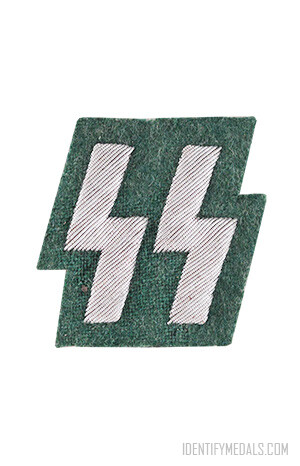
The SS Membership Runes for Order Police was a badge worn by members of the Ordnungspolizei (Orpo) who were also full members of the Schutzstaffel (SS). This badge featured two white Sig Runes, the symbol of the SS, and was centered on the lower left-hand pocket of the jacket.

This badge marked the initial step towards merging the Order Police with the SS, a process supported by Kurt Daluege and Heinrich Himmler. The integration advanced further in 1942, when all Orpo Police Generals were granted equivalent SS ranks and began wearing modified SS-Police rank insignia.

The SS Membership Runes for Order Police Design

The badge was centered on the lower left-hand jacket pocket. It prominently featured two white Sig Runes, which are the iconic symbol of the SS, signifying the wearer’s dual membership in both the Order Police and the SS.

The two white Sig Runes were centrally placed, symbolizing the SS. The runes are in a stylized font typical of Nazi iconography.

The background of the badge is a dark green color, creating a strong contrast with the white runes and ensuring the symbol is easily recognizable from a distance.
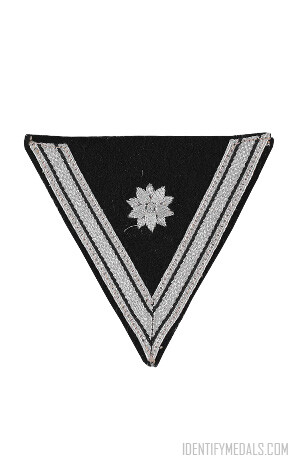
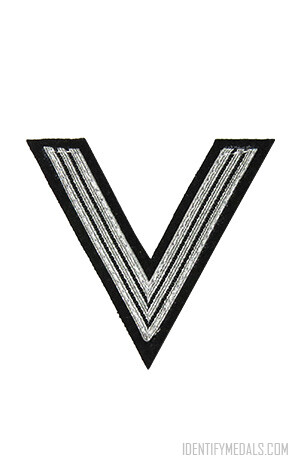
The SS Chevron for Former Police and Military

The SS Chevron for Former Police and Military was a service badge awarded to members of the Nazi Party Schutzstaffel (SS) for service.

The SS Chevron for Former Police and Military (or SS-Ehrenwinkel mit Stern für ehemalige Polizei- und Wehrmachtsangehörige in German) was a service badge awarded to members of the Nazi Party Schutzstaffel (SS) who had previously served in law enforcement, the Reichswehr, or Der Stahlhelm, Bund der Frontsoldaten (“The Steel Helmet, League of Front-Line Soldiers”).

Notable recipients included Arthur Nebe, recognized for his service as a detective with the Berlin Police Department, and Franz Josef Huber, who had served as a police inspector with the Munich Police Department.

The SS Chevron for Former Police and Military Design

This badge signified prior professional service and was visually similar to the Honor Chevron for the Old Guard, distinguished by a darkened center and a silver service pip.

The average price for an authentic SS Chevron for Former Police and Military typically ranges from $300 to $600 USD, depending on its condition and provenance.

The Hitler Youth Badge

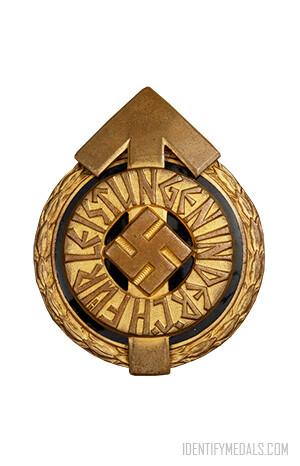
The Hitler Youth Badge was a political award in Nazi Germany, given for various levels of service to the Hitler Youth (Hitler Jugend).

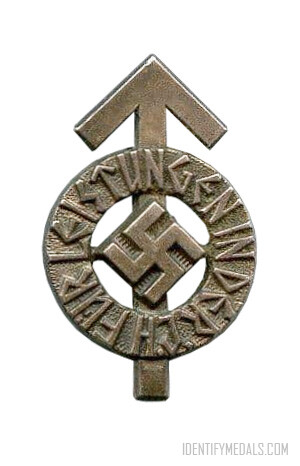
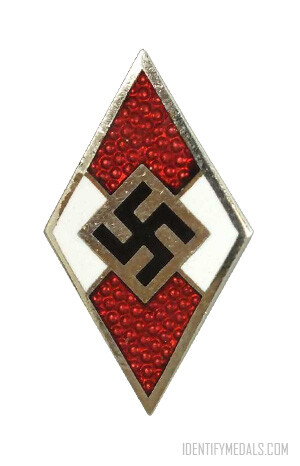
The Hitler Youth Badge (or Das Hitler-Jugend-Abzeichen in German) was a political award in Nazi Germany, given for various levels of service to the Hitler Youth (Hitler Jugend). Initially created in 1929, formal regulations for its presentation were established from 1933. Several other awards for merit and proficiency were also introduced by the Hitler Youth.

Public display of all Nazi Party awards, including the Hitler Youth badge, was banned after 1945.

The Hitler Youth Badge Grades and Designs

Standard Hitler Youth Badge

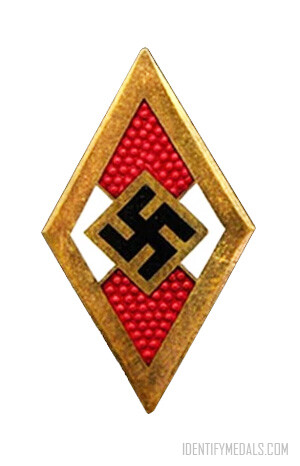
This badge denoted membership, particularly for leaders, and could not be worn once the individual left the Hitler Youth. It featured a golden-framed rhomboid with a black swastika in a red and white field, edged in silver.

Golden Hitler Youth Badge

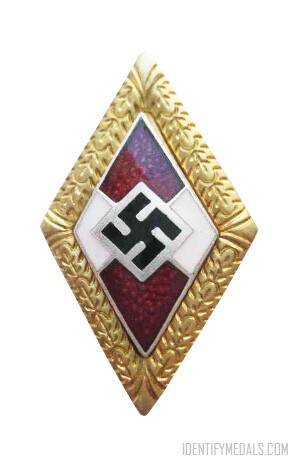
Authorized by Hitler on June 23, 1934, and established by National Youth Leader Baldur von Schirach, this badge recognized leadership, long service, or special achievements. It was awarded to those who joined before October 2, 1932, and completed five years of continuous service. It resembled the standard badge but was edged in gold and could be worn indefinitely, even after leaving the Hitler Youth.

Golden Hitler Youth Badge with Oak Leaves

Instituted in 1935, this badge recognized exceptional services to the Hitler Youth and was awarded to about 250 individuals. It had a higher workmanship and was framed with a narrow border of oak leaves.

The Hitler Youth Badge - Nazi Germany Medals - Interwar & WW2
The Hitler Youth Badge - Badge, obverse.
The Hitler Youth Badge - Gold version, obverse.
The Hitler Youth Badge - With Oak Leaves version, obverse.

Other Hitler Youth Badges

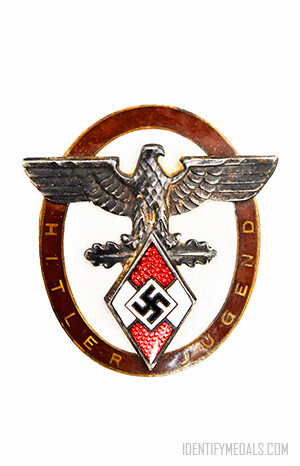
The variety of Hitler Youth badges arose from the organization’s desire to recognize different levels of achievement, service, and merit among its members. These included:

Hitler Youth Information

Right Now on eBay 
Clicking a link to eBay may result in a referral commission being paid if a purchase is made.
Loading…

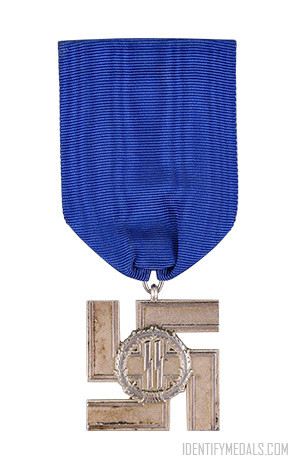
The SS Long Service Award (25 Years of Service)

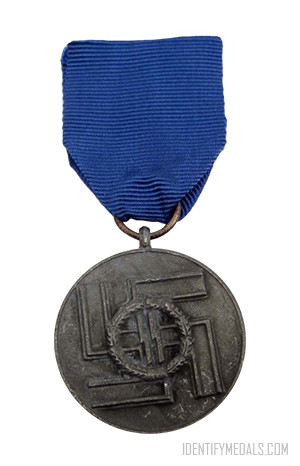
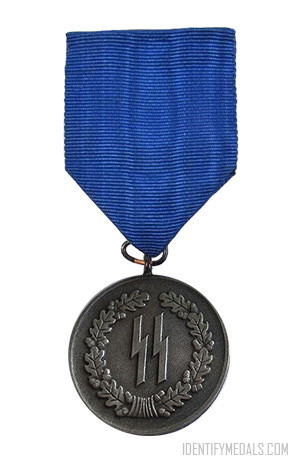
The SS Long Service Awards were given to SS members in grades of four, eight, twelve, and twenty-five years of service.

The SS Long Service Awards (or SS-Dienstauszeichnungen in German) were given in grades of four years, eight years, twelve years, and twenty-five years as an acknowledgment for faithful and true services of SS members in the SS-Verfügungstruppen (SS Dispositional Troops), SS-Totenkopfverbänden (Death’s Head Units) und SS-Junkerschulen (Junker Schools). It was first introduced by Adolf Hitler on 30 January 1938.

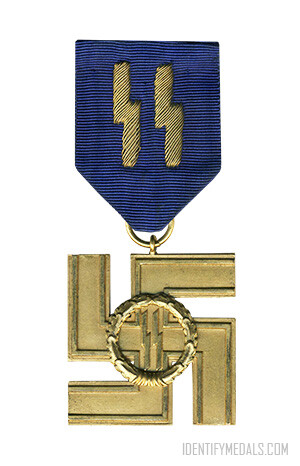
The SS Long Service Award for 25 years of service was the highest class of the SS long service awards, specifically designed to honor members of the SS who had dedicated a quarter-century to the organization.

The SS Long Service Awards Grades or Classes

The grades are awarded to the respective ranks as follows:

  • 1st Class (Gold) for 25 years true service awards to eligible Officers, NCO’s and Men
  • 2nd Class (Silver) for 12 years true service awards to eligible Officers, NCO’s and Men
  • 3th Class (Bronze) for 8 years true service awards to eligible Officers, NCO’s and Men
  • 4th Class (Black) for 4 yrs true service for eligible NCO’s and Men.

The SS Long Service Award for 25 years of service was awarded to officers, non-commissioned officers (NCOs), and enlisted men, recognizing their prolonged commitment and loyalty to the SS and the Nazi Party over a significant part of their careers.

The four-year and eight-year awards were the most common awards, and despite the fact that the Nazi movement lasted for little over 25 years, awards of the 25-year version were made well before 25 years of actual service were completed. This was because Kampfzeit (or “Time of Struggle”) counted double. Nevertheless, this was one of the rarer awards given out by Nazi Germany.

The SS Long Service Awards Design

The SS service awards were designed in Munich by Professor Karl Diebitsch, an artist and the Schutzstaffel (SS) officer responsible for designing much of the SS regalia in the Third Reich, including the chained SS officer’s dagger scabbard.

On its reverse side, each award had emblazoned the inscription, in German: FÜR TREUE DIENSTE IN DER SS (“For Loyal Service in the SS”). 

The awards varied in design depending on the length of service of the recipient, and the branches of the Wehrmacht (LuftwaffeHeer and Kriegsmarine) had different insignia. The Nazi Party and German Police also had a similar service award.

The twenty-five-year service award was designed in the shape of a swastika, featuring a gold finish. It was bestowed upon all officers, non-commissioned officers (NCOs), and enlisted men in recognition of their long-term service.

The Honor Chevron for the Old Guard

The Honor Chevron for the Old Guard was a decoration worn by members of the Nazi Party’s SS. It was nstituted by Adolf Hitler in 1934.

The Honor Chevron for the Old Guard (or Ehrenwinkel der Alten Kämpfer in German) was a distinctive decoration worn by members of the Nazi Party’s SS. Instituted by Adolf Hitler in February 1934, this silver chevron was worn on the upper right sleeve and signified early membership in the Nazi movement.

This chevron was awarded to all members of the SS who had joined the Allgemeine SS, the NSDAP, or any other affiliated party organization before January 30, 1933. This date marked the Nazi Party’s rise to power, and thus early membership was highly prized as a sign of loyalty and commitment to the party’s cause.

Following the Anschluss, the annexation of Austria into Nazi Germany in 1938, the eligibility for the Honor Chevron was extended. Austrians who had joined the Austrian National Socialist Workers’ Party (DNSAP) before February 18, 1938, were also entitled to wear the insignia. Additionally, this decoration was later made available to former members of various Nazi security services, the Ordnungspolizei (order police), and the Wehrmacht, provided they met specific criteria.

The Honor Chevron for the Old Guard Design and Wear

The Honor Chevron for the Old Guard served not only as a mark of early and dedicated support for the Nazi Party but also as a symbol of elite status within the SS and other Nazi organizations. Its display on the uniform was a visible indication of the wearer’s longstanding loyalty to Hitler and the Nazi ideology.

The Nuremberg Party Day Badge

The Nuremberg Party Day Badge was a highly esteemed political decoration within the NSDAP and the second national award of the party.

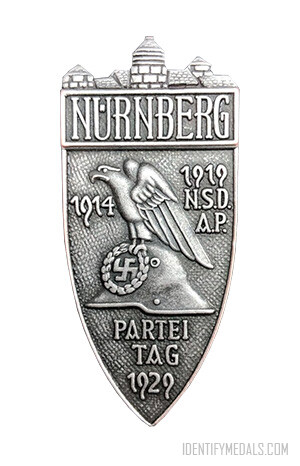
The Nuremberg Party Day Badge (or Das Nürnberger Parteiabzeichen von 1929 in German) was a highly esteemed political decoration within the Nazi Party (NSDAP). Recognized as the second national award of the party, it was established through regulations on November 6, 1936, to commemorate the 4th Reichsparteitag (National Party Day) held in Nuremberg from August 1-4, 1929.

Also referred to as the “1929 Nürnberg Party Badge,” this special honor badge was awarded to Nazi Party members who attended the 1929 national rally in Nuremberg. The badge symbolized the “Old Guard” and was prominently worn by high-ranking Nazi leaders, including Adolf Hitler, during subsequent rallies in Nuremberg. Permission to wear the badge was granted by the Gauleiter (Senior district leader), and the right to wear it could be revoked by Hitler or Martin Bormann, the chief of the Nazi Party Chancellery.

In a 1936 order by Hitler regarding Nazi awards, the Nuremberg Party Badge was ranked second, preceded only by the Coburg Badge and followed by the SA Rally Badge of 1931, the Golden Party Badge, and the Blood Order.

The Nuremberg Party Day Badge Design

The badge was to be worn on the left breast side of a uniform and measured 21mm wide by 48mm high. It featured the Nuremberg Castle at the top with the word “Nürnberg” underneath. An eagle perched atop a helmet was depicted in the center, with inscriptions around it reading “1914-1919” and “N.S.D.A.P. 1929 Partei Tag.”

The Frontbann Badge

The Frontbann Badge was introduced in 1932 by the SA Group Berlin-Brandenburg to honor the members of the Frontbann organization.

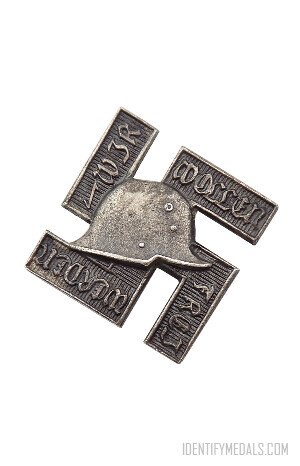
The Frontbann Badge (or Frontbannabzeichen in German) was introduced in 1932 by the SA Group Berlin-Brandenburg to honor the members of the Frontbann organization.

This badge was awarded to individuals who had joined the Frontbann before December 31, 1927, and who also had been members of the Nazi Party or another right-wing paramilitary group prior to that date. 

In 1933, it was officially recognized as a Nazi Party decoration. However, by the end of 1934, the badge was no longer authorized for wear by members of the NSDAP.

The Frontbann Badge Design

The badge was made of silver, featured a pin-back, and measured 20 mm in diameter.

Its design included a swastika with a German helmet at the center, and the inscription “WIR-WOLLEN-FREI-WERDEN” (“We want to be free”) on the arms of the swastika.

The Banner of Labor (DDR)

The Banner of Labor was established in 1954 and awarded for excellent and long-standing service in strengthening and consolidating the GDR.

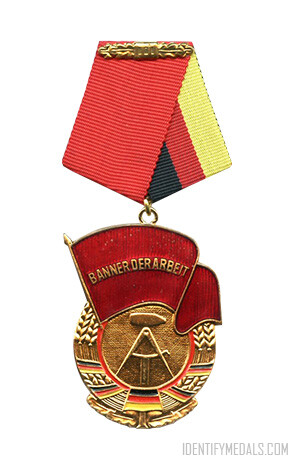
The Banner of Labor (or Banner der Arbeit in German) was an esteemed order in the German Democratic Republic, established on August 4, 1954. It was designed to honor individuals, collectives, enterprises, and organizations for “excellent and long-standing service in strengthening and consolidating the GDR, especially for achieving outstanding results for the national economy.”

The creation and evolution of the Banner of Labor reflected the GDR’s focus on recognizing and incentivizing productivity and loyalty to socialist ideals. By rewarding outstanding service and economic contributions, the GDR aimed to promote a culture of excellence and collective achievement, which was central to its ideological framework. The award ceremonies, held on a significant day for workers worldwide, reinforced the state’s commitment to labor and its role in building a socialist society.

The Banner of Labor Classes

Initially introduced in a single class, it was later divided into three classes on August 8, 1974, each with associated cash awards.

  • 1st Class: The highest distinction, accompanied by a cash award of 1,000 East German marks. This class was limited to 250 awards per year.
  • 2nd Class: Included a cash award of 750 East German marks, with an annual limit of 500 awards.
  • 3rd Class: Came with a cash award of 500 East German marks, limited to 1,000 awards per year.

For collectives with up to 20 members, the cash awards were scaled to 2,000, 3,500, and 5,000 marks per member, respectively, depending on the class.

The Banner of Labor Criteria

The Banner of Labor was awarded to individuals and collectives across all three classes. Enterprises, collective organizations (Kombinate), institutions, and cooperatives were eligible for the 1st Class award. A prerequisite for receiving this order was that individuals or members of collectives had already received other state awards, ensuring that the recipients had a history of recognized contributions.

The order could be awarded multiple times in any class and could also be granted to citizens of other countries, reflecting its broad scope of recognition.

Awards were presented annually on May 1st, coinciding with International Workers’ Day, by the Chairman of the State Council or his representative. Recipients also received a certificate alongside the medal.

The Banner of Labor Design

The Banner of Labor medal is gilded and measures 44 x 37 mm. It was designed to be worn on the left chest.

The medal features a prominent red banner with the inscription “Banner der Arbeit,” surrounded by a wreath of oak leaves, symbolizing strength and endurance. At the center, the emblem of the GDR—a hammer and compass, surrounded by a ring of rye—highlights the award’s connection to labor and socialism.

Establishments awarded the Banner of Labor were entitled to display a symbol of the order on their flag and official documents

The Patriotic Order of Merit (DDR)

The Patriotic Order of Merit was a national GDR award established in 1954 and awarded for special services to the state and to society.

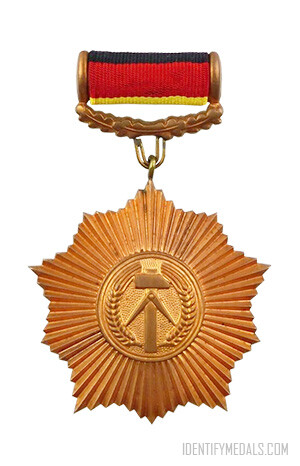
The Patriotic Order of Merit (or Vaterländischer Verdienstorden in German) was a prestigious national award in the German Democratic Republic (GDR), established in 1954. It was granted annually to individuals and institutions for exceptional contributions to the state and society across various fields, including politics, economics, culture, and military service.

The Patriotic Order of Merit was often awarded during significant state anniversaries and events, highlighting the recipient’s alignment with socialist values and contributions to the GDR’s development. For instance, in 1968, Party Chief Walter Ulbricht awarded Karin Janz a silver Patriotic Order of Merit, recognizing her contributions to sports and the international prestige of the GDR.

The order served not only as a personal accolade but also as a tool for promoting the state’s values and rewarding loyalty to the socialist cause. It embodied the GDR’s emphasis on collective achievement and the importance of contributing to the state’s socialist ideology.

The Patriotic Order of Merit Criteria

The official language for the award outlined its purpose as being given “for outstanding merit”:

  • In the struggle of the German and international labor movement and in the fight against fascism.
  • In the establishment, consolidation, and fortification of the German Democratic Republic.
  • In the fight to secure peace and advance the international influence of the German Democratic Republic.

Each level of the order could be awarded only once to an individual or institution. With the exception of recipients of the honor clasp, all awardees also received a monetary sum as part of their recognition.

The Patriotic Order of Merit Classes

The Patriotic Order of Merit was structured into several classes, reflecting the level of contribution and achievement:

  • Honor Clasp in Gold: This was the highest distinction, awarded for exceptional merit and typically conferred upon those with an extraordinary impact on the state and society.
  • Gold, 1st Class: Recognized significant contributions across various sectors.
  • Silver, 2nd Class: Awarded for notable achievements, albeit at a slightly lower level than the gold class.
  • Bronze, 3rd Class: Given for commendable service and contributions that were still worthy of national recognition.

The Patriotic Order of Merit Design

The award featured a distinctive design. It was a ten-pointed star, with a central medallion displaying the state crest of the GDR. The medallion was enameled in red for the gold and silver classes, signifying the highest levels of honor. 

The medals were suspended from a ribbon that was red with gold accents, highlighting the importance of the award.

The Meritorious Military Pilot of the German Democratic Republic

The Meritorious Military Pilot of the German Democratic Republic was the highest title awarded by the RDG to military pilots.

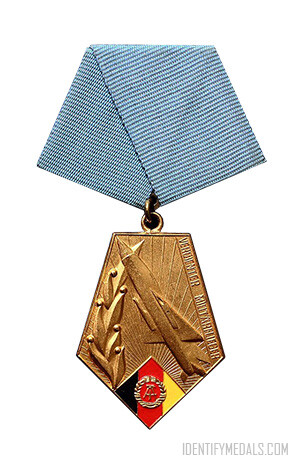
The Meritorious Military Pilot of the GDR (or Verdienter Militärflieger der DDR in German) was the highest honorary title awarded to military pilots of the East German National People’s Army. Instituted on August 1, 1974, by the Council of Ministers of the GDR, this prestigious title was bestowed in the form of a medal and was awarded until the dissolution of the GDR in 1990.

Award Criteria

This honorary title was granted to military pilots who demonstrated:

  • Distinguished performance, with outstanding results in both political and military duties.
  • Exceptional contributions to the development and combat readiness of the National People’s Army (NPA).
  • A Class I performance level.
  • An incident-free aviation record. The number of recipients was limited to 10 military pilots per year.

The Pilot of the GDR (DDR) Medal Design

The golden medal was shaped like a pentagon, measuring 31.5 mm in width and 41.5 mm in height. At the bottom tip, the emblem of the NPA, featuring the enameled flag of the German Democratic Republic (GDR), was displayed. The medal’s main design included a MiG-23 or MiG-21 aircraft ascending steeply against a bright rising sun, with a laurel branch on the left and the inscription “VERDIENTER MILITÄRFLIEGER” on the right. The reverse side of the medal was glossy and plain.

Versions

  • 1974–1976: Made from gold-colored nonferrous metal, varnished, with a size of 40.5 × 30 mm including an arched eye. It was mounted on a small medal bar measuring 14 × 25 mm.
  • 1976–1989: Similar to the previous version but with a round eye, mounted on a pentagon bar with a gibbon bar measuring 14 × 25 mm. This version was also brass-plated, and the reverse side featured additional ornamentation.

Buy this Medal

Right Now on eBay 
Clicking a link to eBay may result in a referral commission being paid if a purchase is made.
Loading...