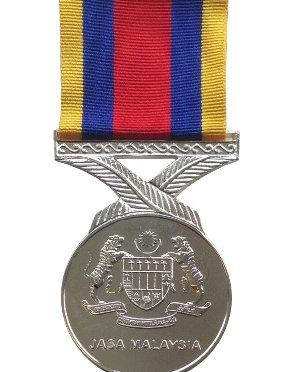
The Pingat Jasa Malaysia Medal

The Pingat Jasa Malaysia Medal (or Malaysian Service Medal) is a medal given by the King and Government of Malaysia and established 3 March 2004. The award is in recognition of “distinguished chivalry, gallantry, sacrifice, or loyalty” in contributing to the freedom of independence of Malaysia.

The medal recognizes service by members of the Malaysian Armed Forces during the Malayan EmergencySecond Malayan Emergency, and the Indonesia–Malaysia confrontation. The medal was also offered for award to members of the Commonwealth forces from Australia, Fiji, India, Nepal, New Zealand, and the United Kingdom who served in Malaysia during the Malayan Emergency and the Indonesia–Malaysia confrontation.

The medal can be conferred and accepted posthumously by next of kin.

The Pingat Jasa Malaysia Medal Design

The medal is circular, made of base metal (brass)-coated nickel silver, and measures 38 mm in diameter.

The obverse bears the Coat of arms of Malaysia with the inscription “JASA MALAYSIA” beneath it. The reverse shows a map of Malaysia and the initials P.J.M underneath.

The ribbon is a 35 mm corded ribbon and has five colored vertical stripes. The colors are those of the Malaysian flag. The individual colors and widths of the five vertical stripes are as follows: 4.5 mm yellow, 7 mm blue, 12 mm red, 7 mm blue, and 4.5 mm yellow. The medal is suspended by two crossed palas palm fronds which are attached to a straight suspension bar covered in a decorative pattern.

No clasps or bars were issued for this medal.
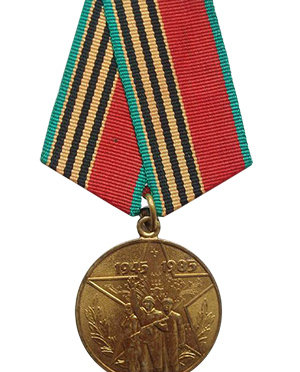
The Soviet 40th Anniversary Medal

The Soviet 40th Anniversary Medal was established on 12th April 1985 and awarded to British and Canadian forces who served mainly in RN or MN ships on Arctic Convoys. The medal was approved in 1994 by Her Majesty the Queen and first awarded by the Soviet Government to selected ex-Servicemen – in particular surviving veterans of the Arctic Convoys of World War II.

Similar medals were issues for the 50th and subsequent five year anniversaries as well. However, those for the 55th anniversary and above have not been authorized for wear.

The Soviet 40th Anniversary Medal Design

The medal is circular, struck in bronze, and measures 32 mm in diameter.

The obverse features a group of servicemen and women in front of a five-pointed star and flanked by oak leaves and the dates 1945-1985 above. The reverse has the inscription “40th Anniversary of the Victory in the Great Patriotic War 1941-1945” in Russian.

The ribbon is one-half red and the other orange with three black stripes, edged with pale blue. Later issues of the medal have no blue edges.

The medal is worn in the Russian style.

The Rhodesia Medal

The Rhodesia Medal was initiated by the British Government in consultation with Australia, New Zealand, Fiji, and Kenya, whose forces took part in Operation AGILA, (Operation MIDFORD for the New Zealand forces). The medal was awarded for service of at least 14 days between 1 December 1979 and 20 March 1980, to members of the military and police forces, as well as eligible civilians, who participated in monitoring the ceasefire and supervising the elections in the lead-up to Zimbabwean independence.

The role of the multi-national force was to keep the peace between 22,000 guerrilla fighters and the Rhodesian forces during the ceasefire and run-up to the 1980 elections. There was no minimum qualifying period for those killed, wounded or disabled due to service, or where a recipient was decorated for gallantry.

Each country treats the medal as part of its own honors system. Recipients of the Rhodesia Medal also received the Zimbabwean Independence Medal in either silver or bronze, although British personnel did not have permission to wear it in uniform, while New Zealand granted approval for restricted wear only.

The Rhodesia Medal Design

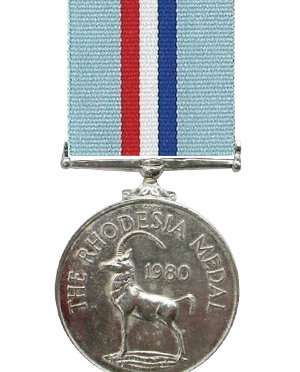
The medal is circular, made of rhodium-plated cupro-nickel, and measures 36 mm in diameter. It was issued by the Royal Mint.

The obverse features the crowned effigy of Queen Elizabeth II with the inscription ELIZABETH II DEL GRATIA REGINA FID.DEF. The reverse depicts a sable antelope surrounded by the inscription THE RHODESIA MEDAL’ and ‘1980‘. The medal was issued named to British armed forces personnel, but unnamed to police officers.

The medal is suspended from a 32 mm sky-blue ribbon with three central stripes of red, white, and blue. No clasps were awarded.

The Vietnam Medal (1968)

The Vietnam Medal is a joint Australian and New Zealand campaign medal awarded for service in the Vietnam War. It was jointly developed by the two countries, although there were separate Royal authorization warrants for each one.

Australia

Qualifying service for the Vietnam Medal includes 28 days in ships or craft on inland waters or off the coast of Vietnam, one or more days on the posted strength of a unit or formation on land, one operational sortie over Vietnam or Vietnamese water by aircrew on the posted strength of a unit, official visits either continuous or aggregate of 30 days, or one day or more by members of accredited philanthropic organizations attached to Australian forces in an official capacity for full-time duty – all between 29 May 1964 and 27 January 1973.

New Zealand

The medal was awarded to all members of the New Zealand armed forces who, between 29 May 1964 and 27 January 1973, either served for 28 days, continuous or aggregated, in ships or craft employed in operations on inland waters or off the coast of Vietnam; served for one day or more on the posted strength of a unit or formation on land in Vietnam; conducted one operational sortie over Vietnam or Vietnamese waters by aircrew on the posted strength of a unit allocated for direct support of operations in Vietnam; served for 30 days or more, continuous or aggregated, on official visits, inspections or other occurrences of a temporary nature on duty in Vietnam, or in ships or craft engaged in operations off the Vietnamese coast. Service terminated by death or wounds, or the award of decoration for gallantry, led to the immediate award of the medal, regardless of whether the qualification period had been fulfilled.

The Vietnam Medal Design

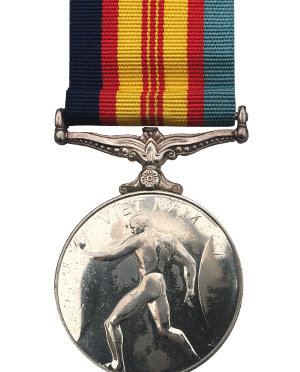
The medal is circular, struck in nickel-silver, and measures 36 mm in diameter.

The obverse bears the crowned effigy of Queen Elizabeth II with the inscription ‘ELIZABETH II DEI GRATIA REGINA F.D.’. The reverse of the medal has the word ‘VIETNAM‘ at the top center above a depiction of a man standing between two symbolic spheres, “in representation of the ideological war in Vietnam“.

The recipient’s name, rank, and serial number are engraved on the edge of the medal.

The ribbon contains a broad central stripe of bright yellow surmounted by three thin red stripes (representing the Republic of Vietnam). The ribbon also has a blue stripe to represent the Navy, two red stripes for the Army, and a light blue stripe for the Air Force.

The United Nations Emergency Force Medal

The United Nations Emergency Force Medal is a service medal of the United Nations instituted in 1957 and awarded for service in the United Nations Emergency Force between 7 November 1956 and 19 May 1967.

In 1956, Egypt came into conflict with the combined forces of Israel, France, and the United Kingdom resulting in the Suez Crisis. Combined political pressure from the United States, the Soviet Union, and the United Nations resulted in the withdrawal of French, British and Israeli forces from Egyptian territory and the cessation of hostilities. To maintain peace, the United Nations established its first Peacekeeping force, the United Nations Emergency Force (UNEF). Brazil, Canada, Colombia, Denmark, India, Norway, Sweden, and Yugoslavia provided troops to serve in the UNEF. The mission lasted from November 1956 until June 1967. 

Ninety days of service with the UNEF was required for award of the medal.

The United Nations Emergency Force Medal Design

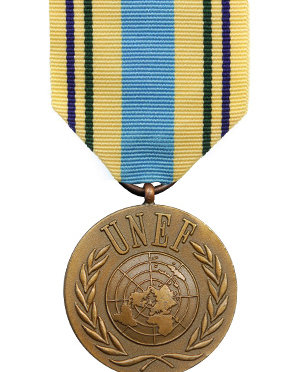
The medal is circular, struck in bronze, and measures 35 mm in diameter. It’s similar in appearance to other United Nations Medals.

The obverse depicts the official emblem of the United Nations, a world map oriented from the north pole. Above the emblem are the letters UNEF. The reverse is plain except for the words “In the Service of Peace” in relief.

The ribbon is sand yellow with an 8 mm central stripe of light blue. On either side of the central stripe, 3 mm from the edge, is a 1 mm stripe of dark blue 2 mm apart from a 1 mm stripe of dark green. The sand yellow color represents the Sinai while the wide central stripe represents the UN. Of the two thin stripes, the blue represents the Suez Canal, and the green represents the Nile River Valley.

The Accumulated Campaign Service Medal

The Accumulated Campaign Service Medal (and its 2011 version) are medals awarded to the Armed Forces to recognize long campaign service.

The Accumulated Campaign Service Medal (and its 2011 version) are medals awarded by Her Majesty Queen Elizabeth II to members of her Armed Forces to recognize long campaign service.

The original medal was instituted in January 1994 and awarded to holders of the General Service Medal who had completed 36 months of accumulated campaign service, with a clasp for each period of further 36 months of campaign service. Criteria for part-time members of the Royal Irish Regiment were similar but with 1000 days replacing 36 months. The replacement Accumulated Campaign Service Medal 2011 is currently awarded to holders of various campaign service medals who have completed 720 days of campaign service.

Service personnel is now (2020) eligible for an Accumulated Campaign Service Medal (ACSM) after two years of operational service instead of the three years previously required.

> Learn more about Qualifying for the Accumulated Campaign Service Medal (gov.uk)

The Accumulated Campaign Service Medal Design

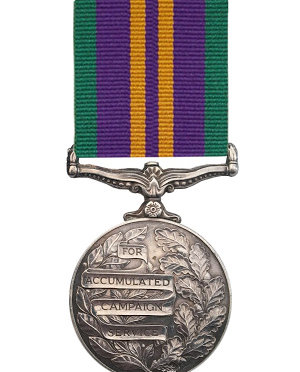
The medal is circular, struck in silver, and measures 36 mm in diameter.

On the obverse, it bears the Crowned Effigy of the Sovereign and on the reverse, the description “FOR ACCUMULATED CAMPAIGN SERVICE” set within a four part ribbon surrounded by a branch of oak leaves with laurel and olive leaves woven through the motto ribbon. 

The ribbon is purple and green, like that of the General Service Medal (1962) with an added central gold stripe denoting excellence. The Accumulated Campaign Service Medal 2011 uses the same medal, but with a ribbon with two central gold stripes. When the ribbon only is worn, a silver rosette is worn on the ribbon for each clasp, with a single gold rosette indicating four clasps.

The Accumulated Campaign Service Medal is hallmarked on the rim to the right of the suspension fixing. The 2011 version of the medal is not hallmarked.

Find This Medal

Right Now on eBay 
Clicking a link to eBay may result in a referral commission being paid if a purchase is made.
Loading...

The United Nations Korea Medal

The United Nations Service Medal for Korea (or UNKM) is a military decoration established by the United Nations on December 12, 1950.

The United Nations Service Medal for Korea (or UNKM) is a military decoration established by the United Nations on December 12, 1950. The decoration was the first international award ever created by the United Nations and recognized the multi-national defense forces which participated in the Korean War.

The medal is awarded to any military service member, of an Armed Force allied with South Korea, who participated in the defense of South Korea from North Korea between the dates of June 27, 1950 and July 27, 1954. International Red Cross personnel engaged for service during the war with any United Nations relief team in Korea were not eligible for the medal.

National variants were produced but the British and Commonwealth type was granted to all personnel who had served at least one full day in Korea or in support units in Japan. Those who served after the armistice of 1953 were also entitled the UN medal.

On November 22, 1961, the United Nations officially changed the name of the United Nations Service Medal to the United Nations Service Medal Korea. Most countries consider the United Nations Service Medal an automatic decoration, if some other Korean service award was bestowed, and generally award the medal without requesting permission through United Nations channels.

The United Nations Korea Medal Design

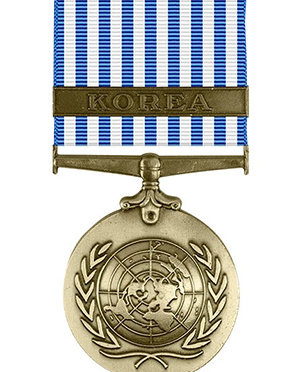
The medal is struck in bronze alloy and measures 35 mm in diameter.

The obverse depicts the ‘World-in-a Wreath‘ emblem of the United Nations. The reverse has the inscription: “FOR SERVICE IN DEFENCE OF THE PRINCIPLES OF THE CHARTER OF THE UNITED NATIONS”. Each participating country has the text in the most appropriate language.

The medal hangs from a claw attachment on a straight bar suspension. Each medal is worn with a medal bar bearing the inscription KOREA in the same language as the reverse inscription. 

The ribbon is made up of 17 equal stripes of United Nations Blue (Bluebird 67117) and white, 9 blue, and 8 white, each 564 inch (2.0 mm) wide.

The South African Medal for Korea

The South African Medal for Korea is a military campaign medal instituted by the Union of South Africa in 1953 and awarded to volunteers of the Union Defence Forces for service in Korea during the 1950-1953 Korean War.

The Union Defence Forces (UDF) were established in 1912 and renamed the South African Defence Force (SADF) in 1958. On 27 April 1994, it was integrated with six other independent forces into the South African National Defence Force (SANDF).

More than 200 officers and some 545 other ranks saw action in Korea between 1950 and 1953, along with some members from other branches of the Union Defence Forces. South Africa’s primary contribution to the United Nations Command during the Korean War was the Flying Cheetahs, 2 Squadron of the South African Air Force. During the Korean War, South African pilots flew altogether 2,890 operational missions, during which 34 pilots and two ground crew were killed in action or listed as missing in action.

The South African Medal for Korea Design

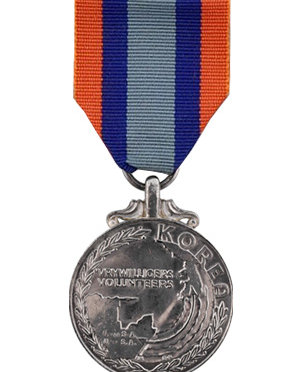
The medal is struck in silver and measures 38 mm in diameter. Around the edge is a laurel wreath, the left branch spreading from the bottom of the medal to the top, while the right branch is shorter to allow space for the inscription “KOREA”.

The obverse has the words “VRYWILLIGERS” and “VOLUNTEERS”, with outlines of the maps of the Korean Peninsula and South Africa, including South-West Africa. The maps are connected by a line with an arrowhead at each end and five wavy lines. Superimposed on the map of South Africa are the inscriptions “U. van S-A.” and “U. of S.A.”

The reverse bears the pre-1994 South African Coat of Arms and Queen Elizabeth II’s royal cipher (E II R) above the Coat of Arms.

The ribbon is 32 millimeters wide, with a 6 millimeters wide orange band and a 5 millimeters wide dark blue band, repeated in reverse order and separated by a 10 millimeters wide light blue band in the center. The medal number is impressed at the bottom of the medal on the rim.

The NASA Exceptional Achievement Medal

The NASA Exceptional Achievement Medal is an award established in 1991 and awarded to both civilian members of NASA and military astronauts.

The NASA Exceptional Achievement Medal is a NASA award established in 1991 and awarded to both civilian members of NASA and military astronauts.

The medal can be awarded to a NASA employee if they make substantial contributions characterized by a substantial and significant improvement in operations, efficiency, service, financial savings, science, or technology which directly contribute to the mission of NASA. For civilians, the decoration is typically bestowed to mid-level and senior NASA administrators who have supervised at least four to five successful NASA missions. Astronauts may be awarded the decoration after two to three space flights.

The medal is authorized as a military decoration for display on active duty military uniforms upon application from the service member to the various branch of the military in which they serve.

The NASA Exceptional Achievement Medal Design

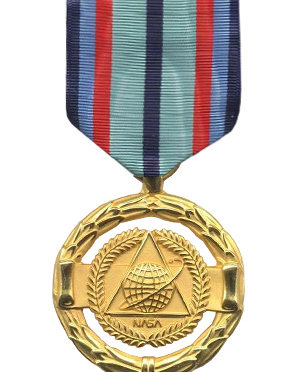
The medal is circular and struck in bronze gilt.

The reverse is plain except for the inscription “EXCEPTIONAL ACHIEVEMENT“.

The ribbon has stripes in dark blue, blue, red and turquoise, with a central dark blue line.

Find This Medal Online

Right Now on eBay 
Clicking a link to eBay may result in a referral commission being paid if a purchase is made.
Loading...

The NASA Exceptional Administrative Achievement Medal

The NASA Exceptional Administrative Achievement Medal is an award given to people of the federal service for significant support of NASA.

The NASA Exceptional Administrative Achievement Medal is a prestigious NASA award given to any person in the United States federal service for a significant, specific accomplishment or contribution characterized by unusual initiative or creativity that clearly demonstrates a substantial improvement in administrative support contributing to the mission of NASA.

These include:

  • Exceptional initiative in carrying out office/program support activities that resulted in improved processes and operations.
  • Development and improvement of administrative support methods and processes that resulted in substantial benefit to the office or program.
  • Notable competence and resourcefulness in accomplishing and improving office/program processes and operations.

The award is given to any civil service employee in the NASA Classification 500 Group: Clerical/Assistant and related support positions including positions engaged in routine one-grade interval clerical and support work requiring the application of practical knowledge of the established clerical or administrative systems, procedures, and techniques of a subject-matter area or program.

The NASA Exceptional Administrative Achievement Medal Design

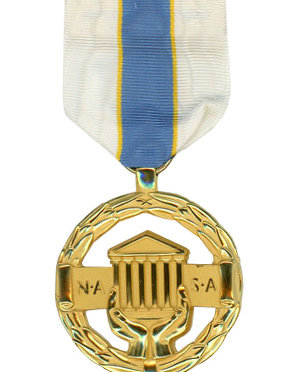
The medal is circular and struck in bronze gilt.

The reverse is plain.

The ribbon has a central larger light blue stripe, with thin yellow and larger white stripes towards the edges.

Find This Medal Online

Right Now on eBay 
Clicking a link to eBay may result in a referral commission being paid if a purchase is made.
Loading...