The King’s Badge

The King’s Badge is a lapel badge issued to servicemen who, as a result of their injuries, had been discharged from active service.

The King’s Badge is a lapel badge authorized by the Ministry of Pensions in the early part of the Second World War and initially issued to servicemen who, as a result of their injuries, had been discharged from active service.

Its basic purpose was to show that the wearer was a veteran. As well as members of the armed services, merchant navy and fishing fleets qualifying, by late 1944, it was also awarded to the coastguards, police, members of the Civil Defence Services, and the Home Guard. The badge was to be worn only on civilian clothing and by the end of 1941 over 8,000 had been awarded.

Three versions of the badge were produced.

The King’s Badge Design

The badge is struck in silver and measures 26 millimeters in diameter.

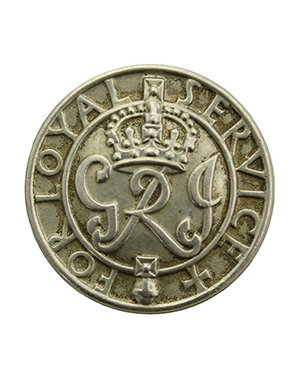
The obverse shows the initials “GRI” for Georgius Rex Imperator, in this case referring to King George VI. The earlier badge was in the name of his father, George V. The wording around the initials read “For King and Empire Services Rendered to For Loyal Service”.

The reverse is plain and the badges are not numbered or named.
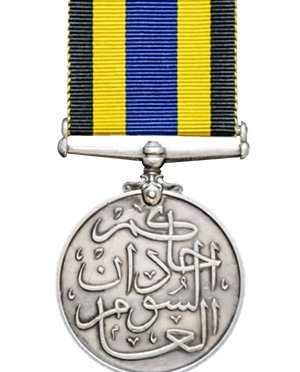
The Sudan Defence Force General Service Medal

The Sudan Defence Force General Service Medal is a campaign medal awarded for service in minor operations within the Anglo-Egyptian Sudan.

The Sudan Defence Force General Service Medal is a campaign medal instituted in 1933 and awarded for service in minor operations within the Anglo-Egyptian Sudan.

The medal superseded the Khedive’s Sudan Medal (1910) and was awarded on the recommendation of the Commandant of the Sudan Defence Force (SDF) to locally recruited personnel of the SDF, police and other approved Sudanese who served in minor operations classed by the Governor-General as of sufficient importance to warrant the grant of the medal.

About 9,000 SDF General Service Medals were issued. No further awards were made after 1945, with the medal becoming obsolete with Sudanese independence in 1956.

The Sudan Defence Force General Service Medal Design

The medal is circular, struck in silver and measures 36 millimeters in diameter.

The obverse shows the seal of the Governor-General of Sudan. The reverse bears a stationary group of Sudanese soldiers, with “The Sudan” in Arabic below.

The ribbon has a central stripe of royal blue, edged by two yellow stripes and two black stripes at the edges.

The India General Service Medal 1936-39

The Indian General Service Medal is a campaign medal approved in 1938 for issue to men of the British and Indian armies and of the RAF.

The Indian General Service Medal (or 1936 IGSM) is a campaign medal approved on 3 August 1938, for issue to officers and men of the British and Indian armies, and of the Royal Air Force.

The medal was awarded for minor military campaigns on the North-West Frontier of India between 1936 and 1939. Each campaign covered by the medal was represented by a clasp on the ribbon; two were sanctioned, both relating to operations in Waziristan:

  • North West Frontier 1936–37
  • North West Frontier 1937–39

Following the grant of Indian Independence in 1947 the medal became obsolete, although it could still to be worn in uniform by British, Indian and Pakistani servicemen.

The India General Service Medal 1936-39 Design

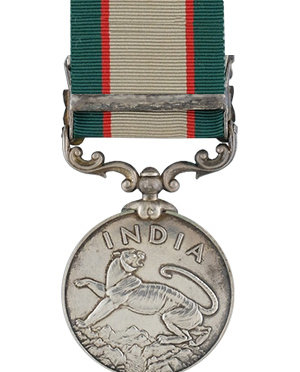
The medal is circular, struck in silver and measures 36 millimeters in diameter.

The obverse shows a crowned effigy of King George VI. The reverse bears a tiger with the word INDIA across the top.

The ribbon is stone colored flanked by narrow red stripes, with broad green stripes at the edges.

The Iraq Active Service Medal

The Iraq Active Service Medal, also known as the King Faisal’s War Medal, is a British campaign medal established in May 1926. 

The Iraq Active Service Medal, also known as the King Faisal’s War Medal, is a British campaign medal established in May 1926.

The medal was awarded to British Army and RAF personnel stationed in Iraq or serving with the Iraq Levis. It was originally issued without a clasp, but clasps denoted subsequent actions or periods of service.

From 1931 on, medals were issued with appropriate clasps from the outset.

The Iraq Active Service Medal Design

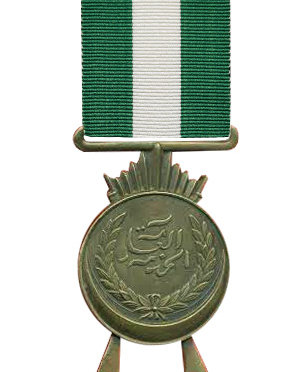
The medal is circular, struck in bronze and measures 38 millimeters in diameter.

The obverse shows a crescent forming the lower part, with an Arabic inscription above signifying “General Service” in two laurel branches. The medal is superimposed on crossed rifles, with rays in the arc between the muzzles.

The reverse bears the name of King Faisal I in Arabic and the date (AH) 1344 (1926).

The ribbon measures 31 millimeters and has equal stripes in green, white and green. The suspension is a flattened loop suspender.

The General Service Medal 1918-62

The General Service Medal (1918 GSM) was instituted in 1923 to recognize service in certain minor Army and Royal Air Force operations.

The General Service Medal (1918 GSM) was instituted in 1923 to recognize service in minor Army and Royal Air Force operations for which no separate medal was intended.

Local forces, including police, qualified for many of the clasps, as could units of the Indian Army prior to 1947.

A total of eighteen clasps were awarded, the medal never being awarded without a clasp. The clasps are:

  • S. Persia
  • Kurdistan
  • Iraq
  • N.W. Persia
  • Southern Desert Iraq
  • North Kurdistan
  • Palestine
  • S.E. Asia 1945–46
  • Bomb and Mine Clearance 1945–49
  • Bomb and Mine Clearance 1949–56
  • Palestine 1945–48
  • Berlin Airlift
  • Malaya
  • Canal Zone
  • Cyprus
  • Near East
  • Arabian Peninsula
  • Brunei

The General Service Medal 1918-62 Design

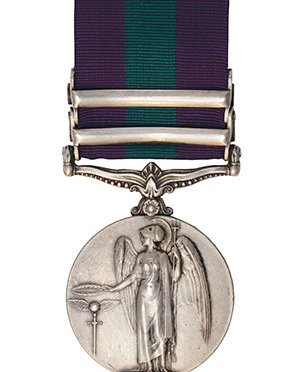
The medal is circular, struck in silver and measures 36 millimeters (1.4 in) in diameter. It was designed by E Carter Preston.

The obverse bears the crowned effigy of the reigning monarch: George V coinage head (1918-30), George V crowned and robed bust (1931-36), George VI Ind Imp (1937-49), George VI Fid Def (1949-52), ELizabeth II Br Omn (1952-54) and Elizabeth II Dei Gratia (1955-62).

The reverse shows the standing winged figure of Victory in a Corinthian helmet and carrying a trident, bestowing a wreath on the emblems of the Army (the sword) and the RAF (the wings).

The ribbon is 32 mm (1.3 in) wide and has three equal stripes of purple, dark green and purple.

The service number, rank, name and regiment or corps of the recipient are impressed on the rim of the medal in small block capitals. A bronze oak leaf emblem is worn on the ribbon of the medal to signify a mention in dispatches or King’s/Queen’s Commendation for a campaign for which the GSM was awarded.

The clasps consist of silver bars bearing the name of the relevant campaign or theatre of operations. They are attached to the medal’s suspension bar.

The Naval General Service Medal 1909-62

The Naval General Service Medal was instituted in 1915 to recognize service by the Royal Navy and Royal Marines in certain minor campaigns.

The Naval General Service Medal was instituted in 1915 to recognize service by the Royal Navy and Royal Marines in minor campaigns that would not otherwise earn a specific campaign medal.

The Army/Air Force equivalent was the General Service Medal (1918). Both these medals were replaced by the General Service Medal in 1962.

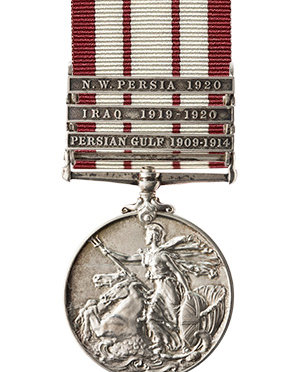
The medal was awarded with the following clasps:

  • MALAYA
  • BOMB & MINE CLEARANCE 1945-46
  • CANAL ZONE

The Naval General Service Medal 1909-62 Design

The medal is struck in silver and measures 36 millimeters in diameter.

It was awarded with one of five obverse designs:

  • George V (1915-36)
  • George VI Ind Imp (1936-49)
  • George VI Fid Def (1949-52)
  • Elizabeth II Br Omn (1952-53)
  • Elizabeth II Dei Gratia (1953-62)

The ribbon is white with broad crimson edges and two narrow crimson stripes towards the center.

The Ceylon Volunteer Service Medal

The Ceylon Volunteer Service Medal is a non-wearable campaign medal awarded by the Government of Ceylon during World War I.

The Ceylon Volunteer Service Medal is a non-wearable campaign medal awarded by the Government of Ceylon to all members of the Ceylonese armed forces that volunteered for overseas service during World War I.

The medal was the only one of its kind, Ceylon being the only British crown colony to issue a medal of its own for its citizens’ service in the war. Those awarded the medal were servicemen of either the Ceylon Defence Force, including the all-European Ceylon Planters’ Rifle Corps, or the Ceylon Royal Naval Volunteer Reserve.

Although the exact number of medals struck is disputed, sources cite numbers between 450 and 3000. 

The Ceylon Volunteer Service Medal Design

The medal is cast in bronze and measures 45 by 52 by 3 millimeters.

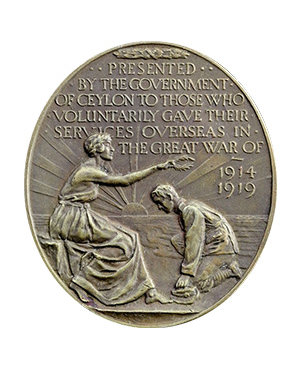
The obverse bears the personification of Ceylon- a seated, right-facing robed, and laureate female figure placing, with her right hand, a laurel wreath crown on the bowed head of a left-facing soldier kneeling on his left knee. The soldier rests his cap on the ground with his right hand, while the background depicts a multi-rayed sun setting into the sea behind them. An inscription above the scene reads: “PRESENTED BY THE GOVERNMENT OF CEYLON TO THOSE WHO VOLUNTARILY GAVE THEIR SERVICES OVERSEAS IN THE GREAT WAR OF 1914 – 1919“. Above the words is a short piece of laurel wreath, bound.

The reverse shows a front-facing illustration of a winged, robed and laureate Victory seated on a throne. Her right hand is raised aloft, holding a laurel wreath, while her left holds a shield emblazoned with the coat of arms of Ceylon. A plaque inscribed with the recipient’s name is located at the figure’s feet, above a skull and spiked helmet obscuring a horizontal scythe.

The medal was awarded without a ribbon.

The Memorial Plaque Medallion

The Memorial Plaque was issued after WW1 to the next-of-kin of all British and Empire service personnel who were killed during the war.

The Memorial Plaque was issued after the First World War to the next-of-kin of all British and Empire service personnel who were killed as a result of the war.

The plaques are about 4.75 inches (120 mm) in diameter, cast in bronze, and came to be known as the “Dead Man’s Penny“, because of the similarity in appearance to the much smaller penny coin.

A total of 1,355,000 plaques were issued, which used a total of 450 tons of bronze, and continued to be issued into the 1930s to commemorate people who died as a consequence of the war.

The Memorial Plaque Design

Over 800 designs were submitted in a public competition for the design of the plaque. The winner was the sculptor and medallist Edward Carter Preston using the pseudonym Pyramus, who received two first-place prizes of £250 for his winning and also an alternative design.

The obverse includes an image of Britannia holding a trident and standing with a lion. The designer’s initials, E.CR.P., appear above the front paw. In her outstretched left hand Britannia holds an olive wreath above the rectangular tablet bearing the deceased’s name cast in raised letters. Below the name tablet, to the right of the lion, is an oak spray with acorns. Two dolphins swim around Britannia, symbolizing Britain’s sea power, and at the bottom a second lion is tearing apart the German eagle.

The reverse is blank, making it a plaquette rather than a table medal. Around the picture the legend reads “HE DIED FOR FREEDOM AND HONOUR“, or for the 1500 plaques issued to commemorate women, “SHE DIED FOR FREEDOM AND HONOUR“.

Smaller or miniature unofficial bronze plaques were produced by other manufacturers, for example Wright and Sons of Edgware, Middlesex, who sold them for 13 shillings and sixpence each.

The Messina Earthquake Commemorative Medal

The Messina Earthquake Commemorative Medal is a British campaign medal established in 1908 and awarded by the King of Italy to Royal Naval and other personnel who went to the aid of victims of the tragic earthquake that hit Messina in December 1908.

At 5:22 am on the 28th December 1908 the Sicily & Calabria area of Italy was struck by a 7.5 magnitude earthquake, a major disaster with a terrible death toll (estimated 70,000 to 100,000). Many nations came to the aid of the affected areas and various ships in the Mediterranean at the time were deployed to offer whatever help could be given. Messina was the worst affected population center and a number of Royal and British Merchant Navy vessels landed men to assist, from digging survivors out from collapsed buildings to assisting with the evacuation of the injured and homeless.

In the aftermath, it was decided by the Italian Royal family that a merit medal would be produced to be awarded to those who distinguished themselves “whether by rendering assistance and medical treatment or by donating health and administrative services and meeting the material and spiritual needs of the sufferers of the disaster.

An estimate of up to three hundred of these merit medals were awarded.

The Messina Earthquake Commemorative Medal Design

The medal is circular, struck in silver, gold and bronze and measures either 31.5 millimeters (for individuals) or 40 millimeters (for institutions) in diameter.

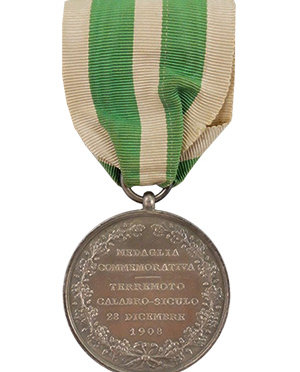
The obverse shows a left-facing profile of King Victor Emanuel III. The reverse bears a wreath of oak leaves within which are the words “MEDAGLIA COMMEMORATIVA / TERREMOTO CALABRIO SICULO 28 DECEMBRE 1908“.

The ribbon is green with white edges and a central white stripe.

The Natal Rebellion Medal

The Natal Native Rebellion Medal is a British campaign medal authorized in 1907 for service in Natal during a Zulu revolt against British rule and taxation in 1906.

In the years following the Second Boer War, British employers in Natal found it difficult to recruit sufficient Zulu farm workers because of increased competition from the gold mines on the Witwatersrand. To coerce more Zulu men to enter the labor market, the Natal Colonial government introduced a £1 head tax, in addition to the existing hut tax. The revolt, led by Chief Bambatha kaMancinza, leader of the amaZondi clan of the Zulu people who lived in the Mpanza Valley, was sparked in February 1906, when two British tax collectors were killed near Richmond.

Martial law was declared and Bambatha embarked on a series of guerrilla attacks, using the Nkandla forest as a base. The revolt continued until colonial troops managed to surround the rebels at Mome Gorge. Between 3,000 and 4,000 Zulus were killed during the revolt, some of whom died fighting on the side of the Natal government. More than 7,000 were imprisoned, and 4,000 flogged. King Dinuzulu kaCetshwayo, who gave tacit support to Bambatha, was arrested and sentenced to four years imprisonment for treason.

The 1906 Clasp to the medal was awarded to those who had served for more than fifty days. Altogether 9,979 medals were awarded, 8,045 with the clasp and 1,934 without the clasp.

The Natal Rebellion Medal Design

The medal is circular, struck in silver and measures 36 millimeters (1.4 in) in diameter. It was designed and manufactured by the Goldsmiths and Silversmiths Company of London, having been commissioned by the Natal Government.

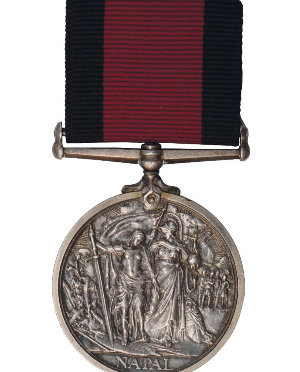
The obverse shows the uncrowned head of King Edward VII facing right, surrounded by the legend “EDWARDVS VII REX IMPERATOR” around the perimeter. The reverse shows the figures of Britannia and Natalia, holding a large sword and standing on a heap of native weapons, against a background of a landscape with a group of Zulu men and huts with a sunrise behind. The name “NATAL” appears in the exergue.

The ribbon is crimson with black edges.