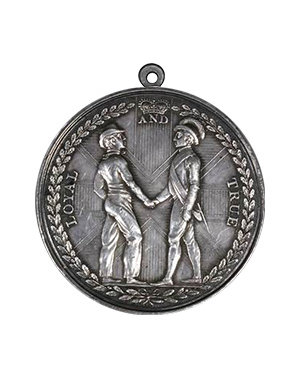
The Earl St Vincent’s Medal

The Earl St Vincent’s Medal was instituted in 1800 and presented in silver and bronze to officers and sailors who had followed Admiral Sir John Jervis from his flagship Victory to the Ville de Paris (and remained loyal to him during the mutiny at the Nore, which involved over 10% of the seamen in the Royal Navy).

When the British fleet under Admiral Sir John Jervis defeated a much larger Spanish fleet under Admiral Don José de Córdoba y Ramos near Cape St. Vincent, Portugal in February 1797, Jervis was made Baron Jervis of Meaford and Earl St Vincent and was granted a pension for life of £3,000 per year.

A specimen in gold was presented to George III and is now in the British Museum and there is also another gold example in the National Maritime Museum.

The Earl St Vincent’s Medal Design

The medal is struck in gold or silver, and measures 48 mm wide. It was designed by Lady Spencer (as recorded in correspondence to her from Jervis in June 1801).

It’s not known how many gold specimens were made, but it can only have been a couple or so.

The obverse bears the bust of the Admiral with his hair long and tied with a ribbon. The uniformed bust of Adml. Jervis l. is surrounded by the inscription “EARL ST VINCENT’S TESTIMONY OF APPROBATION 1800“.

The reverse shows a Rev. Naval Officer and enlisted sailor shaking hands, with a backdrop of the Union flag, all within an oaken wreath.

The medal was awarded without a ribbon.
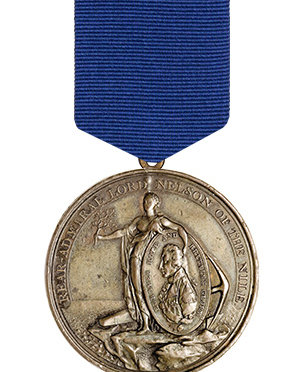
The Davison’s Nile Medal

The Davison’s Nile Medal was instituted in 1798 by Alexander Davison, who was appointed by Nelson for the captured ships after the battle of the Nile on 1 August 1798.

Davison had this medal struck and presented to all who took part in the action. It was awarded in gold to Nelson and his captains, in silver to Lieutenants and Warrant Officers, in gilt metal to Petty Officers, and in copper to seamen and marines.

Admiral Nelson’s medal was stolen in 1900 and it’s believed to have been melted down.

The Davison’s Nile Medal Design

The medal is struck in gold, silver, gilt-bronze or bronze and measures 47 mm wide.

The obverse shows, on a rock near the sea, Peace standing and holding in her right an olive branch. She supports with her left hand a medallion of Nelson, an anchor behind her. An inscription reads ‘REAR-ADMIRAL LORD NELSON OF THE NILE‘, ‘EUROPE’S HOPE AND BRITAIN’S GLORY‘, and below: ‘C.H.K‘. (C.H. Küchler).

The reverse bears a view of Aboukir Bay (the Aboukir promontory on the eastern rather than the western side of the bay), the English Fleet going into action and the French at anchor. A legend reads ‘ALMIGHTY GOD HAS BLESSED HIS MAJESTY’S ARMS‘. In the exergue is the inscription ‘VICTORY OF THE NILE AUGUST 1 1798‘, ‘M . B . SOHO‘ and ‘C . H . KUCHLER . FEC.’ The edge reads: ‘FROM ALEXR DAVISON, ESQR. ST. JAMES’ SQUARE A TRIBUTE OF REGARD.’

The award was given without a ribbon, but was used with an unofficial 32mm wide deep navy blue one and fitted with a ring.

The St Vincent’s Black Corps Medal

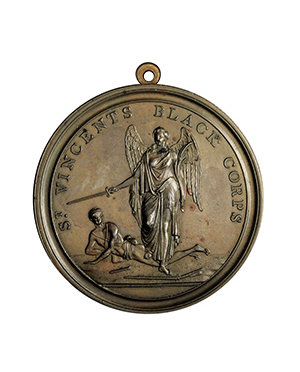
The St Vincent’s Black Corps Medal was instituted in 1795 and awarded to NCOs and men of the St. Vincent’s Black Rangers for service against rebellious Caribs and French forces in 1795.

The first Capture of Saint Vincent took place between 16 and 18 June 1779 during the American Revolutionary War. A French force commander named Charles-Marie de Trolong du Rumain landed on the island of Saint Vincent in the West Indies and quickly took over much of the British-controlled part of the island, assisted by local Black Caribs who held the northern part of the island. The area remained under Carib control until the Second Carib War of 1795, a conflict that pitted large numbers of British military forces against a coalition of Black Carib, runaway slaves, and French forces for control of the island.

British efforts to penetrate and control the interior and windward areas of the island were repeatedly frustrated by disease, incompetence and effective Carib defenses until a major military expedition by General Ralph Abercromby was eventually successful in crushing the Carib opposition in 1797.

The Corps of Natives were raised by Major Seton from among the island’s slaves for service against the rebellious forces.

The St Vincent’s Black Corps Medal Design

The medal is struck in bronze and measures 48.5 mm wide.

The obverse shows the winged figure of Victory brandishing a sword over a fallen foe who has abandoned his musket. The reverse bears a native holding a musket and a bayonet and has the inscription “BOLD ROYAL OBEDIENT” around and “H.G.FEC.” in the exergue.

The award was given without a ribbon.

The Defence of Gibraltar Medal

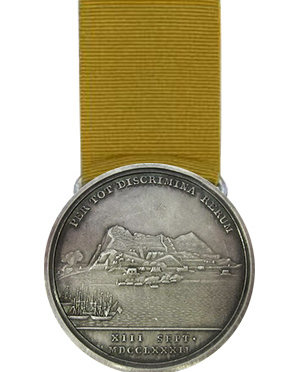
The Defence of Gibraltar Medal was instituted on 13 September 1782 by military commanders General Eliott and Sir John Picton, and awarded to British and Hanoverian troops present during the Franco-Spanish siege of 1779-1783.

Several private medals were struck to commemorate the Defence of Gibraltar during thesiege. The most commonly encountered are the ones struck in silver, which were provided by George Augustus Eliott and Sir Thomas Picton themselves.

The Defence of Gibraltar Medal Design

The medal is struck in silver and measures 49 mm wide (Eliott) and 59 mm wide (Picton).

The obverse for Eliott’s medal was designed by Lewis Pingo and shows a view of the Rock and the naval attacks of 13 September 1782, the climax of the siege. The reverse shows an inscription reading BRUDERSHAFT (“Brotherhood” in German), above a wreath containing the names of the three Hanoverian commanders and General Eliott.

The obverse of Picton’s medal shows a map of the Rock. The reverse shows a 22-line text (the most verbose British medal) above a recumbent lion crutching a shield bearing the castle and key emblem of Gibraltar.

The award was given without a ribbon or suspension, although some later examples show a yellow one.

The Carib War Medal

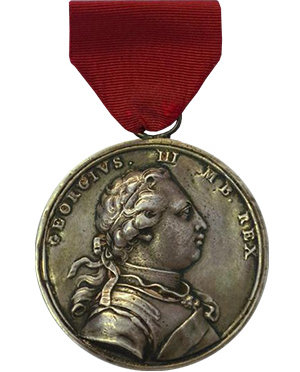
The Carib War Medal was instituted by the Legislative Assembly of St Vincent in the West Indies and awarded to British and West Indian forces (members of the militia and volunteers) who took part in fighting attempts by white settlers to seize Carib-owned land in 1772-1773, which led to a negotiated peace.

The Caribs were descended from the original Carib population of the eastern Caribbean who had intermarried with runaway African slaves. After the allocation of St Vincent to Britain in the Peace of Paris in 1763, the white planters who settled there attempted to seize Carib lands, but the latter fought a successful campaign of resistance and forced the British to sign a treaty recognizing their rights.

The Carib War Medal Design

The medal is struck in  silver and measures 52 mm wide.

The obverse shows a bust of George III in armor. The reverse bears Britannia offering an olive branch to a defeated Carib, and the date MDCCLXXIII in the exergue.

The award was given without a ribbon or suspension, although some later examples show a red one.

The Louisburg Medal

The Louisburg Medal was only given to certain recipients for acts of bravery or distinguished service in the capture of Louisburg in Canada in July 1758, during the Seven Years War. The land forces were commanded by James Wolfe and Jeffrey Amherst, while the fleet was commanded by Edward Boscawen.

The medal could be awarded to British Army and Navy.

The detail of a rare gold Louisburg medal can be seen on this page courtesy of the National Maritime Museum, Greenwich, London (not on display).

The Louisburg Medal Design

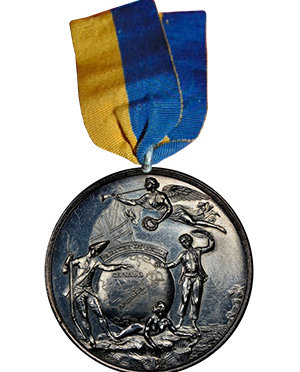
The medal is struck in gold, silver or bronze and measures 42 mm wide.

The obverse shows a globe surrounded by allegorical figures of victory and flanked by servicemen. A Grenadier on the left is turning towards a woman crushed below the globe, who points to approaching boats, while a sailor on the right waves his hat. The inscription on the globe reads “CANADA“, “AMERICA“. The reverse bears burning ships in the harbor, with batteries in the foreground firing at two French vessels, one in flames (The Prudent) and one being towed away (The Bienfaisant). The legend reads “LOVISBOVRG . TAKEN . MDCCLVIII“.

The ribbon measures 32 mm wide and is half yellow and half blue, although the medal was not initially intended for wear and has no suspension.

The King’s Medal for Native Chiefs

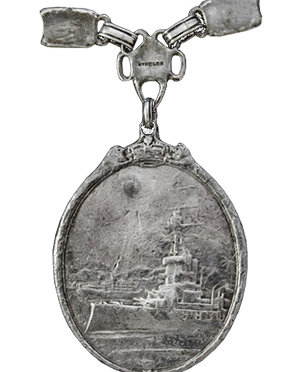
The King’s Medal for Native Chiefs was instituted in 1920 and awarded exceptionally in silver-gilt and usually in silver.

The King’s Medal for Native Chiefs was instituted in 1920 and awarded exceptionally in silver-gilt (First Class) and usually in silver (Second Class).

Various large silver medals were struck for award to native chiefs in various parts of the world, from the eighteenth century onwards. This oval medal was worn around the neck from a silver collar. More modern issues, however, are smaller and intended for wear with a ribbon from the breast.

The medal is normally returned on the death of the recipient.

The King’s Medal for Native Chiefs Design

The medal is struck in silver or silver-gilt and measures 40mm by 34 mm (the original oval with collar) or 36mm by 32mm (the later circular version). 

The obverse bears the crowned effigy of the monarch. The reverse shows a warship, symbolic of imperial power. The medals of Elizabeth II come in two versions: On is larger in size and has a collar, the other is smaller (1955) and fitted with a plain ring for suspension.

The ribbon is yellow watered silk, with two white central stripes (silver-gilt_ or a single white stripe (silver).

The Sea Gallantry Medal

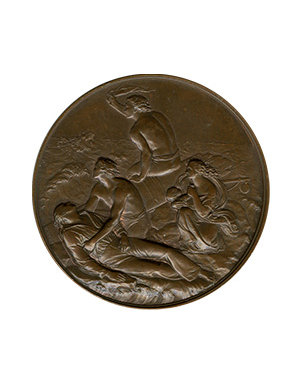
The Sea Gallantry Medal (or SGM, officially ‘The Board of Trade Medal for Saving Life at Sea‘), is an award for civil gallantry at sea in Great Britain and the Commonwealth issued through the Merchant Shipping Act 1854 and first struck in 1855. This medal is exceptional in that it was authorized not by Royal Warrant but by Parliamentary legislation.

The 1856 Act made provision for monetary rewards for life-saving at sea, but in 1855 this was transmuted into medals in gold, silver or bronze. These medals were first warded either for ‘humanity‘, where there was little risk to the life of the recipient or for gallantry, where there was a significant risk to the recipient. The gold medal, if it was ever awarded, must have been of the greatest rarity.

Recipients were entitled to the post-nominal “SGM” until 29 November 2019.

There have only been two awards of the Sea Gallantry Medal (Bronze) since 1974: one in 1981 and the other in 1989. The medal was appeared to have fallen into disuse, although the award (as of 2020) has not been canceled.

The Sea Gallantry Medal Design

The medals were struck in silver or bronze (maybe in gold) and measured initially 58mm. These were not intended for wearing. In 1903 Edward VII ordered that the medal be reduced to 33mm wide and fitted with a suspension bar and ribbon for wearing. Both medals were issued with a minimum of the recipient’s name and date of rescue around the rim, and were sculpted by Bernard Wyon.

The obverse shows the profile of the reigning monarch. The reverse bears the image of a family on a storm-tossed shore reviving a drowning sailor.

The ribbon is bright red with narrow white stripes towards the edges.

The King’s Medal for Service in the Cause of Freedom

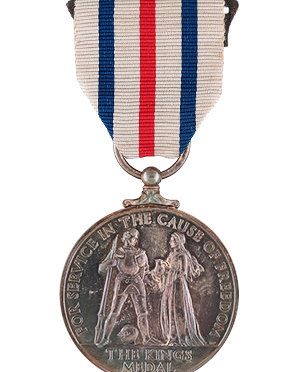
The King’s Medal for Service in the Cause of Freedom was awarded to foreign civilian nationals who had given meritorious service to the Allied cause.

The King’s Medal for Service in the Cause of Freedom is a British medal instituted on 23 August 1945 by King George VI and awarded to foreign civilian nationals, mainly of allied countries, who had given meritorious service to further the interests of the British Commonwealth or the Allied cause during World War II.

Among those activities recognized by the decoration are fundraising for British war relief, scientific research that aided the war effort, and organizing ambulance services. Those who helped British military personnel to escape the enemy, return from occupied areas or for other dangerous work for the British or Allied cause during the war were eligible for the King’s Medal for Courage in the Cause of Freedom.

The medal was awarded 2,539 times.

The King’s Medal for Service in the Cause of Freedom Design

The medal is struck in silver and measures 36 millimeters (1.4 in) in diameter.

The obverse shows the left facing crowned effigy of King George VI with the inscription ‘GEORGIVS VI D:G:BR:OMN:REX ET INDIAE IMP‘.

The reverse bears a medieval warrior in armor carrying a broken lance, being offered sustenance by a woman. The upper circumference is inscribed ‘FOR SERVICE IN THE CAUSE OF FREEDOM‘, with ‘THE KINGS MEDAL‘ below.

The ribbon measures 32 millimeters (1.3 in) wide and is white with a central red stripe, flanked by blue stripes. The medal has a ring suspension and was awarded unnamed.

The Allied Subjects’ Medal

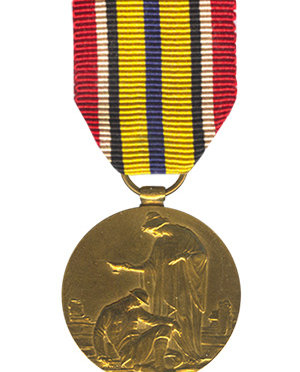
The Allied Subjects’ Medal is a decoration awarded to citizens of allied countries who gave assistance to British and Commonwealth soldiers.

The Allied Subjects’ Medal is a British decoration instituted in 1920 and distributed by the Foreign Office to citizens of allied and neutral countries who gave assistance to British and Commonwealth soldiers – especially escaped prisoners of war, behind enemy lines between 1914–1918. Most medals were awarded to Belgian and French citizens, although Danish, Dutch and other nationals also received it.

Because of delays caused by discussions within Government on the precise form and design of the award meant that it was only manufactured and distributed in 1922.

In France and Belgium, it was generally referred to as Médaille de la Reconnaissance britannique or Médaille de la Reconnaissance anglaise, after the Médaille de la Reconnaissance française.

In total, 134 silver and 574 in bronze medals were awarded, nearly half to women. In addition, 28 further foreign nationals who had rendered notable assistance received honorary appointments to the Order of the British Empire, while about one thousand others received letters of thanks for their services.

The Allied Subjects’ Medal Design

The medal was struck in silver and bronze, and measures 36 millimeters (1.4 in) in diameter. Both medals have the same design.

The obverse shows the left facing bareheaded effigy of King George V with the inscription “GEORGIVS V BRITT: OMN: REX ET IND: IMP:“. The reverse bears a female allegory of Humanity offering a cup to a British soldier resting on the ground, with ruined buildings in the background.

The ribbon is 25 millimeters (1.0 in) wide, and incorporates the French and Belgian national colors: It’s red with a light blue center, flanked by stripes of yellow black and white.

The medal was awarded unnamed.

The medal has a ring suspension.