The Commemorative Medal of the War 1940-1945

The Commemorative Medal of the 1940–45 War (Médaille Commémorative de la Guerre 1940–45 / De Herinneringsmedaille van de Oorlog 1940–1945) is a military decoration of Belgium established on 16 February 1945 by royal decree of the Prince Regent to recognize Belgian servicemen and women who served during the Second World War.

The medal was also awarded to members of the Belgian Resistance and members of Belgium’s Merchant Navy on the side of the Allies. Later decrees allowed for its award to foreign recipients of the Belgian Croix de Guerre.

The Commemorative Medal of the War 1940-1945 Design

The medal measures 38mm in diameter and is circular and struck in bronze.

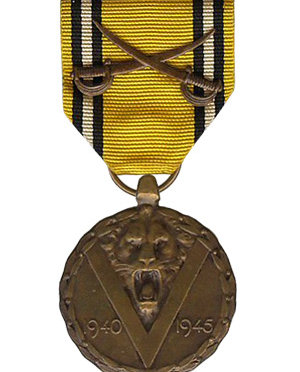
The obverse bears a large V for Victory sign with a relief roaring lion in the V, at the lower left was the relief year “1940”, at the lower right the relief year “1945”. A 3mm wide laurel wreath encircled the entire medal on both the obverse and reverse. On the reverse, within a 5mm wide raised circle, the relief inscriptions “MEDAILLE COMMEMORATIVE” within the upper half and “HERINNERINGSMEDAILLE” in the lower half. In the center of the circle, two 3mm high raised horizontal bars positioned 8mm apart bear the relief inscriptions “DE LA GUERRE” / “VAN DER OORLOG“, at the center, between the two horizontal bars, the relief years “1940–1945”.

The ribbon is 37mm wide yellow silk moiré with 8mm wide edge stripes composed of 2mm wide stripes of yellow, black, white and black, the yellow being closest to the edges. The medal is suspended by a ring through a lateral suspension loop.
The Medal of the Recruiting Centers 1940

The Medal of the Recruiting Centers 1940 (Médaille des Centres de Recrutement 1940 / Medaille van de Recruteringscentra van het Belgisch Leger 1940) is a decoration of the Kingdom of Belgium created by royal decree on

 granted to any man between the ages of sixteen and thirty-five who responded to the order, given in  by the Government, to join the recruiting centers of the Belgian army in France from  and whose period of absence from their home must count at least 10 days and have taken place before .

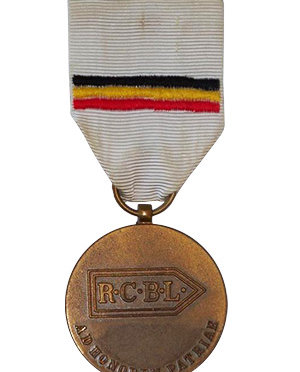
The medal exists in three versions according to the linguistic affiliation of the beneficiary: With the inscription in relief “CRAB” for French speakers, “RCBL” for Dutch speakers and “RZBH” for German speakers.

The Medal of the Recruiting Centers 1940 Design

The medal measures 37 millimeters in diameter and is struck in patinated bronze.

The obverse bears the inscription “CRAB” and “AD HONOREM PATRIAE” in relief and the reverse the year “1940” in relief. The medal is suspended by a ring passing laterally in a suspension barrel at the top of the medal, to a white silk ribbon with a width of 38 mm, in its center horizontally 3 bands of 2 mm, red, yellow and black symbolizing the Belgian flag.

The Medal for Resistance against Nazism in the Annexed Territories

The Medal for Resistance against Nazism in the Annexed Territories (Médaille du Résistant contre le Nazisme dans les Territoires Annexées / Medaille voor Weerstand tegen het Nazisme in de Geannexeerde Gebieden) was established very late, on April 16, 1985.

It was intended for the inhabitants of the German region in Belgium (annexed after the 1st World War) who had actively resisted Nazism during the Second World War: political prisoners, prisoners of war, members of the resistance, saboteurs, and members of the underground press, those who, between May 10, 1940 and January 1, 1943, had – for patriotic reasons – left the region or been expelled from it, those who had forced to enter service with the German army or the labor force in Germany and who had deserted their post before June 6, 1944, etc.

The Medal for Resistance against Nazism in the Annexed Territories Design

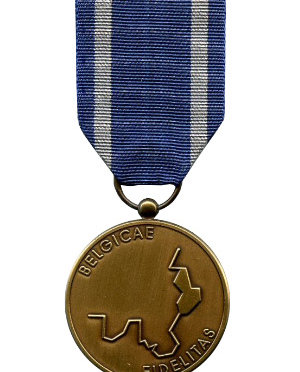
The medal is circular and struck in bronze. The obverse bears the inscription “BELGICAE FIDELITAS” and the reverse “1940-1945”.

There are three different ribbons to indicate the category to which the decorated person belonged: to the deserters of the German service the medal with the blue ribbon with yellow bands, with those which had left the region or were expelled with the ribbon with red bands, with the others that with the ribbon white stripes was awarded.

The Prisoner of War Medal 1940-1945

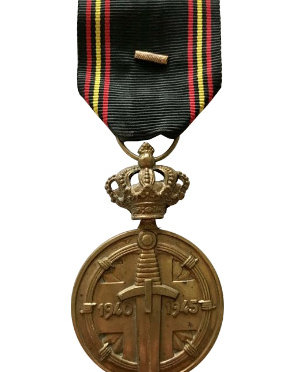
The Prisoner of War Medal 1940–1945 (Médaille du Prisonnier de Guerre 1940-1945 / Krijgsgevangenenmedaille 1940-1945) is a Belgian war service medal established on 20 October 1947 by royal decree.

The medal was awarded to all members of the Belgian Armed Forces imprisoned by Axis Forces during the Second World War.

The Prisoner of War Medal 1940-1945 Design

The medal measures 38 mm in diameter and is circular and struck in bronze. It’s surmounted by a three-dimensional 25 mm high royal crown mounted on a pin giving the entire assembly (medal and crown) a height of 64 mm.

The obverse bears a broadsword pointing down superimposed over a Greek cross with slightly flared ends and the years “1940” and “1945” inscribed in relief on the lateral cross arms. Two triangular laurel leaves protrude from between the cross arms fanning out and a ring of barbed wire encircles the cross along the circumference and 3mm from the medal’s edge. The reverse bears a guard tower and prison camp fence surrounded by a chain along the circumference and 3mm from the medal’s edge.

The ribbon is 37 mm wide black silk moiré with narrow longitudinal 1 mm red/black/yellow/black/red stripes 2 mm from the edges. The medal was suspended by a ring through the crown’s orb. The years of imprisonment were denoted on the ribbon by small striated metal bars.

The Zeppelin Commemorative Badge

The Zeppelin Commemorative Badge is a badge established in 1920 by the Weimar Republic as a “Badge for Airshipmen.”

Institution: 1 August 1920
Country: Germany

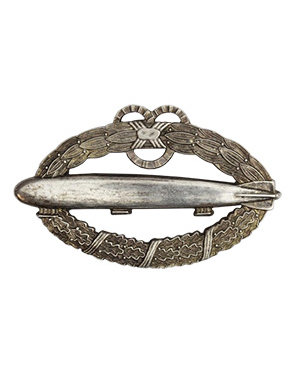
The Zeppelin Commemorative Badge is a badge established on 1 August 1920 by Reichswehrminister Otto Karl Geßler of the Weimar Republic as a “Commemorative Badge for Airshipmen”. The badge was awarded to navy personnel regardless of rank who served on naval airships for at least one year. This condition was waived in case of outstanding merits during the Great War as well as for ex-POWs and crews of naval airships destroyed by enemy fire.

The total true aircrew personnel of the Army Airships numbered around 500 during the War, however during it no badges were issued to them (although the plan existed early on, it was canceled). Instead, the badges were manufactured and issued in the Summer of 1920, as ” Commemorative Badge for Airshipmen”.

The Zepplin badge was a post-war badge, its production was begun in 1920.

The Zeppelin Commemorative Badge Design

The badge measures 67.88mm by 38.77mm and was designed by P. Meybauer in Berlin. It’s struck in silver-plated brass.

The badge has a horizontal oval shape with an airship facing left superimposed on a green enameled wreath. The wreath is made of laurel leaves on its upper part and oak leaves on the lower one. The laurel part of the wreath is tied crosswise on its top by a ribbon that forms three semicircular arcs, two facing above and one beneath. The oak portion in its turn is tied with three ribbons.

The Tank Battle Badge

The Tank Battle Badge (or Kampfwagenab-zeichen in German) is a badge established on 13 July 1921 by Dr. Otto Geller in Germany.

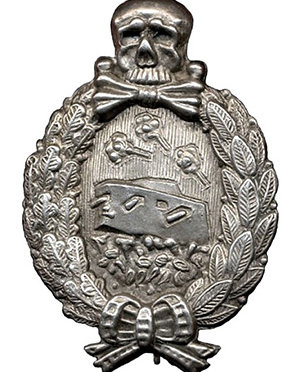
The Tank Battle Badge (or Kampfwagenab-zeichen in German) is a badge established on 13 July 1921 by Dr. Otto Geller in Germany. It wasn’t a wartime insignia, but rather an immediate post-war offering.

The medal was created “In order to keep awake among the German people the memory of the battle vehicle units“. The German tanks made their initial combat appearance at San Quenten, on March 21, 1918, at the start of the Michael Offensive known as “the Great Battle in France”. The First Detachment fielded five German-built A7V tanks and the Second Detachment operated five captured British tanks.

To qualify for the badge, a tanker had to have participated in three assaults against the enemy, but this requirement could be waived if the tanker was wounded. Only about 100 of these badges were awarded.

The Tank Battle Badge Design

The badge is a 2 piece silver hollow-core badge made of metal with a dull silver finish. It measures approximately 75mm by 45mm and is oval shaped, with a skull and crossed bones atop an oval wreath of oak leaves on one side and laurel leaves on the other, enclosing a scene of an A7V tank crossing a battlefield with shells bursting above it. The enclosing wreath is tied at the bottom with a bow.

A total of 99 badges were issued. The Berlin firm of C.E. Junker was the first company authorized to produce it. These badges continued to be produced in the 1930s.

The Naval Wound Badge

The Naval Wound Badge is a badge from Imperial Germany established on 24 June 1918 by Emperor Wilhelm II for three or four wounds.

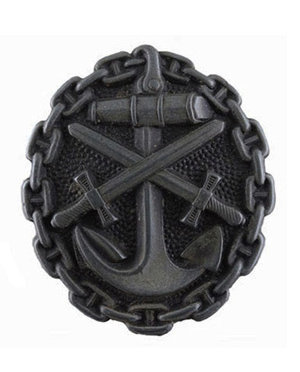
The Naval Wound Badge (or Verwundetenabzeichen für Angehörige der Marine in German) is a badge from IMperial Germany established on 24 June 1918 by Emperor Wilhelm II in the same classes and under the same regulations as the Army badge.

The Wound Badge in Silver was awarded for three or four wounds to members of the Imperial Navy, which were wounded at a sea-fight. Although it was introduced at the closing stage of the Great War, since 1936 all the veterans who were wounded but never received a badge were eligible for that award upon presentation of a documented proof. Another step forward was made on April 20, 1939, when the Ministry of Interior Affairs applied the same procedure to the former military personnel wounded in action during the Great War who were permanent residents of Austria, Sudetenland and Memel, annexed by that time. Thus Army and Naval Wound Badges (model 1918) were presented to veterans until late 1941.

The Naval Wound Badge Design

The badge has the shape of a vertical oval, but unlike the Army Wound Badge it was formed by an anchor chain.

The obverse bears an anchor with two superimposed crossed swords pointing upwards and situated in the middle of the badge. Issued pieces were seamless with a pebbled surface, while privately purchased badges in most cases had elegant cut-out design.

The Bavarian Air Gunner’s Badge

The Bavarian Air Gunner’s Badge is a badge from the Kingdom of Bavaria was introduced in 27 January 1918 by King Ludwig III.

The Bavarian Air Gunner’s Badge is a badge from the Kingdom of Bavaria was introduced in 27 January 1918 by King Ludwig III immediately after Wilhelm II, King of Prussia and Emperor of Germany, instituted similar badges.

The Bavarian Air Gunner’s Badge Design

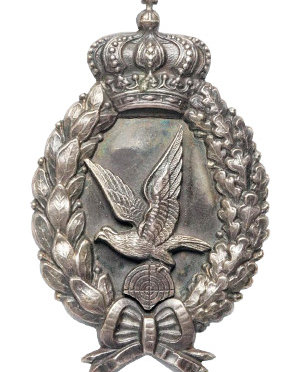
The badge measures 46.2mm by 70.93mm and is struck in Silver. Of hollow construction, it has four went holes and weighs 26.3 grams.

In the obverse, the eagle has its wings raised, atop target sight, radiant within wreath, and crown above. The maker’s name is stamped in the reverse, which has a vertical pinback and breather hole below the catch.

The Naval Observer’s Badge (Prussia)

The Naval Observer’s Badge is a badge from the Kingdom of Prussia introduced in 1915  by the King and Emperor of the German Empire Wilhelm II.

The Naval Observer’s Badge (Beobachter der Fliegertruppe der Marine) is a badge from the Kingdom of Prussia introduced in 1915  by the King of Prussia and the Emperor of the German Empire Wilhelm II.

The badge was awarded to naval observers who successfully passed series of theoretical and practical examinations upon completion of the special training. Operational requirements for naval observers were by far more strict than those for army personnel.

The Naval Observer’s Badge Design

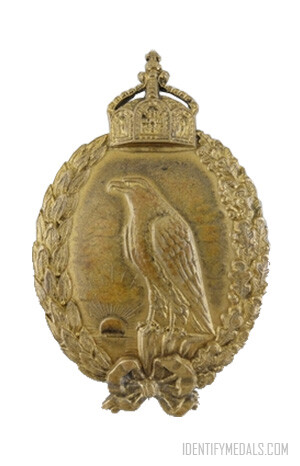
The badge measures approximately 48mm wide and 74mm high and is made of guilded medal. It weighs 58.2 grams.

It has a shape of a vertical oval with an outside perimeter surrounded by a wide wreath. Its left side has laurel leaves symbolizing victory and its right side had oak leaves standing for strength and hardiness. Both were joined together with a ribbon bow at the bottom thus signifying a combination of those two qualities. Imperial crown topped the badge.

The obverse of the badge carries an image of an eagle with lowered wings sitting on a rock and facing left. The background shows a sea with rising or descending sun and clouds above. The reverse is either plain or carries an image of multiple straight rays radiating from the center.

Depending on the manufacturer, the badge differs in certain details (for example, some had crown inserts and lower ribbon fragments cut out). The manufacturers’ hallmarks and silver standards were often found on the reverse or the pin.

The Naval Sea Service Pilot’s Badge (Prussia)

The Naval Sea Service Pilot’s Badge is a badge from the Kingdom of Prussia awarded to qualified NCO pilots during WWI.

The Naval Sea Service Pilot’s Badge is a badge from the Kingdom of Prussia awarded to qualified NCO pilots during WWI.

The Imperial Air Service Korps eventually consisted of 88 Jastas (squadrons). Prussia formed 67 Jastas, Bavaria formed 10 Jastas, Saxony formed 7 Jastas, and Wurttemberg formed 4 Jastas. All used the Imperial badge with the Prussian crown except for Bavaria.

Naval Sea Service Pilot’s Badge Design

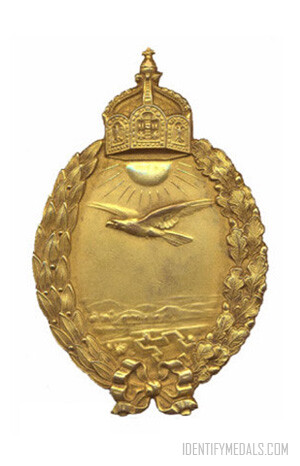
The badge is struck in guilded solid bronze.

Its obverse shows a sea eagle flying over the sea and Helgoland rock.