- Time Period: Post-WW2
- Institution: 20 May 1976
- Country: United States
The Coast Guard Arctic Service Medal was established on May 20, 1976 by the Commandant of the Coast Guard, Admiral Owen W. Siler, to recognize Coast Guard personnel who serve in the challenging and unforgiving Arctic region. The medal is awarded retroactively to service dating back to January 1, 1946 for qualifying Arctic duty. It remains a current award within the Coast Guard’s decorations.
The Coast Guard Arctic Service Medal Criteria
This medal is awarded to any member of the United States Coast Guard who completes twenty‑one days of non‑consecutive duty north of the Arctic Circle—either afloat aboard Coast Guard vessels or ashore at designated locations—under competent orders.
Aircrew who fly missions into and out of Arctic areas may also qualify after accumulating twenty‑one qualifying days of service. Eligible duty includes time spent aboard cutters operating in polar waters or at remote stations such as those in Alaska, Greenland, Canada, and Norway. Civilians who support Coast Guard missions in the Arctic may be recommended for the medal as well.
The Coast Guard Arctic Service Medal Design
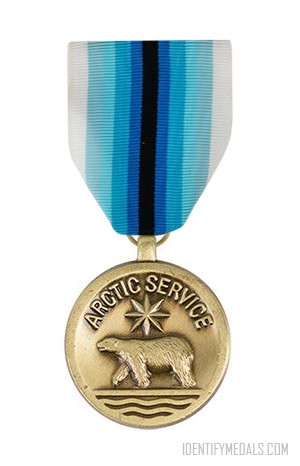
The Coast Guard Arctic Service Medal features a bronze medallion that visually reflects its geographic focus.
The obverse (front) has a polar bear depicted in profile under an eight‑point star (representing the North Star) with the words “ARCTIC SERVICE” above. The polar bear symbolizes the harsh Arctic environment and the cutter Bear, a historic vessel associated with polar operations. The reverse (back) shows the Coast Guard Shield, signifying the authority and service of the U.S. Coast Guard.
- Ribbon: The accompanying service ribbon has a distinctive pattern representing Arctic service and is worn on the uniform when the full medal is not displayed.
- Devices: Although no devices for multiple awards are standard, service stars may be authorized in some cases for subsequent qualifying service.