The Royal Niger Company’s Medal

The Royal Niger Company’s Medal is a campaign medal awarded for service in minor military operations in Nigeria between 1886 and 1897.

The Royal Niger Company’s Medal is a campaign medal awarded for service in minor military operations in Nigeria between 1886 and 1897 and issued in 1899 by the Royal Niger Company. The award covered a series of small punitive expeditions in the company’s territory between 1886 and 1897, with only operations where casualties had occurred qualifying.

Those involved were locally recruited troops and constabulary employed by the Royal Niger Company, as well as a small number of British army officers and non commissioned officers seconded to local forces.

No British Army units took part. For native forces, only those who were still in service when the medal was issued received the medal. No further awards were made after the Royal Niger Company had its charter revoked in 1899.

The Royal Niger Company’s Medal Design

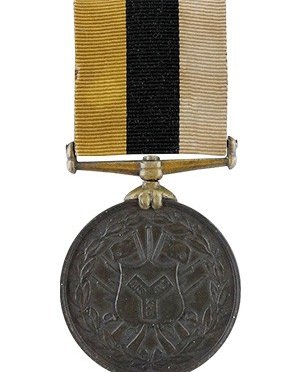
The medal measures 38 millimeters (1.5 in) in diameter. It was awarded in silver to Europeans (some 100 awarded) and bronze to native Africans. The medal was designed and manufactured by Spink and Son of London.

All Royal Niger Company’s medals were issued with a single clasp that read “NIGERIA 1886-1897” on the silver medals and “NIGERIA” on the bronze.

The obverse of both medals depicts a left facing portrait of Queen Victoria, designed by Sir Joseph Boehm with the inscription “VICTORIA REGINA ET IMPERATRIX”.

The reverse shows the arms of the Royal Niger Company (a shield bearing the words “PAX, JUS, ARS”, Latin for Peace, Justice, Skill), with a trophy of arms and flags behind, all surrounded by a laurel wreath.

Silver medals had the name and rank of the recipient impressed or engraved on the rim. Bronze medals were issued with a number impressed on the rim.

The 31.7 millimeters (1.25 in) wide ribbon has three equal strips of yellow, black and white, with the yellow to the left when facing the wearer.
The Egypt Medal (1882–1889)

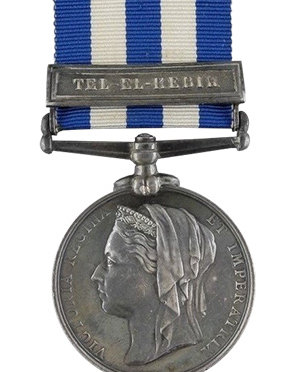
The Egypt Medal is a campaign medal awarded for military actions during the 1882 Anglo-Egyptian War and in the Sudan between 1884 and 1889.

The Egypt Medal (1882–1889) is a campaign medal awarded for the military actions involving the British Army and Royal Navy during the 1882 Anglo-Egyptian War and in the Sudan between 1884 and 1889.

Resentment at increasing British and other European involvement in Egypt since the opening of the Suez Canal in 1869 triggered an Egyptian army mutiny that threatened the authority of the British-backed Khedive of Egypt, Tewfik Pasha. In response, a British military intervention was launched to protect British interests. Once in Egypt, the British became involved in the conflicts in the Sudan, which Egypt had occupied since the 1820s.

A total of 13 clasps were awarded, two for the Anglo-Egyptian War of 1882 and eleven for service in the Sudan between 1884 and 1889:

The Egypt Medal Design

The Egypt medal is struck in silver, circular and measures 36 millimeters (1.4 in) in diameter.

The obverse displays the veiled head of Queen Victoria with the Latin legend “VICTORIA REGINA ET IMPERATRIX” (‘Victoria, Queen and Empress’). The reverse shows the Sphinx on a pedestal with the word ‘EGYPT’ above.

Medals for the 1882 campaign had the year “1882” below the Sphinx. Awards for service in the Sudan from 1884-89 were undated. The recipient’s number, rank, name and regiment are engraved on the edge.

The ribbon measured 32 millimeters (1.25 in) wide, with three blue and two white stripes of equal width.

The Kabul to Kandahar Star

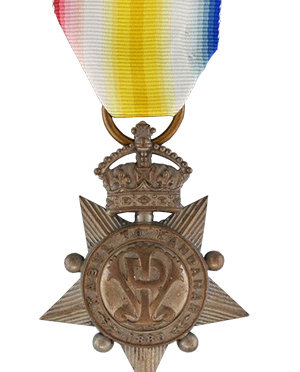
The Kabul to Kandahar Star was awarded to British and Indian troops who had participated in the 320 mile march from Kabul to Kandahar.

The Kabul to Kandahar Star (or the Roberts Star or Kandahar Bronze Star) was awarded to British and Indian troops who had participated in the 320 mile march from Kabul to Kandahar in Afghanistan between 9 and 31 August 1880. It was also awarded to the troops stationed en route at Kelat-i-Ghilzie, who accompanied General Roberts on the final ninety miles to Kandahar.

The march took place to relieve Kandahar, where a British force was being besieged by Afghan forces. On reaching Kandahar, Roberts decisively beat the Afghans on 1 September 1880 at the Battle of Kandahar and lifted the siege. The war was concluded soon after.

Just over 11,000 Kabul to Kandahar Stars were awarded, all recipients also receiving the Afghanistan Medal, usually with the ‘Kandahar’ bar.

The Kabul to Kandahar Medal Design

The Kabul to Kandahar medal is a bronze five-pointed star measuring 62mm high and 48mm wide and suspended by the Imperial Crown. The medal was made from guns captured at the Battle of Kandahar.

The obverse displays, in the middle, the royal monogram “VRI” surrounded by the text “Kabul to Kandahar 1880”. The reverse is plain with a hollow center, with the name of the recipient around the edge.

The Afghanistan Medal

The Afghanistan Medal is a campaign medal awarded to those who served in Afghanistan between during the Second Afghan War.

The Afghanistan Medal is a campaign medal awarded to members of the British and Indian armies who served in Afghanistan between 1878–1880 during the Second Afghan War, the first war being from 1839–1842.

The war was caused by British fears of increasing Russian involvement in Afghan affairs. In 1877 the Afghan Amir refused to accept a British Resident and in 1878 agreed a treaty with Russia granting it protective rights in Afghanistan. In response, a British-led force entered the country and advanced on Kabul. The Afghans sued for peace and accepted a British Resident in Kabul, but the Resident was murdered in September 1879 and the war recommenced. A British-led force occupied Kabul, defeating the Afghans en route at Charasia. Sporadic fighting continued and after defeat at Maiwand, a British force were besieged in Kandahar, resulting in the Afghan defeat leading to the conclusion of the war.

Medals awarded to the 66th Foot (Berkshire Regiment) and E Battery of B Brigade, Royal Artillery, rate a high premium as these units sustained the heaviest casualties as the battle of Maiwand in July 1880.

Plain silver clasps were awarded and are found as follows:

The Afghanistan Medal Design

The Afghanistan Medal is struck in silver and circular, measuring 36 millimeters (1.4 in) in diameter.

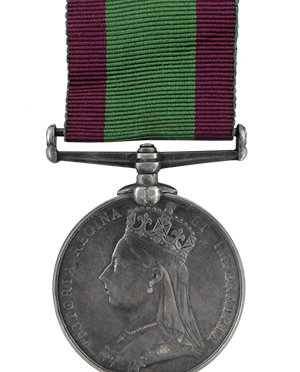
The obverse of the medal displays a veiled effigy of Queen Victoria facing left, with “VICTORIA REGINA ET IMPERATRIX” around the edge. The reverse shows marching and mounted soldiers with arms with an elephant carrying a cannon. In the upper-left of the medal around the edges is “AFGHANISTAN” and on the bottom in a straight line is “1878-79-80”.

The medal hangs from a plain suspender which is attached to the medal with a double toe claw. The ribbon for the medal is 33 millimetres (1.3 in) in width and is dark green with broad crimson edges.

The South Africa Medal (1880)

The South Africa Medal (1880) was awarded to members of the British Army, Royal Naval Brigade and Colonial Volunteers for the Anglo-Zulu War.

The South Africa Medal (1880), also known as the Zulu War Medal, is a campaign medal instituted by the British Government in 1880 and awarded to members of the British Army, Royal Naval Brigade and Colonial Volunteers who were involved in a series of South African tribal wars in the Cape of Good Hope, Colony of Natal and Transvaal between 1877 and 1879, most notably for the Anglo-Zulu War of 1879.

Between 1877 and 1879 a number of particularly difficult punitive expeditions were mounted by the British against Xhosa, Zulu and Basuto tribes in the eastern area of the Cape of Good Hope and northern Natal (as well as against the Bapedi of Chief Sekhukhune in the northern Transvaal).

The medal could be awarded to all personnel, including British regular forces, Colonial Volunteers and native levies, who had served September 1877 and December 1879. The military operations during this period were a series of separate campaigns against specific tribes and the unrest would eventually culminate in the Anglo-Zulu War in 1879.

Seven clasps were awarded to recipients who had served in a campaign in the year or each of the years as denoted on the clasp:

  • “1877” – 153 clasps awarded.
  • “1877-8” – 5,822 clasps awarded.
  • “1877-8-9” – 3,525 clasps awarded to recipients who had qualifying service in all three years.
  • “1877-9” – Eight clasps awarded to recipients who had qualifying service in 1877 and 1879, with no service in 1878.
  • “1878” – 2,009 clasps awarded.
  • “1878-9” – 1,185 clasps awarded.
  • “1879” – 18,332 clasps awarded.

A total of approximately 36,600 medals were awarded.

The South Africa Medal Design

The medal was sanctioned for these campaigns, a new version of the South Africa Medal (1853) with minor alterations to the reverse design. The year “1853” in the older medal’s reverse exergue was replaced by a military trophy consisting of a Zulu ox-hide shield and four crossed assegais.

The medal was struck in silver and circular, measuring 36 millimeters in diameter. It has a swiveling suspender.

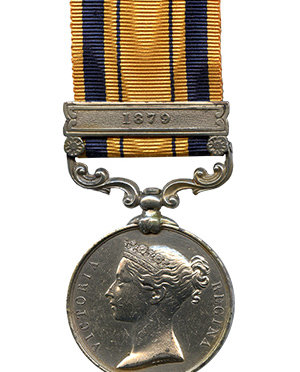
The obverse of the new medal remained identical to that of the earlier medal. It displays the diademed head of Queen Victoria, facing left. The medal is inscribed “VICTORIA” at left and “REGINA” at right around the perimeter.
The reverse shows a crouching lion on a plinth in front of a protea bush with a single flower. The medal is inscribed “SOUTH AFRICA” around the top perimeter and has a military trophy consisting of a Zulu ox-hide shield and four crossed assegais in the exergue.

The ribbon is similar to that of the South Africa Medal (1853), but with wider blue pinstripe bands. It is 32 millimeters wide, with a 2½ millimeters wide golden yellow band, a 4 millimeters wide blue band, a 3 millimeters wide golden yellow band and a 1 millimeter wide blue band, repeated in reverse order and separated by an 11 millimeters wide golden yellow band.

The Ashantee Medal

The Ashantee Medal is a British campaign medal awarded to British, Colonial, and allied native forces during the Third Anglo-Ashanti War.

The Ashantee Medal is a British campaign medal awarded to British, Colonial and allied native forces who were deployed against the army of the Ashanti King Kofi Karikari during the Third Anglo-Ashanti War, from June 1873 to February 1874. The medal was instituted on 1 June 1874.

Forces present included a Royal Navy contingent exceeding 3,500, two battalions of the West India Regiment, and a battalion each from the Royal Welch Fusiliers, the Black Watch and the Rifle Brigade.

The Ashantee Medal Design

The Ashantee medal is struck in silver, circular, and measures 36 millimeters (1.4 in) in diameter. It was designed by Leonard Charles Wyon (the obverse) and  Sir Edward Poynter (the reverse).

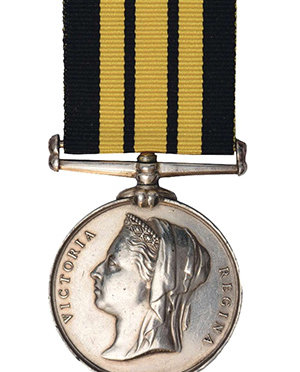
The obverse displays the diademed, veiled head of Queen Victoria and the inscription VICTORIA REGINA. The reverse shows a scene of bush fighting between British and Ashanti in dense jungle, inspired by the campaign. 

The ribbon measures 31.7 millimeters (1.25 in) wide, with yellow with black edges and two narrow black central stripes.

The recipient’s name and unit was engraved on the rim of the medal in capitals, filled with black, along with the years 1873-4.

Find This Medal

Right Now on eBay 
Clicking a link to eBay may result in a referral commission being paid if a purchase is made.
Loading...

The Canada General Service Medal

The Canada General Service Medal is a campaign medal awarded to both Imperial and Canadian forces for duties related to the Fenian raids.

The Canada General Service Medal is a campaign medal awarded to both Imperial and Canadian forces by the Canadian Government for duties related to the Fenian raids between 1866 and 1871.

The medal was not issued until 1899 and people had to applied for it. The period for applying was first extended to 1907, and then to 1928. With late applications, approximately 16,668 medals were awarded , including 15,300 to members of Canadian units.

The medal was always awarded with a clasp, and 20 medals were awarded with all three clasps. Those were:

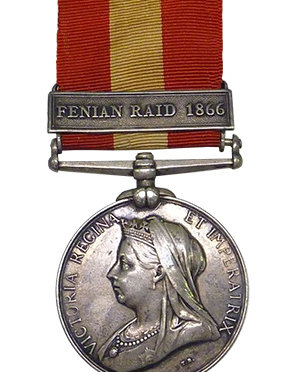
  • FENIAN RAID 1866: For services related to the Fenian raids of 1866. 8,591 clasps were awarded.
  • RED RIVER 1870: For services related to the suppression of the Red River Rebellion. 8,606 clasps were awarded.
  • FENIAN RAID 1870: For services related to the Fenian raids of 1870. 565 clasps were awarded.

The Canada General Service Medal Design

The obverse of the medal bears the head of Queen Victoria with the legend “VICTORIA REGINA ET IMPERATRIX”.

The reverse depicts the red ensign of Canada surrounded by a wreath of maple leaves with the word CANADA above.

The Abyssinian War Medal

The Abyssinian War Medal is a medal awarded to those who participated in the punitive 1868 Expedition to Abyssinia.

The Abyssinian War Medal is a medal awarded to those who participated in the punitive 1868 Expedition to Abyssinia, led by Lieutenant-General Sir Robert Napier, between 4 October 1867 and 19 April 1868. This expedition was carried out by armed forces of the British Empire against the Ethiopian Empire (Emperor Tewodros II of Ethiopia had imprisoned several missionaries and two representatives of the British government.)

About 14,000 medals were awarded, 12,000 to the British and Indian armies and 1,981 to the Royal Navy.

The Abyssinian Medal Design

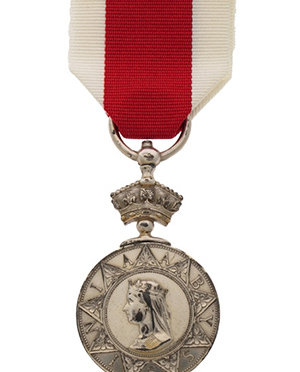
The Abyssinian medal is struck in silver an measures 1.25 inches (32 mm) in diameter. It was designed by Joseph and Alfred Wyon, and struck at the Royal Mint.

The medal is unique in that the recipient’s name and unit were embossed on the reverse of the medal. This required that the dies for the reverse had to have a removable center so each recipient’s name and unit could be impressed, with each medal minted individually.

The obverse bears the left facing effigy of a diademed Queen Victoria. Around the edge is a stylized border with indentions, between the indentions are the letters ABYSSINIA. The bust is similar to that on the New Zealand Medal issued in the same year.

The medal is held by a ring suspension attached to a crown surmounting the medal. The medal is borne upon a crimson ribbon 1.5 inches (38 mm) wide, with white borders.

The New Zealand Medal

The New Zealand Medal is a campaign medal awarded to Imperial and Colonial troops in the New Zealand Wars of 1845–47 (and 1848) and 1860–66.

The New Zealand Medal is a campaign medal awarded to Imperial and Colonial troops in the New Zealand Wars (previously known as the Māori Wars, Anglo-Māori Wars or Land Wars) of 1845–47 (and 1848) and 1860–66. The medal was authorized in 1869 for award only to survivors.

Imperial forces included the British Army, Royal Navy and Royal Marines. The Colonial militia were recruited locally or in Australia, and included mobile forces like Von Tempskys Forest Rangers and the Arawa Flying Column from a Māori tribe for the guerrilla war in the New Zealand bush.

Colonial militia claimants had to prove that they had been under fire. Claims were finally closed for Europeans in 1915 and Māori in 1916.

The number struck was 1,957 (Imperial government) and 2,500 (Colonial government), total 4,457, of which about 4,400 were issued.

The New Zealand Medal Design

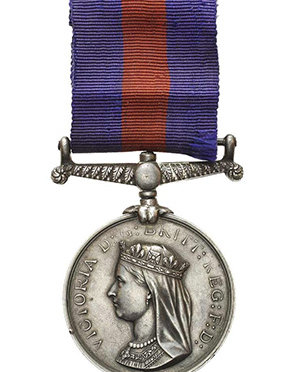
The New Zealand medal was designed by the brothers A. B. and J. S. Wyon. It is struck in silver, circular and measures 36 millimeters (1.4 in) in diameter. It has a straight bar suspender ornamented with New Zealand fern fronds. 

The obverse shows an effigy of Queen Victoria facing left and wearing a diadem and veil, with the legend: “VICTORIA D: G: BRITT : REG : F : D :”

The reverse has a laurel wreath containing the year or years between which the recipient served, with the words “NEW ZEALAND” above and “VIRTUTIS HONOR” (Honor of valor) below.

The ribbon measures 1.25 inches (32 mm) wide, is of blue with a 10mm red center stripe. No clasps (bars) were issued.

The Indian Mutiny Medal

The Indian Mutiny Medal is a campaign medal issued to officers and men who served in operations in suppression of the Indian Mutiny.

The Indian Mutiny Medal is a campaign medal issued to officers and men of British and Indian units who served in operations in suppression of the Indian Mutiny. The medal was approved in 1858.

The Indian Mutiny Medal was initially sanctioned to those troops who had been engaged in action against the mutineers. However, in 1868 it was extended to all those who had borne arms or who had been under fire, including members of the Indian judiciary and the Indian civil service who were caught up in the fighting.

Five clasps were authorized, though the maximum awarded to any one man was four:

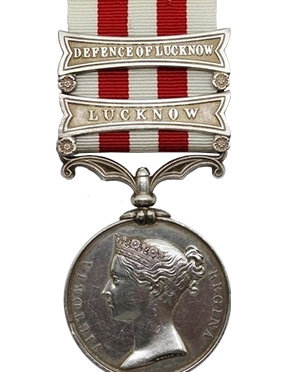
  • Delhi: 30 May – 14 September 1857. Awarded to troops participating in the recapture of Delhi.
  • Defence of Lucknow: 29 June – 22 November 1857. Awarded to original defenders of Lucknow.
  • Lucknow: November 1857 – March 1858. Awarded to troops under command of Sir Colin Campbell who were engaged in final operations leading to the surrender of Lucknow and the clearing of the surrounding areas.
  • Central India: January – June 1858. Awarded to all those who served under Major-General Sir Hugh Rose in actions against Jhansi, Kalpi, and Gwalior. 

Around 290,000 Indian Mutiny medals were awarded.

The Indian Mutiny Medal Design

The medal was designed by William Wyon. The reverse was designed by Leonard Charles Wyon, who also engraved the die of the medal.

The obverse shows the diademed head of a young Queen Victoria with the legend VICTORIA REGINAThe reverse displays a helmeted Britannia holding a wreath in her right hand and a union shield on her left arm. She is standing in front of a lion. Above is the word INDIA, with the dates 1857-1858.

The medal measures 1.25 inches (32 mm) wide and the ribbon is white with two scarlet stripes, with each stripe of equal width.