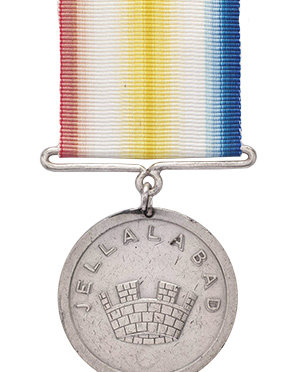
The Jellalabad Medals

The Jellalabad Medal is a campaign medal awarded for the defence of Jalalabad and issued by the British East India Company.

The Jellalabad Medal is a campaign medal awarded for the defence of Jalalabad from 12 November 1841 to 7 April 1842 and issued by the British East India Company and established by George Eden, the Governor-General of India, on 30 April 1842.

The medal was awarded during the First Afghan War to the troops under the command of Sir Robert Sale. About 2,600 soldiers had taken part, including the 13th Foot, the 35th Bengal Native Infantry and detachments from other Indian Army units and some loyal Afghan forces.

The Jellalabad Medal Design

Two different versions of the Jellalabad Medal were awarded. The original medal was struck in silver and produced by the Calcutta Mint. It measured 39 millimeters (1.5 in) in diameter.

The obverse depicts a mural crown with the word ‘JELLALABAD’ above. The reverse shows the date ‘VII APRIL 1842‘ over three lines. The suspension is a straight steel suspender attached to the medal by way of a steel clip.

This version was considered inartistic and insufficient to issue to next of kin of those who had died during the campaign. The East India Company therefore decided to strike a further issue of a new design.

The second version of the medal was struck in silver and designed by William Wyon and produced by the Royal Mint in London. It measured 36 millimeters (1.4 in) in diameter.

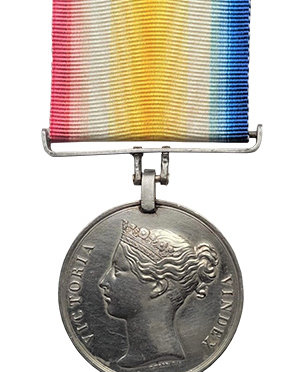
The obverse depicts the diademed head Queen Victoria facing left with the inscription ‘VICTORIA VINDEX’ (PROTECTOR). The reverse shows a winged figure of Victory flying over the fortress at Jellalabad. Above is the inscription ‘JELLALABAD VII APRIL’ with below the year ‘MDCCCXLII’. The suspension is a straight suspender attached to the medal by way of a steel clip.
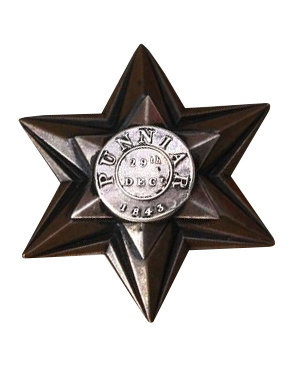
The Gwalior Star (Punniar)

The Gwalior Star is a Campaign medal presented to the soldiers of the British Army and Bengal Army who took part in the Gwalior Campaign.

The Gwalior Star is a Campaign medal presented to the soldiers of the British Army and the British led Bengal Army who took part in the 1843 Gwalior Campaign by the Honourable East India Company.

Tensions between the East India Company and the State of Gwalior had been growing and finally led to a British advance into Gwalior early in December 1843.

On December 29, 1843, the British Army defeated Maharaja Shrimant Jayaji Rao Scindia, and regained control of Gwalior. The first division of the army, commanded by General Sir Hugh Gough, was victorious at the Battle of Maharajpoor. Major-General Grey, with the second division, was victorious at the Battle of Punniar on the same day.

The Gwalior Star Medal Design

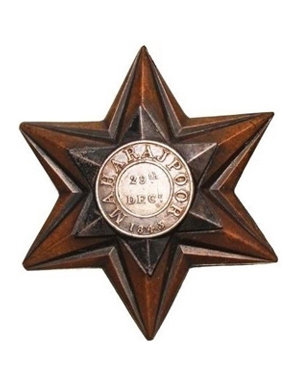
The Gwalior medal is a six pointed star and measures 50 millimeters (2.0 in) diameter. It’s made of bronze from guns captured during the Gwalior Campaign.

In the obverse, the center of the star is a silver disk, which bears the Date 29th Dec, 1843 and the name of one of the Gwalior Campaign battles, either Maharajpoor or Punniar. The reverse of the medal is plain and engraved with the name and regiment of the soldier to whom the medal was awarded.

Manufactured at the Calcutta Mint, this medal was presented by the British India Government originally as a star with a clip on the back to be worn on the breast. Eventually most of these were fitted with a ring or bar of varying design.

The ribbon used was the common ribbon used on many East India Company medals: a red-white-yellow-white-blue gradient ribbon such as that found on the Candahar, Ghuznee, Cabul Medal.

The Gwalior Star (Maharajpoor)

The Gwalior Star is a campaign medal presented to the soldiers of the British Army and the British led Bengal Army for the Gwalior Campaign.

The Gwalior Star is a Campaign medal presented to the soldiers of the British Army and the British led Bengal Army who took part in the 1843 Gwalior Campaign by the Honourable East India Company.

Tensions between the East India Company and the State of Gwalior had been growing and finally led to a British advance into Gwalior early in December 1843.

On December 29, 1843, the British Army defeated Maharaja Shrimant Jayaji Rao Scindia, and regained control of Gwalior. The first division of the army, commanded by General Sir Hugh Gough, was victorious at the Battle of Maharajpoor. Major-General Grey, with the second division, was victorious at the Battle of Punniar on the same day.

The Gwalior Star Medal Design

The Gwalior medal is a six pointed star and measures 50 millimeters (2.0 in) diameter. It’s made of bronze from guns captured during the Gwalior Campaign.

In the obverse, the center of the star is a silver disk, which bears the Date 29th Dec, 1843 and the name of one of the Gwalior Campaign battles, either Maharajpoor or Punniar. The reverse of the medal is plain and engraved with the name and regiment of the soldier to whom the medal was awarded.

Manufactured at the Calcutta Mint, this medal was presented by the British India Government originally as a star with a clip on the back to be worn on the breast. Eventually most of these were fitted with a ring or bar of varying design.

The ribbon used was the common ribbon used on many East India Company medals: a red-white-yellow-white-blue gradient ribbon such as that found on the Candahar, Ghuznee, Cabul Medal.

The Second China War Medal

The Second China War Medal is a British medal for British and Indian armies and Royal Navy who took part in the Second Opium War.

The Second China War Medal is a British medal issued by the British Government in 1861 to members of the British and Indian armies and Royal Navy who took part in the Second Opium War against China between 1857 to 1860.

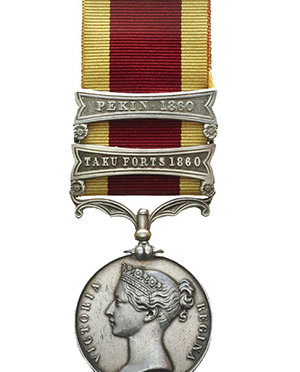
The medal was issued with the following clasps: China 1842 (awarded to those who had already received the medal for the First China War), Fatshan 1857, Canton 1857, Taku Forts 1858, Taku Forts 1860 and Pekin 1860.

The medal could also be awarded without a clasp.

The Second China War Medal Design

The Second China War medal was designed by William Wyon. The medal’s obverse shows the diademed head of Queen Victoria with the legend ‘VICTORIA REGINA’. The reverse has the same shield bearing the Royal Arms, with a palm tree and trophy of arms behind, as found on the First China War Medal with the inscription ‘ARMIS EXPOSCERE PACIM’ above and the word ‘CHINA’ in the exergue below.

The 32 mm ribbon is crimson with yellow edges. The original design had five equal stripes of blue, yellow, red, white and green, edged with red, representing the colors of the Qing dynasty flag, but this ribbon was not finally adopted.

The China War Medal (1842)

The China War Medal is a military medal awarded to members of the British and Indian forces who took part in the First Anglo-Chinese War.

The China War Medal is a military medal designed by William Wyon and issued by the British Government in 1843 to members of the British and Indian forces who took part in the First Anglo-Chinese War (1839–42).

The medal was originally intended by the Governor-General of India to be awarded exclusively to all ranks of the Honourable East India Company’s Forces. In 1843, however, the British Government authorized its award to all members of the British Army, Royal Navy and the Indian Army and Navy, who had “served with distinction” in China between 5 July 1840 and 29 August 1842 in the Canton River operations of 1841 (First and Second Battle of Canton), First and second capture of Chusan, in 1840 and 1841, the Battles of AmoyNingpoChinhaiTzekiChapuWoosung, in the Yangtze River, and the assault of Chinkiang.

This campaign became known as the First Opium War, ending in the seizure of Nanking and the treaty that opened five ports to trade and ceded Hong Kong to Great Britain.

The China War Medal Design

The medal measures 35 millimeters (1.4 in) in diameter, with a wide ribbon in crimson with wide yellow edges (the crimson representing the heraldic color of Great Britain, and the yellow the imperial color of China). The non-swiveling suspender is plain and straight being sweated directly to the medal.

The First China War Medal’s reverse was originally designed depicting the British lion trampling on the fallen Chinese dragon. However, this was considered too insensitive to the Chinese. It was changed to a shield bearing the Royal coat of arms with a palm tree and trophy of arms behind, with the inscription “ARMIS EXPOSCERE PACIM” above and “CHINA 1842” in the exergue below.

The obverse shows the diademed head of Queen Victoria with the legend “VICTORIA REGINA”.

No clasps were authorized for this medal.

The Candahar, Ghuznee, Cabul Medal

The Candahar, Ghuznee, Cabul Medal was awarded to those who took part in the campaign in Afghanistan in 1842.

The Candahar, Ghuznee, Cabul Medal was was approved by General Order at Simla 4 October 1842 and awarded to those who took part in the campaign in the spring and summer of 1842 to restore British standing in Afghanistan after earlier defeats during the First Anglo-Afghan War.

Approximately 22,100 Candahar, Ghuznee, Cabul medals were awarded, some 4,400 to members of the British Army and 17,700 to the mainly native forces of the Honourable East India Company.

The Candahar, Ghuznee, Cabul Medal Design

The medal was designed by William Wyon and struck in silver. It measures 36 millimeters (1.4 in) in diameter.

The obverse shows the diademed head Queen Victoria facing left with the inscription ‘VICTORIA VINDEX’ (PROTECTOR). Four different reverses were struck, indicating the campaigns in which the recipient served: ‘CANDAHAR 1842’ within a laurel wreath, surmounted by a crown. ‘CABUL 1842’ within a laurel wreath, surmounted by a crown. ‘GHUZNEE’ ‘CABUL’, each within a separate laurel wreath, surmounted by a single crown and with the year ‘1842’ below. ‘CANDAHAR, GHUZNEE, CABUL 1842’ within a single laurel wreath, surmounted by a crown.

The suspension consists of a straight steel suspender, attached to the medal by way of a steel clip and pin. The ribbon is the watered rainbow colored ribbon common to most East India Company medals, with a pattern of red, white, yellow, white and blue.

The recipient’s name and regiment were engraved on the edge for the medal.

The Army of India Medal

The Army of India Medal is a British campaign medal issued to officers and men of the British Army and the Army of the East India Company.

The Army of India Medal (AIM) is a British campaign medal approved on 21 March 1851 and issued to officers and men of the British Army and the Army of the Honourable East India Company.

The Army of India Medal was as a retrospective award to survivors of various actions during the period 1803–1826, among them four wars: the Second Mahratta War (1803–04), the Gurkha War (1814–16), the Pindaree or Third Mahratta War (1817–18), and the First Burmese War (1824–26) with the siege of Bhurtpoor (1825–26).

Each action or battle was represented by a clasp on the ribbon. A total of twenty-one ribbons were sanctioned, and while the maximum awarded to one man was seven, most medals were awarded with a single clasp.

Because the medal was only awarded to survivors, there are substantially fewer medals compared with the number of men who served during this period. Forty-eight years had passed between the first battle commemorated and the date of issue. A total of 4,500 medals were awarded.

The Army of India Medal Design

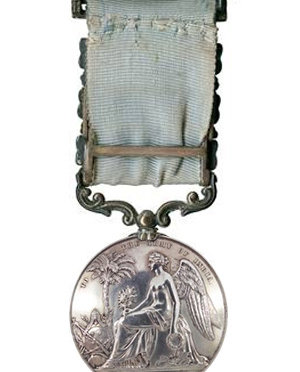
The Army of India medal is circular and made of silver. It measures 1.4 inches (36 mm) in diameter and was designed by William Wyon.

The obverse bears an effigy of a young Queen Victoria wearing a diadem. On either side of the effigy is the inscription VICTORIA and REGINA. The reverse bears and an allegorical representation of Victory holding a laurel branch in her right hand and a wreath in her left. In the foreground is a lotus flower, with a palm tree and trophy of arms in the background. Above is the inscription TO THE ARMY OF INDIA, below in the exergue 1799-1826.

The pale blue ribbon is 1.25 inches (32 mm) wide.

The Ghuznee Medal

The Ghuznee Medal is a campaign medal awarded to troops for participation in the storming of the fortress of Ghuznee in Afghanistan.

The Ghuznee Medal is a British campaign medal struck in 1839 and awarded to troops of the British and Indian Armies for participation in the storming of the fortress of Ghuznee in Afghanistan, from 21 to 23 July 1839 (known as the Battle of Ghazni that took place during the First Anglo-Afghan War).

The Ghuznee Medal was the second medal awarded to all ranks of the British Army for a specific campaign (the first one was the Waterloo Medal).

The medal was struck on the orders of Shuja Shah Durrani, the Shah of Afghanistan, to show his appreciation to the British forces who had helped him restore his throne by storming the fortress. Because the Shah died before the medals could be distributed, it was then bestowed by the Governor-General of India in the name of the Government of India.

The Ghuznee Medal Design

The Ghuznee Medal is made of silver and is based on a design by John Luard, a British army officer and artist. It was struck at the Calcutta Mint. It measures  37 millimeters (1.5 in) in diameter.

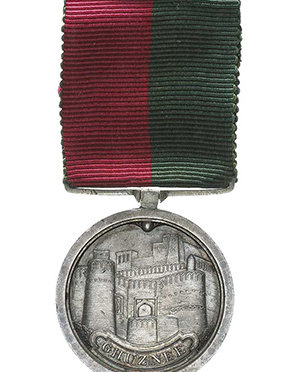
The obverse shows the fortress of Ghuznee with the word ‘GHUZNEE’ below. The reverse depicts a mural crown surrounded by a laurel wreath and the date ’23d JULY 1839’.

The suspender is straight with a ring passing through a smaller loop soldered to the top of the medal. The ribbon has two equal stripes of crimson and dark green. Originally the ribbon was to have been half green and half yellow.
The medal was issued unnamed.

Two separate dies exist for this medal with one having a wider border around the edge than the other. The second also has a narrower and taller fortress.

The Waterloo Medal

The Waterloo Medal is a British military medal established in 1816-17 and struck for all those who participated in the Waterloo campaign.

The Waterloo Medal is a British military medal established in 1816-17 by the House of Commons. The military medal was to be struck for all those who participated in the Waterloo campaign.

On 23 April 1816, it was announced in the London Gazette that the Prince Regent had been graciously pleased to confer the Waterloo Medal upon every officer, non-commissioned officer and soldier of the British Army who took part in the battles of Ligny (16 June 1815), Quatre Bras (16 June 1815) and/or Waterloo (18 June 1815). This included also members of the King’s German Legion.

The measure was supported by the Duke of Wellington, who on 28 June 1815 wrote to the Duke of York: “…the expediency of giving to the non commissioned officers and soldiers engaged in the Battle of Waterloo a medal. I am convinced it would have the best effect in the army, and if the battle should settle our concerns, they will well deserve it.

On 17 September 1815, the Duke of Wellington wrote to the Secretary of State for War recommending “that we should all have the same medal, hung to the same ribbon as that now used with the [Army Gold] Medal.

The Waterloo Medal was finally issued in 1816–1817 and given to every soldier that had been present at one or more of the battles of Ligny, Quatre Bras and Waterloo. Each and every soldier was also credited with two years extra service and pay, and were to be known as “Waterloo Men“.

Different Waterloo Medals

The Waterloo medal was the first medal issued by the British Government to all soldiers present during an action, and it was also the first campaign medal awarded to the next-of-kin of men killed in action.

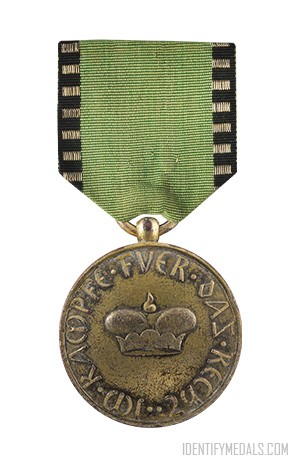
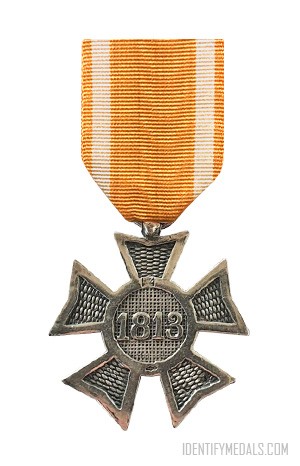
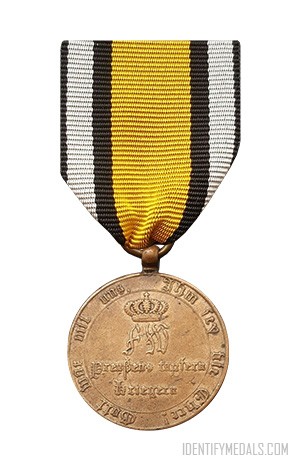
Seven nations of the Seventh Coalition struck medals for soldiers who took part in the campaign: 

British Campaign Medals: The Brunswick Waterloo Medal

The Brunswick Waterloo Medal

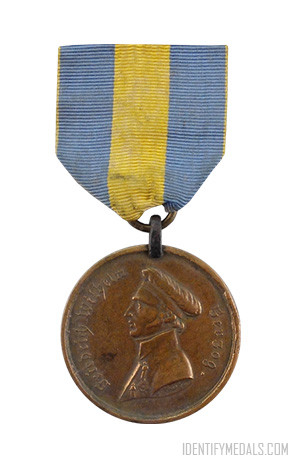
The Brunswick Waterloo Medal was a campaign medal awarded to those who participated in the Battles of Quatre Bras and Waterloo.

British Campaign Medals: The Hanoverian Waterloo Medal

The Hanoverian Waterloo Medal

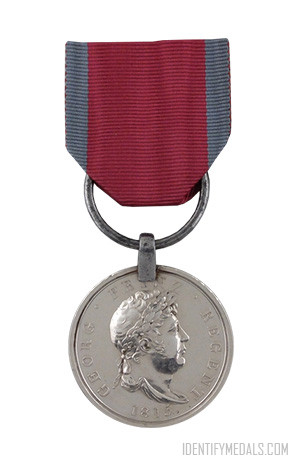
The Hanoverian Waterloo Medal was issued to all members of the Hanoverian army who fought in the battles of Quatre Bras and Waterloo.

British Campaign Medals: The Nassau Medal for Waterloo

The Nassau Waterloo Medal

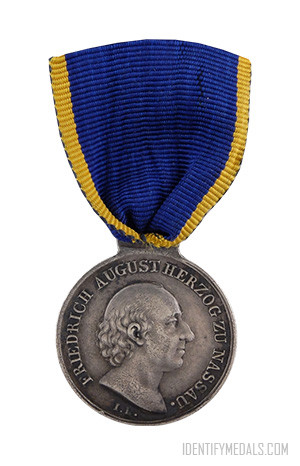
The Waterloo Medal is a campaign of the Duchy of Nassau established by Frederick Augustus, Duke of Nassau on 23 December 1815.

The Waterloo Medal Design

The Waterloo medal is made of silver and is 37 mm (1.5 in) in diameter. It was designed by Thomas Wyon, a recently appointed Chief Engraver to the Royal Mint. The medals were to be awarded originally in bronze, but it was decided at a late stage that they should be produced in fine silver.

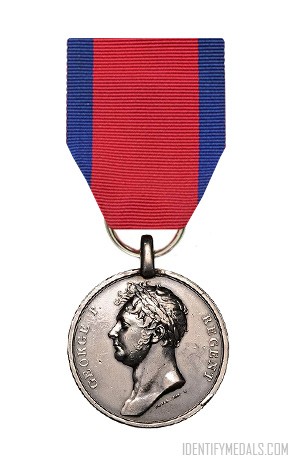
The obverse of the Waterloo medal shows a left facing effigy of the Prince Regent with the inscription GEORGE P. REGENT. The reverse displays a figure of Victory seated on a plinth with the words WELLINGTON above, and WATERLOO and the date JUNE 18 1815 below.

The design of the Waterloo medal was modeled on an ancient Greek coin from Elis, that belongs today to the British Museum collection.

Find This Medal

Right Now on eBay 
Clicking a link to eBay may result in a referral commission being paid if a purchase is made.
Loading...