The Lint voor Wonden Award

The Lint voor Wonden Medal was instituted on 21 December 1920 as a retrospective award for Boer veteran officers and men.

The Lint voor Verwonding, or Wound Riband, is a military campaign decoration in South Africa. Established on December 21, 1920, it was a retrospective honor for Boer veteran officers and soldiers of the 1899–1902 Second Boer War who had sustained injuries in combat.

The Lint voor Wonden, also known as Lint voor Verwonding, was officially designated as Lint voor Verwonding Opgedaan Gedurende de Anglo-Boere Oorlog, 1899–1902 (Riband for Wounds Sustained During the Anglo-Boer War, 1899–1902). It was instituted through Government Notice no. 2307 on December 21, 1920, and published in the Union of South Africa Government Gazette on December 24, 1920.

This honor was retroactively conferred upon Boer veteran officers and soldiers who were wounded in action while serving in the combat forces of the South African Republic and the Orange Free State during the Second Boer War, spanning from October 11, 1899, to May 31, 1902.

The Lint voor Wonden Award Design

The Lint voor Wonden or Lint voor Verwonding was accompanied by a certificate upon issuance. The initial version of this certificate was simple and unadorned, filled out by hand with details such as the recipient’s rank, name, and the Republican Force they served with. Additionally, the recipient’s file number was included in the top left corner of the document.

In a later version, the certificate featured a full-color reproduction of the riband. While the Republican Force was pre-printed on this version, it did not include space for the recipient’s file number.

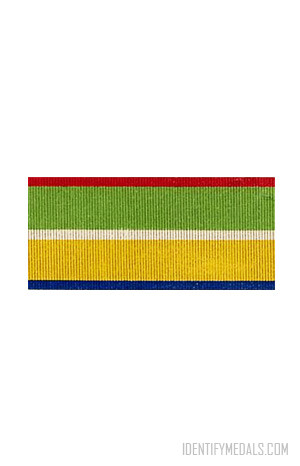
The riband itself measured 1+1⁄2 inches (38 millimeters).
The Medalje voor de Anglo-Boere Oorlog

The Medalje voor de Anglo-Boere Oorlog is a retrospective South African military campaign medal instituted on 21 December 1920.

The Medalje voor de Anglo-Boere Oorlog, a South African military campaign medal, was established on December 21, 1920. It was intended as a retrospective honor for Boer veteran officers and men who fought in the 1899–1902 Second Boer War.

Originally designated as the De Zuidafrikaanse Republiek- en Oranje Vrijstaat Oorlogsmedalje (the South African Republic and Orange Free State War Medal), and commonly known as the Anglo-Boere-Oorlog Medalje, it was instituted via Government Notice no. 2307 on December 21, 1920.

Published in the Union of South Africa Government Gazette on December 24, 1920, the medal was created to provide recognition to Boer veteran officers and men who served in the combat forces of the South African Republic and the Orange Free State during the Second Boer War from October 11, 1899, to May 31, 1902. These individuals remained in service of the Republican forces until May 31, 1902, without surrendering, taking parole, or swearing allegiance before that date.

The Medalje voor de Anglo-Boere Oorlog Design

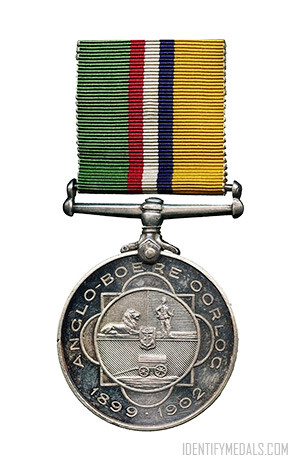
The medal is crafted in silver and measures 1+7⁄16 inches (37 millimeters) in diameter and 1⁄8 inch (3 millimeters) in thickness at the raised rim. It is attached to a fixed bar suspender using claws and a pin inserted through the upper edge. The recipient’s rank, initials, and surname are impressed in block capitals on the rim.

Both sides of the medal feature an ornamental frame encircled by the inscription “ANGLO-BOERE OORLOG” above and the years “1899 • 1902” below. One side displays the coat of arms of the South African Republic at the center of the frame, while the other side features the coat of arms of the Orange Free State. This design allows recipients to wear the medal to display the coat of arms of the state under which they served.

The ribbon, measuring 1+1⁄4 inches (32 millimeters) wide, combines the colors of the two former Republics.

The Dekoratie voor Trouwe Dienst

The Dekoratie voor Trouwe Dienst is a South African military decoration established in 1920 for Boer officers of the Second Boer War.

The Dekoratie voor Trouwe Dienst, abbreviated as DTD, is a military decoration in South Africa. Established in 1920, it serves as a retrospective honor for Boer officers who served during the Second Boer War from 1899 to 1902.

Neither the South African Republic (Transvaal) nor the Orange Free State had their own official honors systems. Hence, the decoration was created to provide Boer veteran officers, serving within the Union Defence Forces, with recognition parallel to their compatriots who fought on the British side during the conflict.

Throughout the Second Boer War, Republican commanders were directed to record the names of individuals within their ranks who displayed exceptional valor on the battlefield. These names were to be submitted to the War Council for verification and publication in the Staats Courant (Government Gazette) with the intention of awarding a medal post-war. However, as the Republican forces were defeated, the proposed medal never came to fruition.

It was later, in 1920, that King George V instituted the Dekoratie voor Trouwe Dienst, alongside the Medalje voor de Anglo-Boere Oorlog and the Lint voor Verwonding.

The Dekoratie voor Trouwe Dienst Design

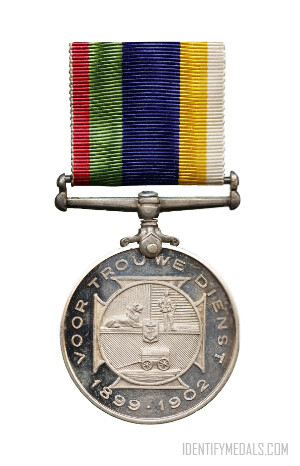
The decoration, crafted in silver, takes the form of a disk measuring 1+7⁄16 inches (37 millimeters) in diameter and 1⁄8 inch (3 millimeters) in thickness at the raised rim. It is attached to a fixed bar suspender using claws and a pin inserted through the upper edge of the medal. The recipient’s rank and name are impressed on the rim.

Both sides of the medal feature an encircled coat of arms on a cross pattée, surrounded by the inscription “VOOR TROUWE DIENST” above and the years “1899 • 1902” below. The coat of arms of the South African Republic is depicted on one side of the cross, while that of the Orange Free State is shown on the other. This design allows recipients to wear the medal to display the coat of arms of the state under which they served.

The ribbon measures 1+1⁄4 inches (32 millimeters) wide and combines the colors of the two former Republics. While officially designated as red, green, white, blue, and orange, the orange hue appears as yellow on the actual ribbons.