The Volunteer Officers’ Decoration

The Volunteer Officers’ Decoration (or VD) is a British medal instituted in 1892 as an award for long and meritorious service by officers of the United Kingdom’s Volunteer Force.

The award was instituted by Queen Victoria’s Royal Warrant on 25 July 1892. The decoration could be awarded to efficient and thoroughly capable officers of proven capacity for long and meritorious service in the part-time Volunteer Force of the United Kingdom.

The decoration was discontinued in the United Kingdom when it was superseded by the Territorial Decoration in 1908, but it continued to be awarded throughout the British Empire, defined as being India, the Dominion of Canada, the Crown Colonies and the Crown Dependencies.

Volunteer Officers’ Decoration Design

The medal is oval skeletal and is struck in silver, with parts of the obverse in silver-gilt. It measures 43 millimeters (1.69 inches) high and 35.5 millimeters (1.4 inches) wide with a ring suspender formed of silver wire.

The obverse shows an oak leaf wreath in silver, tied with gold, with the Royal Cypher below the Royal Crown, both in gold, in the center. The reverse is plain with the hallmarks impressed at the bottom. 
The ribbon is dark green and 1 12 inches (38 millimeters) in width and is suspended from a silver bar-brooch decorated with an oak leaf pattern. The decoration was awarded unnamed but was frequently unofficially engraved in various styles.
The Territorial Force Efficiency Medal (1908)

The Territorial Force Efficiency Medal is a United Kingdom award for long service in the Territorial Force between 1908 and 1921.

It was established in 1908 following the enactment of the Territorial and Reserve Forces Act 1907, (7 Edw.7, c.9) which instigated a major re-organization of the old Volunteer Force and the remaining units of Militia and Yeomanry. 

The medal was awarded to non-commissioned officers and men for a minimum of 12 years service in the Territorial Force, providing they attended 12 annual training camps. Previous service in other part-time forces, including the Volunteer Force could count, and war service counted double. Bars were awarded for further periods of 12 years.

The Territorial Force Efficiency Medal (1908) Design

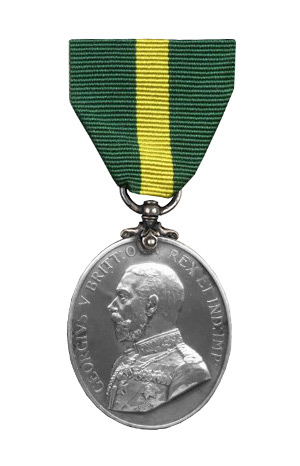
The medal is oval, struck in silver and measures 38 millimeters (1.5 inches) high and 31 millimeters (1.2 inches) wide.

The obverse shows the bust of the reigning King in Field Marshall’s uniform, facing left. Originally Edward VII was shown, with the legend, “EDWARDVS VII REX IMPERATOR“. In 1911 the image was changed to that of George V, the legend reading “GEORGIVS V BRITT: OMN: REX ET IND: IMP:“.

The reverse has a raised rim and bears the inscription “TERRITORIAL FORCE EFFICIENCY MEDAL” on four lines.

The ribbon is 32 millimeters (1.26 inches) wide and originally plain dark green with a central yellow stripe. In December 1919 was changed to plain dark green with yellow edges. For members of the Honourable Artillery Company (HAC) the ribbon is half blue, half scarlet with yellow edges.

The recipient’s service number, rank, name, and unit were impressed on the edge of the medal. The medal hangs from a ring suspension, attached to the medal by a claw fixing.

Notes

This entry was updated on 21 March 2023. The medal image was replaced to show the effigy of George V. Thank you David Wilcock for this information.

The Territorial Efficiency Medal (1921)

The Territorial Efficiency Medal is a United Kingdom award for long service in the Territorial Army awarded for a minimum of 12 years service.

The Territorial Efficiency Medal (or TEM) is a United Kingdom award for long service in the Territorial Army established in 1921 and awarded to non-commissioned officers and men for a minimum of 12 years service in the Territorial Army – provided they attended 12 annual training camps.

Bars for further periods of 12 years service were intended but never issued since the medal was superseded by the Efficiency Medal after 9 years. Previous service in other part-time forces including the Territorial Force could count, while war service counted double. 

The award superseded the Territorial Force Efficiency Medal when the Territorial Force became the Territorial Army in 1921. It was superseded by the Efficiency Medal in 1930.

The Territorial Efficiency Medal (1921) Design

The medal is oval, struck in silver and measures 38 millimeters (1.5 inches) high and 31 millimeters (1.2 inches) wide.

The obverse shows the effigy of King George V in Field Marshall’s uniform facing left, circumscribed by the inscription “GEORGIVS V BRITT: OMN: REX ET IND: IMP:“. The reverse bears a raised rim and bears the inscription “TERRITORIAL EFFICIENCY MEDAL” on three lines.

The ribbon is 32 millimeters (1.26 inches) wide, plain dark green with yellow edges. The medal hangs from a ring suspension, attached to the medal by a claw fixing. The recipient’s service number, rank, name, and unit were impressed on the edge of the medal.

For members of the Honorable Artillery Company (HAC) the ribbon was half blue, half scarlet with yellow edges.

The Territorial Force War Medal

The Territorial Force War Medal is a campaign medal awarded to members of the British Territorial Force and Nursing Service from WW1.

Time PeriodThe Great War

Year of Institution: April 1920
Country: Great Britain

The Territorial Force War Medal is a campaign medal awarded to members of the British Territorial Force and Territorial Force Nursing Service who volunteered or served overseas on or before 30 September 1914 and is the rarest of the five British Great War medals.

Those who received the award had to have been serving with the Force on 4 August 1914 or have completed four years service with the Force before 4 August 1914 and rejoined on or before 30 September 1914. They also had to not have qualified for the 1914 Star or 1914-15 Star.

A total of 33,944 Territorial Force War Medals were awarded, including 227 to nurses of the Territorial Force Nursing Service (the only women to receive the medal).

The Territorial Force War Medal Design

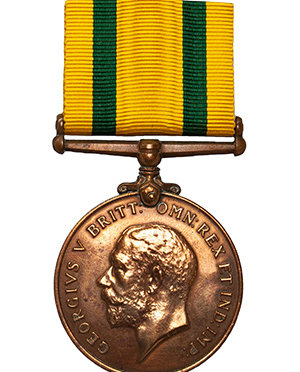
The medal is a circular, made of bronze and measures 36mm (1.42 in) in diameter.

The obverse shows a King George V bareheaded effigy, facing left, with the legend: “GEORGIVS V BRITT : OMN : REX ET IND : IMP :“. The reverse displays a wreath with the text “FOR / VOLUNTARY / SERVICE / OVERSEAS / 1914-19′ in the center, and ‘TERRITORIAL WAR MEDAL” around the upper outer edge.

The ribbon is yellow with two green stripes and measures 32 mm (1.25 in) wide. The suspender is a straight bar.