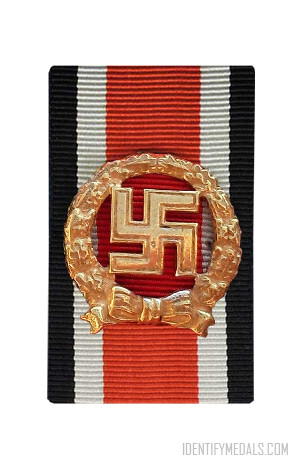
The Honor Roll Clasp of the Army

The Honor Roll Clasp of the Army / Heer was a German decoration first issued in July 1941 after the German invasion of the Soviet Union.

The Honor Roll Clasp (or Ehrenblattspange in German) was a World War II German military decoration issued in July 1941 after the German invasion of the Soviet Union.

The Honor Roll existed in three different versions: One for the Army (Heer), one for the Air Force (Luftwaffe), and one for the Navy (Kriegsmarine) – all of which also have de-nazified versions.

To be eligible for the clasp, across all three services, a recipient must have:

  • Previously received the Iron Cross in both the first and second classes;
  • Demonstrated further distinction in combat subsequent to being awarded the Iron Cross in both classes; and
  • Been listed in the Honor Roll of the German Army.

The Honor Roll of the German Army (or Ehrenblatt des Deutschen Heeres) was initially released in July 1941 and documented the names of soldiers who had displayed extraordinary valor in combat. It was originally published in the Army Ordinance Gazette (Heeres-Verordnungsblatt).

The Honor Roll Clasp of the Army Design

The clasp was crafted from gilt metal and features a wreath measuring 24.5 mm in diameter, composed of six clusters of oak leaves on either side. At its widest point, the wreath measures 5 mm in width, narrowing to a point at the apex where two oak leaves met tip-to-tip. The badge’s height from base to tip is 26 mm. The reverse of all clasps has four pins for attachment.

The Honor Roll Clasp of the Army / Heer shows a large swastika superimposed (soldered) on the wreath.

More Army/Waffen-SS War Badges

The Army/Waffen-SS war badges were military decorations awarded by Nazi Germany to members of the Army (Heer) and the Waffen-SS. Explore the complete collection below:

The Honor Roll Clasp of the Kriegsmarine

The Honor Roll Clasp of the Kriegsmarine was a German decoration first issued in July 1941 after the German invasion of the Soviet Union.

The Honor Roll Clasp (or Ehrenblattspange in German) was a World War II German military decoration issued in July 1941 after the German invasion of the Soviet Union.

The Honor Roll existed in three different versions: One for the Army (Heer), one for the Air Force (Luftwaffe), and one for the Navy (Kriegsmarine) – all of which also have de-nazified versions.

To be eligible for the clasp, across all three services, a recipient must have:

  • Previously received the Iron Cross in both the first and second classes;
  • Demonstrated further distinction in combat subsequent to being awarded the Iron Cross in both classes; and
  • Been listed in the Honor Roll of the German Army.

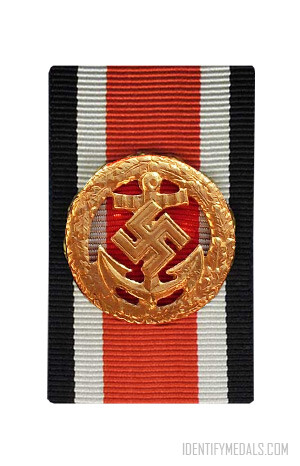
The Honor Roll Clasp of the Kriegsmarine (Ehrentafel der Deutschen Kriegsmarine) was established in February 1943 and received a wearable decoration (seen in the picture) in May 1944.

The Honor Roll Clasp of the Kriegsmarine Design

The clasp was crafted from gilt metal and features a wreath measuring 24.5 mm in diameter, composed of six clusters of oak leaves on either side. At its widest point, the wreath measures 5 mm in width, narrowing to a point at the apex where two oak leaves met tip-to-tip. The badge’s height from base to tip is 26 mm. The reverse of all clasps has four pins for attachment.

The Honor Roll Clasp of the Kriegsmarine shows a swastika superimposed on an anchor.

More Naval War Badges

The Naval War Badges (Kriegsmarine) badges were awarded to sailors, officers, and personnel of the Kriegsmarine who demonstrated exceptional skill, bravery, and dedication in naval warfare. Explore the complete collection below:

The Honor Roll Clasp of the Luftwaffe

The Honor Roll Clasp of the Luftwaffe was a German decoration first issued in July 1941 after the German invasion of the Soviet Union.

The Honor Roll Clasp (or Ehrenblattspange in German) was a World War II German military decoration issued in July 1941 after the German invasion of the Soviet Union.

The Honor Roll existed in three different versions: One for the Army (Heer), one for the Air Force (Luftwaffe), and one for the Navy (Kriegsmarine) – all of which also have de-nazified versions.

To be eligible for the clasp, across all three services, a recipient must have:

  • Previously received the Iron Cross in both the first and second classes;
  • Demonstrated further distinction in combat subsequent to being awarded the Iron Cross in both classes; and
  • Been listed in the Honor Roll of the German Army.

The Honor Roll Clasp of the Luftwaffe (Ehrenblatt der Deutschen Luftwaffe) was established on July 5, 1944, concurrently with the introduction of the decoration. Air Force personnel who had previously been awarded The Luftwaffe Honour Goblet or the Luftwaffe Honour Plate were automatically eligible for the Air Force Honour Roll Clasp. 

The Honor Roll Clasp of the Luftwaffe Design

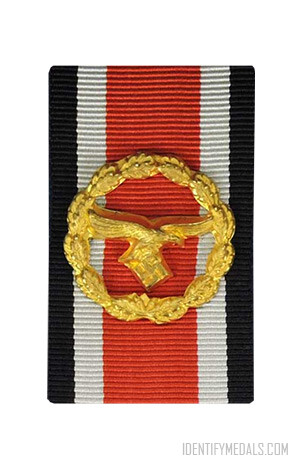
The clasp was crafted from gilt metal and features a wreath measuring 24.5 mm in diameter, composed of six clusters of oak leaves on either side. At its widest point, the wreath measures 5 mm in width, narrowing to a point at the apex where two oak leaves met tip-to-tip. The badge’s height from base to tip is 26 mm. The reverse of all clasps has four pins for attachment.

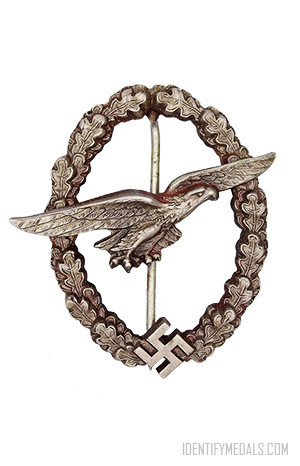
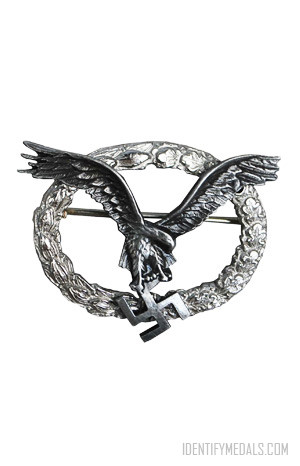
The Honor Roll Clasp of the Luftwaffe shows the Luftwaffe eagle within the circular gilt metal oak wreath.

More Luftwaffe War Badges

Awarded to members of the German Luftwaffe for their achievements and contributions to air warfare, the Luftwaffe War Badges symbolized excellence, courage, and skill in aerial combat and support roles. Explore the complete collection below:

The Front Flying Clasp of the Luftwaffe

The Front Flying Clasp of the Luftwaffe was a WW2 German military decoration awarded to Luftwaffe personnel for operational flights.

The Front Flying Clasp of the Luftwaffe (or Frontflugspange in German) was a World War II German military decoration conferred upon aircrew and select Luftwaffe personnel to acknowledge the quantity of operational flights undertaken.

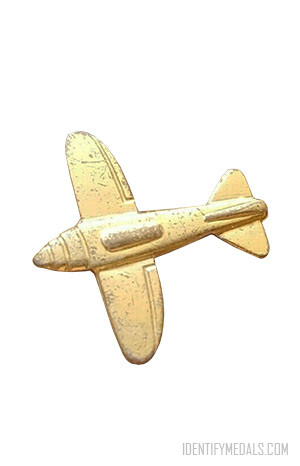
Instituted by Reichsmarschall Hermann Göring on January 30, 1941, it came in Bronze, Silver, and Gold grades, with the possibility of an upgrade to include diamonds. Pennants appended to the clasp indicated the number of missions completed in specific aircraft types.

Front Flying Clasps were awarded for missions carried out in various Luftwaffe aircraft categories, including day fighters, night fighters, long-range night fighters, heavy fighters, air-to-ground support fighters, bombers, reconnaissance, transport, and gliders.

The introduction dates for the different clasps were as follows:

  • January 30, 1941, for the Front Flying Clasp
  • June 26, 1942, for the Pennant to the Gold Front Flying Clasp
  • April 29, 1944, for the Pennant indicating the number of missions completed

And the criteria for qualification was:

  • Bronze – 20 flown missions
  • Silver – 60 flown missions
  • Gold – 110 flown missions

The Front Flying Clasp of the Luftwaffe Design

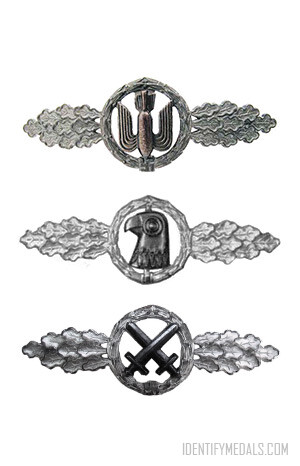
Each badge features a central device, typically blackened, encircled by a wreath of laurel leaves situated between two stylized wings composed of oak leaves, with a swastika positioned at the base of the wreath.

The clasps themselves measure approximately 7.5 cm (3 in) by 2.5 cm (1 in). The design of the central device varies based on the type of aircraft flown. Additionally, the clasp pennant was introduced to provide supplementary recognition for an increased number of operational missions or flights, a distinction that expanded as the war progressed.

In accordance with the post-war German Denazification initiative, these clasps were made available for wear in 1957, albeit with their Swastika emblems removed.

More Luftwaffe War Badges

Awarded to members of the German Luftwaffe for their achievements and contributions to air warfare, the Luftwaffe War Badges symbolized excellence, courage, and skill in aerial combat and support roles. Explore the complete collection below:

The Naval Front Clasp

The Naval Front Clasp was a World War II German military decoration awarded to officers and men of the Kriegsmarine during the Third Reich.

The Naval Front Clasp (or Marine-Frontspange in German) was a German military decoration awarded during World War II.

Established in 1944, the recipients were officers and enlisted personnel of the Kriegsmarine for their prolonged and frontline service across all naval units, except for the submarine service, which had its separate award.

This bronze clasp recognized service or acts of valor that exceeded the requirements of the basic war badge. Instituted on November 19, 1944, by Grand Admiral Karl Dönitz.

The Naval Front Clasp Design

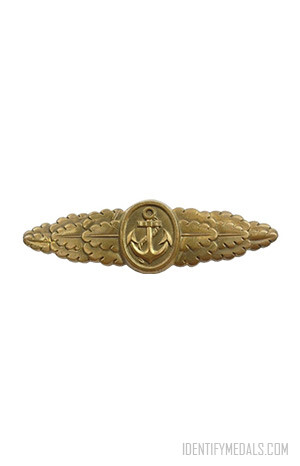
Each wing consisted of six staggered oak leaves, totaling twelve. At the bottom of the central wreath, an anchor adorned the design.

More Naval War Badges

The Naval War Badges (Kriegsmarine) badges were awarded to sailors, officers, and personnel of the Kriegsmarine who demonstrated exceptional skill, bravery, and dedication in naval warfare. Explore the complete collection below:

The U-Boat Front Clasp

The U-Boat Front Clasp was a World War II German Kriegsmarine military decoration awarded during the Third Reich.

The U-boat Front Clasp (or U-Boot-Frontspange in German) was a German military decoration awarded for continuous service and valor during World War II.

Established on May 15, 1944, the award aimed to align the U-boat force with other branches of the German armed forces, each possessing comparable accolades to honor acts of valor. Merits for receiving the award were not explicitly outlined; rather, decorations were conferred based on recommendations from U-boat commanders, subject to approval by Karl Dönitz.

Often, awards were granted in recognition of the number of completed patrols or displays of bravery in combat. The clasp was worn on the upper left breast.

The award was conferred in two tiers, distinguished by their material.

  • Bronze: This represented the lower grade and was granted based on criteria such as the number of war patrols undertaken, the level of risk inherent in the missions, and individual acts of bravery.
  • Silver: Introduced on November 24, 1944, this class aimed to extend recognition to bronze recipients who continued to demonstrate merit, faced heightened risks, and displayed acts of valor.

The U-Boat Front Clasp Design

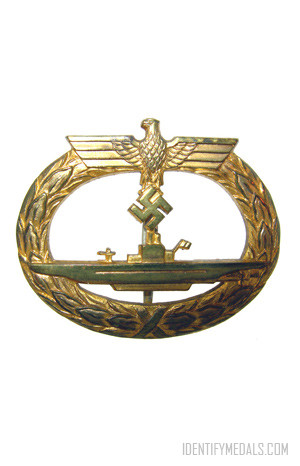
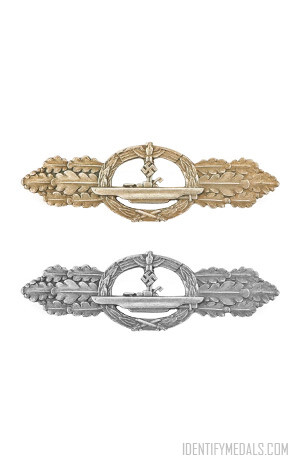
Wilhelm Ernst Peekhaus from Berlin presented the design for the badge, featuring a central laurel wreath adorned with a stylized submarine and wings made of oak leaves.

Each wing consisted of six staggered oak leaves, totaling twelve. At the bottom of the central wreath, two crossed swords adorned the design, while the submarine in the middle echoed the U-Boat War Badge’s design. Integrated into the wreath was an eagle with downturned wings grasping a swastika.

Following the conclusion of the war, German sailors could only wear the medal if it did not bear National Socialist symbols, in accordance with the German Ordensgesetz. An alternative design featuring a complete laurel wreath, devoid of the eagle and swastika, with a submarine emblem centered within, was created for this purpose.

More Naval War Badges

The Naval War Badges (Kriegsmarine) badges were awarded to sailors, officers, and personnel of the Kriegsmarine who demonstrated exceptional skill, bravery, and dedication in naval warfare. Explore the complete collection below:

The Close Combat Clasp

The Close Combat Clasp (Nahkampfspange) was instituted on 25 November 1942, during WW2, for participation in hand-to-hand fighting.
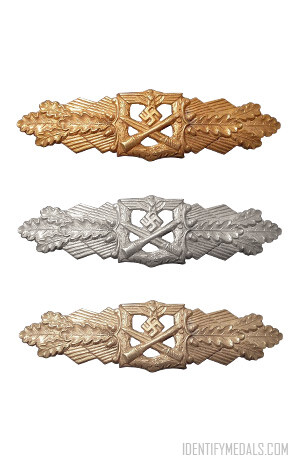
The Close Combat Clasp (Nahkampfspange in German) was a war badge awarded to Waffen SS and Wehrmacht Heer soldiers during World War II. Established on November 25, 1942, the Close Combat Clasp was awarded to German soldiers who displayed exceptional bravery and skill in close combat situations, treet fighting, or other situations where the use of firearms was impractical or ineffective. This included combat actions within buildings, trenches, or other confined spaces where the enemy was engaged at close range.

To be eligible for the Close Combat Clasp, soldiers had to meet certain requirements, including demonstrating individual bravery and skill in close combat situations. These engagements were often intense and dangerous, requiring quick thinking, physical strength, and the ability to adapt to rapidly changing circumstances.

The Close Combat Clasp was one of many military decorations instituted by the Nazi regime during World War II to honor acts of bravery and valor among its soldiers. Despite its association with a regime responsible for some of the greatest atrocities in human history, the award itself remains a significant historical artifact.

The Close Combat Clasp Design

The clasp was made of bronze, silver, or gold, with varying criteria determining which level of award a soldier received. For instance:

  • The bronze clasp was awarded for 15 days of close combat.
  • The silver clasp for 25 days of close combat.
  • The gold clasp for 50 days or more of close combat engagements.

The award was typically worn on the upper left pocket and above the ribbon bar. Individuals would only wear one (the highest level they had received).

More Army/Waffen-SS War Badges

The Army/Waffen-SS war badges were military decorations awarded by Nazi Germany to members of the Army (Heer) and the Waffen-SS. Explore the complete collection below: