The Cross for the Yucatán

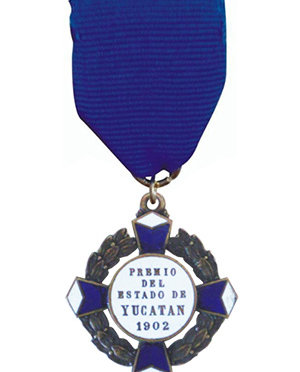
The Cross for the Yucatán was issued for the suppression of revolts and for general military service as the army put down rebellions. 

The Cross for the Yucatán was a medal issued during the twentieth century for the suppression of revolts and for general military service as the Mexican army put down rebellions by Mayan Indians.

In Spanish colonial times, the Yucatán (like most of New Spain) population operated under a legal caste system: peninsulares (officials born in Spain) were at the top, the criollos of Spanish descent in the next level, followed by the mestizo population (of mixed European-Amerindian descent), then descendants of the natives who had collaborated with the Spanish conquest of Yucatán, and at the bottom were the other native indios.

The Caste War of Yucatán (1847–1901) began with the revolt of native Maya people of Yucatán, Mexico against the European-descended population, called Yucatecos. The latter had long held political and economic control of the region. A lengthy war ensued between the Yucateco forces in the north-west of the Yucatán and the independent Maya in the south-east.

The war officially ended in 1901 when the Mexican army occupied the Maya capital of Chan Santa Cruz and subdued neighboring areas. Another formal end was made in 1915, when a Mexican general was sent to subdue the territory. However, skirmishes with small settlements that refused to acknowledge Mexican control continued until 1933.
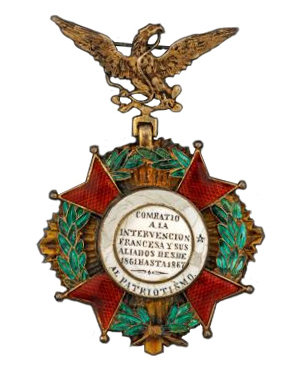
The Cross for the French Intervention

The Cross for the French Intervention is part of several medals created during the occupation of Mexico by French troops between 1862 and 1867.

On July 12 1859, Juárez decreed the first regulations of a new reform: “The Law of Nationalization of the Ecclesiastical Wealth.” The civil war between Liberals and Conservatives that followed (Civil War of the Reform) severely damaged Mexico’s infrastructure and crippled its economy. In view of the government’s desperate financial straits, Juárez canceled, in 1861, repayments of interest on foreign loans that had been taken out by the defeated conservatives.

Spain, Britain and France, angry over unpaid Mexican debts, sent a joint expeditionary force that seized the Veracruz Customs House in December 1861. Spain and Britain soon withdrew after they realized that the French Emperor Napoleon III intended to overthrow the Juárez government and establish a Second Mexican Empire, with the support of the remnants of the Conservative side in the Reform War.

Faced with US opposition to a French presence and a growing threat on the European mainland from Prussia, French troops began pulling out of Mexico in late 1866.

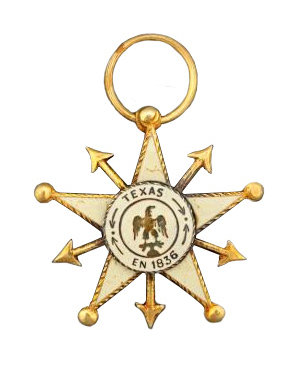
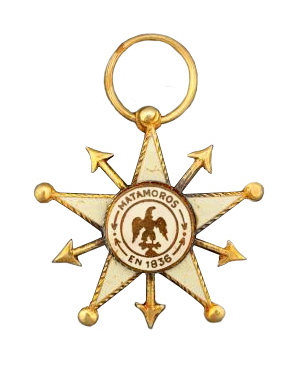
The Star for the Defense of Matamoros (1836)

This set of medals were issued during the period 1835-1841 of armed conflict between settlers and the Mexican army that began in late 1835.

As the number of American settlers in the Mexican state of Texas kept growing, the Mexican government made the decision in 1830 to close the border to all immigration, imposing as well numerous restrictions like the abolition of slavery.

The Mexican government believed the United States had instigated the Texas insurrection (October 2, 1835 – April 21, 1836) with the goal of annexation. The Mexican Congress passed the Tornel Decree, declaring that any foreigners fighting against Mexican troops “will be deemed pirates and dealt with as such, being citizens of no nation presently at war with the Republic and fighting under no recognized flag.”

The revolution began in October 1835, after a decade of political and cultural clashes between the Mexican government and the increasingly large population of American settlers in Texas. Colonists and Tejanos disagreed on whether the ultimate goal was independence or a return to the Mexican Constitution of 1824. In March 1836, a second political convention declared independence and appointed leadership for the new Republic of Texas.

Determined to avenge Mexico’s honor, Santa Anna vowed to personally retake Texas. His Army of Operations entered Texas in mid-February 1836 and found the Texians completely unprepared. Mexican General José de Urrea led a contingent of troops on the Goliad Campaign up the Texas coast, defeating all Texian troops in his path and executing most of those who surrendered. Santa Anna led a larger force to San Antonio de Béxar (or Béxar), where his troops defeated the Texian garrison in the Battle of the Alamo, killing almost all of the defenders.

After the Texans’ defeat in April 1836 of General Santa Anna, Mexico made no further attempt to reconquer the territory, although it refused to recognize its independence. The annexation of Texas as the 28th state of the United States, in 1845, led directly to the Mexican–American War. By the terms of the Treaty of Guadalupe Hildago, signed in 1848, Mexico ceded almost half its national territory to the United States.

The Star for the Defense of Texas (1836)

This set of medals were issued during the period 1835-1841 of armed conflict between settlers and the Mexican army that began in late 1835.

As the number of American settlers in the Mexican state of Texas kept growing, the Mexican government made the decision in 1830 to close the border to all immigration, imposing as well numerous restrictions like the abolition of slavery.

The Mexican government believed the United States had instigated the Texas insurrection (October 2, 1835 – April 21, 1836) with the goal of annexation. The Mexican Congress passed the Tornel Decree, declaring that any foreigners fighting against Mexican troops “will be deemed pirates and dealt with as such, being citizens of no nation presently at war with the Republic and fighting under no recognized flag.”

The revolution began in October 1835, after a decade of political and cultural clashes between the Mexican government and the increasingly large population of American settlers in Texas. Colonists and Tejanos disagreed on whether the ultimate goal was independence or a return to the Mexican Constitution of 1824. In March 1836, a second political convention declared independence and appointed leadership for the new Republic of Texas.

Determined to avenge Mexico’s honor, Santa Anna vowed to personally retake Texas. His Army of Operations entered Texas in mid-February 1836 and found the Texians completely unprepared. Mexican General José de Urrea led a contingent of troops on the Goliad Campaign up the Texas coast, defeating all Texian troops in his path and executing most of those who surrendered. Santa Anna led a larger force to San Antonio de Béxar (or Béxar), where his troops defeated the Texian garrison in the Battle of the Alamo, killing almost all of the defenders.

After the Texans’ defeat in April 1836 of General Santa Anna, Mexico made no further attempt to reconquer the territory, although it refused to recognize its independence. The annexation of Texas as the 28th state of the United States, in 1845, led directly to the Mexican–American War. By the terms of the Treaty of Guadalupe Hildago, signed in 1848, Mexico ceded almost half its national territory to the United States.

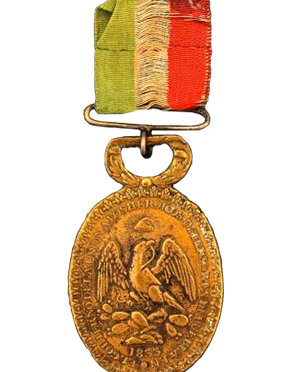
The Defense of Puebla Medal (1833)

The Defense of Puebla was a government authorized medal for the militia defenders at Puebla during the Revolt of the Polkos in Mexico in 1833.

The Defense of Puebla was a government authorized medal for the militia defenders at Puebla during the Revolt of the Polkos in Mexico in 1833.

Valentín Gómez Farías (14 February 1781 – 5 July 1858) was the President of Mexico for five short periods between the 1830s and 1840s. During his term in 1833 and in the absence of President Antonio López de Santa Anna (1794–1876), he enacted significant liberal reforms that were aimed at undermining the power of the Roman Catholic Church and the army in Mexico – for example, he advised Catholic clerics to limit their sermons to religious concerns and stop intervening in politics.

Some of Gómez Farías’ legislation restricted the Catholic Church’s power and eliminated some military privileges. The Conservatives, the Church, and the Army quickly responded in the form of the Revolt of the Polkos, calling for the removal of the Liberal government. During it, five Mexican National Guard regiments rose up in rebellion against the Mexican government, in protest over legislation that permitted the government to requisition money and property from the Catholic Church.

After the revolt was put down, the government authorized a medal for the militia defenders at Puebla: The Defense of Puebla medal.

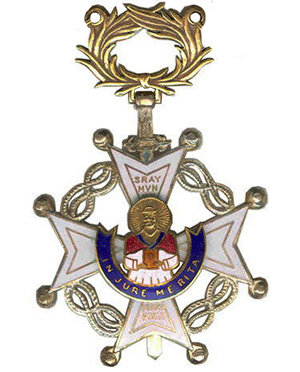
The Order of the Cross of St. Raymond of Peñafort

The Order of the Cross of St. Raymond of Peñafort (or Orden de la Cruz de San Raimundo de Peñafort) is a Spanish civil order of merit established 23 January 1944.

The five classes recognize service to and contributions toward the development and perfection of the law and jurisprudence. The three medals of the order recognize years of unblemished service within the legal and administrative professions under the jurisdiction of the Ministry of Justice. The order is named for St. Raymond of Peñafort, the patron saint of lawyers.

The five classes of crosses of the Order of St. Raymond of Peñafort are as follows:

  • Grand-Cross (Gran Cruz)
  • Cross of Honour (Cruz de Honor)
  • Distinguished Cross 1st Class (Cruz Distinguida de 1.ª Clase)
  • Distinguished Cross 2nd Class (Cruz Distinguida de 2.ª Clase)
  • Single Cross (Cruz Sencilla)

The Order of St. Raymond of Peñafort Design

The medals of the Order of St. Raymond of Peñafort are awarded to legal and administrative professionals working under the jurisdiction of the Ministry of Justice. The medals honor years of unblemished service.

The classes are as follows:

  • Gold Medal of Merit in Justice (Medalla de Oro del Mérito a la Justicia)
  • Silver Medal of Merit in Justice (Medalla de Plata del Mérito a la Justicia)
  • Bronze Medal of Merit in Justice (Medalla de Bronce del Mérito a la Justicia)

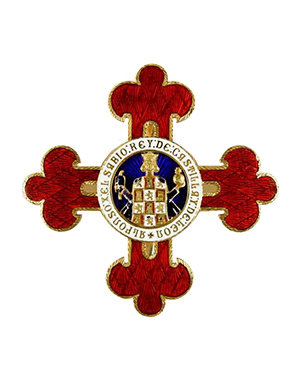
The Civil Order of Alfonso X the Wise

The Civil Order of Alfonso X the Wise (Orden Civil de Alfonso X) is a Spanish civil order from 1939 recognizing education, science, etc.

The Civil Order of Alfonso X the Wise (or Orden Civil de Alfonso X el Sabio) is a Spanish civil order established in 1939 to recognize activities in the fields of education, science, culture, higher education and research.

The order was created on 23 May 1902 by Royal decree as the Order of Alfonso XII. In 1988 the order was reformed and given its current name. The Grand Chancellor is the Minister of Education, Culture and Sport of Spain.

The 1988 reform’s main innovation was to discontinue the previous award’s practice of distinguishing male and female achievements, thereby eliminating explicit sexual discrimination.

It’s awarded in the following grades:

  • Collar
  • Grand-Cross
  • Commander with Plaque
  • Commander
  • Cross
  • Medal

The Crosses of Aeronautical Merit

Crosses of Aeronautical Merit (or Cruces del Mérito Aeronáutico) are Spain’s military award for gallantry or merit in the air. The award can be made in war or at times of peace.

Established on 30 November 1945 by chief of state Francisco Franco as the Order of Aeronautical Merit (Orden del Mérito Aeronáutico) and amended in 1976, 1995, 2003 and 2007. Awarded originally in three classes and a cross in silver for non-commissioned ranks, in 1995 it lost the rank of an order of merit and reduced to two and the number of categories extended to four.

According to the current regulations the decoration is conferred in the following classes:

  • Grand Cross – to generals, admirals or civilian personnel of equivalent rank;
  • Cross – to other officers, non-commissioned ranks or equivalent civilian personnel.

The categories are as follows:

  • with Red Decoration (con distintivo rojo) – for courage, actions, deeds or service during an armed conflict or military operations that involve or may involve the use of armed force and may require significant military or command skills; since 2007 it can be awarded to for acts of gallantry while on an overseas mission and to soldiers fallen during such a mission;
  • with Blue Decoration (con distintivo azul) – for actions, events or extraordinary services including operations resulting from a mandate of the United Nations or of other international organizations;
  • with Yellow Decoration (con distintivo amarillo) – for actions, deeds or service that involve high personal risk and in cases of serious injury or death resulting from such actions or service;
  • with White Decoration (con distintivo blanco) – for actions, deeds or distinguished service during missions of ordinary or extraordinary service in the armed forces or in connection with defense of the country.

Multiple awards of each class and each category to the same individual are possible. The medal is awarded to members of the Spanish Armed Forces, Guardia Civil or civilians.

The Crosses of Aeronautical Merit Design

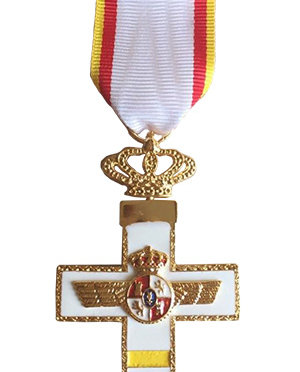
The decoration has the form of a Greek cross with the arms enameled red in the Red Decoration category and white in the remaining categories. The Blue Decoration and Yellow Decoration badges have an additional narrow bar in blue or yellow across the lower arm. The upper arm is surmounted by a Spanish royal crown and has a tablet to engrave the date of bestowal.

The round central shield of the obverse bears the coat of arms of Castile, León, Aragon, Navarre and Granada (until 2003 only alternate coats of arms of Castile and León); in the middle there is a blue oval shield of the House of Bourbon-Anjou. The central shield has gold wings extended to the lateral arms of the cross and is surmounted by a royal crown.

On the reverse there are letters “MA” (Mérito Aeronáutico) on red background. The cross is worn on a ribbon on the left side of chest. Each subsequent award is denoted by a bar with the date of bestowal on the ribbon.

The Grand Cross has the same form as the cross described above but is worn on a sash over the right shoulder. The star added to the class of Grand Cross is gilt, eight-pointed, with the cross superimposed on it; currently between the arms of the cross there are alternate towers (Castile) and lions (León).

The Order of the Spanish Republic

The Order of the Spanish Republic (Orden de la República) was founded in 1932 in the Second Spanish Republic for civil and military merit.

The Order of the Spanish Republic (or Orden de la República Española) was founded in 1932 in the Second Spanish Republic for civil and military merit to the state. It replaced the orders of merit of the former Spanish Monarchy and had the mural crown instead of the royal one.

After the military defeat of the Spanish Republic, Gen. Francisco Franco abolished all Republican Orders and instituted new ones.

The Spanish Republican government in exile issued one order which was a simple medal with a ribbon in the Spanish republican colors.

The Order of the Spanish Republic Design

The order had the usual five degrees. There was a special collar for heads of state and two medals were attached to this order of merit.

The ribbon was red with a white border.

The Order of Civil Merit

The Order of Civil Merit (or Orden del Mérito Civil) was established by King Alfonso XIII of Spain in 1926 to recognize “the civic virtue of officers in the service of the Nation, as well as extraordinary service by Spanish and foreign citizens for the benefit of Spain.”

At the origin, it consisted of four categories: Grand Cross, Commander by Number, Commander, Knight, and Silver Cross (lower rank).

The Provisional Government of the Republic, by decree of 24 July 1931, abolished this order and other orders of the State, except that of Isabel the Catholic, and wanted to replace them with the creation of the Order of the Republic. Saved this interregnum, by Decree of 7 November 1942 restores the Order of Civil Merit, with his previous features, privileges and seniority, with the following categories: Grand Cross, Cordon (designation of the Grand Cross when given to women), Commander of Number, Commander, Officer, Knight, Knot (name of degree Knight when given to women) and Silver Cross, approving its rules by decree of 3 February 1945.

By Royal Decree 2396/1998 of 6 November 1998, published in the Boletín Oficial del Estado 279 of 21 November 1998 (and subsequent correction published in the BOE 40 of 16 February 1999), the approval of the new regulations proceeded, bringing together in one legal text all regulations which were scattered. The current regulation makes a detailed discussion of the merits to be considered for grant, of formal requirements to be met by proposals for entry and promotion within the Order, stating the legitimate authorities to do them, and reporting procedures that can be instructed in order to determine the suitability of granting.

The Order of Civil Merit Design

The Order of Civil Merit comes in seven classes as follows:

  • Collar (Collar) – Order’s Collar.
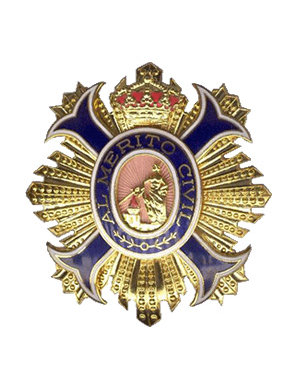
  • Grand Cross (Gran Cruz) – Sash and Plaque (Golden Order’s Star).
  • Commander by Number (Encomienda de Número) – Plaque (Silver Order’s Star).
  • Commander (Encomienda) – Golden order’s star on a necklet.
  • Officer’s Cross (Cruz de Oficial) – Golden order’s cross hanging from a ribbon.
  • Knight’s Cross (Cruz) – Silver order’s cross hanging from a ribbon.
  • Silver Cross (Cruz de Plata) – Simpler silver cross hanging from a ribbon.